


Laughter is one of the most underrated learning tools in a child’s entire development, and we say that with complete seriousness. Yes, we’re serious about being funny. At Apple Tree Preschool BSD, located in the heart of the Educenter BSD Building, we’ve watched children light up from a good story in a way that no flashcard or worksheet has ever managed to match. Funny stories for kids don’t just make them giggle. They build vocabulary, sharpen listening skills, develop a sense of timing, and teach children that learning can feel absolutely wonderful.
So we’ve put together 10 original funny stories for kids that are genuinely silly, completely ridiculous in the best way, and guaranteed to have both you and your little one in fits by bedtime. Read them aloud. Do the voices. Don’t be shy.
10 Funny Stories for Kids That the Whole Family Will Love
From a dragon with hiccups to a cat who writes strongly worded letters, these hilarious short stories, funny tales, and silly stories for children are packed with humour, heart, and the kind of joy that makes Tuesday feel like a party.
1. The Dragon Who Could Not Stop Hiccupping

Gerald had been a dragon for all of his forty-seven years, and for forty-six of those years, he had been extraordinarily good at it. He could breathe fire in shapes. He could do a circle, a star, and on one memorable occasion, a quite passable likeness of a mountain goat. He could fly through narrow canyon passes without clipping a single wing. He could roar so impressively that entire flocks of birds would take off simultaneously from trees half a mile away, which he found deeply satisfying on slow afternoons.
He was, by every reasonable dragon metric, a very accomplished dragon indeed.
And then one Tuesday in October, Gerald hiccupped.
It was a perfectly ordinary hiccup by human standards. A small, undignified little sound, somewhere between a squeak and a pop. But Gerald was not a human. Gerald was a dragon. And when Gerald hiccupped, a small but enthusiastic jet of fire shot out of his nose and set the left half of his welcome mat on fire.
He stamped it out. He stood very still. He held his breath.
He hiccupped again. The right half of the welcome mat caught.
Gerald threw the entire welcome mat into the river below his cave and went inside to think.
The hiccups did not stop.
By Wednesday, he had accidentally singed his best armchair, set fire to his bookshelves twice (losing a particularly beloved cookbook called “Things That Are Not Treasure But Taste Better”), scorched three of his seven ceiling beams, and incinerated his shopping list at the exact moment he’d finished writing it.
He tried every remedy he could find. He drank a barrel of water upside down, which required a surprising amount of logistical creativity and produced only a larger, wetter hiccup. He had a village of very patient gnomes shout “BOO” at him simultaneously, which startled him so thoroughly that he hiccupped four times in rapid succession and accidentally created what would later become known in the region as the Scorched Meadow. He tried breathing into a bag, but the bag immediately caught fire, which rather defeated the purpose.
By Thursday, his neighbour, a sensible wyvern named Patricia, came over to check on him.
“You look,” she said, surveying his smoke-blackened cave and his slightly singed eyebrows, “like you’ve been having a week.”
“It’s the hiccups,” Gerald said miserably. “They won’t stop.”
Patricia sat down on the one chair that had survived. “How long have you had them?”
“Three days.”
“And what were you doing when they started?”
Gerald thought. “I was eating. Very quickly. I may have been in the middle of swallowing an entire roasted ox and trying to read my book at the same time.”
Patricia gave him a very long look.
“Gerald,” she said, with the patience of someone who had been his neighbour for twelve years, “have you considered simply eating more slowly?”
A silence stretched between them.
Gerald opened his mouth. Then he closed it. Then he hiccupped, and his bookshelf caught fire again.
“I’ll get the bucket,” said Patricia.
Gerald tried eating slowly at dinner that night. He chewed each piece twenty-seven times. He put his fork down between bites. He did not attempt to read his book, check his post, or practice his fire-shapes simultaneously.
He went to bed that night in a completely un-singed cave.
No hiccups.
He lay there in the dark for a while, thinking about how the solution to his catastrophic three-day fire-hiccup disaster had been, at its heart, a fairly mild adjustment to his table manners.
He fell asleep with his dignity mostly intact.
Patricia sent him a new welcome mat for his birthday that year. It was fireproof. The note said: “Chew your food.”
Gerald hung it on his wall.
Lesson: Slow down, chew your food, and maybe don’t try to do seventeen things at once during mealtimes.
2. The Cat Who Wrote Strongly Worded Letters
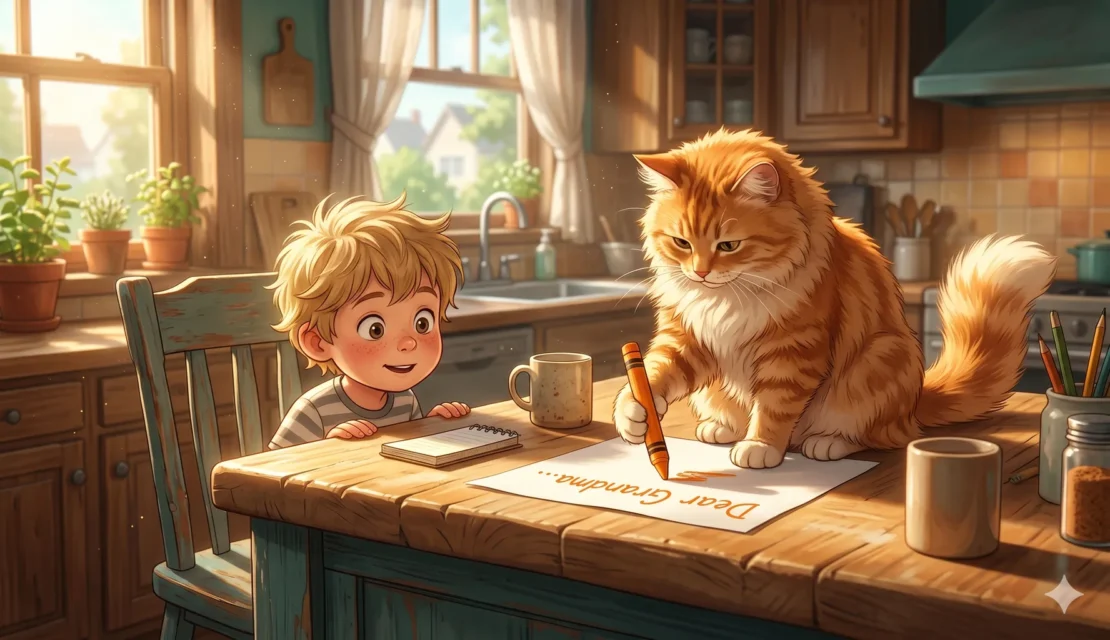
Marmalade was a cat of tremendous personal standards and a very low tolerance for disappointment. He was orange, magnificently fluffy, and absolutely certain that the household in which he lived, the Briggs family at 14 Acacia Close, was being run at a standard significantly below what he deserved.
He had put up with a great deal over the years. The food bowl placed two centimetres too close to the water bowl, a proximity he found deeply unreasonable. The way the youngest Briggs child, a four-year-old named Oscar, persisted in calling him “Marmie” despite repeated corrections. The incident with the vacuum cleaner, which he did not wish to discuss but had never entirely forgiven. The guest bedroom pillow that had been moved without notice or explanation.
For years, Marmalade had registered his complaints in the traditional feline ways: staring pointedly, knocking things off tables, and the occasional slow, deliberate sit on whatever the humans appeared to be paying attention to. But clearly, none of this was getting through.
So Marmalade decided to write letters.
This required some logistics. He could not, technically, hold a pen. But he had observed that Oscar left his fat orange crayon on the floor with extraordinary consistency, and Marmalade had discovered that if he pressed his paw against it and dragged it across paper, he could produce something that, while not exactly calligraphy, conveyed meaning.
His first letter was to Mr. Briggs regarding the food situation.
Dear Mr. Briggs. The salmon in the green tin is superior to the salmon in the blue tin. I have been receiving the blue tin for six weeks. This is unacceptable. Please advise. Regards, Marmalade.
He left it on the kitchen table.
Mr. Briggs found it at breakfast, stared at it for a long time, and showed it to Mrs. Briggs.
“Did Oscar write this?” he asked.
“Oscar can’t write,” said Mrs. Briggs. “He’s four.”
“Then who wrote it?”
They both looked at Marmalade, who was sitting on the counter with the bearing of someone who had made his position quite clear and was waiting for a response.
Mr. Briggs switched to the green tin the following morning. Marmalade ate it in a measured, dignified way that nonetheless communicated appreciation.
Encouraged, he continued.
His second letter was to Mrs. Briggs regarding the pillow situation.
Dear Mrs. Briggs. The pillow in the guest room has been relocated. I had a system. I would appreciate its return to the left side of the bed, adjacent to the window. The current arrangement is chaotic. Thank you for your attention to this matter. Best, Marmalade.
The pillow was returned within the day.
His third letter was to Oscar directly, though it required more crayon work than the others.
Dear Oscar. My name is Marmalade. Not Marmie. Not Marmy. Not Orange Boy. Not Mr. Fluffins. Marmalade. It has four syllables. I believe in you. Sincerely, Marmalade.
Oscar stared at this letter for a very long time with his reading face on, which involved a lot of squinting and his tongue slightly out.
“Mum,” he called. “Marmie wrote me a letter.”
Mrs. Briggs came in. She read the letter. She pressed her lips together very firmly in the way adults do when they are trying not to laugh.
“What does it say?” Oscar asked.
“It says,” she managed, “that he would like you to call him Marmalade.”
Oscar looked at the cat. Marmalade looked at Oscar. The moment had a certain gravity.
“Okay, Marmalade,” said Oscar.
Marmalade blinked once, in a slow, satisfied way, and jumped off the counter.
The letters continued for years. The family collected them in a folder. They became, in the telling, the kind of family story that got brought out at every gathering, passed around, read aloud with voices, and laughed about until someone had to put their drink down.
Marmalade never confirmed or denied authorship. But he did seem to sit up a little straighter whenever the folder came out.
Lesson: Communicate clearly and specifically. Vague hints rarely work as well as a direct, well-written letter. Even if it’s in orange crayon.
3. The Wizard Who Kept Forgetting His Spells

Professor Aloysius Bumbleton had been a wizard for fifty-three years, which was long enough, most of his colleagues agreed, that he should have had the basics fairly well sorted by now.
He had not.
It wasn’t that Aloysius was a bad wizard. He was, in many important respects, a genuinely talented one. His weather-prediction spells were nearly flawless. His ability to locate lost objects was legendary at the academy, particularly useful given how often he lost things himself. His transformation work was exceptional, when he could remember the words.
The problem, and it was a significant one in the field of magic, was that Aloysius had the memory of a particularly inattentive goldfish.
He kept a notebook for his spells. He then lost the notebook. He kept a backup notebook. He lost that too. He started keeping a backup of the backup, which he tied to his wrist with a piece of string. He then forgot the piece of string was there and spent an entire morning wondering why his hand felt slightly heavier than usual.
His apprentice, a sharp twelve-year-old girl named Bea who had been assigned to him by the academy with a mixture of optimism and apology, had developed a system. She wrote the five most commonly needed spells in large letters on a chalkboard that she propped up wherever Aloysius happened to be working. She had also started keeping a second copy in her pocket.
One Monday morning, Aloysius needed to turn a pumpkin into a carriage. This was bread-and-butter wizard work, entirely routine, the sort of thing that should take about fifteen seconds and produce a serviceable vehicle.
He stood in front of the pumpkin. He pointed his wand.
He said the spell.
The pumpkin turned into a fairly confused-looking armadillo.
He tried again. The armadillo became a large decorative urn.
He tried a third time. The urn split open and produced forty-seven very surprised sardines, which scattered across the workroom floor.
Bea appeared in the doorway, looked at the sardines, and looked at Aloysius.
“Did you check the board?” she asked.
Aloysius looked at the board. He read the carriage spell. He looked back at the collection of sardines milling around his feet.
“I was quite close,” he said.
“The armadillo part was close,” Bea conceded. “The sardines less so.”
He cleared up the sardines with a correctly-remembered clearing spell, checked the board one more time, and successfully produced a perfectly good carriage from a new pumpkin on the fourth try.
It was, he felt, a reasonable outcome.
The academy sent him a new evaluation form that year. Under “Areas for Development,” Bea had written, in her neat, careful handwriting: “Carrying the notebook. Looking at the notebook. Remembering that the notebook exists.”
Under “Strengths,” she had written: “Genuinely wonderful at finding lost objects. Excellent at weather. Never gives up. Makes very good tea.”
Aloysius read this over breakfast and felt, on the whole, that he had been assessed fairly.
He framed it and put it on the wall.
He forgot where he put the nail, so he used a sticking spell instead, which worked perfectly, because that one he had never forgotten.
Some spells just stick.
Lesson: Everyone has gaps and strengths. The secret is finding the people who help fill the gaps and working with them honestly.
4. The Elephant Who Was Afraid of Mice (And What He Did About It)

Hector the elephant was afraid of mice.
He was aware that this was, statistically speaking, somewhat ironic. He weighed four thousand kilograms. He could uproot a tree without working up much of a sweat. Other animals moved out of his way out of pure instinct, not because Hector was unfriendly, he was actually extremely friendly, but simply because moving out of the way of something that large was basic common sense.
And yet. Mice.
The very sight of one sent Hector into a panic so complete and immediate that he had once, in the process of fleeing a single mouse the size of a mango, accidentally sat on a Land Rover. The park rangers had been very understanding about it, which he appreciated, but the embarrassment had lingered.
His best friend, a zebra named Ziggy, was the only other animal who knew about the mouse situation. Ziggy had promised faithfully never to tell anyone, and had kept that promise for three years, except for the time he told the giraffes, but that was, he maintained, a different situation.
“You have to face it,” Ziggy told him one afternoon, the two of them standing under an acacia tree. “You can’t spend your whole life rearranging your walking routes to avoid the area near the termite mound.”
“I can,” said Hector. “I’ve been doing it for four years.”
“The long way round adds twenty minutes to your morning walk.”
“I enjoy the exercise.”
Ziggy looked at him for a while. “Hector. You are the largest land animal on this continent. You are afraid of something that weighs thirty grams.”
“Size is not the determining factor in fear,” Hector said, with some dignity.
“True,” said Ziggy. “But at some point you might want to have a word with yourself about the Land Rover.”
A week later, a small mouse named Percy moved into the hollow log near Hector’s favourite watering hole. This meant that avoiding Percy would require Hector to find a new watering hole, which was frankly an unacceptable situation.
Hector stood fifty metres from the log for a long time.
Then he walked forward ten metres. His heart was hammering. His ears were flat against his head.
He walked forward five more.
Percy came out of the log. He was, objectively, tiny. Brown. Whiskered. He looked up at Hector the way you might look up at a particularly tall building, with straightforward practicality and without any drama at all.
“Hullo,” said Percy.
Hector made a very small sound that he hoped came across as dignified. It did not.
“I’m Percy,” said the mouse. “Sorry, did I startle you?”
“No,” said Hector, who was trembling slightly.
Percy went back into his log to get a seed he had been saving and offered half to Hector.
Hector ate it. His trunk was shaking a little, but he ate it.
“Nice spot,” said Percy. “Good water.”
“Yes,” said Hector.
They sat together in silence for a while. Percy ate his half of the seed. Hector stood very still and worked on the breathing.
By the following week, Hector was still nervous around mice. He probably always would be, at least a little. But he had a route to the watering hole, and Percy was usually around in the mornings, and they had developed a perfectly comfortable routine of sitting quietly together, which Hector found, unexpectedly, helped considerably.
The fear hadn’t gone. But it had gotten smaller. And Hector had gotten, in a way that mattered more than his size ever could, braver.
He never sat on another Land Rover.
Lesson: Courage is not the absence of fear. It’s showing up at the watering hole anyway, one day at a time.
5. The Chef Who Cooked Everything Blue
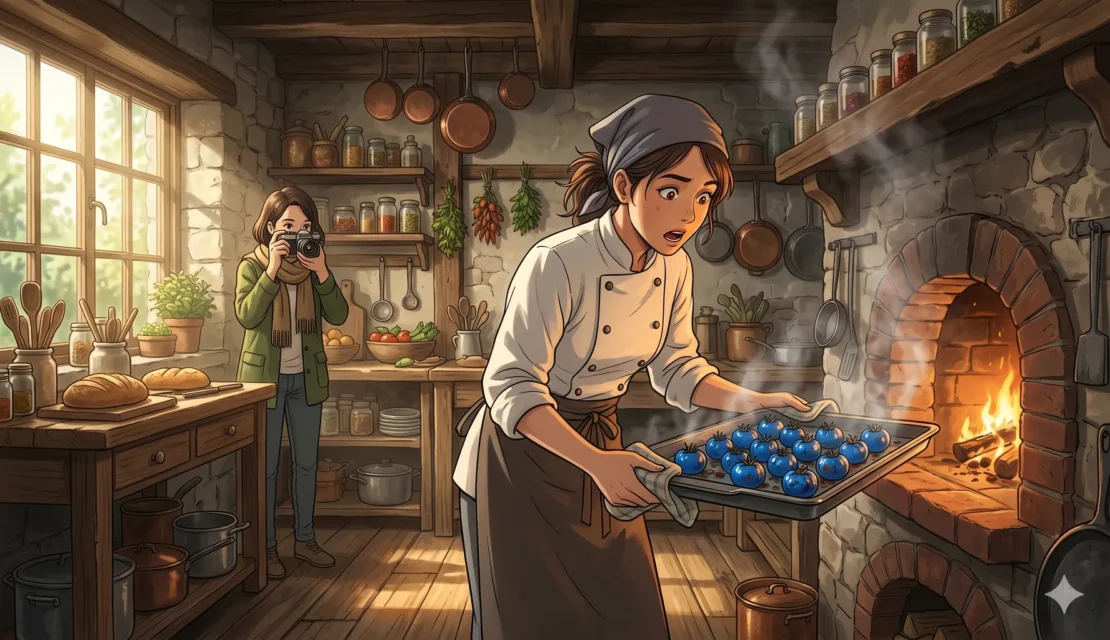
Chef Rosario had been cooking for thirty years, and she was excellent at it. Her restaurant was small, only twelve tables, tucked down a side street in a town that wasn’t on most maps, but people drove two hours to eat there on a Tuesday. Her pasta made grown adults emotional. Her bread was the kind of bread that made you briefly reconsider all your major life decisions.
So when her oven broke in the middle of Tuesday lunch service and she borrowed her neighbour Silvio’s spare oven, she was not expecting anything unusual to occur.
Silvio was a painter. He was also, it turned out, a person who stored some of his materials in the same cupboard as his kitchen supplies, without any particularly clear labelling system.
The first sign that something was wrong came when Rosario pulled out a tray of roasted tomatoes and they were a deep, vivid, entirely improbable blue.
She stared at them.
She checked the recipe. Tomatoes had always been red, in her experience and in all the literature.
She tasted one. It tasted exactly like a roasted tomato, perfectly seasoned, beautifully caramelised. Just blue.
She sent it out anyway. Table four, a food writer named Georgina, took a photo before she even picked up her fork.
The pasta came out blue. The bread was blue. The soup was the most extraordinary shade of blue that a soup had ever achieved in recorded culinary history. Rosario stood in the kitchen looking at a pot of blue minestrone and felt something she hadn’t expected, which was that she was actually rather enjoying this.
She sent everything out.
The dining room was, for about fifteen seconds, completely silent.
Then Georgina posted the photo.
By eight o’clock that evening, there were forty people standing outside the restaurant. By the next morning, there were journalists. Rosario’s phone rang from a number in Milan. Then from one in Tokyo. Then from New York.
She figured out what had happened, of course. A container of Silvio’s ultramarine powder, a pigment he used in his painting, had mixed with her olive oil at some point that afternoon. She was not entirely sure how. She was not entirely sure she wanted to know.
Silvio was apologetic. He brought her flowers. She forgave him immediately and asked him what other colours he had in the cupboard.
She ran Blue Tuesdays at the restaurant for the next three years. Every Tuesday, the entire menu was blue. The price went up. The waiting list hit six months. Rosario appeared on the cover of a food magazine with a bowl of blue pasta and an expression of someone who had stopped being surprised by her own story.
She always said, when people asked how it happened, that her best professional decision was the one she made not by planning or skill or thirty years of expertise, but by simply sending out a tray of blue tomatoes instead of throwing them away.
“The best things,” she would say, “start with something going a little wrong.”
Lesson: Things going sideways is not the end of the story. Sometimes it’s the beginning of the best part.
6. The Boy Who Named All His Vegetables

Finn was seven years old, a deeply empathetic child, and his parents had made the mistake of giving him his own vegetable patch.
It had started with good intentions. They wanted him to understand where food came from, to develop responsibility, to spend some time away from screens. All of this worked beautifully. Finn took to the garden with tremendous enthusiasm. He watered every morning. He weeded, carefully and cheerfully. He read about companion planting and came to the dinner table one evening with a detailed proposal for rotating his crops.
The problem emerged at harvest time.
Finn had named them.
All of them.
The carrots were Gerald, Patricia, Norbert, Susan, and the twins Mike and Michelle. The zucchinis were Captain Zoom and Lieutenant Big, because they had grown the fastest and he felt they deserved the appropriate military recognition. The three pumpkins were Humphrey, Edmund, and Dave, and he could tell them apart by what he described as their “energy.”
His mother came out to the garden one September morning with a basket and her sleeves rolled up, ready to harvest. She reached for a carrot.
“That’s Gerald,” said Finn, appearing at her elbow.
“I know, sweetheart. He’s going to be part of tonight’s soup.”
Finn’s face arranged itself into an expression of complex and sincere grief.
They stood in the garden for a long time after that.
His mother, who was a woman of considerable patience and genuine creativity, suggested a compromise. They would have a ceremony. Each vegetable would be thanked properly before harvest. There would be a small speech. Finn could say goodbye in an official way.
Finn considered this. “Can I write the speeches?”
“Absolutely.”
The harvest ceremony took forty-five minutes and involved eleven individual speeches, a moment of silence for Captain Zoom (who had, his eulogy noted, truly lived up to his name), and a brief song of Finn’s own composition performed for the pumpkins.
Dave was the last to be harvested.
“Goodbye, Dave,” said Finn. “You were the roundest.”
“That’s a beautiful thing to say,” said his mother seriously.
The soup that evening was, Finn admitted after two bowls, really good.
“Gerald was a great carrot,” he said.
“He really was,” his mother agreed.
They grew a second patch the following spring. The new carrots were named the Gerald Collection, in his honour.
Lesson: Caring about things, even carrots, is never something to be embarrassed about. A person who loves things deeply makes the world a richer place.
7. The Dog Who Thought She Was a Life Coach

Biscuit was a golden retriever who had, over the course of her six years, developed a very high opinion of her own wisdom. This was based primarily on the fact that whenever she sat next to a human who seemed upset, they tended to feel better afterward. She was aware this probably had something to do with being soft and warm and uncritically accepting of all people. But she preferred to interpret it as professional competence.
She had decided, somewhere around age four, that she was a life coach.
Her first client was the teenage boy next door, Marcus, who sat on the back fence one Saturday looking as though he had personally received news that the sun was going out.
Biscuit trotted over. She sat next to him. She looked at him with the deep, steady gaze of someone who has sat with a great many feelings and found them all manageable.
Marcus didn’t say anything for a while.
Then he said, “She didn’t want to come to the school thing with me.”
Biscuit did not know who “she” was. This was fine. In Biscuit’s experience, you often didn’t need to know the details. You just needed to stay.
She put her head on his knee.
Marcus was quiet for another few minutes. Then he said, “I mean, it’s fine. It’s not a big deal.”
Biscuit made a soft sound.
“Okay, it is a little bit of a big deal.”
More silence. More head-on-knee.
“I just thought she might want to come, you know? That’s all.”
Biscuit wagged her tail, once, slowly.
“Yeah,” said Marcus. “I think I just needed to say it out loud.” He scratched behind her ears for a while. “Thanks, Biscuit.”
Biscuit returned home satisfied. She had not said a single word. She had offered no advice, no solutions, no reframes or strategies or action plans. She had simply been present, warm, and entirely without judgment.
She felt this was probably the whole job.
Her second client was the grandmother down the road, who had been worrying about a letter from the council. Her third was a postman who sat on a wall for ten minutes every Thursday and shared half his lunch with Biscuit, which Biscuit chose to file under therapeutic benefit.
Word got around. Children would come to sit with Biscuit after difficult days at school. Adults would wander over to her garden spot on their evening walks and spend five quiet minutes in her company before continuing home looking marginally more settled.
Her owners could not explain why their garden had become a social hub.
Biscuit could not explain it either, in the sense that she could not explain anything verbally. But she had a strong working theory: most people were not looking for someone to solve their problems. They were looking for someone to sit with them while they worked it out themselves.
She was very good at sitting.
Her waiting list would have been enormous if she had kept one.
Lesson: Sometimes the most helpful thing you can do for someone is simply show up, stay quiet, and let them know they’re not alone.
8. The Princess Who Refused to Be Rescued

Princess Cordelia had been kidnapped by a dragon named Kevin on a Tuesday, which was already an inconvenient day for it to happen because she had a full calendar.
She sat in Kevin’s cave, looked around, and immediately began assessing the situation with the practical efficiency of someone who had read seventeen books on problem-solving and taken notes.
The cave was large. The entrance was twenty metres up a cliff face. There was a considerable amount of treasure, most of it dusty, stacked along the far wall. Kevin was asleep at the mouth of the cave, snoring in a way that echoed impressively.
By Wednesday morning, three knights had arrived at the bottom of the cliff.
Cordelia heard them from inside the cave. She heard the shouting, the clanking of armour, the general fanfare of a rescue attempt gearing up. She also heard Kevin wake up, sigh heavily, and lumber toward the entrance.
She walked to the mouth of the cave.
“Kevin,” she said. “Don’t eat them.”
Kevin stopped. “Then what am I supposed to do?”
“Talk to them. Tell them I’m fine. Tell them I’ll be down Thursday.”
Kevin looked at her. “You want me to talk to them.”
“Briefly. You could also offer them some of the water from the stream. It’s quite good water.”
Kevin, who had been kidnapping princesses for forty years and had never once been asked to offer water to the knights, stood there for a moment processing this.
“What are you doing until Thursday?” he asked.
“I have a plan,” said Cordelia.
The plan involved reorganising Kevin’s treasure into a sensible catalogued system, which had been bothering her since she arrived. She also wrote three letters she had been putting off, fixed a structural problem with the cave’s drainage using a method she had read about, and had several long conversations with Kevin, who turned out to be quite interesting once you got him talking.
On Thursday morning, she climbed down the cliff using a rope she had braided from the decorative cords on Kevin’s treasure chests.
The three knights were still at the bottom. They had been camping.
“We’re here to rescue you,” said the tallest one, Sir Geoffrey, looking slightly uncertain.
“That’s very kind,” said Cordelia. “I rescued myself, but I appreciate the thought.”
She invited them all to tea at the palace. Kevin came too, because by that point they had made plans and she had promised him a tour of the library.
The story of Cordelia’s Tuesday-to-Thursday kidnapping became very famous. Later accounts tended to focus on the romance of the rescue. Cordelia herself always corrected anyone who told it that way.
“The interesting part,” she would say, “is not being rescued. It’s what you do while you’re waiting.”
Lesson: You are more resourceful than any situation gives you credit for. Look around, make a plan, and get on with it.
9. The Class Hamster Who Ran for Mayor

The Year Two class at Plum Street Primary had a hamster named Wellington who had, over the course of two academic years, developed a significant local profile.
He had not set out to become a public figure. He had set out, primarily, to use his wheel, to eat sunflower seeds, and to sleep inside the hollow log in his cage at strategic intervals throughout the day. These were modest goals and he pursued them diligently.
But then Zara, aged seven and a person of considerable political instincts, noticed that whenever something went wrong in the classroom, Mrs. Chen consulted Wellington.
This was not exactly accurate. What Mrs. Chen actually did was walk over to Wellington’s cage when she needed to think and look at him while she worked through the problem. Wellington, for his part, usually continued on his wheel or sat in a meditative kind of way that, if you were seven and looking for significance, could be interpreted as advisory.
Zara mentioned to her table group that Wellington might be running the school.
This was not accurate either, but it was interesting, and interesting ideas at age seven have a way of gaining momentum quickly.
By the following Monday, seventeen children were of the firm belief that Wellington was, at minimum, a senior figure in the school’s decision-making process. By Wednesday, someone had made him a small cardboard badge that said “WELLINGTON: CHIEF HAMSTER.”
Wellington wore it for one session before pulling it off and burying it in his bedding, which everyone interpreted differently.
Then Callum announced that the city was having a mayoral election and wouldn’t it be funny if Wellington ran.
It would indeed be funny. It was so funny that it became a class project.
They made posters. Wellington’s key policies, as interpreted by the class after studying his behaviour and having what they described as “quite a few conversations” with him, were as follows:
- More outdoor time for everyone
- Shorter Mondays
- Mandatory snack breaks every forty-five minutes
- Wheels should be available to all citizens who wanted them
His campaign slogan was “Wellington: He Listens,” which was true in the specific sense that Wellington was very rarely not in the room.
The project ran for two weeks and involved writing, maths, art, public speaking, and a genuine classroom debate about what made a good leader. It was, Mrs. Chen would later tell colleagues at a professional development day, one of the most productive fortnight’s worth of work she had ever facilitated.
Wellington himself remained calm throughout. He ran on his wheel. He ate his seeds. He sat in his log when he wanted quiet, which the children had agreed to respect.
On the last day of the project, Zara gave the closing speech.
“Wellington teaches us,” she said, reading from her notes with great solemnity, “that you don’t have to be the loudest or the biggest to matter. You just have to show up every day and do your best, and people will notice.”
Wellington was on his wheel at the time.
He had no comment.
Lesson: Showing up consistently, doing your best quietly and without fuss, and being genuinely present is a kind of leadership all by itself.
10. The Magician Who Could Only Do One Trick

Marco the Magnificent had been a magician for twenty-two years, and in that time he had mastered exactly one trick.
This was not, strictly speaking, the ideal outcome for a professional magician. The industry standard suggested a portfolio. Marco had a portfolio in the sense that a photograph album with one photo in it is technically a portfolio.
His one trick was this: he could pull a perfectly ripe mango out of thin air.
Not any fruit. Not a rabbit, or a bunch of flowers, or a string of scarves. Specifically, always, a mango. Every time. The mango was always at peak ripeness. It was always, by every sensory metric, an extraordinary mango. People who received the mango would eat it and immediately want another one and ask where he had got it from.
“Magic,” Marco would say, and for once, this was completely true, and entirely unsatisfying as an answer.
He had tried for years to expand his repertoire. He practiced with cards. The cards fell everywhere. He tried the disappearing coin. The coin did not disappear. He attempted the levitation illusion and pulled a muscle. He gave the rabbit trick one serious attempt, and the less said about that afternoon, the better.
Every time he tried something new, something went slightly wrong.
Every time he tried the mango, a perfect mango appeared.
He spent fifteen years being mildly embarrassed about this.
Then he did a show at a hospital, because the children’s ward had asked for a magician and he was the only one available on short notice. He walked in, somewhat anxious about the reception, and performed his one trick.
Thirty-seven times.
The children lost their minds. A perfect mango appearing from nowhere was, it turned out, genuinely extraordinary when you were eight and lying in a hospital bed and hadn’t expected the afternoon to contain any magic at all. They wanted it again and again. They wanted to hold the mangoes. They wanted to know how. They wanted to try. They filled the ward with noise and questions and mango juice and the specific, brilliant energy of children who have just seen something wonderful.
Marco sat in his car afterward and cried a little. Not from sadness.
He went back every month for the next six years.
He never learned any other tricks.
He became the most beloved magician in the region.
“One thing done perfectly,” he told a young magician who came to him for advice many years later, “will take you further than twenty things done adequately. Find your mango. Then go and share it.”
The young magician nodded seriously, wrote it down, and went home to practice.
Marco drove home and produced a perfect mango from the glove compartment, because he could never really stop.
Lesson: One genuine gift, fully owned and generously shared, is worth more than a long list of things you half-know how to do.
Why Funny Stories for Kids Are Serious Business
We know that sounds like a contradiction. Funny and serious in the same sentence? But here at Apple Tree Preschool BSD, we’ve seen with our own eyes what happens when a child encounters a story that makes them laugh and then quietly teaches them something. The lesson lands without any resistance at all. There is no “I don’t want to learn this.” There is only laughter, and then, a little later, understanding.
Laughter Is a Learning Superpower
When children laugh, they are relaxed. When they are relaxed, their brains are in an optimal state for receiving new information. Funny stories for kids aren’t a break from learning. They are learning, packaged in the most effective possible delivery system.
Research in early childhood education consistently shows that humour, narrative, and emotional engagement all deepen memory retention. The children in our programmes at Apple Tree don’t just hear stories. They retell them, act them out, draw them, and debate them. Every single time, they go deeper into the ideas without it ever feeling like work.
A Happy Child Is a Ready-to-Learn Child
This is one of the things we care about most deeply. Our mission at Apple Tree Preschool BSD is to help children grow smart and happy together with their parents, and we mean both of those things equally. A child who comes to school with joy in their body and curiosity in their heart learns everything more easily, connects with others more naturally, and builds the kind of confident, resilient character that will serve them their entire lives.
We do this through our Singapore curriculum, through hands-on exploration, through music and creativity and Physical Education and Moral and all the other subjects that make up a genuinely whole education. And yes, through stories. Funny ones, serious ones, magical ones, and everything in between.
Come and see what we mean, in person, at the Educenter BSD Building.
Come and Be Part of Our Story
We hope these 10 funny stories for kids gave your family exactly the kind of laughter-filled evening they deserved. Stories like these are at the heart of what we believe about children: they are curious, creative, imaginative, deeply funny, and absolutely full of potential.
If you’d love for your little one to spend their days in a place that honours all of that, come and visit us. We’d love to meet your family and show you everything we have to offer.
Register now and come play and laugh and learn with other children at Apple Tree Preschool BSD! Chat with us on WhatsApp or call us directly at +62 888-1800-900. We genuinely cannot wait to welcome your little one!





Be the first to write a comment.