

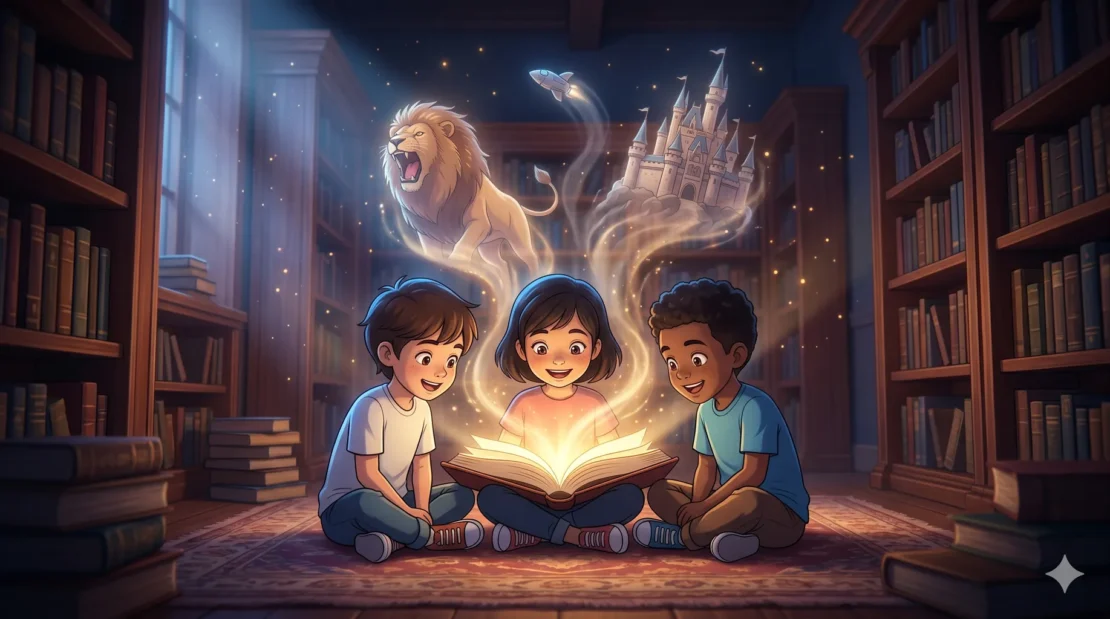
Every parent has been there: it’s bedtime, your little one is wide awake with those big curious eyes, and the only magic powerful enough to finally settle them down is a good story. Short stories for kids are not just a sweet way to end the day, they are one of the most powerful tools for building imagination, shaping character, and sparking a love of learning that lasts a lifetime. At Apple Tree Preschool BSD, nestled inside the Educenter BSD Building, we believe that storytelling is one of the earliest and most beautiful bridges between children and the big world around them. So whether you’re a parent looking for tonight’s bedtime read or simply someone who wants to give your child the gift of great stories, you are in exactly the right place.
15 Short Stories for Kids That Will Spark Their Imagination
These timeless short moral stories for children cover friendship, courage, honesty, kindness, and cleverness. Each one is a little adventure your child can carry in their heart. Pull up a chair, get cozy, and let the storytelling begin!
1. The Lion and the Mouse
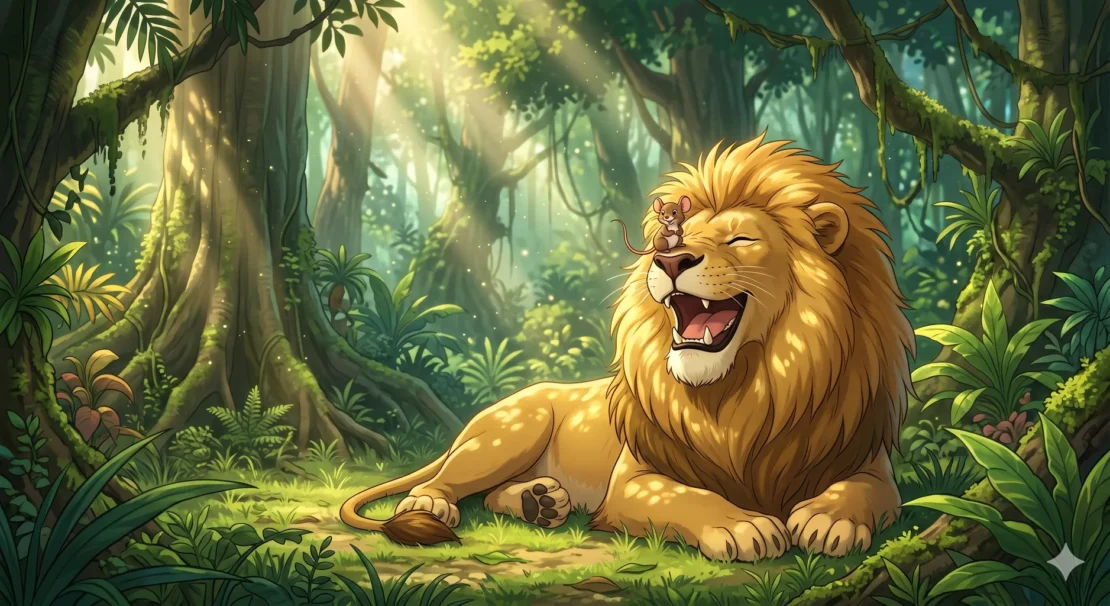
Deep in the heart of a vast jungle, where the trees grew so tall they seemed to tickle the clouds, there lived a great and mighty lion. Everyone knew him. The birds stopped singing when he roared. The deer froze mid-step when he walked past. He was the king of the jungle, and he knew it.
One warm afternoon, after a long morning of patrolling his territory, the lion found a soft, grassy patch beneath a giant mango tree and decided to take a nap. He curled up, tucked his enormous nose into his paws, and within minutes, he was snoring so loudly that the leaves trembled overhead.
Now, not too far from where the lion slept, a tiny brown mouse was busy doing what mice do best: scurrying around, sniffing for seeds, and generally minding his own business. He hopped over a pebble, ducked under a mushroom, and before he even realized it, he was running straight across the lion’s fluffy golden mane.
The lion woke up with a jolt.
“WHO DARES DISTURB THE KING?!” he bellowed, his golden eyes blazing with fury. He reached out one enormous paw and pinned the tiny mouse to the ground.
The little mouse looked up with wide, terrified eyes. His whole body was trembling. He could feel the warmth of the lion’s breath against his tiny whiskers.
“P-please, Your Majesty,” the mouse squeaked, his voice barely above a whisper. “I didn’t mean to wake you. I made a terrible mistake. Please, please let me go. I promise, if you spare me today, I will find a way to repay you someday.”
The lion stared down at the mouse for a long, dramatic moment. Then he did something surprising: he burst out laughing.
“You?” he said, chuckling and shaking his magnificent mane. “Repay ME? The king of the jungle? What could a tiny little thing like you possibly do for me?” He laughed again, a big rolling belly laugh that echoed through the trees.
But even as he laughed, the lion felt something soft in his chest. The mouse was so small. So honest. So earnest. It would be embarrassing, really, to crush something so tiny and helpless.
“Go on then,” the lion said, lifting his paw. “Get out of here before I change my mind.”
The mouse bolted. He didn’t stop running until he was safely back in his little burrow beneath the roots of an old banyan tree. He sat there catching his breath, his tiny heart hammering, overwhelmed with gratitude.
Several weeks passed. One golden afternoon, the mouse was out collecting crumbs near the edge of the jungle when he heard it: a deep, desperate, roaring sound. Not the proud roar of a king announcing his arrival. This was something different. Something raw and frightened.
The mouse followed the sound, weaving through the tall grass, until he found the lion. The great king was trapped inside a thick net of ropes, tangled and knotted so tightly that the more he struggled, the more twisted up he became. His legs were bound, his mane was caught in a knot, and hunters could be heard in the distance, getting closer.
The mouse didn’t hesitate for even a second.
He threw himself at the nearest rope and started gnawing with his tiny but incredibly sharp teeth. Nibble, nibble, nibble. One rope snapped. Then another. Then another. His little paws worked furiously, his teeth moving faster than they ever had before. The lion lay still, barely daring to breathe, watching the tiny creature work with fierce determination.
Within minutes, the ropes fell away. The lion shook himself free, stretched out his enormous body, and stood up tall once more.
He looked down at the mouse.
The mouse looked up at the lion.
Neither of them said anything for a moment. They didn’t need to.
“Thank you, my small friend,” the lion said softly. “I laughed when you said you would repay me. I was wrong to doubt you.”
The mouse smiled, his tiny whiskers twitching. “Size doesn’t measure the size of a heart,” he said simply.
And from that day forward, the great lion and the little mouse were the best of friends. The jungle had never seen a more unlikely pair, but somehow it just made perfect sense.
Moral of the Story: No act of kindness is ever too small, and no helper is ever too little. True friendship and gratitude know no size.
2. The Boy Who Cried Wolf
On the gentle rolling hills just outside a small, busy village, there lived a young shepherd boy named Marco. Every single morning, Marco woke up before the sun had fully stretched across the sky, ate his bread and cheese, and headed up the hill with his family’s flock of fluffy white sheep.
His job was simple: watch the sheep, keep them safe, and call for help if a wolf appeared.
Simple, yes. Exciting? Not even a little bit.
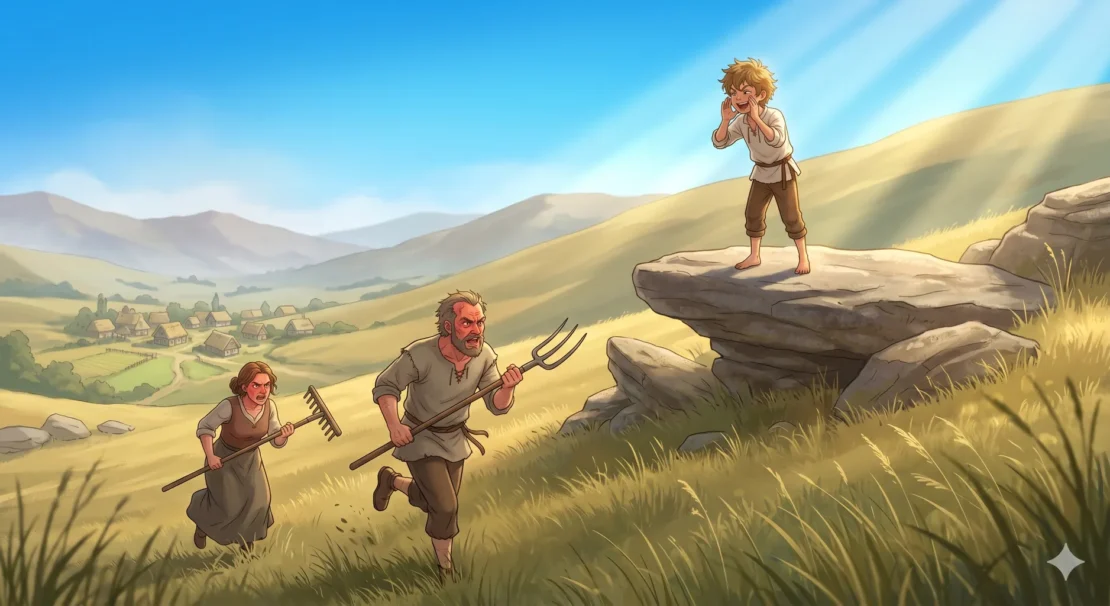
Most days, Marco sat on a big flat rock at the top of the hill, chewing a piece of grass, watching the sheep wander around eating absolutely nothing interesting, and counting down the hours until he could go home. The sheep just went “baaaa.” The wind just went “whoosh.” And that was it.
“This is the most boring job in the whole entire world,” Marco muttered one morning, kicking a pebble off the rock.
He looked down at the village below. He could see the farmers working in their fields, the baker carrying loaves of bread, and the women hanging laundry on the lines. Everyone was busy. Everyone was doing something.
And then a mischievous little idea crept into Marco’s head.
He stood up on his rock, cupped his hands around his mouth, and yelled at the top of his lungs: “WOLF! WOLF! There’s a wolf eating the sheep!”
Down in the village, heads snapped up. People dropped their tools, grabbed their shovels and sticks, and came running up the hill as fast as their legs would carry them, huffing and puffing and tripping over their own feet.
When they arrived at the top, panting and alarmed, they found Marco sitting on his rock, laughing so hard he was rolling around.
“Where’s the wolf?” the baker demanded, red-faced and sweating.
“There is no wolf!” Marco gasped between giggles. “I was just bored!”
The villagers were not amused. They trudged back down the hill grumbling, muttering things under their breath that Marco probably shouldn’t have heard. But the boy didn’t care. It was the most fun he’d had in months.
A few days later, boredom crept back. And Marco did it again.
“WOLF! WOLF! It’s eating all the sheep!”
Once again, the villagers came running. Once again, there was no wolf. Once again, Marco laughed. The villagers left angrier than before, shaking their fists and warning him not to do it again.
But Marco just shrugged.
Then one quiet afternoon, as the sun began dipping behind the hills and Marco was packing up to head home, a shadow appeared at the edge of the tree line. A large, grey, shaggy shape. Yellow eyes. Long teeth.
A real wolf.
It moved slowly toward the flock, and the sheep started bleating in panic, scattering in every direction.
Marco leaped to his feet, his heart hammering in his chest, and screamed at the top of his lungs: “WOLF! WOLF! PLEASE, THERE’S A REAL WOLF! HELP ME!”
Down in the village, the people heard him.
They looked at each other.
“It’s that boy again,” the farmer said, shaking his head.
“Just another trick,” the baker agreed, and went back to his oven.
Nobody came.
The wolf scattered the sheep across the hillside, and by the time Marco managed to chase it away by throwing rocks and screaming, several of his sheep had disappeared into the forest.
That evening, Marco sat alone on the hill, trembling and ashamed. When the village elder finally came to check on him, he found the boy with red eyes and dusty cheeks.
“Why didn’t anyone come?” Marco whispered.
The old man sat down beside him quietly. “Because nobody believed you,” he said gently. “When you lie, even for fun, you spend your trust like coins. And when your coins are gone, nobody has a reason to believe you when it matters most.”
Marco never forgot those words.
Moral of the Story: Honesty is one of the most valuable things you can own. Once you lose people’s trust, it is very hard to get it back.
3. The Tortoise and the Hare
In a meadow full of wildflowers and buzzing bees, there lived a hare who was, without any doubt, the fastest animal around. He knew it. He never stopped talking about it. Every morning he would sprint in circles around the pond just to remind everyone, and every evening he would announce his speed at the top of his voice while the other animals tried to eat their dinners in peace.
“I am the fastest!” he would declare, doing a little spin. “Nobody can touch me. Not the fox. Not the deer. Certainly not that slowpoke tortoise!”
The tortoise, who was sitting nearby quietly eating a leaf, looked up calmly. He had a kind, weathered face and gentle brown eyes. He did not look offended. He did not look bothered. He simply chewed his leaf and said, quite pleasantly, “I challenge you to a race.”
The whole meadow went silent.
Then the laughter started. The squirrels nearly fell out of their trees. The rabbits (cousins of the hare, and honestly a bit embarrassed by him) pressed their paws over their mouths. Even the owl who usually maintained a very dignified expression let out a soft, startled hoot.
The hare looked at the tortoise. He looked at his own powerful, sleek legs. He looked back at the tortoise’s stumpy little ones.
“A race?” he said. “You? Against me?”
“Yes,” said the tortoise simply. “A race.”
The hare agreed immediately, because really, how could he resist? This would be the most hilarious thing he had ever done.
The next morning, all the animals of the meadow gathered along the trail that wound from the old oak tree, through the bluebell field, over the mossy bridge, and all the way to the finish line at the big red gate by the farmer’s fence. It was a long race, maybe the longest anyone had ever run. But for a hare, long races were nothing.
The fox raised a paw. “Ready? Set? GO!”
The hare burst forward like a stone from a catapult. His legs were a blur. The trees rushed past. The flowers bent back in the wind he created. Within thirty seconds, he was so far ahead that when he looked back, he couldn’t even see the tortoise.
He slowed to a jog. Then a walk. He looked around at the peaceful sunny meadow. He yawned.
“This is too easy,” he said, stretching out his long back legs. “I could finish this race in my sleep. In fact, why not? I’ll take a little nap, let that old tortoise get a bit closer so this is at least somewhat interesting, and then I’ll dash to the finish line. Easy win.”
He curled up under a shady oak tree, rested his head on his paws, and closed his eyes.
He did not mean to sleep so long.
Meanwhile, the tortoise kept walking. Step by step, steady and sure. His little legs moved at exactly the same pace they always did. Not fast. Not flashy. Just consistent. He passed the bluebell field. He crossed the mossy bridge. He didn’t stop to rest. He didn’t look behind him. He just kept going, putting one foot in front of the other, his eyes fixed on the path ahead.
When the hare finally woke up, the sun had moved quite significantly across the sky. He stretched, yawned, and looked around. No tortoise in sight.
“Good,” the hare muttered, standing up and shaking out his fur. “Plenty of time.”
He began to lope easily along the trail, feeling refreshed. But as the red gate came into view in the distance, he noticed something strange. There was a small dark shape moving steadily toward it. A round shape. A slow shape.
A tortoise shape.
The hare’s eyes went wide.
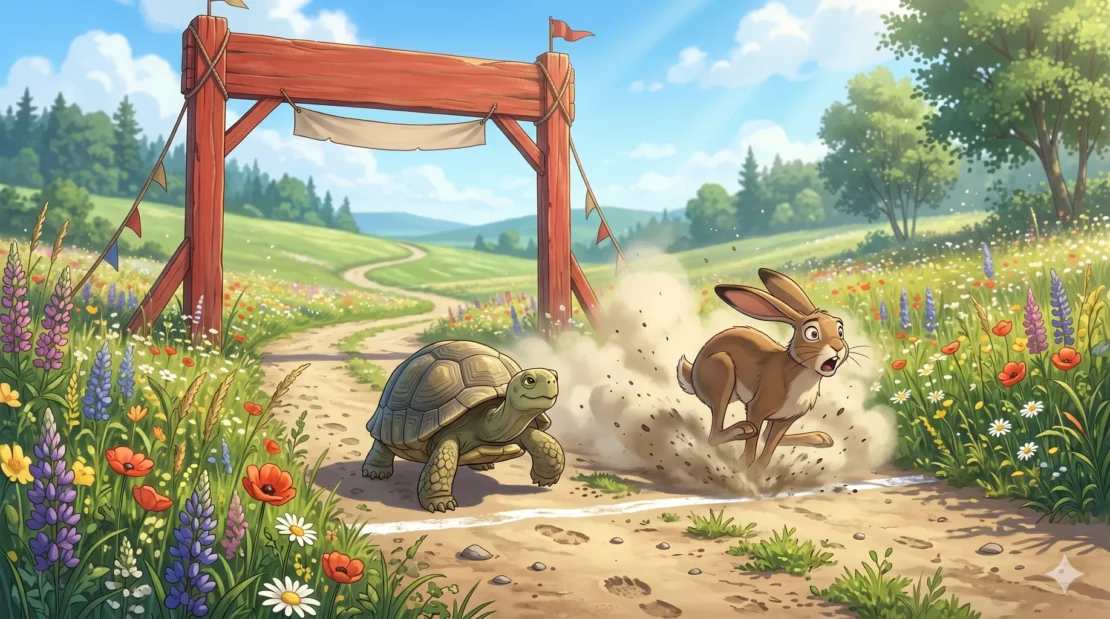
He ran. He ran faster than he had ever run. His legs pumped furiously, kicking up dust clouds behind him. The finish line was right there! The gate was right there! He could make it, he was so fast, nobody was faster than him, he could definitely still win this!
The tortoise took his final steady step across the finish line.
The whole meadow erupted. The squirrels cheered. The rabbits stamped their feet. The owl clapped his wings together solemnly. The tortoise stood at the finish line, breathing a little heavily, his ancient face soft with quiet satisfaction.
The hare skidded to a stop just behind the line, kicking up a cloud of dust. He stood there, chest heaving, staring at the tortoise.
The tortoise looked over at him kindly. “You are much faster than me,” he said. “You always were. But while you were sleeping, I was walking.”
The hare opened his mouth, then closed it again. He had absolutely nothing to say.
Moral of the Story: Talent and speed mean nothing without consistency and effort. Slow and steady really does win the race.
4. The Ant and the Grasshopper
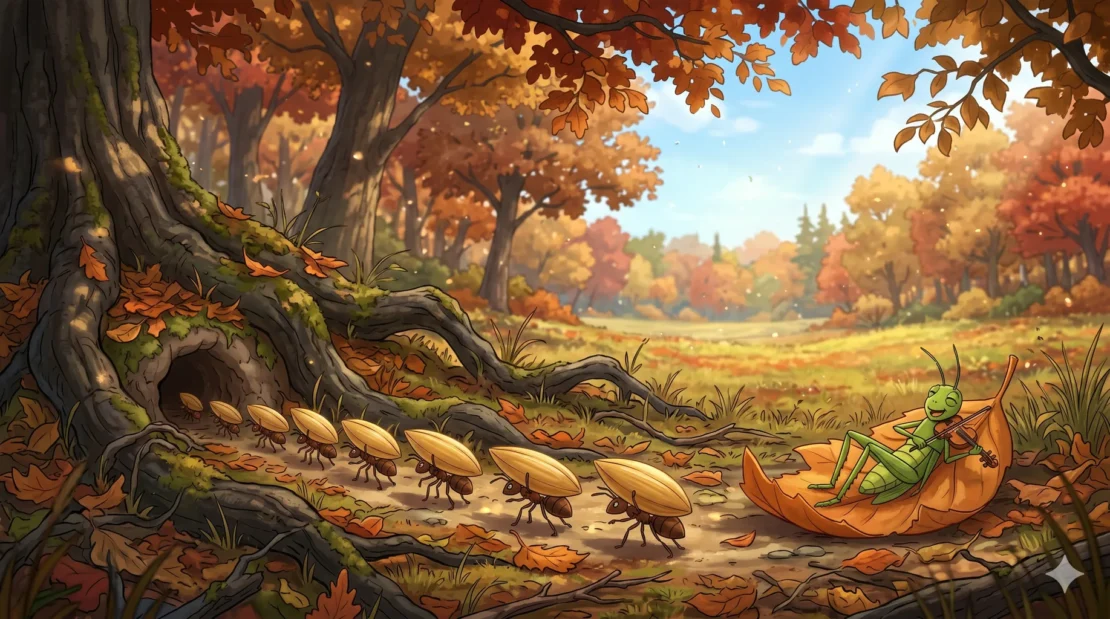
It was the most glorious summer anyone in the meadow could remember. The sun shone warm and golden, the flowers were bursting with colour, the river sparkled like a ribbon of diamonds, and every single blade of grass seemed to hum with life. It was, in short, a perfect time to be alive and to have absolutely no worries in the world.
The grasshopper felt exactly this way.
He leaped from flower to flower all morning, playing his tiny fiddle and singing little songs he made up on the spot. His music was actually quite good, not that he was being modest about it. He played love songs to the butterflies, lullabies to the sleeping beetles, and cheerful jigs to anyone who would listen.
But not far from where the grasshopper was singing, a column of small brown ants was moving in a very determined, very unmusical line. And leading the column was a particularly focused ant named Aba.
Aba was carrying a grain of wheat that was nearly as big as her entire body. Her six legs worked in perfect rhythm. She did not stop. She did not rest. She moved the grain forward and then turned right back around to get another one.
The grasshopper hopped over and landed in front of her with a cheerful bounce.
“Aba! It’s a beautiful day! Why are you working so hard? Put down that grain and come sing with me!”
Aba didn’t break her stride. “Winter is coming,” she said simply.
The grasshopper looked up at the blazing blue sky and laughed so hard he almost fell over. “Winter? Aba, it’s the middle of summer! There are flowers everywhere! The sun is shining! Come on, take a break, eat a berry, be happy!”
“Winter is coming,” Aba repeated, and kept walking.
The grasshopper shook his head and went back to his fiddle. The ants, he decided, had absolutely no sense of joy.
And so the summer rolled on. The grasshopper played and sang and leaped and danced and ate all the food he could find because there was so much of it. The ants worked every single day, carrying grain and seeds and dried berries into their underground home, stacking it all neatly in their storerooms, preparing and preparing and preparing.
Then one morning, the grasshopper woke up and the air felt different.
Cold.
The flowers had gone. The river had slowed. The leaves on the trees had turned orange and brown and were falling in great rustling waves. And then came the snow, soft and silent, covering everything in a thick white blanket.
The grasshopper looked around at the empty meadow. His fiddle was cold in his hands. His stomach was completely empty. He searched under the snow for food and found nothing. He dug around the bare stems of what used to be flowers and found nothing. He sat down in the cold and shivered and thought about all the grains he had ignored all summer.
With nowhere else to go, he made his way to the ants’ home.
Aba opened the door and looked at him quietly.
“I’m so hungry,” the grasshopper said, his teeth chattering. “I played all summer and never saved anything. Could you spare just a little food?”
Aba looked at him for a long moment. She was not unkind. But she was honest.
“We worked all summer so that we would have enough,” she said gently. “Come in and get warm. I will share a little with you. But next summer, my friend, while you are playing, please also think about tomorrow.”
The grasshopper sat by the ants’ warm fire, eating a small but precious portion of grain, and he made himself a very serious promise.
Next summer, he told himself, he would play his fiddle in the mornings and work in the afternoons.
He kept that promise.
Moral of the Story: Enjoy today, but always prepare for tomorrow. Hard work and planning ahead make the hard times so much easier to get through.
5. The Crow and the Pitcher
It had not rained in the forest for a very long time.
The streams had shrunk to thin silver threads. The puddles had dried up entirely. The mud at the riverbank had cracked into a jigsaw of dry, pale plates. Every creature in the forest was thirsty, and none more desperately so than a small, sharp-eyed crow named Kira.
Kira had been flying for hours. Her wings ached. Her black feathers felt dusty and heavy. Her throat was so dry it hurt to caw. She swooped over the meadows, circled the old orchard, dipped low over the cracked riverbed. Nothing. Everywhere she looked, the water was gone.
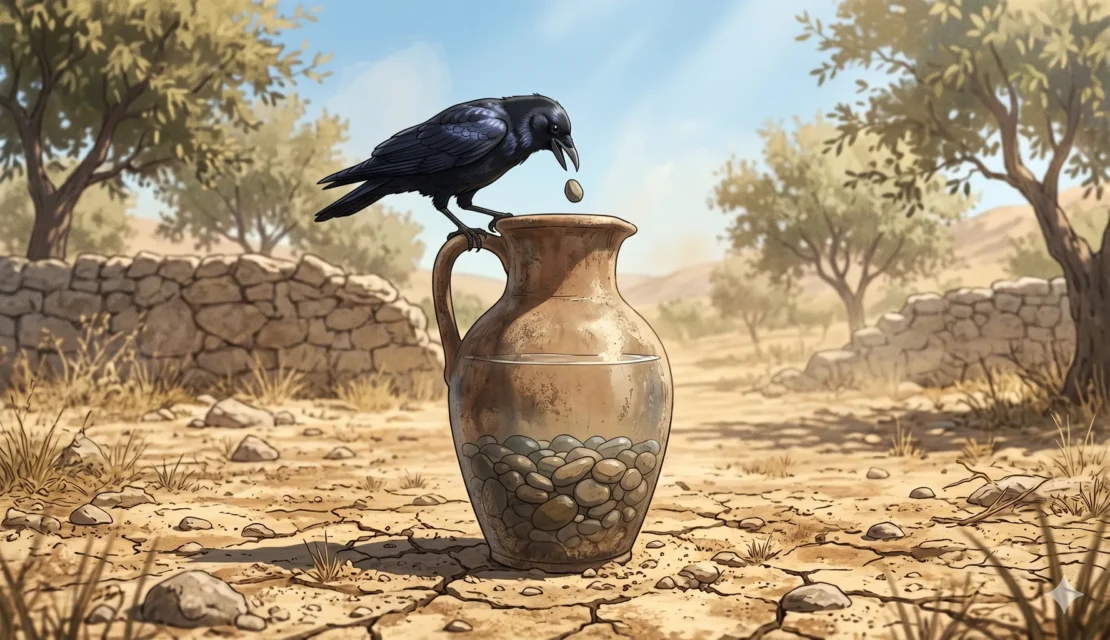
She was just beginning to think that maybe she should give up for the day when she spotted something half-hidden in the tall grass near an old stone wall. It was a large clay pitcher, the kind that farmers used to carry water from the well. She landed beside it and hopped closer, her head tilting from side to side with birdly curiosity.
She looked inside.
There was water at the bottom! Not much, maybe a few inches deep, but it was there. Cool and clear and real. Kira almost cried with relief. She leaned her head in, stretched her neck as far as it would go, and…
Her beak couldn’t reach.
She tried again. And again. She stood on her tiptoes. She angled herself sideways. She nearly fell headfirst into the pitcher trying to get just a drop of that precious water onto her tongue. But it was no use. The pitcher was too tall, and the water level was too low.
Kira sat back and stared at the pitcher.
She could smash it. But then the water would soak into the dry ground and be gone. She could tip it over. Same problem. She thought about calling for help, but who would come? Everyone was just as thirsty as she was.
She looked around her. The old stone wall was covered in tiny pebbles. The ground was scattered with small rocks of all sizes. And something clicked in Kira’s clever little crow mind.
She picked up a pebble in her beak and dropped it into the pitcher. It landed with a satisfying plunk. She watched the water.
It rose. Just a tiny, tiny bit. But it rose.
Kira’s eyes went wide with excitement.
She flew to the wall and picked up another pebble. Dropped it in. The water rose a little more. Another pebble. Another tiny rise. She worked faster now, back and forth, back and forth, from the wall to the pitcher, pebble after pebble after pebble. The sound of plunking filled the hot, dry air. The water crept slowly up the sides of the pitcher.
Up.
Up.
Up.
Until finally, after what felt like a hundred trips, Kira leaned her head into the pitcher and the cool water met her beak. She drank and drank and drank. It was the most wonderful thing she had ever tasted in her entire crow life.
When she finally lifted her dripping head, she felt like a new bird.
She looked at the pile of pebbles still on the ground, at the pitcher full of stones and water, and she felt something even better than the water itself. She felt proud. Not because someone had helped her or because luck had stepped in, but because she had figured it out on her own.
She had used her brain when her wings weren’t enough.
Moral of the Story: When strength and reach aren’t enough, use your mind. Cleverness and persistence together can solve almost any problem.
6. The Greedy Dog
In the town of Millbrook, there was a butcher’s shop that smelled absolutely, wonderfully, magnificently of meat. The butcher was a big cheerful man who whistled while he worked, and every afternoon he would trim a fat, juicy bone and set it on the counter, ready for the lucky customer who ordered it.
One afternoon, a scruffy brown dog with bright amber eyes managed to sneak into the shop while the butcher’s back was turned. Quick as a flash, he snatched the biggest bone he could find, the kind with thick meaty bits on both ends, the kind that was perfect for a long happy afternoon of chewing, and he bolted out the door before anyone could catch him.
He ran and ran, the bone clamped proudly in his jaws, feeling like the luckiest dog in all of Millbrook. He had a plan: he would cross the little wooden bridge over the stream, find a quiet shady spot in the park on the other side, and enjoy his magnificent stolen bone all by himself.
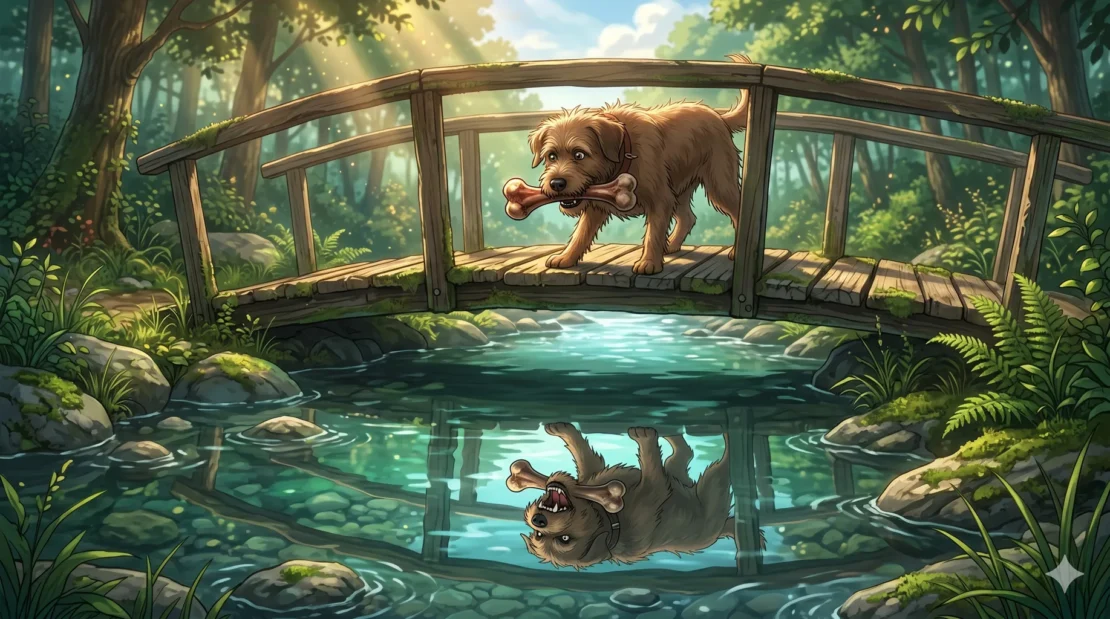
He reached the bridge and trotted out across it, his claws clicking happily on the old wooden planks. He was halfway across when he happened to glance down at the water below.
And he saw another dog looking up at him.
A very handsome dog. A very well-fed-looking dog. A dog who was also carrying a bone that looked, if anything, even bigger and meatier than his own.
The dog on the bridge forgot everything. He forgot where he was going. He forgot that he had already won the lottery of all dogs today. All he could see was that other dog’s bone and how much better it looked than his.
He growled at the other dog. The other dog growled back (at least it seemed that way).
The dog on the bridge’s eyes narrowed. If he could scare that other dog into dropping his bone, he would have TWO bones. Two! He would be the greatest, most successful dog in the entire history of Millbrook.
He opened his jaws wide and let out a great, ferocious, magnificent bark.
His own bone splashed into the stream below.
The dog stared down at the water. The reflection was gone. The “other dog” was gone. And his very real, very delicious, very well-stolen bone was sinking to the bottom of the cold stream.
He sat on the bridge for a very long time, his head drooping, his ears flat, his stomach growling mournfully.
He had been so busy wanting more that he had lost what he already had.
He slunk home that evening with nothing, and the butcher, who had watched the whole thing from his shop window, shook his head slowly and went back to whistling.
Moral of the Story: Be grateful for what you have. Greediness doesn’t bring you more. More often than not, it leaves you with less.
7. The Golden Goose
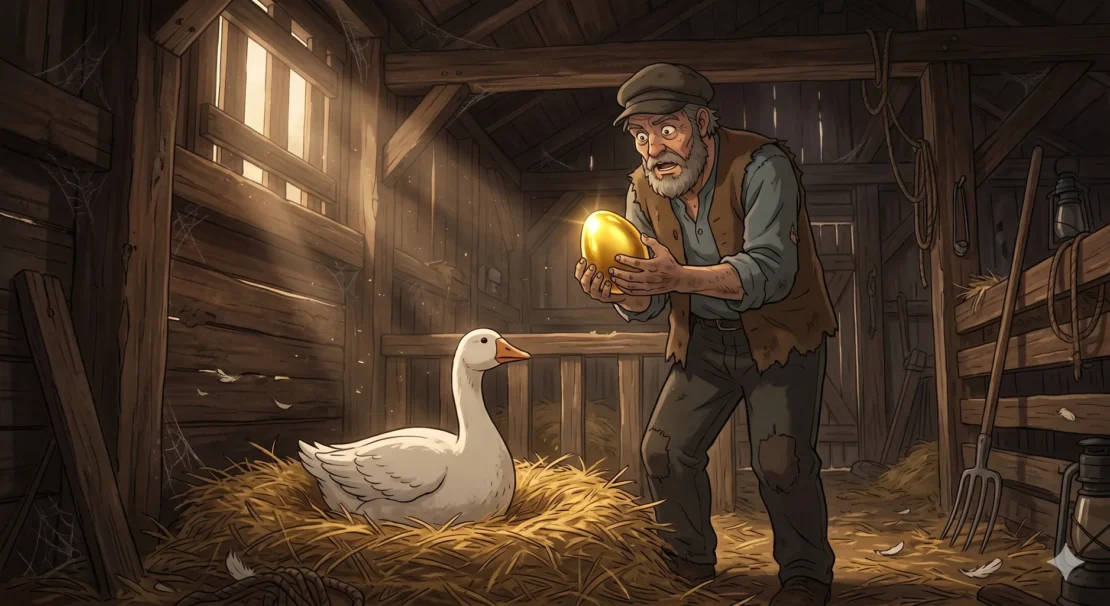
Once there was a farmer and his wife who owned a very ordinary-looking goose. She wasn’t particularly beautiful. She didn’t do tricks. She didn’t even lay very many eggs. But one grey autumn morning, when the farmer went to check on her in the pen, he found something that made him blink and look again.
There, nestled in the straw, was a single golden egg.
Not painted gold. Not wrapped in gold paper. Actually, solidly, genuinely GOLD.
The farmer picked it up with trembling hands. It was heavy and warm and unmistakably real. He ran back to the house and showed his wife, and for a few minutes, they just stared at each other with wide eyes and dropped jaws.
Every morning after that, the goose laid one golden egg. Every single morning, without fail, one perfect egg. The farmer would take it to town, trade it for a very large sum of money, and come home rich. Within a few weeks, they had more money than they had ever dreamed of. New furniture. New clothes. A proper roof on the house. Everything.
But one evening, as the farmer sat counting his money, a thought crept into his head. A very dangerous, very greedy thought.
“One egg a day is wonderful,” he said slowly. “But what if the goose has dozens of golden eggs inside her right now? What if we don’t have to wait? What if we could have all of them at once?”
His wife looked at him uncertainly. “She gives us one egg a day,” she said. “That’s already wonderful.”
“But THINK of it,” he said, his eyes gleaming. “All that gold, all at once. We’d be the richest family in the whole country. Why wait a year when we could have everything tomorrow?”
That night, he made up his mind. The next morning, instead of collecting the egg from the nest, he went to the pen with a knife.
The goose looked up at him with her calm brown eyes.
A few minutes later, the farmer stood in the pen, looking down, his face pale. There were no golden eggs inside the goose. There was nothing special inside her at all. She was a goose, and he had lost her, and with her, he had lost the one egg a day that had already been changing his life.
He sat down in the straw of the empty pen and buried his face in his hands.
He had destroyed the very thing that had blessed him, all because he couldn’t wait. He already had more than enough. He had been so blinded by what he could get that he threw away what he already had.
They were back to being ordinary farmers, with nothing but the memory of gold to keep them company in the evenings.
Moral of the Story: Patience and gratitude are worth more than greed. When you already have something good, taking care of it is far wiser than destroying it for more.
8. The Milkmaid and Her Pail
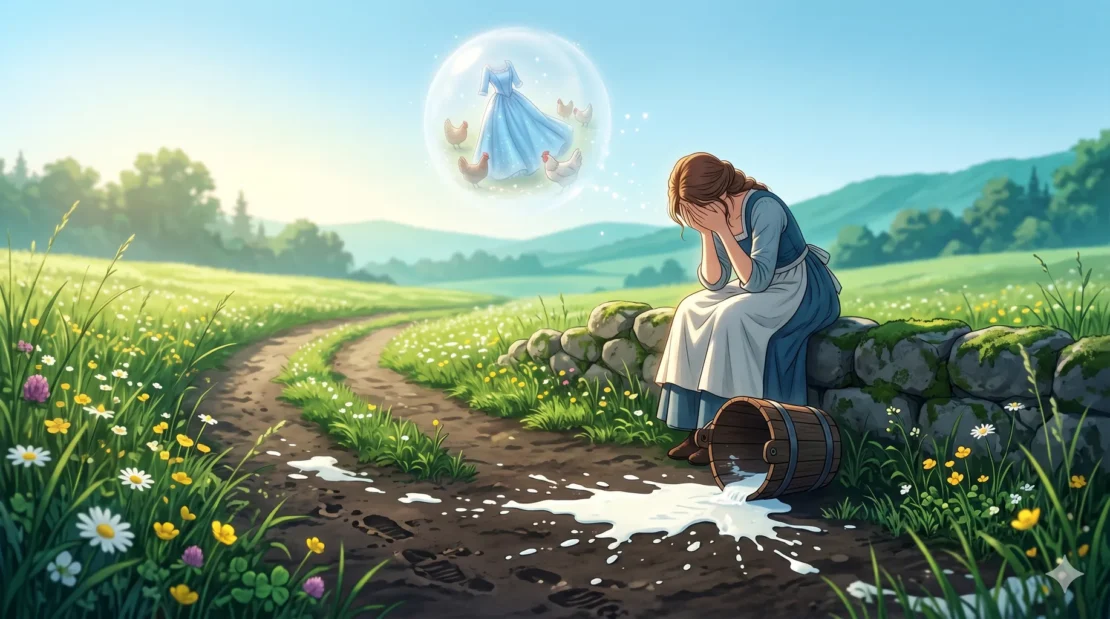
Molly was a milkmaid, and she was very good at her job. Every morning she rose with the sun, went to the barn, milked the cows with practiced hands, and set out across the fields balancing a large pail of fresh, creamy milk on her head.
She was graceful at it, too. She had been doing it since she was small, and she could walk the whole winding path to the market without spilling a single drop, even on the uneven bits near the old stone fence.
One particular morning, the milk looked especially rich and thick, and as Molly walked, her mind began to wander in the most delightful direction.
“This is a wonderful pail of milk,” she said to herself, walking steadily with her head held high. “I’ll sell it at the market for a very good price. And with that money, I’ll buy myself a hundred eggs. And when those eggs hatch, I’ll have a hundred chicks. And those chicks will grow into fine chickens, and I’ll sell most of them, but keep the best ones.”
She smiled to herself, the morning sun warm on her face.
“And with the money from the chickens, I’ll buy a new dress. A beautiful one, with blue ribbons and white lace. I’ll wear it to the village fair, and all the boys will want to dance with me. But I won’t dance with just anyone.” She lifted her chin proudly. “I’ll turn them all down, every last one of them, like this!”
She tossed her head back with a dramatic, proud gesture.
The pail on her head wobbled.
Then it tipped.
Then it fell.
Molly froze, her arms outstretched in the moment after, watching helplessly as the milk splashed out across the path in a great white wave, soaking into the dry ground and disappearing as if it had never been there at all. The pail rolled sadly into the ditch.
She stood in the middle of the path, her dress splashed with milk, her hair dripping, her beautiful imaginary dress with blue ribbons, her hundred imaginary chicks, her hundred imaginary eggs, her lovely imaginary market profit, all of it gone. Draining into the dirt right along with the actual milk.
Molly sat down on the stone fence and let out a long, deep sigh.
When she got home and told her mother what had happened, her mother simply hugged her and said softly, “Oh, Molly. We should never count our chickens before they hatch.”
Molly looked down at her empty pail.
“Or our eggs before they’re bought,” she added quietly. “Or our dress before it’s made.”
Her mother laughed softly and kissed the top of her milk-damp hair.
“Come on,” she said. “There’s more milk to collect. And this time, just walk.”
Moral of the Story: Dreams are wonderful, but don’t get so lost in future plans that you forget to take care of the present moment right in front of you.
9. The Kind Woodcutter and the Magical Axe
Deep in the forest where the trees grew close together and the river sang as it tumbled over the rocks, there lived a young woodcutter named Eli. He was not rich. He was not powerful. But he worked hard every day, cared for his elderly mother, and never once complained about the life he had.
His most prized possession in the world was his axe. It was a simple iron axe with a worn wooden handle, nothing fancy. But it was his father’s axe, passed down to him when his father passed away, and Eli polished it every night and treated it with the same care a king might treat his crown.
One ordinary morning, Eli was cutting wood near the river when his axe slipped from his hands and tumbled through the air, spinning once, twice, and then splashing straight into the deepest part of the river with a sickening plop.
Eli stood at the edge of the bank, staring at the dark water where his axe had disappeared, and his whole body went cold. He could see nothing below the surface. The current was too strong to swim in. His axe, his father’s axe, was gone.
He sat down on the muddy bank and put his face in his hands, and he cried. He wasn’t ashamed of it. He loved that axe, and it was gone, and he was just a poor woodcutter who couldn’t afford a new one.
Then, something remarkable happened.
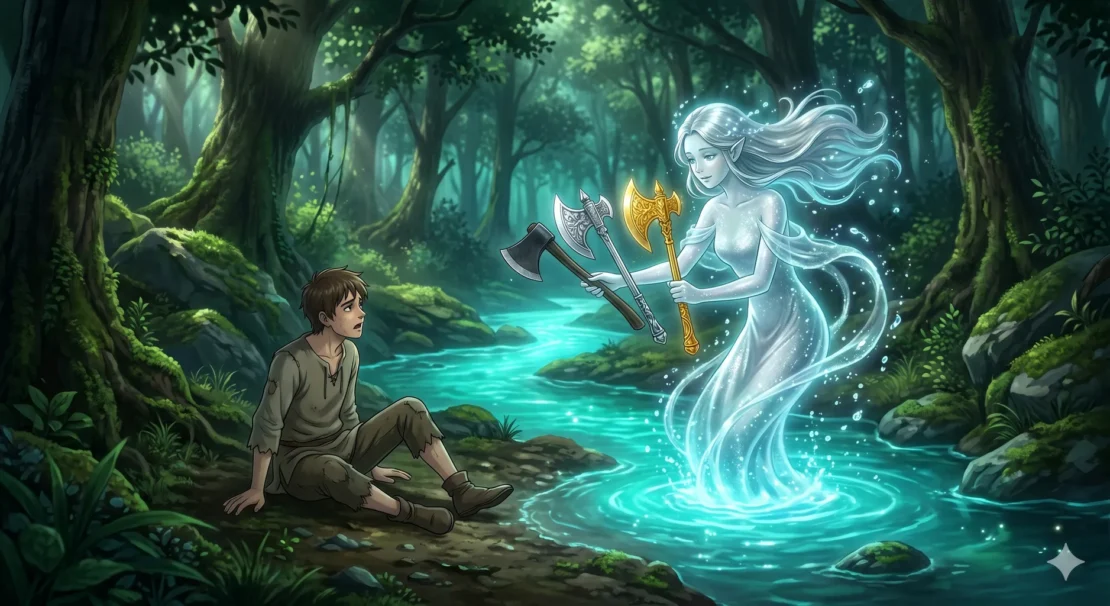
The water in front of him began to shimmer. A gentle ripple spread outward from the center, and slowly, a figure rose from the river. A river spirit, silvery and shimmering, holding an axe in her hands. But it was not Eli’s axe. The one she held was made of gleaming pure gold.
“Is this your axe?” the spirit asked, her voice like water over pebbles.
Eli looked at the golden axe. It was beautiful. It was worth more than everything he owned put together. He could sell it and take care of his mother for years. He could buy a house. He could change his whole life.
He shook his head.
“No,” he said quietly. “That isn’t mine.”
The spirit smiled and let the golden axe sink back into the water. She reached in again and rose holding a silver axe, bright and perfect.
“Is this yours?”
Eli shook his head again. “No. That isn’t mine either.”
The spirit reached in one more time and came up holding a plain iron axe with a worn wooden handle.
“That one,” Eli said immediately, his voice catching. “That one is mine.”
The spirit looked at him for a long moment. Then she smiled, a warm and knowing smile, and she handed him not just the iron axe, but all three. The iron, the silver, and the gold.
“Your honesty is rarer than all the gold in this river,” she said softly. “Take all three. You have earned them.”
Eli walked home that evening with his father’s axe back on his shoulder and two more axes in his arms. He and his mother never had to worry about money again.
He kept his father’s axe on the wall above the fireplace, cleaned and polished, just as it had always been.
Moral of the Story: Honesty is always worth more than any amount of gold. What you gain through truthfulness will always be more lasting than what you could gain through deception.
10. The Clever Rabbit and the Hungry Lion
In a wide, golden savanna where the grass swayed in warm afternoon winds, a great and terrifying lion had decided that he was tired of chasing his food. He announced to all the animals of the plain that from this day forward, they would send him one animal every single day to eat, and in return, he would not hunt the rest of them. “One animal a day,” he declared, “and you all live in peace.”
The animals were terrified but reluctantly agreed. It seemed like the only choice they had.
One by one, day by day, an animal would make the slow, sad walk to the lion’s den. A deer. A wildebeest. A young zebra. The animals of the savanna grew miserable and frightened. They knew their turn was coming, and they could do nothing about it.
Until the day it was the rabbit’s turn.
Bina the rabbit was small, brown, and had very long ears that caught every word anyone spoke within a hundred metres. She was also, as every rabbit who had ever met her would tell you, extraordinarily clever.
When the other animals gave her sad, sympathetic looks, she did not cry. She thought.
She thought all morning, her nose twitching and her ears swiveling this way and that. And by the time afternoon came, she had a plan. A good one.
She set off toward the lion’s den, but instead of arriving quickly, she walked very, very slowly. She stopped to smell flowers. She took the long way round the lake. She examined interesting pebbles. When she finally arrived, the sun was nearly setting.
The lion was furious.
“You’re LATE!” he roared, his mane trembling with rage. “And you’re TINY! I ordered a proper meal, and you bring me this?!”
Bina bowed humbly. “I am so deeply sorry, Your Mightiness,” she said, her voice respectful but steady. “I was coming as fast as I could, but another lion stopped me on the way. He said he was the true king of this savanna and that I should go to HIS den instead.”
The lion went absolutely rigid.
“ANOTHER lion? On MY savanna?!”
“Yes,” said Bina, her eyes wide and innocent. “He was very large and very fierce. I told him you were the real king, but he just laughed and said he was bigger and stronger and that this savanna belongs to him now.”
The lion was shaking with outrage. “Show me. Show me where this imposter is. RIGHT NOW.”
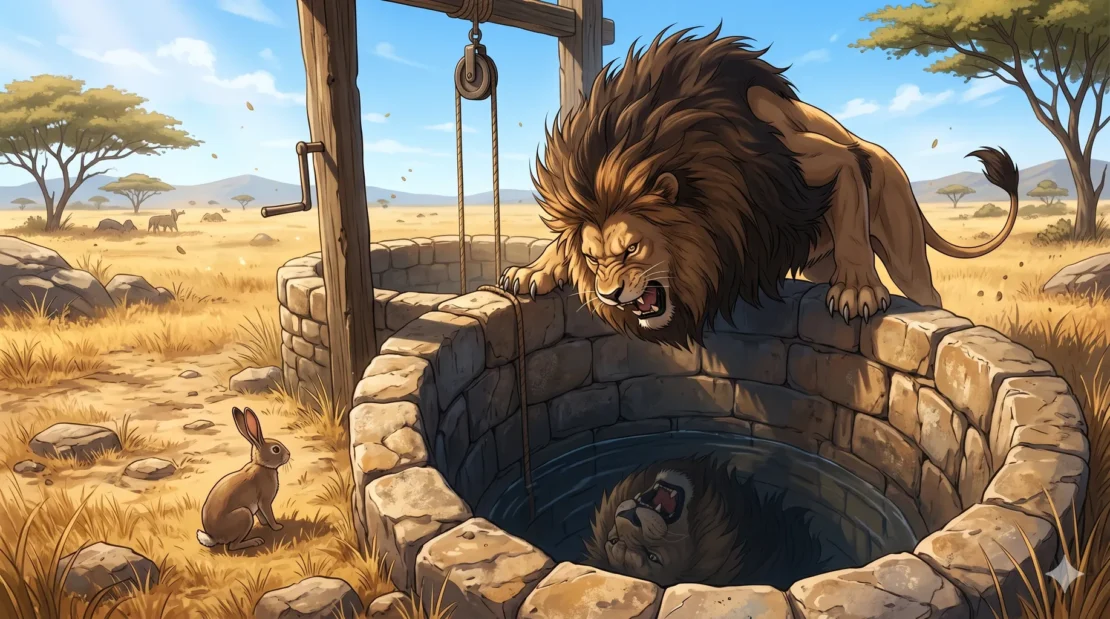
Bina led the lion across the plain, down toward the edge of the old well near the fig trees. She stopped at the rim and pointed down.
“He lives in there,” she said simply.
The lion shoved his head over the edge and stared down into the well.
A lion stared back at him. Big, furious-looking, with an enormous mane.
The lion roared down into the well.
The well roared back.
The lion, absolutely convinced he was looking at a rival king, roared louder, leaned further over the edge, and then, with a great splash and a thunderous echo, tumbled in.
The well was deep and the sides were steep. The lion scrambled and scrambled, but there was no way out.
Bina looked down at him calmly. “That was your reflection,” she said pleasantly.
Back on the savanna, the animals heard the whole story and cheered so loudly that the birds flew off the trees in a startled cloud. They were free. Not because they were stronger than the lion. Not because they had weapons or armies. Because one small rabbit had thought very carefully, and then acted very bravely.
Moral of the Story: A clever mind and a brave heart can overcome even the most powerful opponent. You don’t need to be the biggest to win.
11. The Proud Peacock
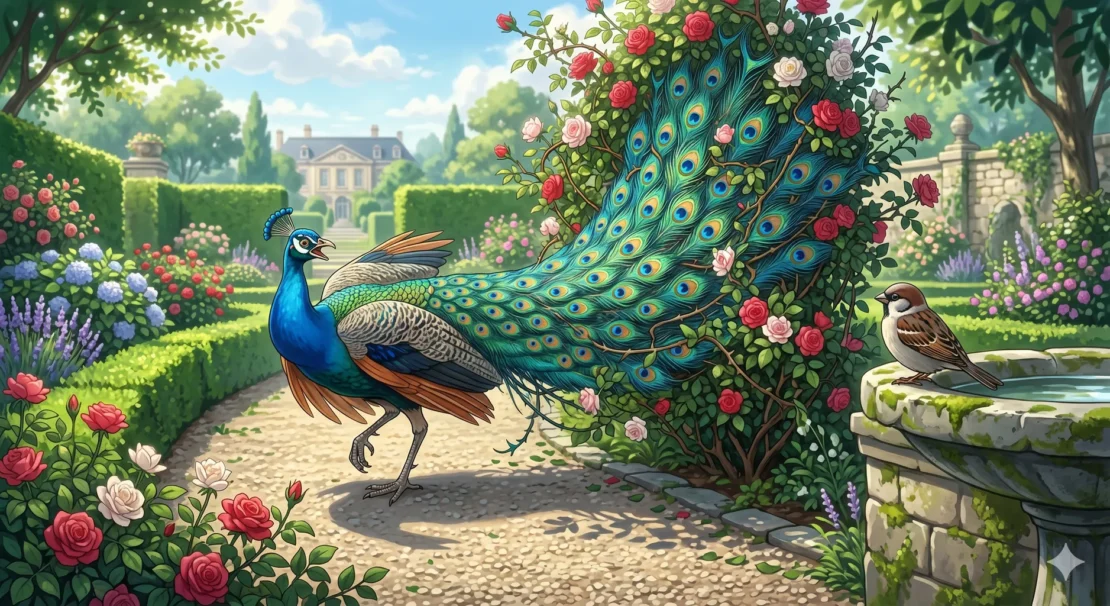
In the gardens of a great estate, there lived a peacock of breathtaking beauty. His feathers were the richest, deepest blue and green, shimmering like jewels in the sunlight. When he spread his tail, it was like a painting come to life, an enormous fan of colour that made everyone who saw it stop and stare.
And the peacock knew it.
“Am I not the most magnificent creature in these gardens?” he would announce every morning, fanning out his tail for maximum effect. “Look at these colours. Look at this tail. There is simply no one more beautiful than me.”
The other animals mostly tried to go about their days.
“Your feathers are very lovely,” the old horse said one afternoon, without looking up from his hay.
“Lovely?” the peacock repeated, deeply offended. “LOVELY? My feathers are not lovely. They are spectacular. They are unparalleled. They are a gift to everyone who has the privilege of seeing them.”
The horse flicked his tail and said nothing.
The problem was that the peacock had begun to care only about how he looked. He spent his mornings admiring his reflection in the pond. He spent his afternoons posing for the benefit of any animal who happened to be passing. He refused to go anywhere he might get muddy, which meant he missed the best feeding spots. He refused to run in case he ruffled his feathers, which meant that every time there was any kind of trouble, he was the last to get anywhere useful.
One afternoon, a fox appeared at the edge of the garden, scouting for a meal.
Every animal heard the warning call and ran. The chickens bolted for the coop. The rabbits vanished into their burrows. The horse cantered to the far field. Even the old sleepy cat got herself up to the top of a wall.
The peacock, however, was in the middle of the pond garden, looking at his reflection.
By the time he heard the commotion and understood what was happening, he tried to run, and then stopped. His beautiful, magnificent, spectacular tail was caught in the rose bushes at the edge of the path. The more he tugged, the more tangled it became. He flapped and squawked and pulled.
The gardener, hearing the noise, came running and scared the fox away just in time.
The peacock stood in the middle of the path, his tail partially detached from one rosebush, his feathers bent at odd angles, looking considerably less magnificent than usual.
An old sparrow landed on the fence nearby.
“You know,” the sparrow said thoughtfully, “if you’d spent half as much time learning to run as you did looking at your reflection, you wouldn’t have needed saving.”
The peacock opened his beak. Closed it again. Looked at his bent, disheveled feathers.
“Your feathers are beautiful,” the sparrow continued kindly. “But beauty isn’t what keeps you safe, or happy, or useful. Character does that.”
The peacock thought about this for a very long time.
He still admired his feathers sometimes. You can’t just completely stop being who you are. But he also started joining the other animals for morning runs. And he learned, gradually, that being liked for who you are feels much better than being stared at for what you look like.
Moral of the Story: Outer beauty is a wonderful thing, but inner qualities like kindness, humility, and effort matter far more in the long run.
12. Timun Mas and the Green Giant
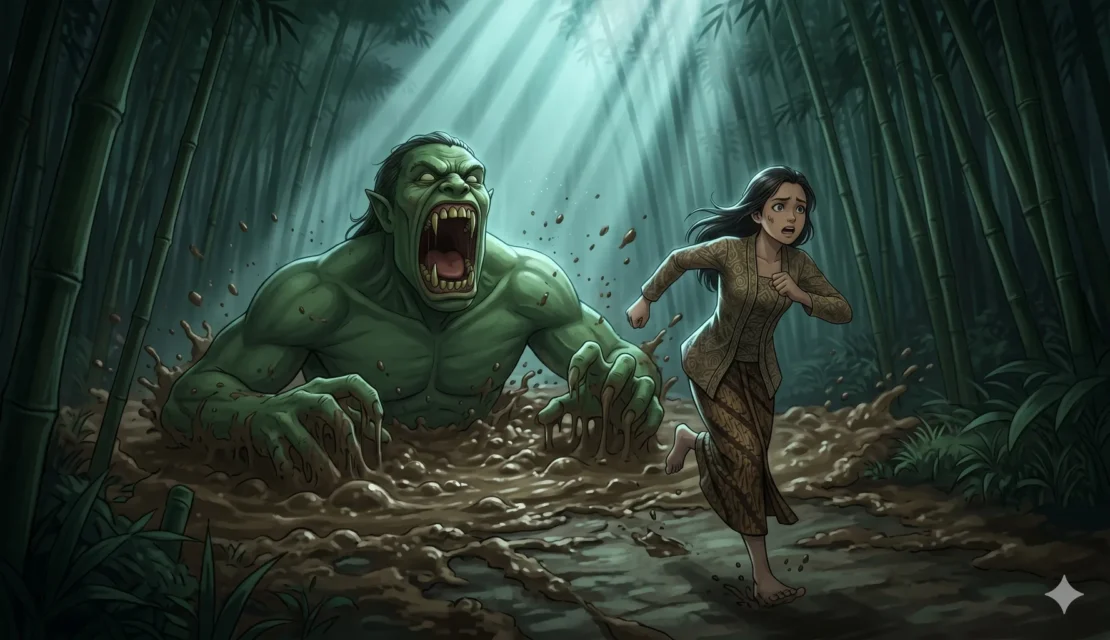
Long ago, in a small village surrounded by rice paddies and bamboo groves on the island of Java, there lived a widow named Mbok Sirni. She had a simple home, a small garden, and one wish that she carried in her heart every single day: she wanted a child.
One night, she prayed under the silver light of a full moon, asking the spirits of the forest to grant her wish. A giant named Buto Ijo heard her prayer. He appeared before her, enormous and green, with teeth like sharpened bamboo and eyes like burning embers.
“I will give you a child,” the giant said, his voice rumbling like distant thunder. “But when the child turns sixteen, she belongs to me.”
Mbok Sirni was so desperate for a child that she agreed.
The giant gave her a tiny cucumber seed and told her to plant it with care. She did. She watered it every morning, talked to it every evening, and sang to it at night. And before long, a cucumber grew, larger and greener than any she had ever seen. When she opened it, curled up inside on a bed of soft golden seeds, was a beautiful baby girl.
She named her Timun Mas, which means Golden Cucumber.
Timun Mas grew up bright, brave, and deeply loved. Mbok Sirni never spoke of the bargain she had made, but as Timun Mas’s sixteenth birthday drew near, the weight of it grew heavier than anything she had ever carried.
She went to see a wise woman in the next village, who listened carefully and then gave her four small pouches. “Give these to your daughter,” the wise woman said. “When the giant comes, she will know what to do.”
On the morning of Timun Mas’s sixteenth birthday, Buto Ijo appeared at their door, shaking the ground with each step.
Mbok Sirni pressed the four pouches into Timun Mas’s hands, tears streaming down her face. “Run, my daughter. Run and don’t look back.”
Timun Mas ran. Through the paddy fields, into the forest, over the hills, her bare feet flying across the earth. Behind her, the thundering footsteps of the giant shook the trees.
When she could hear him getting closer, she opened the first pouch and threw the contents behind her: cucumber seeds. In an instant, a massive tangled jungle of cucumber vines spread out across the path, thick and thorny and impossible to push through. The giant tore at the vines, cutting himself on the thorns, but he was through it in minutes.
She opened the second pouch: needles. They scattered behind her and immediately grew into a dense forest of bamboo, sharp and tall as a wall. The giant smashed through it, slower now, bleeding and furious.
She opened the third pouch: salt. It spread into a wide, churning sea behind her, and the giant waded through it, roaring with effort, but still coming.
She threw the last pouch: shrimp paste. It hit the ground and erupted into a vast, bubbling swamp of deep mud. The giant ran into it, sank to his knees, then his waist, then his chest. He struggled and thrashed, but the mud held him like a fist.
Slowly, the giant sank into the swamp and was gone.
Timun Mas stood at the edge of the swamp, her chest heaving, her heart hammering. The forest was quiet around her. Somewhere behind her, far away, she could hear the birds singing above her mother’s village.
She turned and walked home.
When Mbok Sirni opened the door and saw her daughter standing in the morning light, she pulled her in and held her so tightly that Timun Mas could barely breathe. But she didn’t mind at all.
Moral of the Story: Bravery, quick thinking, and the love of a parent can protect you through the darkest and most frightening moments. Never underestimate the power of courage and wisdom working together.
13. The Little Star Who Lost Her Shine
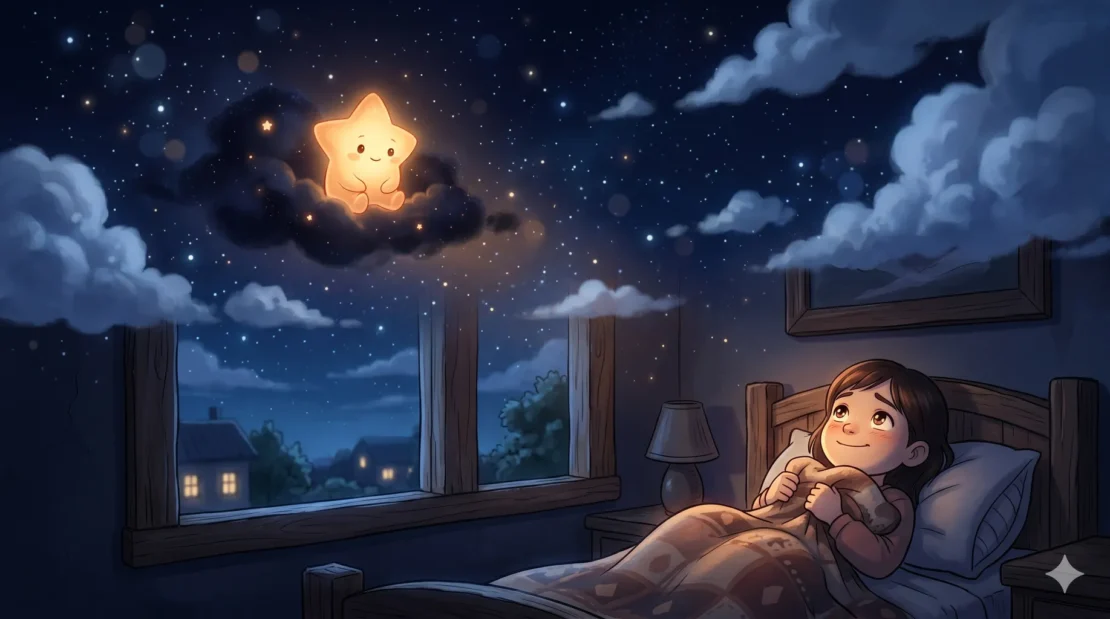
High up in the velvet sky, where the clouds floated like soft white pillows and the moon kept watch over everything below, there lived thousands and thousands of stars. They sparkled and twinkled, lighting up the dark for all the creatures of the earth below who were scared of the night.
Among them was a small star named Lumi.
Lumi was not the biggest star. She was not the brightest. But she had a warm, gentle glow that the animals below had grown fond of. The owls navigated by her. The lost travellers looked for her. The babies who couldn’t sleep gazed up at her and felt a little calmer.
One evening, Lumi looked down and noticed the other stars.
Big Orion blazed with incredible power. The North Star shone steady and proud. Even the little stars around her seemed to sparkle more brilliantly than she did on nights when the sky was particularly clear.
“I’m not very bright,” Lumi said to herself. “I’m not very big. What’s the point of me shining at all?”
And so, one night, she decided not to shine.
She pulled her light inward and sat in the dark, watching the other stars glow around her.
Down below on earth, a small girl named Pita was lying in her bed, struggling to sleep. Pita had always been afraid of the dark, and every night, she would find Lumi’s familiar warm glow in the corner of the sky and feel better. But tonight, when she looked up at her usual spot, there was only darkness where Lumi had been.
Pita’s eyes went wide. She pulled her blanket up to her chin. The dark felt bigger than usual.
Her grandmother came in to check on her and found her wide awake and frightened.
“What’s wrong, little one?”
“My star is gone,” Pita whispered.
Her grandmother looked out the window and then sat down beside her on the bed. “That little warm star?” she said softly. “She’s been there every night since you were a baby. I remember when you were very small, you would calm down the moment you saw her.”
Pita nodded.
Her grandmother smiled. “Perhaps she doesn’t know how important she is.”
Up in the sky, Lumi had been watching. She had seen Pita’s frightened face. She had heard the grandmother’s words. And something warm and aching moved through her.
She hadn’t known.
She hadn’t known that all this time, one small girl had been looking for her. That she had been the difference between feeling afraid and feeling safe for someone who was much smaller than the dark.
Slowly, Lumi let her light out again. She didn’t try to shine as brightly as Orion. She didn’t try to be as steady as the North Star. She just shone the way she shone, her own warm gentle way.
Down below, Pita looked up and let out a long, relieved breath. There she was. Her star, exactly where she should be.
She closed her eyes and fell asleep.
And Lumi understood, at last, that you don’t have to be the biggest or the brightest to matter. You just have to show up, consistently, and be yourself.
Moral of the Story: You don’t need to be the best or the brightest to make a difference in someone’s life. Simply being present, being kind, and being yourself is more than enough.
14. The Farmer, His Sons, and the Hidden Treasure
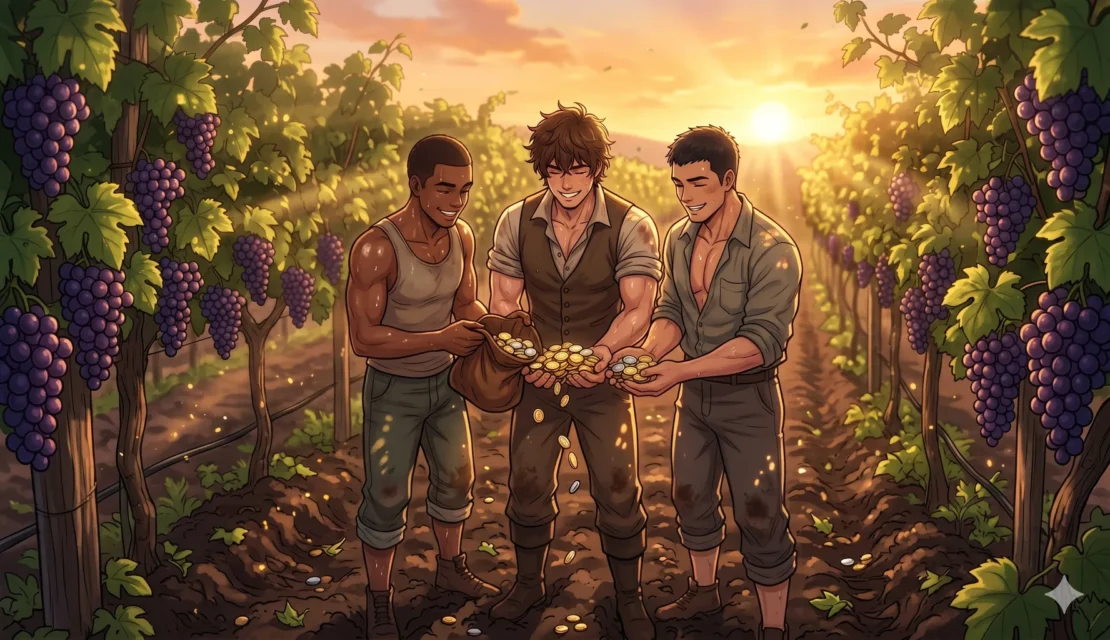
There was once an old farmer who had worked his land for fifty years. He had three sons, and he loved each of them deeply, but he also worried about them, because they were, in the most affectionate way possible, extremely lazy.
They did not help on the farm. They slept in. They argued over who should fetch the water. They came up with increasingly creative reasons why each particular chore was someone else’s job. The farmer had tried everything: asking nicely, asking firmly, asking with a raised voice, asking while holding a broom.
Nothing worked.
When the farmer grew very old and knew that his time was running short, he called his three sons to his bedside. They came and sat around him, looking mildly concerned but also eyeing the door in case this was going to be a long talk.
“My sons,” the old farmer said, his voice thin but steady. “I have something to tell you. Something I have kept secret my whole life.” He paused for effect. He had been looking forward to this moment. “There is treasure buried in the vineyard.”
The sons looked at each other.
“Treasure?” the eldest said.
“Buried treasure,” the farmer confirmed. “Somewhere in the vineyard, beneath the soil, I buried gold many years ago. I have never dug it up. I always meant to tell you, but I waited for the right moment. The treasure is yours. All of it.”
A few days later, the farmer passed away peacefully, and his sons buried him with love and grief and genuine sadness. But as soon as the mourning period was over, they rolled up their sleeves and went to the vineyard.
They dug. And they dug. And they dug.
Every single square meter of that vineyard was turned over, loosened, and examined. They dug in rows. They dug in circles. They dug at dawn and in the afternoon heat. They poked every corner and lifted every root. They argued over who had missed a spot and went back to check.
They found no gold. No silver. Not even a single old coin.
Exhausted and confused and more than a little annoyed, the eldest son sat down and looked at the deeply, beautifully, thoroughly dug-up vineyard in front of him.
And then the harvest came.
Because the soil had been turned and aerated so thoroughly, the grapes that year were bigger, juicier, and more abundant than they had been in a generation. The yield was extraordinary. The brothers sold the grapes at the market for more money than the farm had made in years.
They stood in the vineyard at the end of harvest, counting their earnings.
The youngest son was quiet for a long time. Then he said softly, “I think I understand what Father meant.”
The eldest looked at him.
“The treasure wasn’t gold,” the youngest said. “It was this. The soil. The vineyard. The work itself. He just knew we wouldn’t do the work unless we thought we were looking for something.”
The three brothers looked at the flourishing vineyard around them, at the strong healthy vines, at the rich dark soil their hands had turned.
“Clever old man,” the eldest said finally.
“The cleverest,” the youngest agreed.
They kept farming the vineyard. And every year, the harvest was good, because every year, they took care of the land. The real treasure, as it turned out, was exactly where their father had said it was. Right there, in the vineyard, all along.
Moral of the Story: Hard work itself is the greatest treasure. What you build with your own hands and effort will always reward you more richly than anything given for free.
15. The Two Friends and the Bear
Two young friends, Aiden and Sam, had been best friends since they were old enough to remember. They went to the same school, lived on the same street, and had made each other a solemn promise that the way best friends do, on a sunny afternoon with the very serious weight of childhood behind it. They promised to always look out for each other, no matter what.
“No matter what,” Aiden had said.
“No matter what,” Sam had agreed.
One autumn afternoon, the two of them decided to take a shortcut through the woods on their way home from school. The forest was beautiful that time of year, full of orange and gold leaves spinning gently down through the afternoon light. They walked along the trail, talking and laughing, their backpacks bouncing, completely at ease.
Then Aiden grabbed Sam’s arm and went completely still.
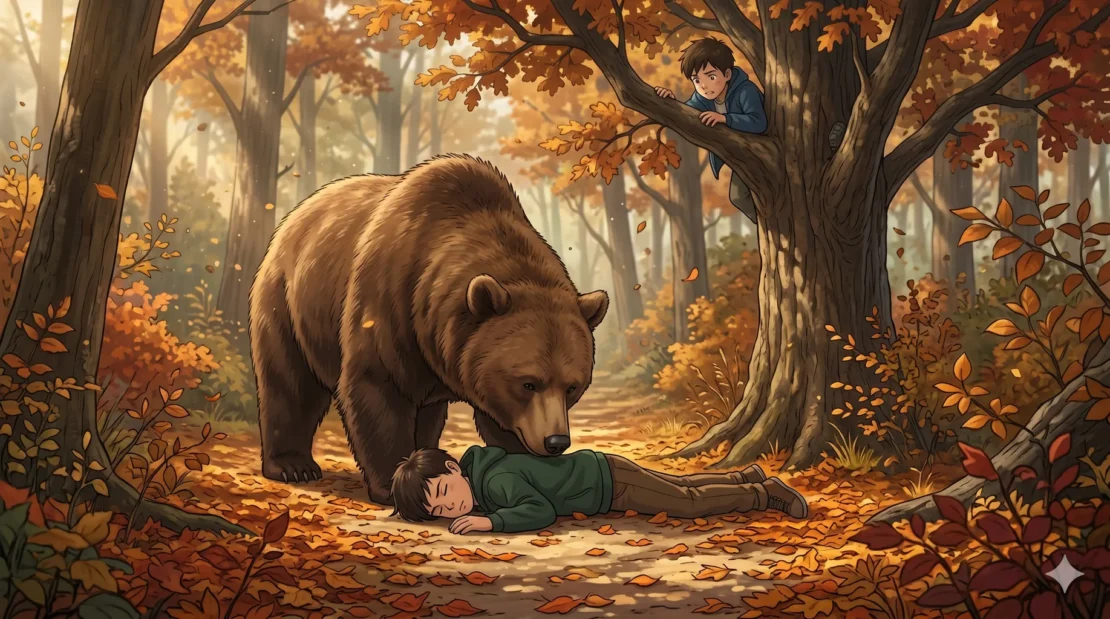
There, on the path ahead, was a bear. A large brown bear, sniffing the air, turning its great shaggy head in their direction.
For one frozen second, both boys stood there, not breathing.
Then Aiden let go of Sam’s arm.
He spotted the nearest tree, took a running jump at it, grabbed the lowest branch, and hauled himself up. He climbed quickly, pulling himself higher and higher until he was well out of reach, tucked safely among the branches, barely making a sound.
Down below, Sam didn’t know how to climb trees. He stood on the path alone, the bear getting closer, his heart pounding so hard he could feel it in his ears. He had about two seconds to think of something.
He had heard somewhere, maybe from his grandfather, that bears generally won’t bother an animal that isn’t moving. That they sometimes ignore things that seem dead. He didn’t know if it was true. It was the only thing he had.
Sam dropped to the ground, lay flat on his back, closed his eyes, and held his breath. He lay completely, utterly, perfectly still.
The bear reached him and stopped. It lowered its enormous head and sniffed Sam’s hair. His ear. His shoulder. Sam didn’t move. He didn’t breathe. He didn’t twitch a single finger.
After what felt like a very long time but was probably about thirty seconds, the bear huffed, lost interest, and ambled away into the trees. Its heavy footsteps faded. The forest went quiet again.
Sam opened his eyes and looked up at the blue sky.
He was still alive.
Aiden climbed down from the tree, dusting off his hands, and walked over. He was grinning a little, which Sam found not particularly appropriate given the circumstances.
“That was wild!” Aiden said. “What did that bear do? It looked like he was whispering in your ear or something.”
Sam stood up slowly, brushing the leaves off his jacket. He looked at Aiden for a moment.
“He told me,” Sam said quietly, “that a friend who climbs a tree and leaves you alone with a bear when you need him isn’t much of a friend at all.”
Aiden’s grin faded.
Sam didn’t say anything else. He picked up his backpack and walked the rest of the way home. Aiden walked beside him, and neither of them spoke for a long time.
The promise they had made, the one about no matter what, felt very different to both of them on that particular walk home.
Moral of the Story: True friendship means showing up when things are hard, not just when they are easy. The real test of a friend is what they do when it costs them something.
Why Short Stories for Kids Are More Powerful Than You Think
We all intuitively know that stories matter. But what we sometimes forget is just how deeply they work on children’s developing minds. Short stories for kids are not just entertainment fillers between meals and bedtime. They are some of the most effective tools we have for building emotional intelligence, moral reasoning, and a love of language, all at the same time.
When a child hears about Marco the shepherd boy and his consequences for lying, they aren’t just hearing a cautionary tale. They are practicing how to feel empathy, how to think through cause and effect, and how to connect emotions to outcomes. Stories create what researchers call “narrative transport,” which is essentially the experience of being fully inside a story’s world, and when children are transported like that, their brains process the moral lessons in a deep, embodied way, not just as abstract rules from an adult.
What Stories Teach Without Teaching
Here’s something we’ve seen again and again at Apple Tree Preschool BSD: children who are told “don’t lie” often nod along politely and then lie anyway. But children who have heard the Boy Who Cried Wolf and felt the moment when nobody came to help… they remember it differently. Stories plant seeds in places that direct instruction doesn’t reach.
The short moral stories for children in this collection are each designed around a different core value:
- Kindness and gratitude (The Lion and the Mouse, The Kind Woodcutter)
- Honesty and trust (The Boy Who Cried Wolf, The Kind Woodcutter)
- Patience and consistency (The Tortoise and the Hare, The Golden Goose)
- Cleverness and problem-solving (The Crow and the Pitcher, The Clever Rabbit)
- Bravery and resilience (Timun Mas, The Two Friends and the Bear)
- Self-worth and identity (The Little Star, The Proud Peacock)
- Hard work and preparation (The Ant and the Grasshopper, The Farmer and His Sons)
- Contentment and avoiding greed (The Greedy Dog, The Golden Goose)
Together, they form a kind of emotional curriculum, one that you can deliver one bedtime story at a time.
Tips for Reading Stories with Your Kids
You don’t need to be a professional storyteller to make these short stories for kids come alive. Here are a few things we always encourage parents to try.
Use different voices for different characters. It sounds silly but children absolutely love it, and it helps them track who’s speaking. Pause before a big moment and ask your child what they think is going to happen. After the story, try asking one gentle question like “What would you have done if you were the mouse?” rather than launching straight into the moral lesson. Let them arrive at the meaning themselves. It sticks so much better that way.
And if they want to hear the same story fifteen times in a row? That’s actually a wonderful sign. Repetition is how children process and internalize. It means the story is doing its job.
Help Your Child Fall in Love with Stories at Apple Tree Preschool BSD
We’ve just walked through 15 short stories for kids packed with adventure, heart, and some very important life lessons. From the lion who learned humility to the little star who discovered her worth, each story is a small world your child can carry with them.
At Apple Tree Preschool BSD, storytelling is woven into everything we do. Whether it’s through our Language and Literacy program, our Moral Education sessions, or simply the stories our teachers bring into the classroom each day, we believe in the power of narrative to shape confident, empathetic, curious little learners. Our programs welcome children from 1.5 years old through Kindergarten 2, guided by a Singapore curriculum delivered with warmth, creativity, and genuine love for every child.
If you’re looking for a place where your child will not just learn but truly thrive, we’d love for you to come and see us. We’re located in the Educenter BSD Building, right in the heart of BSD, and we would be so happy to welcome your little one into our community.
Come and start your child’s story with us! Whether you’re just exploring your options or ready to register, our team is here for you.
Chat with us on WhatsApp or call us directly at +62 888-1800-900 and let’s find the perfect program for your child together.
Because every great story has a beginning, and this one starts here.



Be the first to write a comment.