


Every child who has ever heard the Cinderella story knows the glass slipper, the pumpkin carriage, and the stroke of midnight. But here is something that might genuinely surprise you: the Cinderella story is not just one story. It is hundreds of stories, told across thousands of years, on nearly every continent on earth, in so many different shapes and colours that the similarities are almost more astonishing than the differences.
Here at Apple Tree Preschool BSD, nestled in the heart of the Educenter BSD Building, we love exploring how different cultures tell the same story in entirely different ways, because it shows children something profound: that the values of kindness, perseverance, and inner worth are not owned by any one place or people. They belong to everyone. Tonight, we’re sharing five of the most beautiful Cinderella story variations from around the world, each one fully told and completely worth reading aloud.
5 Cinderella Story Versions That Prove This Tale Belongs to the Whole World
From a golden fish in ancient China to a kind-hearted girl in the forests of Germany, these classic Cinderella variations, global fairy tale retellings, and cultural versions of the Cinderella story share one unbreakable thread: goodness is always worth something.
1. Yeh Shen: The Chinese Cinderella Story

In a time before the great dynasties had settled into their long, well-documented histories, in a village tucked between limestone mountains and a still green river, there lived a girl named Yeh Shen. She was the daughter of a chief who had died when she was young, leaving her in the care of a stepmother who had her own daughter to favour and very little warmth left over for anyone else.
Yeh Shen’s stepmother gave her the hardest work, the heaviest stones to carry, the coldest hours in the kitchen before sunrise. Yeh Shen did not complain. This was partly because she was kind by nature and partly because she had a friend, the only friend her stepmother had not yet managed to take from her.
The friend was a fish.
It was not an ordinary fish. It had golden eyes and scales that caught the light in a way that made the river seem richer for its presence. Yeh Shen had found it small and struggling in a drying creek bed and brought it home in a jar, then moved it to a pond, then to a larger pond as it grew. She fed it from her own small portion of food every day and talked to it in the quiet hours when no one was listening. The fish, for its part, would rise to the surface whenever she approached and watch her with its golden eyes in a way that felt very much like recognition.
When her stepmother discovered the fish, she was jealous of the happiness it brought Yeh Shen. While Yeh Shen was sent on a long errand to collect water from the far well, her stepmother put on Yeh Shen’s clothes, went to the pond, called the fish to the surface, and killed it. She cooked it for dinner and threw the bones away behind the woodpile.
When Yeh Shen returned and found her fish gone, she wept with a grief that went beyond the loss of a pet. The fish had been her one remaining comfort in a life that offered very few.
That night, an old man with the bearing of someone who existed at the edges of ordinary reality appeared to her. He told her to find the bones of her fish, hidden behind the woodpile, and to keep them safely. They had power, he said. When she needed something, she should ask the bones and ask sincerely.
Yeh Shen found the bones and kept them wrapped in silk.
Some time later, news spread through the village that a great spring festival was to be held in the next town, the most important celebration of the year, attended by people from every surrounding village including, most significantly, the chief of the neighbouring territory who was known to be looking for a wife of good character.
Yeh Shen longed to go with a longing so strong she could feel it in her chest. Her stepmother, of course, told her she must stay home and watch over the grain stores while her stepsister attended in fine new clothes.
When they had gone, Yeh Shen went to the bones.
She knelt in front of them and whispered her wish.
What happened next came quickly and completely. She found herself clothed in a gown of sea-green silk that shimmered with an inner light, her hair arranged with jewelled pins, and on her feet a pair of tiny slippers made of gold, so delicate they seemed woven rather than cobbled. She looked at her reflection in the water jar and did not entirely recognise herself, not because she had been transformed into someone else, but because she looked, for the first time in years, the way she actually felt on the inside.
She walked to the festival.
People parted as she arrived. The chief of the neighbouring territory watched her from the moment she entered and did not look elsewhere for the rest of the evening. Her stepsister, somewhere in the crowd, stared and could not place her.
Then her stepmother arrived and looked more carefully.
Yeh Shen, frightened of what recognition might bring, slipped away quickly through the crowd. In her haste, she lost one golden slipper at the edge of the road.
The slipper was found by the chief’s men. The chief declared that whoever fit the slipper would be brought to him, because a shoe made for a foot so small must belong to someone extraordinary.
The search was brief. No foot in the territory fit it. When they came to Yeh Shen’s village and made their announcement, her stepmother pushed her stepsister forward repeatedly and unsuccessfully. Yeh Shen sat quietly by the woodpile.
One of the chief’s men looked at her. “You,” he said. “Come here.”
The slipper slid onto her foot as if it had been waiting.
From her room, she produced its pair.
The chief came himself and found not a girl dressed in her best but a girl sitting simply at the woodpile, wearing one golden slipper and holding the other, looking at him with a directness he found immediately and entirely compelling.
They were married in the spring.
Her stepmother and stepsister were not invited.
The fish bones, wrapped still in their silk, were buried with honour beneath the threshold of the new house, and the golden-eyed fish was never forgotten.
Cultural note: Yeh Shen is believed to predate the European Cinderella story by approximately a thousand years. The story was recorded in the Tang Dynasty and is one of the oldest written versions of the Cinderella story in the world.
2. Rhodopis: The Egyptian Cinderella Story

The oldest Cinderella story that historians have been able to trace began not with a ball gown and a pumpkin but with a sandal and an eagle, in ancient Egypt, more than two thousand years ago.
Her name was Rhodopis, a name meaning “rosy-cheeked,” and she was not Egyptian by birth. She had been born in Greece, in a small coastal village where the sea was blue and the summers were long, and she had been taken from that place as a young girl by traders who sold her as a slave to a merchant in Naucratis, one of Egypt’s busy trading cities where Greek and Egyptian lives crossed and tangled daily.
Rhodopis worked in the household of an old merchant named Charaxos who was, in the particular way of old men with comfortable circumstances, not unkind but entirely inattentive. He noticed very little about the people who kept his house running. He noticed, slightly more, that Rhodopis was different from the other servants. She was quiet where they were noisy, careful where they were careless, and when she thought no one was watching, she danced.
She danced the way people dance when they have no audience and no reason to perform, with complete abandon, in the courtyard in the early mornings when the light came in low and golden and the rest of the house was still asleep. The animals gathered when she danced. Birds landed on the courtyard wall. Even the old merchant’s cat, an animal of enormous personal dignity and selective attention, would come and sit and watch.
The other servants mocked her. She was not one of them in their eyes, not Egyptian, not fully understood, held at a certain distance by the difference of her origins. They called her names. They gave her the worst tasks. They hid her belongings and laughed when she searched for them.
What they hid most successfully, for a time, was one of her sandals.
Charaxos noticed her dancing one morning and was so moved by it that he bought her a pair of beautiful rose-gilded sandals as a gift, the kind of sandals that were expensive and fine and entirely impractical for household work. She wore them on her only free afternoons, sitting by the river, dangling her feet.
One afternoon, a great eagle landed near her and, before she could do anything sensible about it, snatched one gilded sandal from beside her and flew away into the sky.
Rhodopis stared after it with the specific despair of someone who has just had one very nice thing very unexpectedly taken.
The eagle flew south along the Nile and arrived, in the efficient manner of birds with divine purpose, over Memphis where the Pharaoh Amasis was holding court in the open air, as was the Egyptian custom on fine days. The eagle circled once and dropped the sandal directly into the Pharaoh’s lap.
The Pharaoh looked at the sandal for a long time.
He was, by the accounts that have come down through history, a thoughtful man rather than an impulsive one. But something about the sandal, its craftsmanship, the strangeness of its arrival, the feeling that this was not an accident but a message from forces that understood their business better than he did, compelled him to act.
He declared that the sandal’s owner would be found and brought to court.
His messengers travelled up and down the Nile valley. Every woman of suitable standing tried the sandal. None could wear it. The search widened.
Eventually, they arrived at the merchant’s house in Naucratis. The other servants, who had spent considerable energy making Rhodopis feel like nothing and no one, watched with an array of expressions as the messengers asked their question.
Rhodopis came forward quietly. She was wearing her remaining sandal. The lost one, produced from the messenger’s bag, slipped onto her other foot in the easy, inevitable way of something returning to where it belongs.
She was taken to Memphis.
The Pharaoh, when he met her, found what the eagle had evidently already understood: a person of remarkable quality, not despite her circumstances but somehow shining more clearly because of them.
They were married under the wide Egyptian sky, beside the river that had watched her dance alone in the early mornings for years without knowing what would come of it.
Cultural note: The story of Rhodopis was recorded by the Greek historian Strabo around 7 BC, making it one of the earliest traceable Cinderella story traditions in the world. The eagle carrying the sandal to the Pharaoh connects the story to the Egyptian divine, as the eagle was sacred to the god Horus.
3. Aschenputtel: The German Cinderella Story
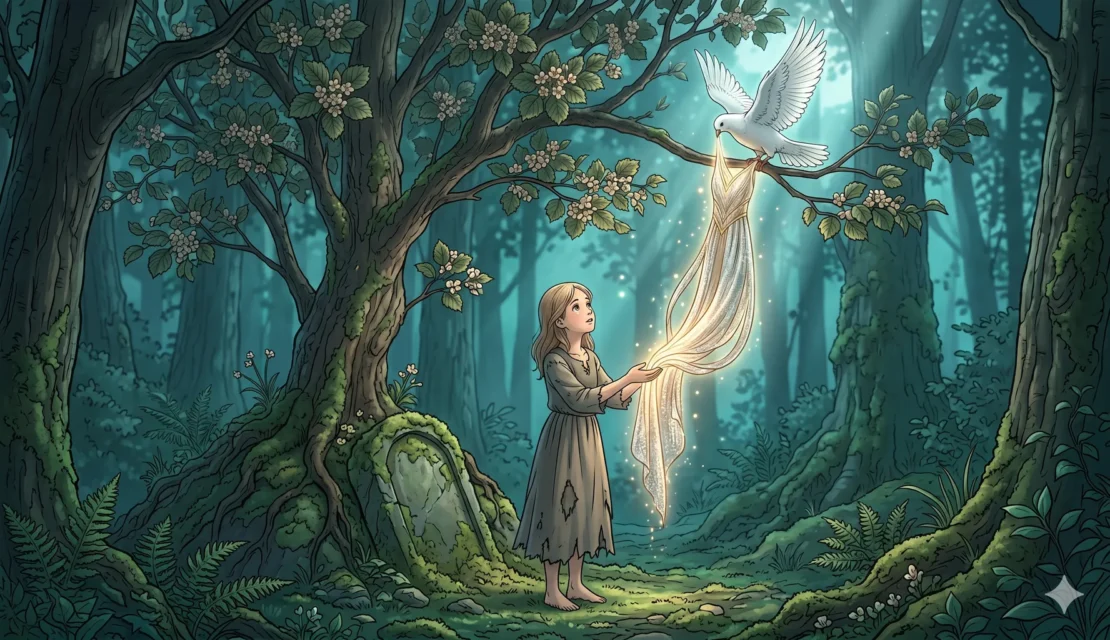
The German Cinderella story, as collected by the Brothers Grimm in the early nineteenth century, is older and considerably less comfortable than the French version most people know. There is no fairy godmother here. There is no magic wand. There is a hazel tree, a white bird, and a girl who earns everything she receives through grief, patience, and a goodness that survives in conditions designed to extinguish it.
Her name in German is Aschenputtel, which translates roughly as “Cinderella” in the sense of one who tends the cinders, the ash girl, the one given the fire to manage and the ashes to sort and none of the warmth.
Her mother died when she was young. Her father remarried. The stepmother and her two daughters moved into the house with the confident authority of people taking over a space, redistributing its contents according to a new hierarchy in which Aschenputtel ranked at the bottom, below the furniture and slightly above the wood pile.
They took her clothes and gave her an old grey smock. They took her room and gave her a pallet near the hearth. They took her name, in effect, by using only the new one. She swept and carried and cooked and cleaned from before dawn until after dark, and when she fell asleep each night near the fire, her face and arms were grey with ash.
On her mother’s grave, she had planted a hazel branch that her father had brought her from his travels, because it was all she had asked for when he offered to bring back gifts. She watered it every day with her tears, and it grew into a tree of unusual beauty. A white bird came and lived in the tree, a bird that watched Aschenputtel with the focused attention of something that understands more than birds usually do.
When news came that the king was holding a three-day festival to find a bride for his son, the stepmother took her daughters into the town with new gowns and high expectations. Aschenputtel asked to go.
She was told she could go if she sorted a bowl of lentils from the ashes in two hours, an impossible task designed to ensure she stayed behind.
She went to the garden and spoke to the birds. They came from every direction and sorted the lentils in one hour.
She was still not allowed to go. She did not have the right clothes, she was told. She was an embarrassment. She must stay.
She went to the hazel tree. She stood beneath it and said the words her mother had taught her, to wish for something beautiful and true. The white bird dropped a gown of silver and gold and shoes of gold to match. She dressed and walked to the festival.
She was the most beautiful person there. The prince danced with no one else for three days. On each of the three evenings, as midnight approached, she fled before he could follow and learn her name, slipping away with the kind of speed that suggested practice at disappearing.
On the third evening, the prince had the palace steps coated with a sticky pitch. Aschenputtel’s golden shoe caught in it as she ran. She pulled free and left the shoe behind.
The prince went through the kingdom with the shoe, as princes do in these stories.
The stepsisters tried, in the Grimm version, with a conviction that extended to extreme measures. Neither succeeded.
Aschenputtel, when she came forward at last, sat by the hazel tree and let the white bird settle on her shoulder. The shoe fit perfectly, because it had been made for her and had always been hers.
The prince saw her then, completely and clearly, as the girl who had been in front of him all three evenings without his knowing it.
As for the stepsisters, the white birds had opinions about the things done to Aschenputtel over the years. The Grimm brothers did not look away from what those opinions amounted to. This version of the Cinderella story has always understood that actions have consequences, and that kindness is a kind of power.
Aschenputtel walked away from the ash and the grey smock and the pallet by the fire and never went back.
Cultural note: Aschenputtel was collected by Jacob and Wilhelm Grimm and published in their 1812 collection. Unlike the Perrault version, there is no fairy godmother and the story has a noticeably darker tone, which the Grimms felt reflected more accurately the oral traditions they were documenting.
4. Cendrillon: The French Cinderella Story
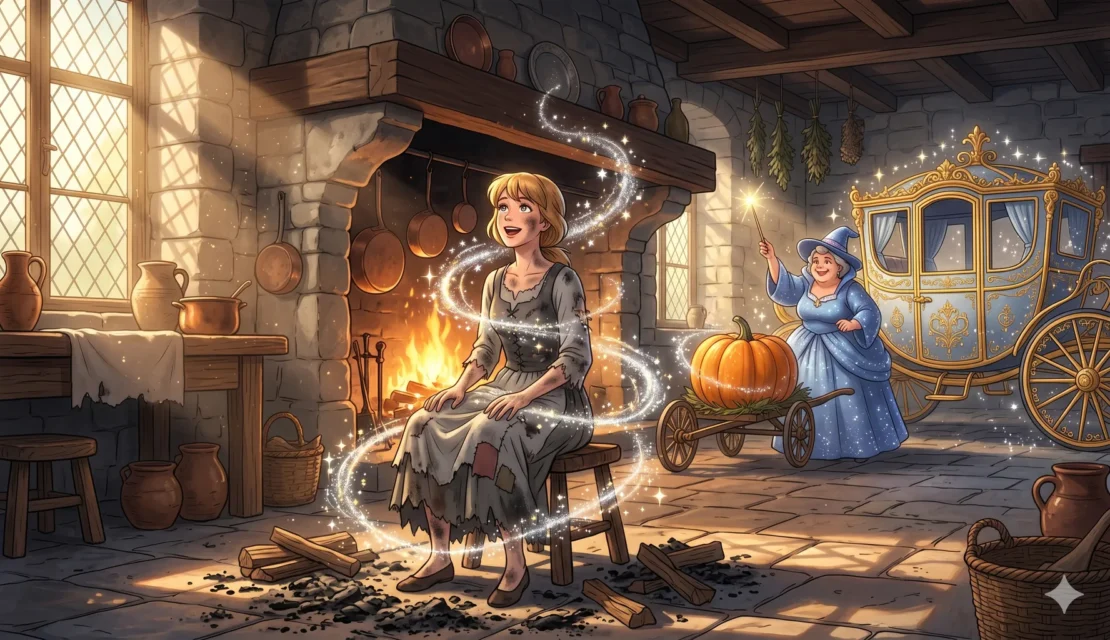
The Cinderella story that most of the world knows, the one with the glass slipper and the pumpkin carriage and the fairy godmother in her best gown, comes from France. It was written down by Charles Perrault in 1697 in a collection of fairy tales intended, ostensibly, for children but read by the French court with considerable pleasure and recognition.
Perrault’s Cendrillon is softer than the Grimm version, more graceful, more courtly, and significantly more forgiving. The cruelty is present but the edges are smoothed. The magic is warmer. The ending is generous in a way that says something about the author’s temperament.
Cendrillon was a girl of exceptional good nature who had been made to live the life of a servant in her own home after her father remarried. Her stepmother was the kind of woman who was not especially cruel by design but who had decided, early and firmly, that her own daughters’ comfort and advancement mattered more than anyone else’s, and had arranged the household accordingly.
Cendrillon cooked and cleaned and laundered. At the end of the day, when the fires died down, she sat in the cinders near the hearth because that was the warmest spot and she was cold from the drafts. Her stepsisters, who had warm rooms and feather beds and no fireside sitting to do, called her Cinderella for it, and the name stuck in the household the way unkind names tend to do.
When the prince’s ball was announced, the household was thrown into a sustained, elaborate fever of preparation. Dresses were ordered. Hair was practiced. Opinions were solicited and discarded and solicited again.
Cendrillon helped with all of it. She pinned hems and arranged hair and offered opinions on which ribbons suited which complexion, and she offered them honestly rather than flatteringly, which was, under the circumstances, a considerable act of character.
She did not ask to go.
Her fairy godmother asked on her behalf.
The fairy godmother appeared in the kitchen as Cendrillon sat among the ashes after the carriage had left, not crying exactly but in the particular quiet of someone who has set aside the feelings for later and is simply breathing until the next thing needs doing.
“Do you want to go to the ball?” asked the fairy godmother.
Cendrillon looked at her. “Yes,” she said, because there was no point in pretending otherwise.
What followed was the transformation that has enchanted children for centuries: a pumpkin from the garden becoming a gilded carriage, six mice becoming six grey horses, a fat rat from the trap becoming a coachman with the most magnificent whiskers, six lizards becoming footmen with green livery. Cendrillon’s ash-stained dress becoming a gown of silver and moonlight, and on her feet, the glass slippers, entirely impractical and entirely perfect.
“Be home before midnight,” said her fairy godmother, with the firm warmth of someone who has arranged something beautiful and intends for it to be respected.
At the ball, Cendrillon was extraordinary. The prince found her immediately, stayed by her side the whole evening, and felt, with the particular clarity of important moments, that he had met someone whose company made the room better.
She left before midnight, as promised, arriving home breathless and happy in her ash-stained dress as the clock struck twelve, with not one glass slipper on her foot.
She went back the second night, and the third.
On the third night, she lost track of time. The clock began to strike midnight as she danced, and she ran, and the glass slipper came off on the palace steps, and the carriage was a pumpkin again before she reached the gate.
The prince kept the slipper and searched the kingdom. When he arrived at Cendrillon’s house, both stepsisters tried and failed with the particular grim determination of people who cannot quite accept that a thing does not fit.
Cendrillon asked, from her corner by the hearth, if she might try.
Her stepsisters laughed.
The slipper fit so easily that it seemed to settle onto her foot with a small, satisfied sigh.
She produced its pair from her apron pocket.
Her fairy godmother appeared one more time and, with a wave, restored the silver and moonlight gown.
What distinguishes Perrault’s version of the Cinderella story most particularly is what comes next. Cendrillon, recognized and claimed by the prince, forgave her stepsisters entirely and found them positions at court with good marriages. She held no grievance. She extended to them the same generosity of spirit that had carried her through everything she had endured.
This, Perrault suggested, was the truest kind of grace: kindness given not when it is easy but when it costs something, and given anyway.
Cultural note: Perrault’s “Cendrillon, ou la Petite Pantoufle de Verre” is the direct source of the Disney animated film and most modern adaptations of the Cinderella story. The glass slipper, fairy godmother, and pumpkin carriage all originate with Perrault’s 1697 version.
5. Bawang Putih: The Indonesian Cinderella Story

In the green, river-laced lowlands of the Indonesian archipelago, among the villages where banana trees grew over the fences and the evenings smelled of frangipani and woodsmoke, a version of the Cinderella story was told that was entirely the region’s own.
Her name was Bawang Putih, which means White Onion, and she was as sweet and gentle as her name suggested. Her stepsister was named Bawang Merah, Red Onion, sharp and quick-tempered, and their household ran along lines that will feel familiar to anyone who knows the Cinderella story in any of its forms.
Bawang Putih’s mother had died when she was young. Her father remarried a widow with a daughter of her own. The stepmother had decided, with the clear-eyed practicality of someone who had two girls to settle and limited resources, that Bawang Merah’s future was the more important one. Bawang Putih was assigned accordingly: the hardest work, the earliest rising, the last food, the smallest portion of warmth and notice.
She washed clothes at the river every morning, walking alone in the cool hours before the village properly woke, carrying the household’s laundry in a wide basket balanced on her hip.
One morning, she dropped a piece of her stepmother’s clothing and watched it carried downstream before she could reach it. She followed the river for a long time, hoping to recover the cloth, because arriving home without it would have consequences she preferred not to think about.
The river carried the cloth to the edge of an old woman’s garden. The old woman lived alone at a bend in the river where the water slowed and the rushes grew tall. She had the bearing of someone who had been in that particular spot for considerably longer than was usual.
“Is this yours?” asked the old woman, holding up the cloth.
“It belongs to my stepmother,” said Bawang Putih honestly. “I lost it in the river. I am sorry. May I have it back?”
The old woman looked at her for a moment. “Come in,” she said. “I will give it back to you, but you must stay a while and help me.”
Bawang Putih stayed for several days. She cooked and cleaned for the old woman, swept the garden path, fetched water, and tended the vegetable beds with the careful attention she brought to everything. She was not kind to the old woman because she expected something in return. She was kind because someone clearly needed help and she was in a position to give it.
When it was time to leave, the old woman brought out two gourds: a large one and a small one.
“Choose,” she said.
Bawang Putih, in the way of people who have been given so little for so long that they have stopped expecting very much, chose the small one.
She walked home.
When she opened the gourd in the kitchen, it was full of gold and jewels and fine cloth, enough to change everything in one moment.
Her stepmother’s response was immediate and completely predictable. She sent Bawang Merah to the old woman at the river bend the next morning with instructions to drop a cloth in the water, follow it, stay for a few days, and come home with the large gourd.
Bawang Merah arrived at the old woman’s garden and did exactly none of the helpful things Bawang Putih had done. She complained about the cooking. She swept badly. She watered the vegetables with the specific inattentiveness of someone performing a task under sufferance. She was bored and she showed it.
When the old woman offered her the two gourds at the end of her stay, Bawang Merah took the large one immediately, heading home already imagining what was inside.
She opened it at the kitchen table in front of her mother.
What came out was not gold.
Bawang Putih, who had been quietly folding laundry in the corner, had the decency not to say anything at all. She thought it was more charitable that way.
The story ends there in most tellings, not with a prince and a palace but with something equally important: the understanding that what you give determines what you receive, and that generosity given without expectation has a way of returning to you doubled, while greed dressed up as cleverness tends to produce exactly the outcome it deserves.
Cultural note: Bawang Merah Bawang Putih is one of the most beloved traditional stories in Indonesian and Malay folklore. It exists in numerous regional variations across Java, Sumatra, and the wider Malay world, and has been adapted into films, television dramas, and children’s books throughout Southeast Asia. It is Indonesia’s own Cinderella story.
What Every Version of the Cinderella Story Is Really Saying
Across ancient Egypt and Tang Dynasty China, through the forests of Germany and the royal courts of France and the green river villages of Indonesia, the Cinderella story says the same thing in five completely different languages and five completely different settings: inner goodness is real, it is visible, and it matters more than circumstances.
The Cinderella Story Teaches Children About Worth and Character
Every variation shows a child who is treated as less than she is, and whose true value is eventually, inevitably recognised. For young children, this is a deeply reassuring thing to hear. Not because we want to promise them that life is always fair, but because we want to build in them the understanding that their worth is not determined by how others treat them.
Different Cultures, One Shared Heart
We find it genuinely wonderful that cultures with no historical contact with each other all arrived at a version of the same story. It suggests that some truths are not cultural at all but human. The idea that kindness has power, that goodness survives hardship, and that the right moment will come for those who remain true to themselves, these are things that parents everywhere have always wanted their children to carry.
At Apple Tree Preschool BSD, we bring this kind of cultural curiosity and story-based learning into everything we do. Through our programs, from our Toddler classes through to Kindergarten, children explore Social Studies, Moral, and Creativity in an environment that celebrates both their Indonesian roots and the wider world they are growing into.
Come and Be Part of Our Story
We hope these five versions of the Cinderella story gave you and your child a new way to see a familiar tale and perhaps a deeper appreciation for just how far and wide human storytelling travels. Every culture has its own glass slipper, and every child deserves to know that their story matters.
If you would love for your little one to grow up in a place where stories, values, and genuine curiosity about the world are at the heart of every single school day, we would be absolutely delighted to welcome your family to Apple Tree Preschool BSD.Register now and come learn, explore, and grow with other children! Chat with us on WhatsApp or give us a call at +62 888-1800-900. We cannot wait to meet your little one!





Be the first to write a comment.