


There is something wonderfully specific about the monsters of Javanese mythology. They are not generic, interchangeable creatures of darkness. They are detailed, they have personalities, they have origin stories, they have specific habits and preferences and particular reasons for being exactly as terrifying as they are. Javanese mythology has been building its roster of supernatural beings for over a thousand years, and the result is one of the richest, most textured mythological traditions anywhere in Southeast Asia.
Here at Apple Tree Preschool BSD, tucked inside the Educenter BSD Building, we love exploring Indonesian heritage and culture with children and families, because understanding where we come from, including the spooky parts, is part of understanding who we are. So tonight, for the parents who grew up hearing these names whispered in the dark and who want to share that wonderfully goosebump-raising tradition with their own children, here are six monsters from Javanese mythology that have been keeping people appropriately cautious for generations.
You have been warned.
6 Creatures from Javanese Mythology That Will Make You Sleep with the Light On
From the jungle-dwelling Genderuwo to the ghostly Kuntilanak wailing in the trees, these Javanese mythological creatures, supernatural beings of Javanese folklore, and legendary monsters of Indonesian mythology have been part of the cultural imagination of Java for centuries.
1. Genderuwo: The Giant of the Dark Corners
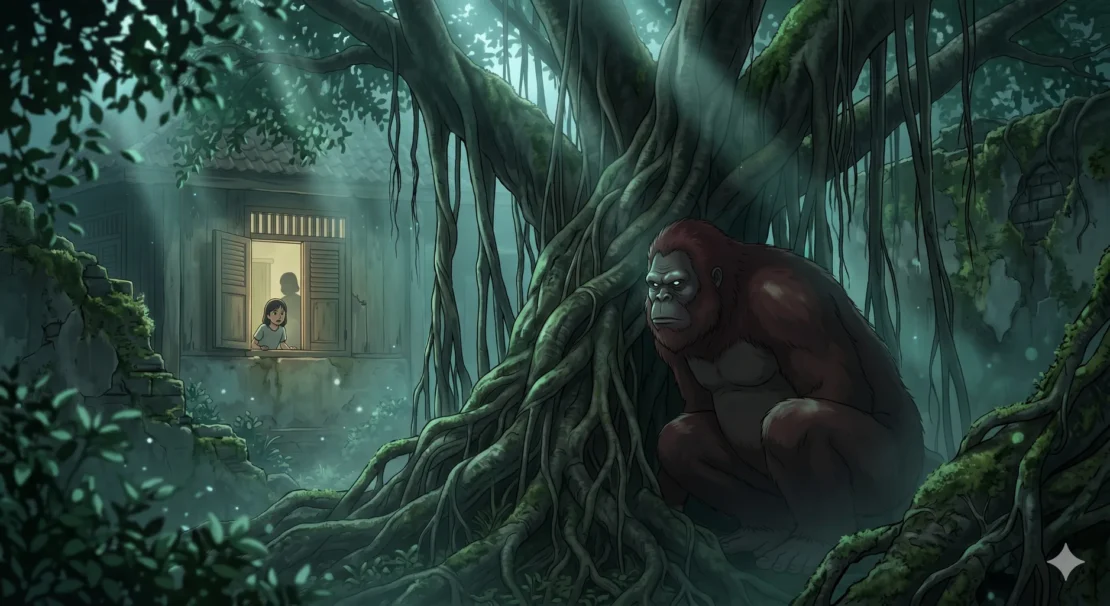
In the lexicon of Javanese mythology, if you were to hold a poll asking which supernatural being people are most thoroughly, viscerally, practically afraid of, the Genderuwo would win comfortably. Not because it is the most powerful creature in the tradition. Not because it has the most dramatic origin story. But because, of all the beings in Javanese mythology, the Genderuwo is the one that most consistently turns up in places where people actually live and go about their daily business.
The Genderuwo is described across Javanese folklore as an enormous, heavily built figure, covered in dark reddish-brown hair, with a broad, flat face and eyes that catch the light in the particular way that eyes should not when there is no light source anywhere nearby. It is substantially larger than a human being, wide-shouldered and heavy, and it moves with the unhurried confidence of something that does not particularly worry about being seen.
Its preferred habitats are the kinds of places that exist right at the edge of ordinary human space. Old buildings that have been abandoned. The thick shadow under large, ancient trees, particularly the beringin, the banyan, whose aerial roots and dense canopy have made it a site of supernatural significance in Javanese tradition for as long as the tradition has existed. Dark corners of houses that nobody uses. The heavy, still air under bridges.
What makes the Genderuwo genuinely unsettling, even as a story, is not its size or its appearance but its behaviour. It does not simply lurk. It interacts.
In the folklore tradition, the Genderuwo is known to move objects in the night, to make sounds in empty rooms, to mimic the voices of family members. It is said to be capable of appearing as someone familiar, a husband, a brother, someone expected, and this mimicry is always described with the particular detail that makes folklore effective: the voice is right but something about the warmth is wrong. Something is slightly off in a way that you cannot name until you are already standing very close.
The older traditions describe the Genderuwo as a being that is drawn to certain kinds of energy, the energy of grief, of loneliness, of a household where someone has recently died or where a marriage is troubled. It finds its way into these spaces the way cold air finds gaps in a wall: not dramatically, but persistently, through the smallest available opening.
There is a story told in several variations across Central and East Java about a widow who lived alone with her young children after her husband’s death. Over the weeks following his passing, small things began happening in the house. A door she had closed in the evening was open in the morning. Food was moved. A smell that was not unpleasant but was unfamiliar settled into certain rooms after dark.
Then one evening, she heard her husband’s voice calling her name from the direction of the beringin tree at the edge of the property.
She was halfway to the door before her eldest child, a twelve-year-old girl, caught her arm.
“It is not Father,” the girl said quietly. “Father never called you by name. He always called you by the house name.”
The woman stopped.
The voice called again from the dark, using her personal name, correctly, with the right pitch and the right intonation, every detail right except the one detail the girl had noticed.
They went inside, bolted the door, and burned incense until morning.
The Genderuwo, according to the tradition, cannot maintain a mimicry perfectly. It always misses one detail, one small specific thing that only someone who genuinely knows the person would know. This is why the Javanese tradition places such value on paying very close attention to the people you love, knowing not just the general shape of them but the specific, particular details that make them themselves.
Cultural note: The Genderuwo appears across Central and East Javanese folklore as well as in Sundanese tradition, where it is sometimes called Gorombolan. It remains one of the most widely discussed supernatural figures in Indonesian popular culture, appearing regularly in horror films, comics, and oral storytelling traditions.
2. Kuntilanak: The Spirit in the Banana Tree
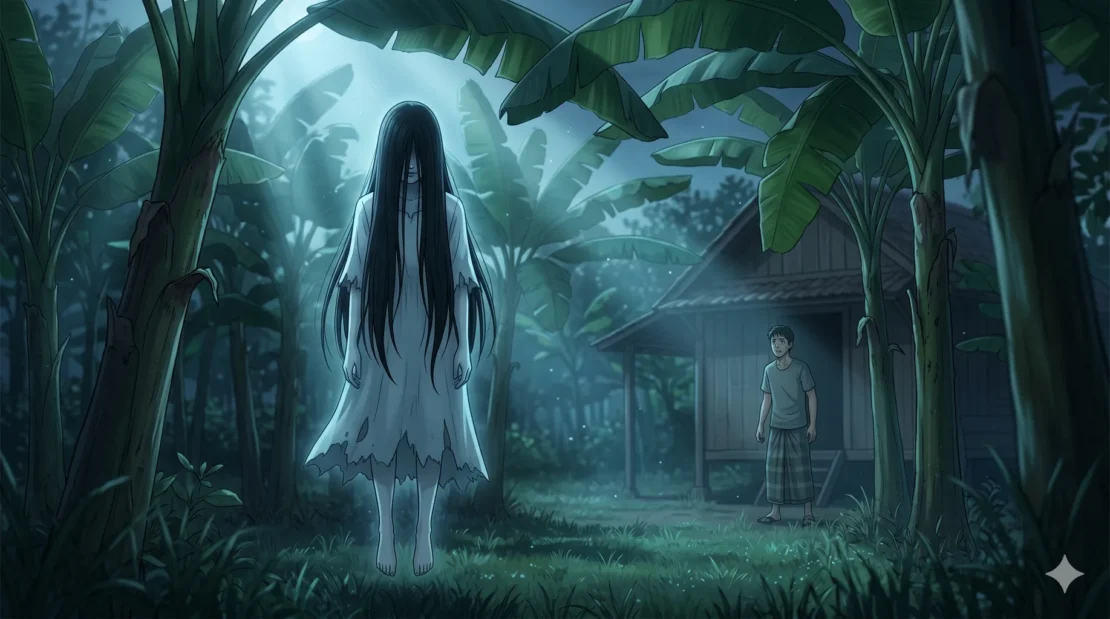
Of all the figures in Javanese mythology, the Kuntilanak is the most immediately recognisable, the most frequently depicted in Indonesian popular culture, and the one whose particular aesthetic, long black hair falling over a white-dressed figure, has travelled furthest beyond the archipelago into the broader Southeast Asian supernatural imagination.
But the Kuntilanak of the original Javanese and Malay tradition is considerably more specific, and considerably more layered, than her many horror film appearances suggest.
The Kuntilanak in the original tradition is the spirit of a woman who died during childbirth or during pregnancy, before the child could be safely delivered. This is not a minor narrative detail. It is the centre of everything about her: why she exists, where she is found, what she wants, and what makes her dangerous. She is a figure of interrupted life, of something immense and natural that was stopped at its most critical and irreversible moment.
She is heard before she is seen.
The sound associated with the Kuntilanak in Javanese folklore is a crying sound that begins somewhere distant and draws closer, or, in the version of the tradition that many people find more unsettling, a crying sound that stops abruptly when you are very close to its source. The laughter that follows the stopped crying is a detail that appears consistently across regional variations and has, for understandable reasons, made its way into a remarkable number of Indonesian horror films.
Her connection to the banana tree, the pisang, is one of the most specific and consistent elements of the Kuntilanak tradition. She is said to inhabit banana trees particularly, to be found in banana groves at night, and in some traditions to use the trunk of the banana tree as a place of rest in a very specific physical sense. This association has made banana trees a site of particular caution in many parts of Java and Sumatra, especially at night, especially for pregnant women and new mothers, who are considered most vulnerable to her attention.
There is a story from the coastal lowlands of Java that has been told, in various forms, for generations.
A young husband whose wife was heavily pregnant received a warning from his grandmother on the evening before his wife went into labour: do not leave the house at night, do not open the door to sounds outside, and do not, under any circumstances, go toward the banana grove at the edge of the property if you hear crying.
His wife went into labour in the hours before dawn. It was a difficult, long labour. The midwife worked through the night. The husband sat outside the room, unable to help, listening to sounds that were hard to listen to.
In the dark of the early hours, he heard crying from the direction of the banana grove.
He thought, in the way of people who are exhausted and frightened and have been sitting with anxiety for hours, that perhaps an animal had got into the grove. He told himself the grandmother’s warning was superstition. He stood up.
The midwife’s assistant, an old woman who had attended a hundred births, came out of the room at that exact moment and looked at him with the flat, direct gaze of someone who has seen this particular decision being made before.
“Sit down,” she said.
He sat down.
His wife delivered safely before sunrise. His child was healthy.
He never asked what the midwife’s assistant had seen in his face that made her come out of that room at that specific moment. Some things, in the Javanese tradition, you are better off not asking directly.
The Kuntilanak tradition carries, beneath its horror, a cultural logic that is worth understanding. In a time and place where death in childbirth was common and devastating, the tradition created a figure that channelled the grief, fear, and spiritual weight of that loss into a story that the community could hold together. She is not simply a monster. She is, in the deepest reading of the Javanese mythology, an embodiment of grief that was never completed.
Cultural note: The Kuntilanak is related to the Pontianak of Malay folklore and the Manananggal of Philippine tradition, suggesting shared roots in broader Austronesian supernatural belief systems. The city of Pontianak in Kalimantan is named after this figure.
3. Wewe Gombel: The Kidnapper Who Actually Has a Point
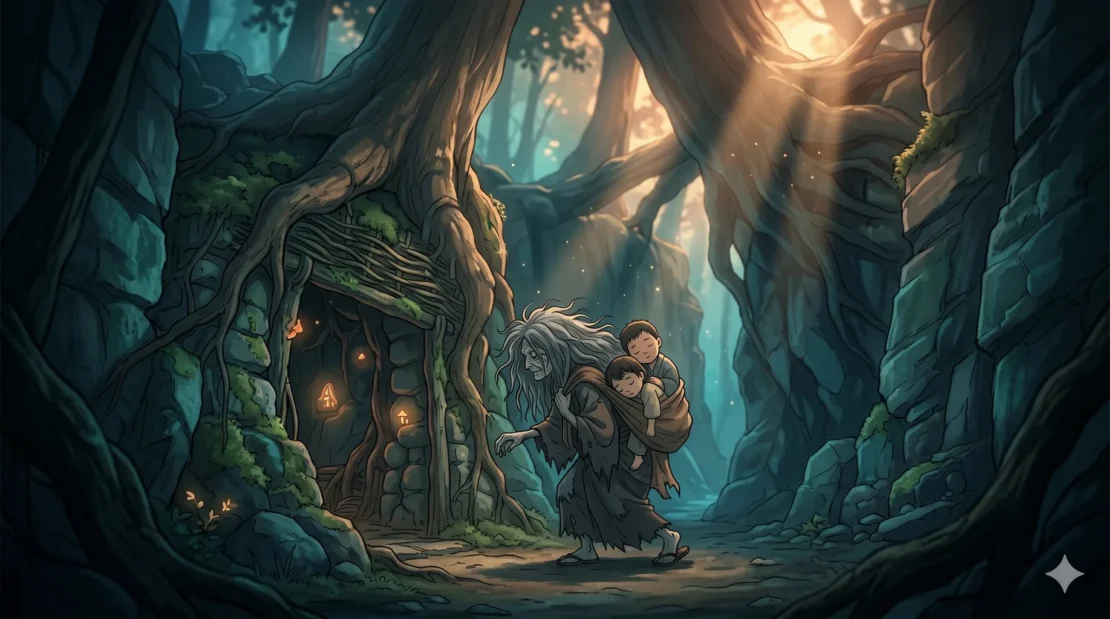
Within Javanese mythology, there are figures who are frightening and figures who are complex, and then there is Wewe Gombel, who manages to be both simultaneously in a way that makes her one of the most interesting supernatural beings in the entire tradition.
Wewe Gombel is described in Javanese folklore as an old woman, elderly and sagging, with long hanging breasts and wild hair, who appears at dusk or at night in places where children play unsupervised. She is a kidnapper of children. This is her primary function in the mythology and the reason generations of Javanese parents have used her name when telling their children to come inside before dark.
But the details of her behaviour in the tradition are peculiar, and the peculiarity is the most interesting thing about her.
Wewe Gombel takes children who are neglected. She does not take children who are well-loved and looked after. She specifically targets children whose parents do not pay them proper attention, children left alone for too long, children who are emotionally abandoned even when physically present in the household. The children she takes are kept safely, fed, and cared for in her supernatural home, and she returns them when the parents have demonstrated genuine remorse and a sincere intention to do better.
This is not your typical monster’s operating procedure.
She has an origin story that explains her. In the tradition of Javanese mythology, Wewe Gombel was once a woman in the Gombel area of Semarang who was deeply wronged: her husband left her for another woman, she killed him in her grief and fury, and she then died herself, possibly by her own hand or possibly pursued by the community. She became a spirit carrying the specific wound of a woman who wanted to be loved and was abandoned instead.
Her kidnapping of neglected children is, in the logic of the Javanese mythology, not simply malice. It is a response to a pattern that she recognises and that she cannot leave unanswered. Children being made to feel abandoned activates something in her that was never resolved in her own life.
There is a story from the hills above Semarang that is told to explain why you should always call your children in before the daylight goes.
A farmer had two young children, a boy of seven and a girl of five. His wife had died the previous year and he was managing alone, working the fields from before sunrise until after sunset, exhausted and grieving and doing his best but frequently leaving the children to look after themselves for very long stretches of the day.
The children played near the ravine at the edge of the property because it was interesting and their father had told them not to, which made it more interesting.
One evening at dusk, the father came in from the fields and the children were not in the house. He called. He searched. He asked the neighbours. No one had seen them since mid-afternoon.
He sat down in the empty house and understood, in the way that the Javanese tradition suggests understanding comes, that the fault was not entirely with the darkness.
He went to the village elder, who told him what needed to be done: go to the ravine at midnight, call the children’s names, acknowledge what had been neglected, and ask, with complete sincerity, for the chance to do better.
He did this. He wept while he did it, which was not part of the instruction but was apparently noted.
The children were home in their beds in the morning, sleeping soundly, and they told their father they had been somewhere warm and very fed and that the old woman had said he was coming to get them.
He did not leave them alone again.
Cultural note: Wewe Gombel is one of the most morally complex figures in Javanese mythology. The Gombel area of Semarang retains strong associations with her legend, and the story continues to be used by Javanese parents as both a warning and, in a more sophisticated reading, as a reminder that children’s emotional neglect has consequences that the tradition takes very seriously.
4. Leak: The Floating Head of Balinese-Javanese Tradition
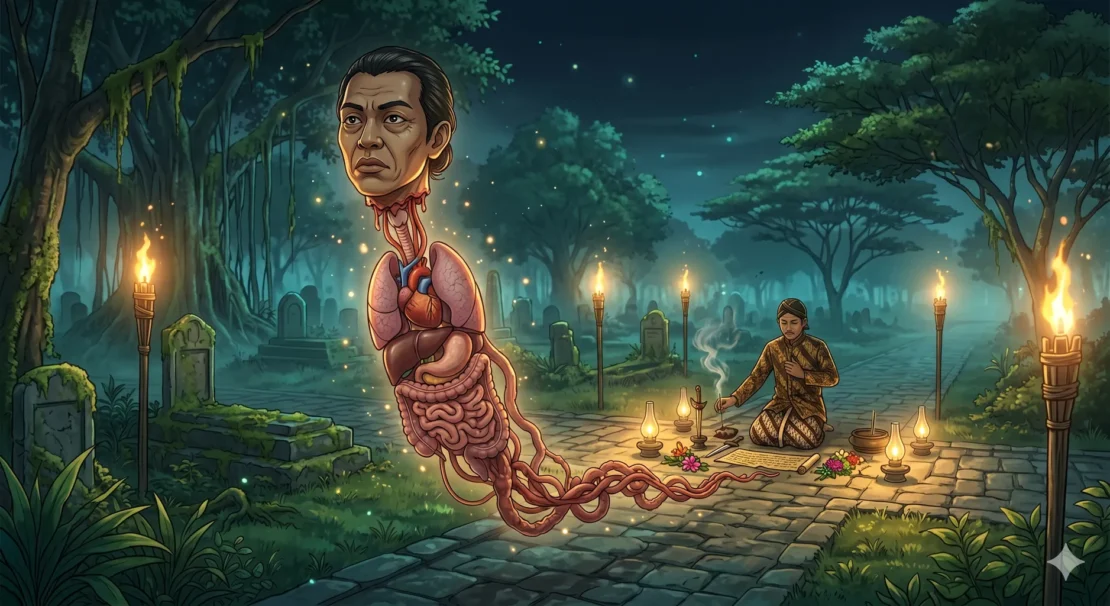
The Leak sits at the intersection of Balinese and Javanese supernatural tradition, one of those figures whose territory spans the narrow strait between the two islands and whose reputation has not diminished in the crossing.
In the visual language of Indonesian mythology, the Leak is distinctive in a way that has made it one of the most reproduced supernatural images in Indonesian art, batik, and performance: it appears as a human head, severed from the body but fully alive, floating through the night air with its internal organs trailing beneath it, glowing faintly, moving with a horrible purposefulness toward whatever it is searching for.
The grotesque specificity of the image is not accidental. In the Javanese and Balinese mythology, the Leak is not a random creature of chaos. It is a practitioner of black magic who has gone too far. It is a human being who chose to study the darkest forms of ilmu, magical knowledge, and who has paid for that choice with their humanity in the most literal possible way: the magic they sought to control has consumed their physical integrity, and now they exist in this separated state, powerful and terrible and no longer quite one thing or another.
The Leak is said to be most active at night and particularly around graveyards and crossroads, both sites of supernatural significance in Javanese mythology. It is associated with illness, with the spread of disease, and in the older traditions, with the specific illness of infants and young children, which gave it a particular place in the anxieties of parents in the communities where the legend was strongest.
There is an account from the border regions between East Java and Bali, preserved in the oral tradition of several villages, about a dukun, a traditional healer, who was called to treat an infant who had been ill for several weeks with a fever that nothing conventional had touched.
The dukun came at night, which was the correct time for this particular diagnosis. She sat with the child for a long time and then asked the parents a series of questions: had they recently moved anything from the crossroads near the village entrance? Had anyone in the family been in conflict with a neighbour who was known for unusual knowledge? Had the child’s father been seen near the graveyard after dark?
The father admitted, reluctantly, that he had moved a stone from the crossroads three weeks earlier because it was blocking his cart path.
The dukun made a sound that indicated this was unfortunate but not irreparable.
The ritual she performed that night was long and involved considerable preparation of materials that she had brought in a bag and that the parents were not entirely clear on the contents of. What they were clear on was that at a certain point during the ritual, something appeared at the window of the room that caused both the dukun and the mother to take a sharp breath, and that the dukun spoke to it, firmly and without apparent fear, in a language the parents did not recognise.
It left.
The child’s fever broke before morning.
The father replaced the stone at the crossroads the following day and did not move it again.
Cultural note: The Leak or Leyak is most strongly associated with Balinese mythology but appears in East Javanese tradition as well. The figure’s origins are connected to the concept of left-path magic in Javanese and Balinese spiritual practice, and it remains one of the most visually distinctive supernatural figures in Indonesian cultural imagery.
5. Tuyul: The Bald Little Thief of Javanese Mythology
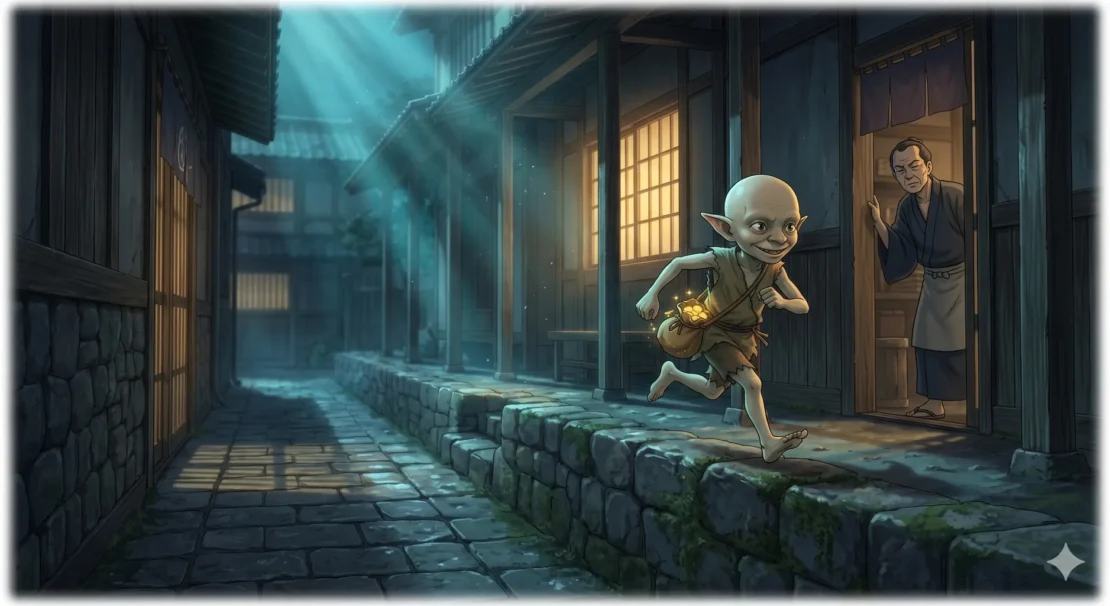
Not all the creatures of Javanese mythology are there to frighten you into the house before dark. Some of them operate in the rather more contemporary territory of financial anxiety and the question of how certain people always seem to do suspiciously well for themselves when nobody is quite sure how.
The Tuyul is a small being, child-sized or smaller, bald-headed and pale, with a wide grin and quick hands. In Javanese mythology, the Tuyul is kept as a kind of supernatural servant by those who acquire it, a process that the tradition describes with considerable specificity: you must purchase or acquire the Tuyul from a dukun, you must care for it as you would a child, feeding it and playing with it, and in return it will go out at night and steal money from the houses of your neighbours and bring it back to you.
The wealth that comes from a Tuyul is, by the logic of Javanese mythology, not clean wealth. It is redistributed wealth, taken from someone else, and it carries consequences. The Tuyul’s owner prospers for a time but is subject to various misfortunes. And the Tuyul itself is described as difficult to get rid of once acquired: it bonds to its owner and must be passed on to someone else or properly released through ritual, and finding someone willing to take on the responsibility is, apparently, not as straightforward as it sounds.
The Tuyul exists in Javanese mythology in the specific cultural space of explaining, with a narrative logic that the community can share and discuss, the question of how some people accumulate wealth in ways that seem to have no visible source or obvious explanation. It is, in its way, a story about the relationship between ill-gotten gains and their consequences, which is a moral concern that every culture finds ways to address.
There is a story from a market town in Central Java that has been told in various forms for at least three generations.
A merchant who had been doing modest business for years suddenly began doing extraordinary business. His stall was always busy. His stock always sold. His competitors could not account for it. His house, which had been ordinary, was extended, then extended again. He wore new clothes. He drove a new vehicle.
The whispers started, as whispers do, slowly and then all at once.
His neighbour, who had been aware for some time of a small, quick shape moving at the edge of his peripheral vision in the dark hours of the night, mentioned it to his wife. His wife mentioned it to her sister. The sister told a trusted friend who happened to know a dukun.
The dukun was asked to investigate.
What the dukun said afterward was not reported in detail, because this particular story is the kind that travels with the details softened for practical reasons. What was reported was that the merchant’s business declined with some speed in the months that followed and that he moved his family to another town before the year was out.
The neighbour reported that the small, quick shape at the edge of his peripheral vision also stopped appearing.
The money, it is noted in the tradition, never fully follows you when you go.
Cultural note: The Tuyul is one of the most widely known figures in Javanese and broader Indonesian mythology, and continues to be referenced in contemporary Indonesian culture, journalism, and everyday speech as a shorthand for wealth acquired through suspect means.
6. Banaspati: The Fireball Spirit of Javanese Mythology

The Banaspati occupies a specific and fiery corner of Javanese mythology. It is described as a supernatural being that manifests as a ball of fire or a tongue of flame, moving through the night air or across the ground, unpredictable in its path and highly dangerous to encounter.
Unlike some of the more narratively complex beings in Javanese mythology, the Banaspati is primarily elemental in its danger. It is fire behaving in ways that fire should not: moving against the wind, changing direction, approaching people rather than consuming fixed objects, and burning with a quality that the tradition consistently describes as not entirely physical.
The Banaspati is associated in Javanese mythology with places where the boundary between the living world and the spirit world is thin: graveyards, the sites of old battles, places where violent death occurred, and certain forests and river bends that have accumulated a long history. It is considered a manifestation of dangerous spiritual energy rather than a spirit with a personality or agenda, which in some ways makes it more unsettling than the beings that can be reasoned with or appeased.
There is a tradition in some parts of Java of specific protective practices for households, involving the placement of certain items at the four corners of a property and the performance of specific prayers at the turn of the season, that is connected directly to protection against the Banaspati and similar fire-manifesting entities. The fact that this practice persisted through Islamisation and continues in some communities today is an indicator of how deeply the Banaspati sits in the Javanese imagination.
The story associated with the Banaspati that is most widely told is one that explains its origin in some regional traditions.
A powerful sorcerer in ancient Java sought to create a servant of fire that would be completely loyal and completely under his control, an entity that would carry out his will with the speed and destructive capability of flame but without the independence that more sentient supernatural beings possessed.
He succeeded, in the way that stories about sorcerers succeeding in Javanese mythology tend to go: completely, and then not at all.
The entity he created was loyal to him and served him as designed for the years of his life. When he died, the binding that held the Banaspati to his will dissolved. What remained was the fire, no longer directed, no longer purposeful, but still active, still moving, still burning with the energy it had been created from, wandering through the dark places of Java looking for the direction it no longer had.
The tradition holds that the Banaspati of any given region is often traceable, through the knowledge of the dukun, to a specific act of magical overreach that took place at some point in the history of that area. The fire is the consequence of something that went wrong. The tradition is, as always in Javanese mythology, making a moral point: that certain powers are not meant to be possessed, and that creating something you cannot ultimately control will eventually produce results you cannot contain.
What you see moving across the dark field at two in the morning, small and orange and moving against the wind, is someone’s unfinished business.
Best to go back inside.
Cultural note: The Banaspati appears in both Javanese and Balinese mythology and is related to similar fire-spirit traditions found across Southeast Asia. In Javanese batik tradition, fire motifs with supernatural associations are among the most ancient design elements, suggesting the deep roots of fire-based supernatural belief in the region.
Why Javanese Mythology Deserves to Be Passed On
We want to be clear about something: we are not suggesting you terrify your four-year-old with tales of floating heads and bald supernatural thieves before bedtime. The question of when and how to introduce children to the richer, more complex corners of their cultural heritage is a genuinely important one, and it deserves thoughtful judgment.
Mythology Is Culture, and Culture Is Identity
The creatures of Javanese mythology are not just scary stories. They are the accumulated moral and social wisdom of a civilisation expressed in the form of narrative. The Wewe Gombel carries a message about parental attention. The Tuyul carries a message about honesty and wealth. The Banaspati carries a message about the limits of human control over things that are larger than us. Every figure in Javanese mythology is, at its core, a lesson wrapped in a story, which is exactly how lessons survive across centuries.
Understanding Our Heritage Makes Us Whole
Children who grow up knowing their own mythology grow up with a richer sense of who they are and where they come from. At Apple Tree Preschool BSD, we believe deeply that a child who understands their cultural roots is a more confident, more grounded, and more curious learner. Through our programs, from Toddler through to Kindergarten 2, we weave Social Studies, Moral, and Creativity together in ways that honour both Indonesian heritage and the wider world.
Javanese mythology is a genuine treasure. Share it with your children at the right age and in the right way, and watch their eyes go wide.
Come and Grow With Us at Apple Tree Preschool BSD
We hope this collection of Javanese mythology creatures gave you something to talk about around the dinner table tonight, or at least a very good reason to check that all the lights are on. These stories are part of who we are as a culture, and they deserve to be told and retold, understood and appreciated, by every new generation.
If you would love for your little one to grow up in a school that takes both heritage and happiness seriously, we would be absolutely delighted to welcome your family.Register now and come explore, discover, and grow with other children at Apple Tree Preschool BSD! Chat with us on WhatsApp or give us a call at +62 888-1800-900. We cannot wait to meet your little one!




Be the first to write a comment.