

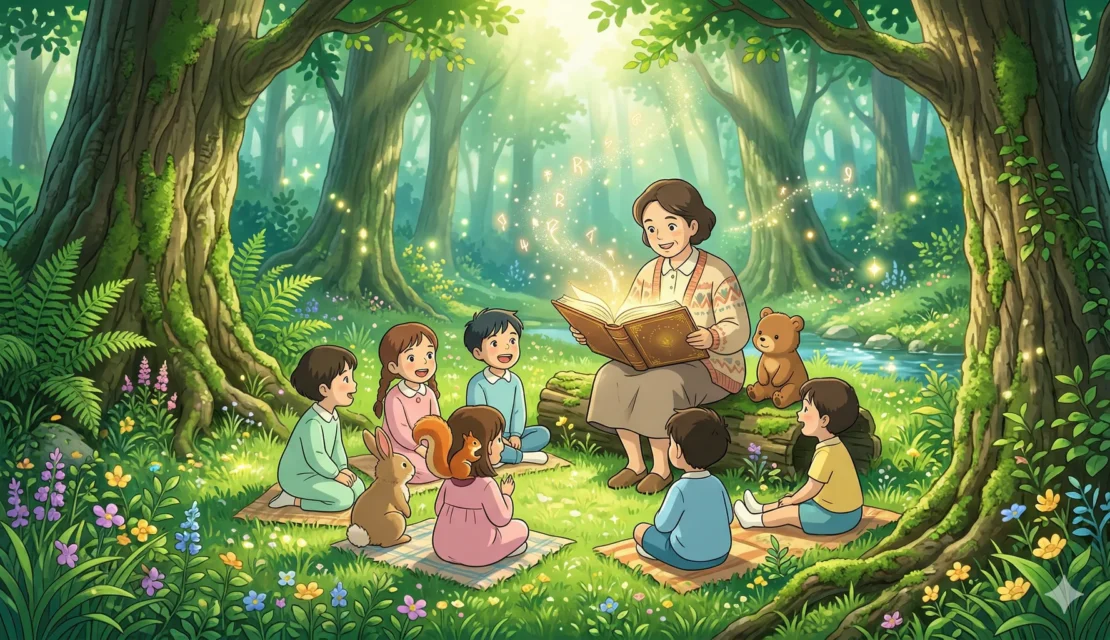
You know that moment when your child asks for “one more story” at bedtime, and you’ve already told the same three stories seventeen times this week? We’ve been there too. The good news is that the world is absolutely full of wonderful kids stories waiting to be discovered, and the best ones don’t just entertain, they teach something that sticks.
At Apple Tree Preschool BSD, we see every single day how a good story can open a child’s mind in ways that lessons and instructions simply can’t. A child who wouldn’t sit still for a five-minute talk will happily listen to a twenty-minute story without moving a muscle. That’s the power of storytelling, and we think every parent deserves a fresh collection to keep in their back pocket.
So here are 8 original kids stories that are fun, full of heart, and absolutely free to read. Grab a cup of tea, find your cosiest spot, and read them aloud tonight.
8 Kids Stories for Curious, Kind, and Brave Little Minds
From funny talking animals to brave little children, these educational stories for kids are packed with adventure, heart, and lessons about friendship, honesty, courage, and more.
1. The Little Cloud Who Wouldn’t Rain
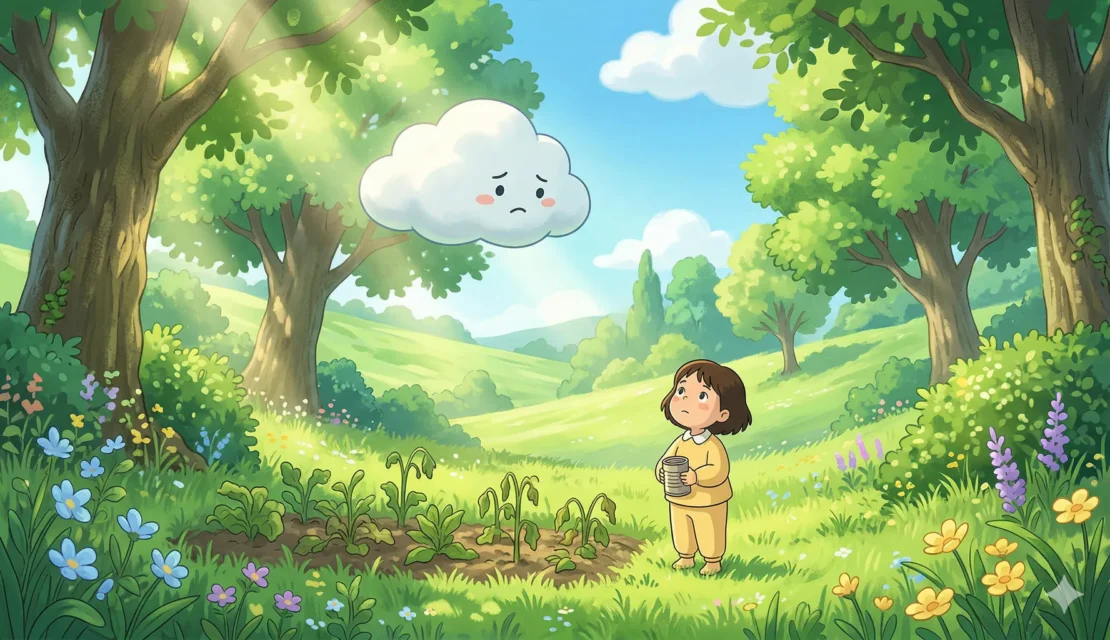
High above the mountains, where the air smelled of clean water and pine trees, there lived a small, round cloud named Nimbus. All the other clouds in the sky had very important jobs. Big grey Cumulon made the thunderstorms that filled the rivers. Soft white Cirra dusted the mountaintops with snow. Even little Mist, the youngest cloud of all, crept down every morning to water the valley flowers before sunrise.
But Nimbus wouldn’t rain.
It wasn’t that he couldn’t. He was perfectly full of water, round and heavy and wobbling with it, like a very overfilled balloon. The problem was that Nimbus was terrified of heights. Not the heights up in the sky, where he floated quite happily. No, the problem was looking down. The moment he peered over the edge of himself and saw how far the ground was, his water just sort of… stayed put.
“You simply have to let go,” said old Cumulon one afternoon, rumbling gently beside him. “The world needs your rain.”
“I know,” said Nimbus miserably. “But what if I fall too fast? What if I land wrong? What if the ground doesn’t want me?”
Cumulon laughed, a low rolling sound like distant thunder. “Rain never lands wrong. It finds where it’s needed. Always.”
Down below, Nimbus could see a small farm. He had been watching it for days. The soil was dry and cracked like old pottery. A little girl named Yara walked out every morning and evening to water the garden with a small tin can, working so hard for so little result. She was trying her absolute best, but the vegetables were wilting anyway.
Something shifted in Nimbus.
He looked at Yara. He looked at her tired little arms, her cracked tin can, her drooping tomato plants.
Then, for the first time in his life, instead of looking down and feeling afraid, he looked down and felt something else entirely. He felt needed.
He took the deepest breath a cloud has ever taken.
And he rained.
He rained the softest, most wonderful rain, not too hard, not too cold, just exactly right. He watched Yara drop her tin can and throw her arms wide open, spinning in the rain with her face pointed up and laughing. The garden drank. The soil turned dark and rich. The tomatoes straightened up.
When it was over, Nimbus felt about half his size. Lighter than he’d ever been.
“How do you feel?” asked Cumulon.
Nimbus looked at the garden below, green and glistening.
“Like I did the right thing,” he said softly.
And every season after that, Nimbus came back to that same valley, without any fear at all.
Lesson: Courage isn’t the absence of fear. It’s choosing to help someone even when you’re scared.
2. The Tortoise Who Learned to Ask for Help
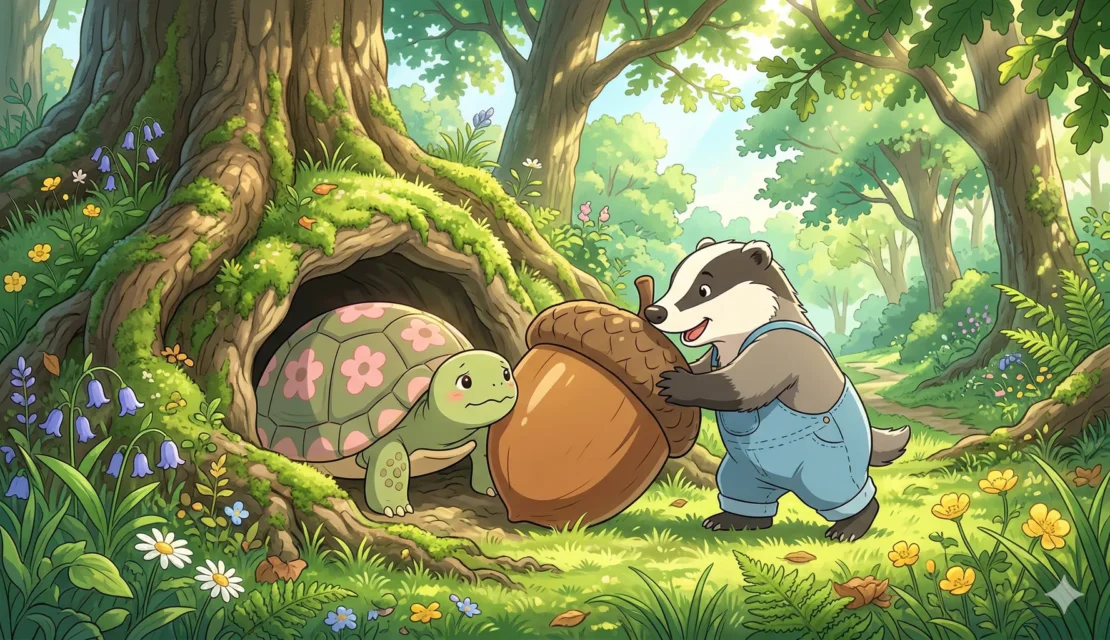
Tilly the tortoise had a reputation in the forest, and she was quietly proud of it. She was the one who always figured things out on her own. When her shell got stuck in the garden gate, she wriggled free herself. When she lost her way in the fern patch, she navigated home alone. When the storm knocked leaves into her burrow entrance, she cleared it out herself, one by one, without asking a single soul.
“I can manage,” was Tilly’s favourite sentence.
The other animals admired her. They also worried about her a little, which she chose not to notice.
One autumn, a particularly enormous acorn rolled into Tilly’s burrow and got completely, thoroughly stuck in the entrance. It was too big to push from the inside, too round to grip properly from the outside, and absolutely impossible for one small tortoise with short legs to dislodge alone.
Tilly tried for three hours. She pushed with her nose. She pushed with her shell. She tried to kick it with her back feet. She considered it from every angle. She sat down, thought very hard, tried again. Pushed, kicked, nudged, shoved.
The acorn didn’t move one millimetre.
It was getting dark. The forest was cooling down. Tilly was stuck inside her own home.
A badger named Bernard happened to trundle past, noticed the oversized acorn, and peered in. “Tilly? Is that you in there? Do you need a hand?”
Tilly opened her mouth to say “I can manage.”
The words just sat there in her throat. She looked at the acorn. She looked at the gathering dark. She looked at her short legs.
“Yes,” she said at last, and it was genuinely the hardest word she had ever said. “I think I do.”
Bernard gave the acorn one cheerful shove with his broad nose and it popped free like a cork from a bottle.
“There you are!” he said brightly, and wandered off into the evening.
Tilly stood in her burrow entrance, breathing the cool air, feeling a little sheepish and a lot relieved.
The next morning, she went and found Bernard and brought him a perfectly ripened wild berry she had been saving.
“What’s this for?” he asked.
“For yesterday,” she said. “And also, I think, for teaching me something.”
Bernard smiled with a mouth full of berry and didn’t ask any more questions.
Lesson: Asking for help is not weakness. It takes real courage, and it often turns out that the people around you were just waiting to be asked.
3. The Colour Thief
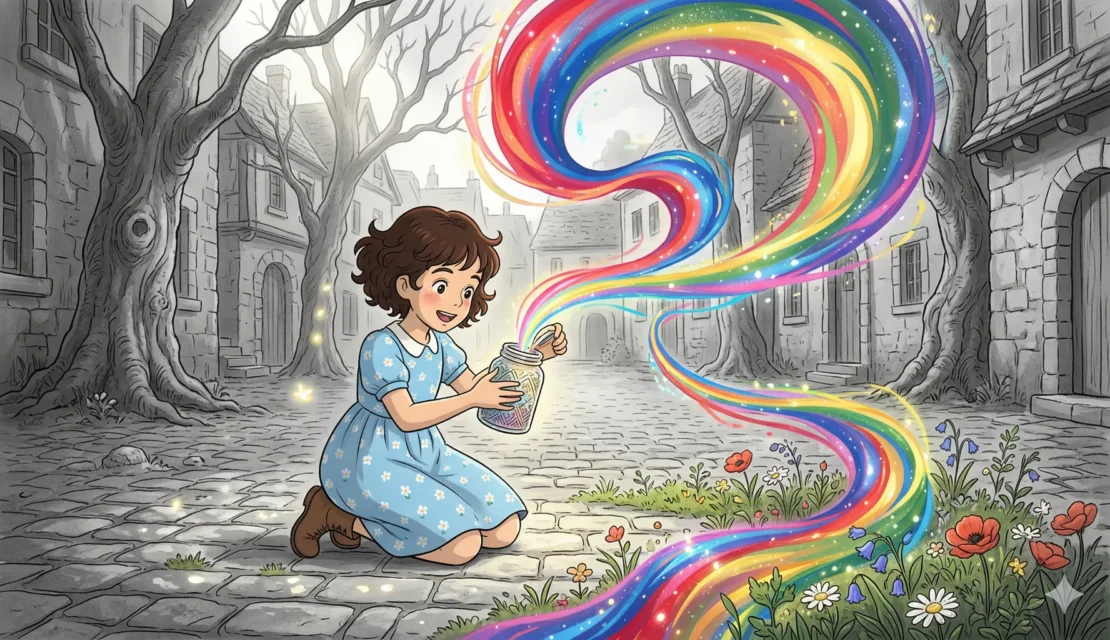
In a town called Painterly, colour was the most important thing in the world. Every building was a different shade, every garden was carefully tended, and the townsfolk wore outfits that were chosen with great thoughtfulness. The sunsets were spectacular. The flowers were extraordinary. People came from far away just to walk the streets and look.
Then one morning, the town woke up grey.
Not grey like overcast. Grey like all the colour had been carefully removed overnight, leaving behind the shapes and outlines of everything, but none of the brightness. The red post boxes were ash-coloured. The yellow bakery was the colour of fog. The blue river ran like pewter.
Nobody could explain it.
A small girl named Indigo, whose parents had named her after a colour they loved very much, decided to find out what happened. She was seven years old and absolutely not the type to wait for grownups to sort things out.
She followed the grey. She noticed that in the town square, the grey was deepest, the darkest, the most complete. She dug with her fingers in the centre of the square and found, buried just below the stones, a small glass jar. And inside the jar, swirling and pressing against the glass, were what appeared to be every colour in the world, trapped.
Taped to the jar was a note. It said: Nobody appreciated it anyway.
Indigo sat back on her heels and thought about that for a long time.
She had a feeling she knew who had written it. There was an old painter named Maestro who lived at the edge of town. He had painted the murals on every wall, the signs above every shop, the flowers on the market awnings. He had lived in Painterly his whole life and had given it its colours, one brushstroke at a time.
And nobody, as far as Indigo could remember, had ever once said thank you.
She took the jar and went to find him.
He was sitting in his colourless studio, looking at grey canvases.
Indigo placed the jar on the table in front of him. “You made all of this beautiful,” she said. “And we never told you. I’m sorry.”
The old painter looked at her for a long moment.
Then he opened the jar.
The colour rushed back into the world like a long exhale, a bloom of gold and red and blue and green spreading out from Painterly in every direction until the town glowed brighter than it ever had before.
Indigo took Maestro’s hand and walked him into the square, where the townsfolk, seeing their colours restored, erupted in understanding.
The thank-yous that followed were long overdue and entirely heartfelt.
Lesson: Never forget to appreciate the people who make your world more beautiful. A simple thank you can mean everything.
4. The Boy Who Collected Worries
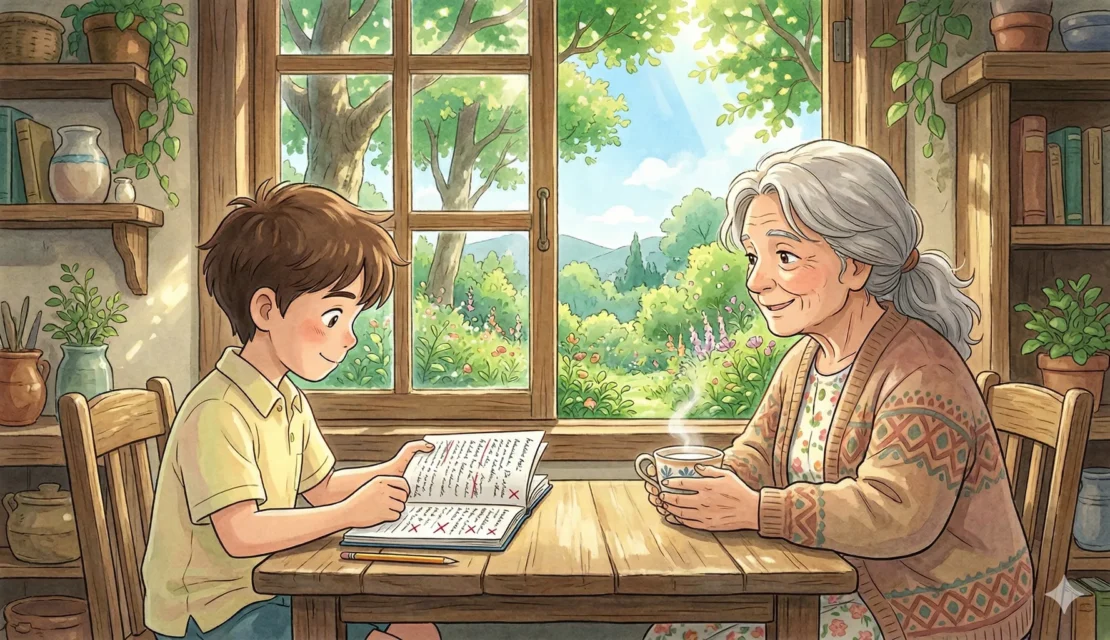
Matteo was a collector. His bedroom was full of beautifully organised things, shells in order of size, stones in order of colour, stamps from twelve countries pinned neatly to a board. He was extremely good at collecting.
Unfortunately, he was also extremely good at collecting worries.
He kept them in his head, which was already quite a full place. There was the worry about the spelling test on Thursday. The worry about whether his best friend Kai was still his best friend after the incident with the football last week. The worry about the funny noise the family car made on long trips. The worry that the funny noise meant the car would break down on their holiday. The worry that if the holiday was cancelled his mum would be disappointed. The worry about his mum being disappointed.
By Tuesday afternoon, Matteo had thirty-seven worries stacked up in his head like a very precarious tower of plates.
He told his grandmother about this. She was the sort of grandmother who listened first and talked second, which was rare and valuable.
She brought out a small notebook and a pen and placed them on the table.
“Write them all down,” she said.
Matteo looked at her. “All of them?”
“Every single one.”
So he did. It took twenty minutes. He wrote all thirty-seven worries in his neatest handwriting. When he was finished, he put down the pen.
“Good,” said his grandmother. “Now, next to each worry, write the answer to this question: is there anything you can actually do about this right now, today?”
Matteo went through the list. The spelling test, he could study tonight. His friendship with Kai, he could call him and just ask. The car, that was for his parents, not for him. The holiday, same. His mum’s feelings, also not his to carry.
He put a small tick next to the ones he could do something about and a small cross next to the ones he couldn’t.
There were six ticks and thirty-one crosses.
“Now,” said his grandmother, “what are you going to do with your evening?”
Matteo looked at his six ticks.
“Study for Thursday,” he said. “And call Kai.”
“Exactly,” said his grandmother, and made him a warm glass of milk.
He slept better that night than he had in two weeks.
Lesson: Sort your worries into what you can control and what you can’t. Then focus only on the first pile.
5. The Girl Who Said Sorry First
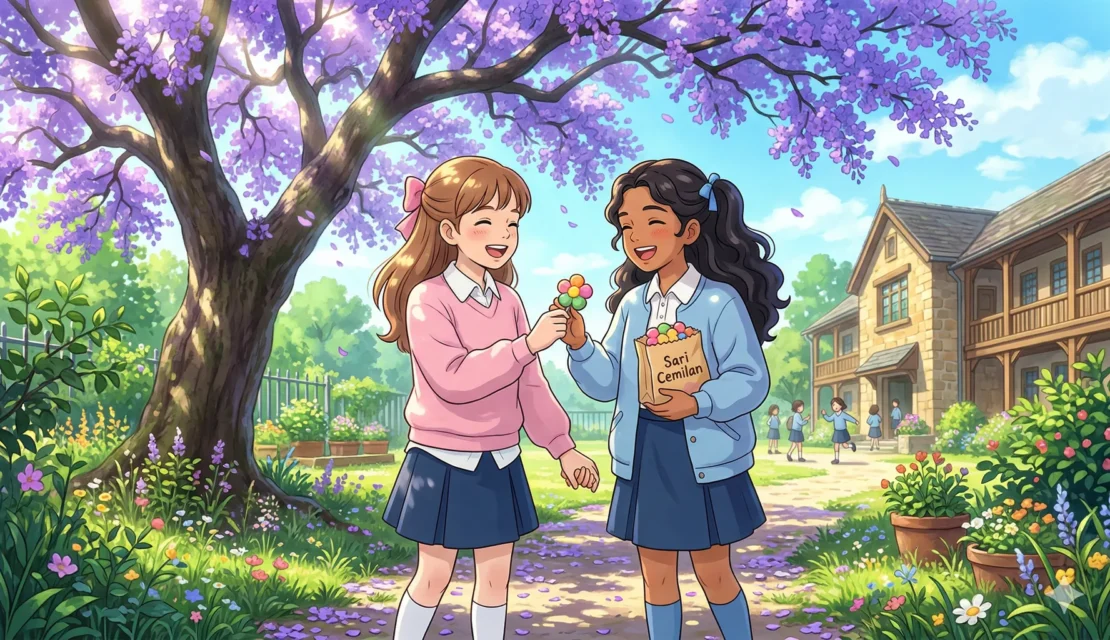
In a noisy, cheerful class of twenty-four children, Lily and Noor had been best friends for so long that nobody could remember a time before they were best friends. They shared everything: snacks, secrets, the best spot under the jacaranda tree at lunchtime.
Then, one Monday, they had an argument.
It was, objectively speaking, a small argument. It was about whose turn it was to be the leader in a group game. The specifics were, frankly, not important. What mattered was that both of them said things a bit sharper than they meant, and both walked away feeling stung.
By Tuesday, they were not talking.
By Wednesday, they were going out of their way not to even look at each other, which takes considerably more energy than people realise.
By Thursday, Lily had told the story to four different people. Each time she told it, the argument grew slightly larger. By version four, it was practically a diplomatic incident.
Noor was doing the same thing at the other end of the classroom.
On Friday, it rained, which meant no jacaranda tree, and both of them ended up inside at adjacent lunch tables, which were basically the same table. They stared at their food. The silence between them was enormous.
Lily thought about Tuesday. She thought about the things she’d said. She thought about version four of the story and realised, uncomfortably, that she had made herself the hero of a story where she was actually about forty percent responsible for what happened.
She put down her fork.
“I’m sorry,” she said. “I was rude on Monday. I didn’t mean the thing I said about your idea being boring. It wasn’t boring.”
Noor was quiet for a moment.
“I’m sorry too,” she said. “I took the last good spot under the tree three weeks in a row. That wasn’t fair.”
They looked at each other.
“Friends?” said Lily.
“Obviously,” said Noor, and pushed half her snack across the table.
They were back under the jacaranda tree the following Monday, sharing secrets and eating snacks, as if nothing had happened. Which, in the way that really mattered, was entirely true.
Lesson: Saying sorry first is not losing. It’s choosing the friendship over the fight, which is always the braver and smarter move.
6. The Seed That Didn’t Want to Grow
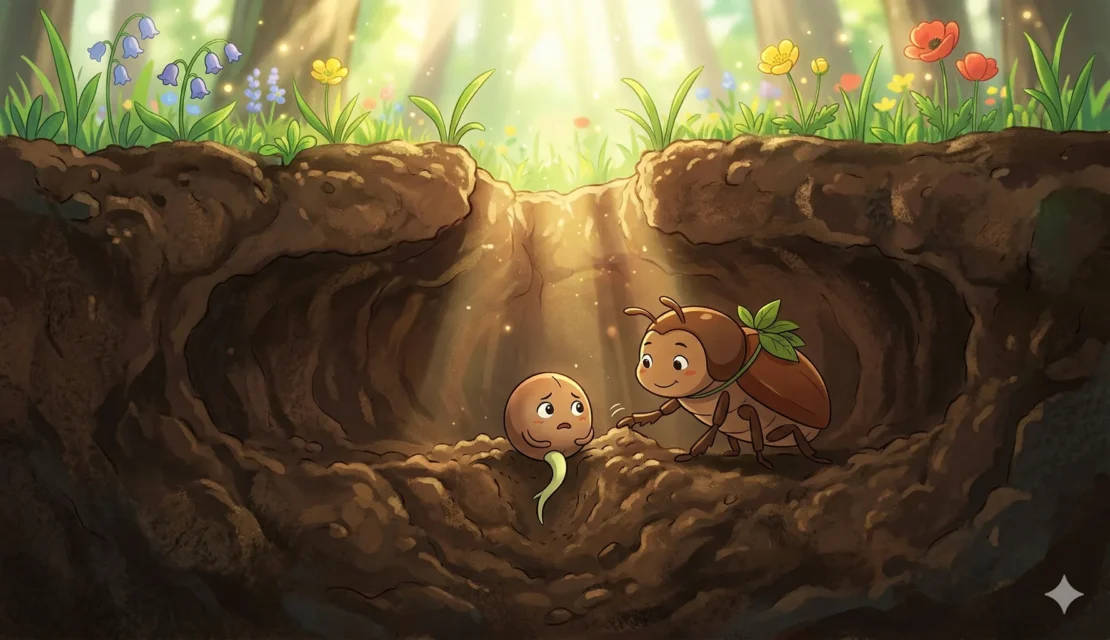
In a beautiful, sprawling garden, a tiny seed sat in the soft dark earth and refused to do anything.
Around it, other seeds were pushing their first little shoots up through the soil, reaching toward the light with tremendous confidence. Brave little green spirals poking up everywhere, becoming flowers and herbs and climbing vines and all sorts of wonderful things.
The small seed watched them and felt something it couldn’t quite name.
A beetle named Gus wandered past underground and nearly walked into the seed, which surprised them both.
“You’re still here?” said Gus. “Most seeds in this section sprouted weeks ago.”
“I know,” said the seed.
“What are you waiting for?”
“I don’t know what I’ll be,” said the seed. “When I come up. I don’t know if I’ll be a good flower or an important plant or anything worth growing into. What if I come up and I’m nothing special?”
Gus considered this with the measured patience of a beetle who had seen many seasons.
“I’ve been in this garden a long time,” he said. “And I’ve never once seen a plant that knew what it would become before it started growing. The rose didn’t know she’d be the tallest thing in the garden. The mint didn’t know she’d spread all the way to the fence. They just grew, and they became.”
The seed thought about this.
“What if I grow slowly?” it asked.
“Some of the best things in this garden grew the slowest,” said Gus. “The oak tree out there took forty years. It’s also the thing that shades everything else.”
The seed sat with that for a little while.
Then, very quietly, very carefully, it sent its first tiny root downward.
It took a long time. The seed was not the first in its section, or the fastest, or the showiest. But it grew. Steadily, stubbornly, in its own time, in its own direction.
What it became was lovely.
Lesson: You don’t need to know who you’ll become before you start growing. Just begin, and trust the process.
7. The Prince Who Forgot to Listen
In a kingdom that was prosperous and mostly well-run, there lived a young prince named Felix who had one significant problem. He was a very, very good talker. He had opinions on everything. He could hold a conversation at extraordinary length, on any subject, with great enthusiasm and absolutely no pauses.
This would have been fine, except that Felix had somehow come to believe that talking and listening were the same thing.
They are not.
His tutors noticed. His friends, when they could get a word in, hinted at it. His older sister told him directly three times, but he was so busy explaining why she was wrong that he missed the message entirely.
Then, one summer, the kingdom ran into trouble. A drought had dried up the north river. The farmers there were struggling. The king sent Felix to go and assess the situation and report back, which was meant to be a learning exercise.
Felix arrived in the north with great energy. He told the farmers what he knew about drought. He explained irrigation theory. He described what he had read in three different books. He talked for most of the first day.
The farmers listened politely.
On the second morning, Felix finally ran out of things to say. A long silence followed, which he found extremely uncomfortable.
An old farmer named Agnes filled it.
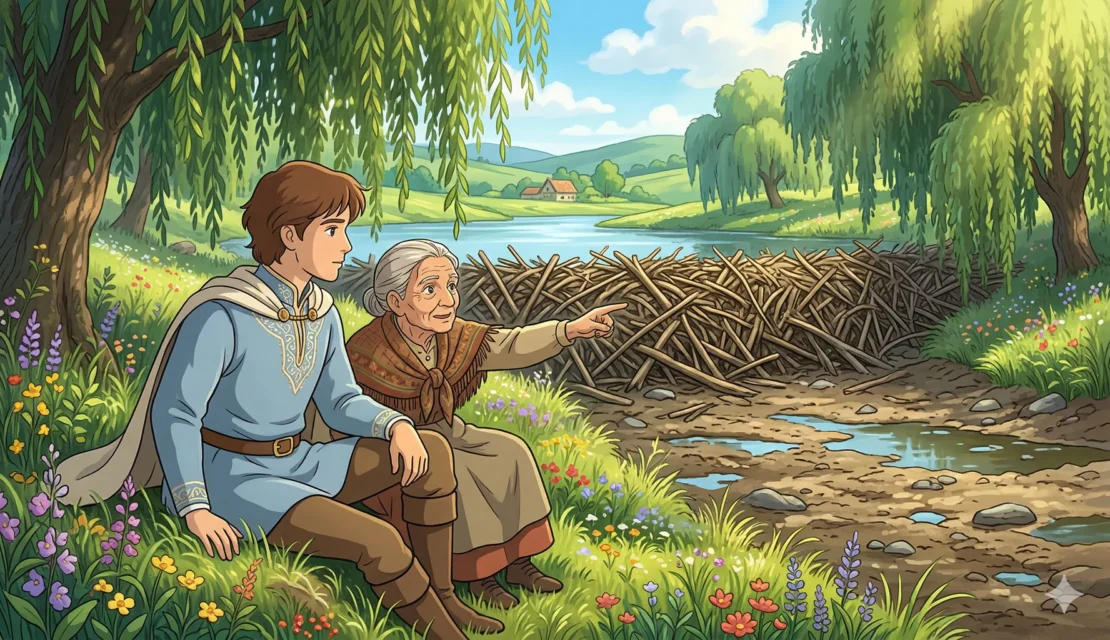
“The water,” she said, “hasn’t dried up. We think it’s been rerouted. There’s a beaver dam three miles upstream, just past the bend. Nobody goes up there. But we’ve noticed the ground is wet further along, which means the water’s going somewhere.”
Felix stared at her. “How long have you known this?”
“Since you arrived,” she said pleasantly. “You didn’t ask.”
Felix rode to the bend the next morning. There was the beaver dam, enormous and industrious, redirecting every drop of water away from the farmland. He reported back to his father, the farmers got their water, and the crisis was resolved.
On the ride home, Felix thought about how many days he had spent explaining things to people who already knew the answer.
He started asking questions after that. More importantly, he started waiting for the answers.
Lesson: The wisest people in the room are often the quietest. Ask questions, then actually listen to the answers.
8. The Night the Stars Went on Strike
The stars had always done their job without complaint, which, when you thought about it, was a considerable job. Every single night, billions of them switched on reliably, without fail, in every corner of the universe, providing light and navigation and beauty and the occasional wish, all completely unpaid and largely unacknowledged.
One evening, just as the sun dipped below the horizon and the sky shifted to the deep purple that means night is arriving, not a single star switched on.
The sky was completely, utterly black.
Down on earth, the confusion was immediate. Children pressed their noses to windows. Lighthouse keepers were perplexed. Sailors checked their compasses twice. Astronomers had very long nights.
A young girl named Astrid, who made it a habit to say goodnight to the stars every single evening from her window, was sitting in front of an empty sky feeling bereft. She had said goodnight to the stars every night for six years. She knew the ones above her neighbourhood by shape. She had names for her favourites.
“Where are you?” she whispered.
Very faintly, one small star blinked.
Astrid pressed closer to the glass. “Are you alright?”
“We were wondering,” said the small star, a little sheepishly, “if anyone actually noticed us.”
Astrid blinked. “Of course I notice you. I notice you every single night.”
“You do,” said the star. “Most don’t. We’ve been up here an awfully long time, and we just sometimes wonder if any of it matters.”
Astrid pulled out the notebook she kept on her windowsill, the one she used to draw constellations, and she turned to a fresh page. And she wrote, in her careful round handwriting, every star she knew by name, and a sentence about each one, what it looked like, when she had first noticed it, why she thought it was beautiful.
Then she held the notebook up to the window, even though she knew the stars probably couldn’t read it, because the gesture felt important.
One by one, the stars switched back on. Then more. Then all of them, blazing away in the dark exactly as they always had, the whole sky lit up like a standing ovation.
Astrid smiled and said, “Goodnight,” like she always did.
“Goodnight,” the sky seemed to say back.
Lesson: Never let the things you love go unappreciated. Small acts of noticing and gratitude matter more than you know.
Why Kids Stories Are One of the Best Learning Tools You Have at Home
Reading these kinds of educational stories for kids isn’t just a lovely way to spend an evening, though it absolutely is that too. Research consistently shows that children who are read to regularly develop stronger vocabulary, deeper empathy, and better emotional regulation. They also tend to handle new social situations more confidently, because they’ve already “rehearsed” complex emotions through the characters they love.
Stories Teach Without Feeling Like Teaching
A child who wouldn’t sit through a lesson on honesty will happily listen to the story of a prince who forgot to listen and come away with exactly the right takeaway. That’s because stories sneak past the part of the brain that resists being told what to do, and speak directly to the part that feels and imagines.
Every Story Becomes a Conversation Starter
After you read one of these kids stories tonight, try asking a simple question: “What would you have done?” You might be surprised what your little one says. These small conversations are where the real learning happens, and they bring you closer together in the process.
The Right Foundation Starts Early
At Apple Tree Preschool BSD, located in the Educenter BSD Building, we build these values into everything we do, from our storytelling sessions to our Singapore-curriculum lessons in Moral, Social Studies, and beyond. The children in our Toddler, Pre-Nursery, Nursery, and Kindergarten classes don’t just learn their letters and numbers. They learn to be kind, curious, resilient, and wonderfully themselves.
Because smart and happy isn’t just what we aim for. It’s what we believe every child truly deserves.
Come and Be Part of Our Story
We hope these 8 kids stories gave you something special to share tonight. Whether your child is 18 months or heading toward primary school, the stories you tell them now will stay with them in ways that nothing else can.
If you’d love for your child to grow up in an environment where learning feels this good every single day, we’d be so happy to welcome your family to Apple Tree Preschool BSD.Come play and learn with other children! Chat with us on WhatsApp or give us a call at +62 888-1800-900. We can’t wait to meet your little one!





Be the first to write a comment.