

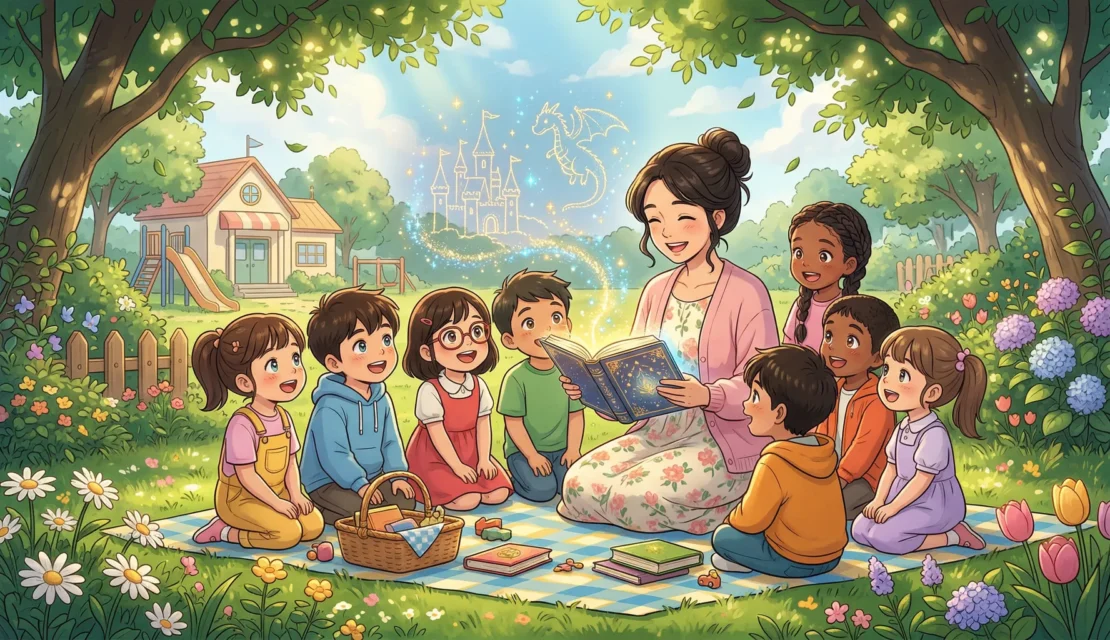
There is something magical about a short story that wraps itself around your heart in just a few minutes. Whether you are curling up with your little one before bedtime or sneaking in a quiet reading moment during nap time, a good tale can spark imagination, teach kindness, and open doors to big conversations with small people. We have always believed that storytelling is one of the most powerful tools in early education, and honestly, it is one of our favorite parts of the day here at Apple Tree Pre-School BSD.
So, we put together 20 original short stories that you and your child can enjoy together in just five minutes or less. Each one carries a gentle lesson, a splash of adventure, and enough wonder to keep tiny eyes wide open. Grab a snack, get cozy, and let’s dive in.
Bite-Sized Tales: Short Stories for Big Imaginations
These short stories are perfect for parents who want meaningful, screen-free bonding moments with their kids. Each tale draws from universal themes of courage, friendship, honesty, and curiosity.
1. The Little Lantern of Lembang
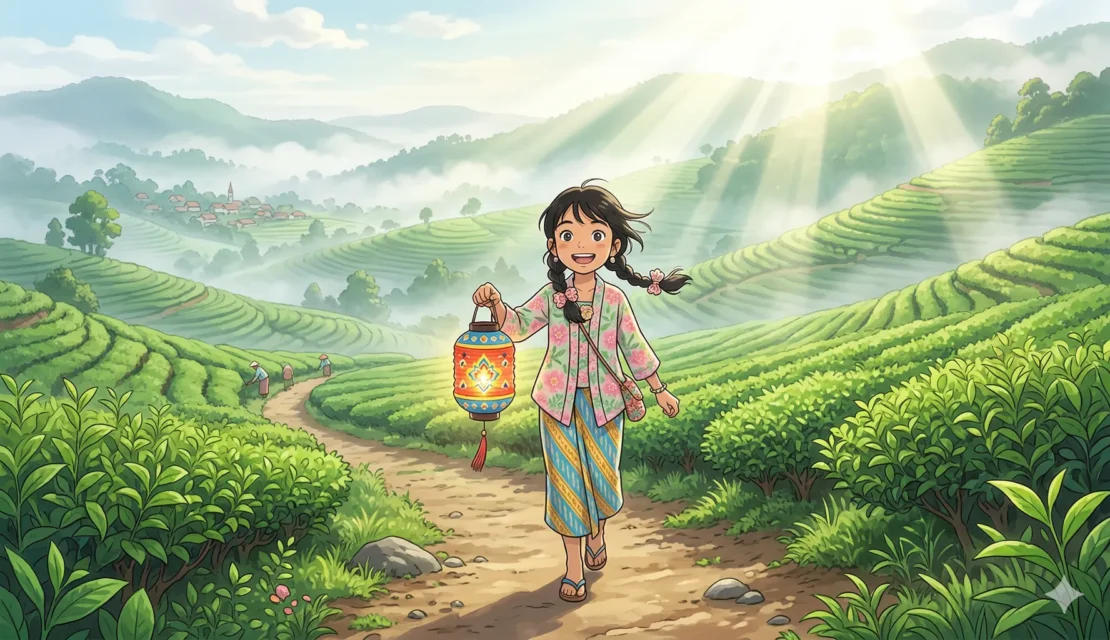
In a misty village tucked between the green hills of Lembang, there lived a girl named Sari who carried a tiny paper lantern everywhere she went. The other children laughed at her. “Why do you carry that silly thing in the daytime?” they would ask.
Sari never minded. Her grandmother had given her the lantern before she passed away, whispering, “When someone is lost in the dark, be the light.” Sari did not fully understand what that meant, but she loved her grandmother, so she carried it proudly.
One rainy afternoon, the village lost power. The streets turned black, and children cried in their homes. Parents fumbled for candles that had already melted down to stubs. Sari walked outside, lit her little lantern, and stood at the village crossroads.
One by one, neighbors followed the glow. Mr. Budi found his way home from the rice field. Ibu Ratna carried her baby safely across the muddy bridge. Even old Pak Hasan, who lived alone at the edge of the forest, saw the light from his window and felt less afraid.
By the time the power came back on, the whole village had gathered around Sari. She was not a hero with a sword. She was just a small girl with a paper lantern. But she had done exactly what her grandmother had asked.
The village elder smiled and said, “Sometimes the smallest light shines the brightest.”
From that night on, no one ever laughed at Sari’s lantern again. In fact, the children of Lembang started making their own. And every time the sky grew dark, you could see dozens of tiny lights flickering through the hills, each one carried by a child who had learned that being kind does not require being big.
Moral: Small acts of kindness can light up the world around you.
2. Bimo and the Talking River

Bimo was the kind of boy who never sat still. He climbed trees before breakfast, chased dragonflies at lunch, and splashed in the river until the sun dipped behind the mountains. His mother would call him “my little hurricane.”
One morning, while wading through the shallow part of the river near his home in Central Java, Bimo heard a voice. It was soft, like water running over smooth stones.
“Could you please stop throwing rocks into me?”
Bimo froze. He looked around. Nobody was there. “Down here,” the voice said. The river itself was talking.
“You can talk?” Bimo’s eyes were as wide as saucers.
“Of course I can,” the river replied. “I have been here for a thousand years. I have seen kingdoms rise and fall. But lately, people have been tossing rubbish and rocks into me, and honestly, it hurts.”
Bimo felt a sting of guilt. He had thrown plenty of rocks himself, never thinking twice about it. “I am sorry,” he whispered. “I did not know.”
The river chuckled, a sound like bubbling water. “Most people don’t. They forget that everything around them is alive in its own way. The trees breathe. The soil feeds. And I carry water to your rice fields so your family can eat.”
Bimo sat on the bank and thought for a long time. Then he made a decision. He ran back to the village and told everyone what the river had said. Some laughed. Some rolled their eyes. But a few children believed him, and together they started cleaning the riverbank every weekend.
Months later, the river ran clearer than it had in years. Fish returned. Birds came back to nest along its banks. And though the river never spoke again, Bimo swore that on quiet mornings, he could hear it humming a thank you.
Moral: Nature gives us so much. The least we can do is take care of it in return.
3. Mira’s Invisible Crown
Mira started her first day at a new school with shaky knees and a stomach full of butterflies. Her family had just moved to BSD from Surabaya, and she did not know a single soul.
During recess, she sat alone under a frangipani tree, picking at her lunch. A group of girls nearby whispered and giggled, glancing in her direction. Mira felt her cheeks burn.
Then a boy named Adi walked over and sat next to her. “Hey, you are new, right?” he asked casually, biting into an apple.
Mira nodded, unable to find her voice.
“Cool. I was new last year. It is awful at first, but it gets better. Want to know my secret?” Adi leaned in like he was sharing classified information. “I pretended I was wearing an invisible crown. Every time someone made me feel small, I just remembered that I was actually royalty.”
Mira laughed for the first time that day. “That is the silliest thing I have ever heard.”
“Maybe,” Adi grinned. “But it worked. And now I have got real friends who like the real me.”
Mira thought about that. She straightened her back, lifted her chin just a little, and imagined a sparkly golden crown sitting on her head. It felt silly, but also kind of wonderful.
By the end of the week, Mira had joined the art club, made three friends, and even answered a question in class without her voice trembling. She never told anyone about the invisible crown, but every morning before school, she would look in the mirror, place an imaginary crown on her head, and whisper, “You have got this.”
Years later, when Mira became a teacher herself, she told every nervous new student the same secret. And it worked every single time.
Moral: Confidence starts from within. Sometimes you just have to remind yourself of your own worth.
4. The Baker Who Forgot How to Smile
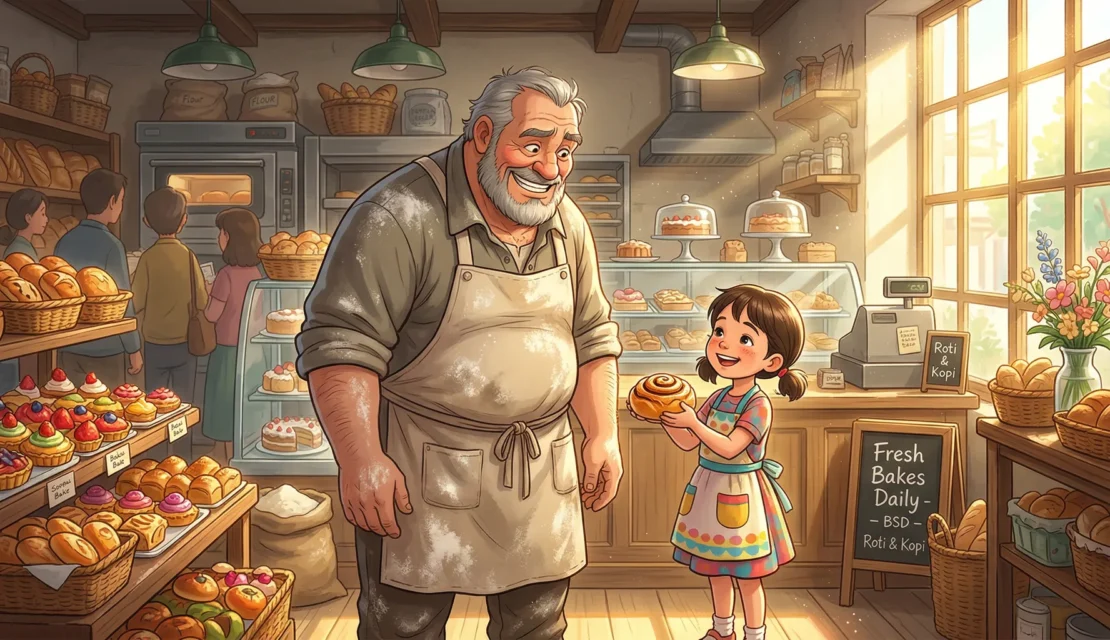
In a bustling neighborhood not far from the Educenter BSD Building, there was a bakery that made the most heavenly cinnamon rolls in town. The baker, Pak Yusuf, was famous for two things: his pastries and his frown.
Nobody could remember the last time Pak Yusuf had smiled. He kneaded dough with a scowl. He iced cakes with a grimace. Even when customers praised his croissants, he would simply grunt and hand over the paper bag.
One Tuesday, a little girl named Alma walked into the shop with her mother. While her mother browsed the bread shelf, Alma marched right up to the counter, stood on her tiptoes, and said, “Excuse me, sir. Your cinnamon rolls make my tummy do a happy dance. Thank you for making them.”
Pak Yusuf blinked. He opened his mouth, closed it, and then something strange happened. The corners of his lips twitched. Slowly, awkwardly, like a rusty gate creaking open, he smiled.
Alma gasped. “You have a really nice smile! You should use it more.”
That small moment cracked something open inside Pak Yusuf. He started greeting customers by name. He put a little smiley face on every pastry bag. He even began letting children peek into the kitchen to watch him bake.
The bakery, which had always been popular for its food, became popular for something else entirely, its warmth. Neighbors lingered longer. Strangers became regulars. And it all started because a four year old girl said thank you.
Pak Yusuf kept a photo of Alma’s first visit pinned above his oven. Underneath, he had written in flour dusted handwriting: “She reminded me that bread feeds the stomach, but a smile feeds the soul.”
Moral: A simple kind word from even the smallest person can change someone’s entire day.
5. Awan and the Cloud Collector
Awan’s name literally meant “cloud” in Indonesian, and honestly, it suited him perfectly. He was a daydreamer. While other kids in his kindergarten class practiced writing letters, Awan stared out the window, watching clouds drift across the sky.
“That one looks like a dragon,” he would murmur. “And that one is definitely a bowl of bakso.”
His teacher, Miss Lina, noticed. Instead of scolding him, she walked over one afternoon and said, “Awan, would you like to be our Cloud Collector?”
Awan’s eyes lit up. “What is a Cloud Collector?”
Miss Lina handed him a sketchbook. “Every day, you draw the most interesting cloud you see. Then you tell the class a story about it.”
Awan took the job very seriously. On Monday, he drew a cloud shaped like an elephant and told a story about an elephant who was afraid of mice but learned to be brave. On Wednesday, he sketched a cloud that looked like a ship and narrated a tale about pirates who searched for treasure but discovered that friendship was the real gold.
The other children started looking forward to Awan’s cloud stories. They would rush to the window during break, pointing and shouting, “Awan, look at that one! What is its story?”
By the end of the semester, Awan had filled three sketchbooks. His writing improved because he wanted to caption his drawings. His confidence soared because his classmates cheered for him every day.
Miss Lina later told Awan’s parents, “He was never distracted. He was just looking at the world differently. All he needed was someone to value that.”
Awan grew up to be an illustrator for children’s books. And every single one of his stories started the same way: “Once upon a time, there was a cloud that looked like…”
Moral: Every child has a unique gift. Sometimes it just needs the right person to notice it.
6. The Garden That Grew Overnight
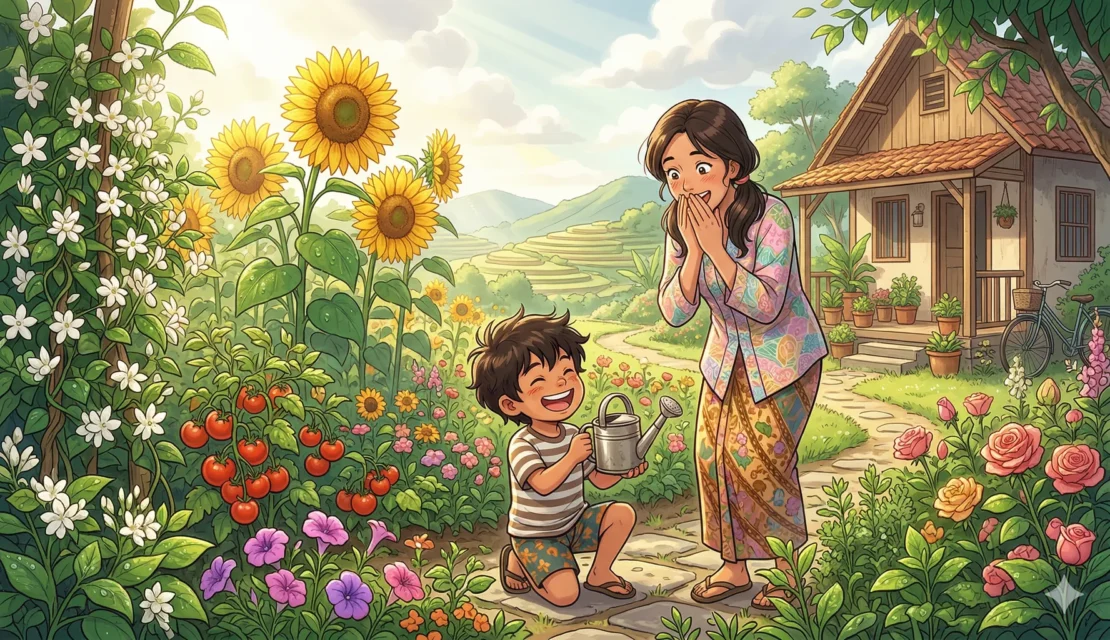
Ibu Dewi’s garden was the saddest patch of land on the street. Dry soil, wilted stems, and a single stubborn weed that refused to leave. She tried everything: fertilizer, singing to the plants (yes, really), even reading them bedtime stories. Nothing worked.
Her five year old son, Rafi, watched her struggle every afternoon. One evening, he whispered to the garden, “Please grow for Mama. She tries so hard.”
The next morning, Ibu Dewi screamed. Not from fear, but from shock. Her garden had exploded with color overnight. Sunflowers stood tall like golden soldiers. Jasmine vines climbed the fence. Tomatoes hung like tiny red lanterns.
The neighbors came running. “How did you do this?” they asked.
Ibu Dewi had no answer. She looked at Rafi, who was grinning mischievously.
“Rafi, did you do something?”
The boy shrugged. “I just asked nicely.”
Now, we could leave the story here and call it magic. But the truth was a little more beautiful. What Rafi had actually done was sneak into the garden at dawn with a watering can he could barely carry. He had seen his mother cry over those plants, and he decided that if she would not give up, neither would he.
He had been secretly watering the garden every morning for two weeks, long before the sun came up, long before anyone noticed. The seeds his mother had planted months ago had simply needed a little more patience, and a little boy who loved her enough to try.
Ibu Dewi hugged Rafi so tight he squeaked. “You are my greatest garden,” she said.
Moral: Love is not always loud. Sometimes it wakes up early and waters the plants when nobody is watching.
7. The Fox Who Wanted to Fly
Deep in a forest on the island of Sumatra, a young fox named Raka sat on a hilltop watching eagles soar above the canopy. “I want to do that,” he declared to absolutely no one.
His friend, a wise old turtle named Kura, overheard him. “Foxes don’t fly, Raka.”
“Maybe they just haven’t tried hard enough,” Raka replied.
So Raka tried. He jumped off logs. He leaped from boulders. He even fashioned wings out of banana leaves and ran off a small cliff, which ended predictably with a mouthful of mud and bruised pride.
The forest animals whispered. “Silly fox. Doesn’t he know his place?”
But Raka kept trying. He studied how birds positioned their wings. He observed how flying squirrels glided between trees using stretched skin. He experimented, failed, adjusted, and experimented again.
One monsoon afternoon, Raka climbed to the top of the tallest hill, wearing a contraption made from bamboo and woven palm fronds. He took a deep breath and jumped.
He did not fly. Not really. But for seven glorious seconds, he glided. The wind caught his makeshift wings, and he sailed over the treetops before tumbling into a pile of soft ferns.
The forest went silent. Then Kura, watching from below, started clapping his tiny turtle feet. One by one, the other animals joined in.
Raka never truly flew like an eagle. But he glided farther than any fox before him. And more importantly, he proved that wanting something impossible is only the first step. The second step is trying anyway.
Moral: You do not have to achieve perfection to achieve something remarkable. Just keep trying.
8. Naya’s Jar of Words
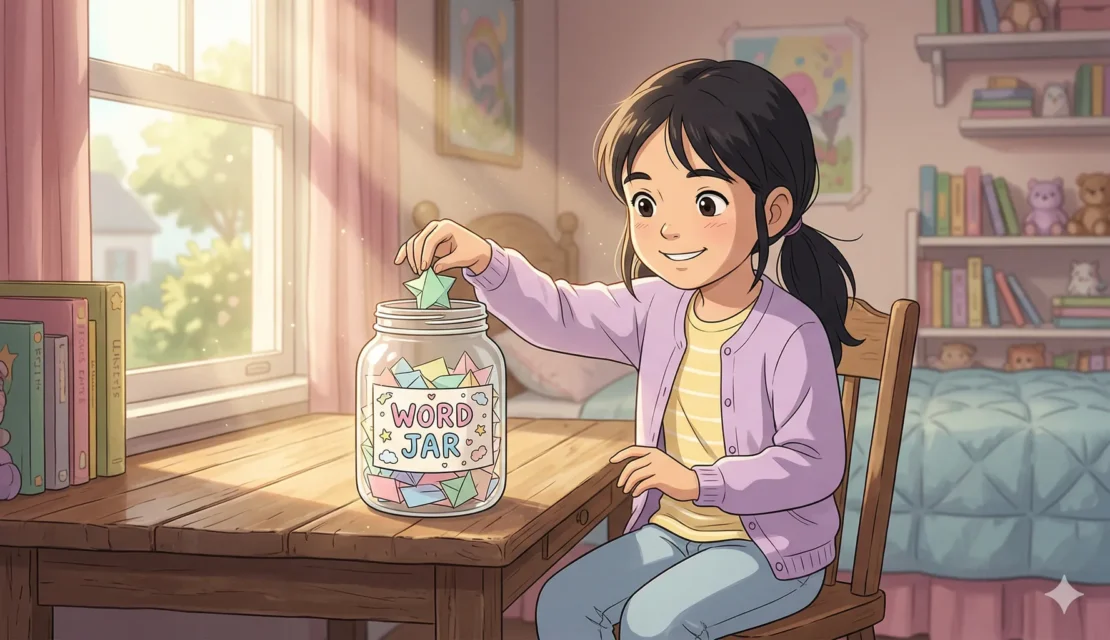
Naya was painfully shy. At school, she barely spoke above a whisper. At home, she communicated mostly through nods and head shakes. Her parents worried, her teachers were concerned, and Naya herself felt trapped inside a bubble of silence.
One afternoon, her grandfather visited from Yogyakarta. He brought her a gift, a small empty glass jar with a wooden lid.
“This is a Word Jar,” he explained. “Every time you want to say something but feel too scared, write it on a piece of paper and put it in the jar. At the end of each week, we will read them together.”
Naya loved the idea. She started filling the jar immediately. “I think the sunset looks like spilled orange juice.” “I want to tell Rina that her drawing is beautiful.” “I wish I could sing in front of the class.”
Each Sunday, her grandfather would call, and they would read the notes together over the phone. He never laughed. He never judged. He just listened and said, “That is a wonderful thought, Naya.”
Slowly, something shifted. The jar gave Naya a voice, even if it was written. And as the weeks passed, she started saying some of those things out loud. First to her parents. Then to her best friend. Then, one remarkable Thursday, she raised her hand in class and answered a question.
Her voice was small. But it was there. And the whole class heard it.
By the time Naya finished primary school, she had filled twelve jars. Her grandfather kept every single one on a shelf in his home. “These,” he would tell visitors, “are the most precious words ever written.”
Moral: Finding your voice takes time, and that is perfectly okay. Every small word counts.
9. The Bridge Builder of Borneo
Two villages sat on opposite sides of a wide river in Borneo. For generations, they had been rivals. The people of Village East said the people of Village West were lazy. The people of Village West said the people of Village East were rude. Nobody remembered how the feud started, but everyone kept it going.
A young boy named Daud lived in Village East. His best friend, Putri, lived in Village West. They had met by accident, both fishing at the same spot where the river narrowed. They did not care about the rivalry. They just liked catching frogs together.
But getting across the river was dangerous. The current was strong, and children were forbidden from crossing. So Daud and Putri could only wave at each other from opposite banks most days.
Daud had an idea. He started collecting bamboo, rope, and old planks. Every day after school, he worked on building a small bridge at the narrow point. Putri saw what he was doing and started building from her side too.
The adults from both villages watched with suspicion. “What are those children doing?” But nobody stopped them, mostly out of curiosity.
After three weeks of work, the two ends of the bridge met in the middle. Daud and Putri high fived right there over the rushing water.
Slowly, cautiously, villagers from both sides started crossing. A grandmother from Village West brought herbal medicine to a sick child in Village East. A farmer from Village East shared his rice harvest with families across the river. The feud, it turned out, had been held together by nothing more than distance.
The village elders eventually reinforced the bridge with proper materials. They named it Jembatan Persahabatan, the Friendship Bridge. And at its center, they carved two small figures: a boy and a girl, reaching toward each other.
Moral: Walls are built by fear. Bridges are built by friendship.
10. Kucing and the Moon
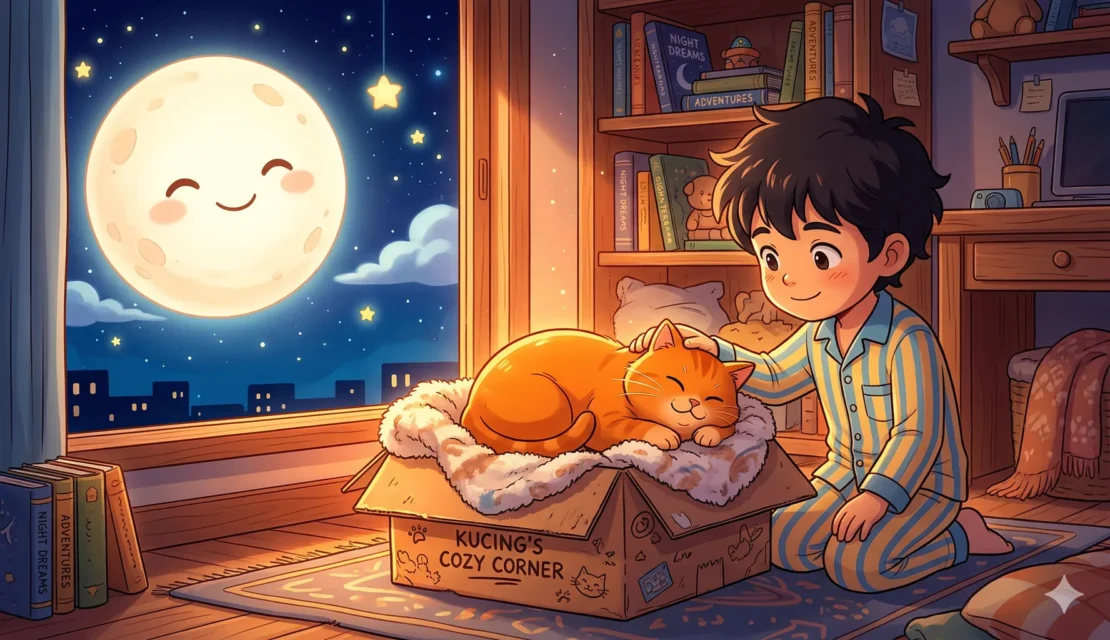
A tiny street cat named Kucing lived under a food stall in Jakarta. She had no owner, no collar, and no name that anyone had given her, so she simply called herself Kucing, which is just the Indonesian word for “cat.”
Every night, Kucing looked up at the moon and meowed. The other stray cats thought she was strange. “Why do you talk to the moon? It cannot hear you.”
“Maybe it can,” Kucing said. “And maybe it is lonely up there, just like me.”
One night, a little boy named Farid, who lived in the apartment above the food stall, heard Kucing meowing. He looked out his window and saw her tiny silhouette against the moonlight. His heart squeezed.
The next evening, Farid left a small dish of warm milk outside the stall. Kucing sniffed it cautiously, then drank every drop. The night after that, Farid sat on the steps and waited. Kucing approached slowly, and for the first time in her life, someone petted her.
Within a week, Kucing had moved from under the stall to a cardboard box Farid had lined with an old towel. Within a month, she was sleeping at the foot of his bed. Within a year, she had grown plump, glossy, and thoroughly spoiled.
She still meowed at the moon sometimes. But now it sounded different. Farid noticed the change one evening. “You are not sad anymore when you meow,” he said.
Kucing purred and nestled closer to him. She was not talking to the moon out of loneliness anymore. She was saying thank you, because the moon had finally sent someone to listen.
Moral: Everyone deserves to be heard. Sometimes all it takes is one person willing to listen.
11. The Painter Who Could Not See Colors
Pak Arman was a beloved art teacher who had a secret he kept from everyone, he was completely colorblind. He saw the world in shades of grey. Yet his paintings were some of the most vibrant in the entire district.
How? He memorized every color by number. Red was tube number 7. Sky blue was number 12. Leaf green was number 3. He labeled each paint tube with braille dots and created his masterpieces through sheer dedication and memory.
A curious student named Zahra discovered his secret when she noticed the tiny dots on his paint tubes. Instead of exposing him, she asked, “Pak Arman, how do you know what beauty looks like if you cannot see colors?”
Pak Arman smiled gently. “Beauty is not about what you see, Zahra. It is about what you feel. When I paint a sunset, I feel warmth. When I paint the ocean, I feel peace. The colors are just the language. The feeling is the message.”
Zahra never told anyone. But she changed the way she painted from that day forward. Instead of copying what she saw, she started painting what she felt. Her artwork became so emotional, so raw, that she won the school art competition that year.
When she accepted her trophy, she thanked Pak Arman publicly. “He taught me that art comes from the heart, not the eyes.”
The audience applauded, and Pak Arman, sitting in the back row, wiped a tear he could not see the color of but could feel perfectly well.
Moral: Limitations do not define you. How you rise above them does.
12. The Boy Who Collected Sounds

Rizki carried a small tape recorder everywhere. While other kids collected trading cards or marbles, Rizki collected sounds. The crunch of gravel under bicycle tires. The call to prayer echoing at dawn. His grandmother humming while she cooked rendang.
“Why do you record all that noise?” his classmates asked.
“They are not noise,” Rizki said firmly. “They are memories you can hear.”
When Rizki’s family moved from their kampung to a new apartment in the city, he felt lost. The sounds were all wrong, honking cars, construction drills, neighbors arguing through thin walls. He missed the roosters, the rustling bamboo, the sound of rain on a zinc roof.
One night, feeling homesick, he played his recordings. His grandmother’s humming filled the small apartment. The bamboo rustled through tiny speakers. The evening crickets sang their familiar song.
His mother walked in and stopped. Tears rolled down her cheeks, but she was smiling. “Play it again,” she whispered.
Rizki played his collection every evening after that. The apartment began to feel less foreign. The sounds of their old home mixed with the new ones, and slowly, the city became familiar too.
Years later, Rizki became a sound engineer for films. He specialized in creating soundscapes that made audiences feel like they were really there. When interviewers asked where his talent came from, he always said the same thing: “I learned early that the most important things in life are not things you see. They are things you hear and hold in your heart.”
Moral: Home is not just a place. It is a collection of moments that live inside you.
13. Lili’s Lunchbox Letters
Every day, Lili opened her lunchbox to find a small folded note from her mother tucked between the rice and the fruit. “You are braver than you think.” “Your smile is my favorite thing in the world.” “Remember, even rainy days make flowers grow.”
Lili loved those notes more than the food itself. She kept every single one in a shoebox under her bed.
When Lili’s mother had to travel overseas for work for three whole months, Lili was devastated. But on the first morning, she opened the freezer and found ninety frozen meals, each in a labeled container. And inside every single one, there was a note.
Her mother had planned ahead. Ninety meals. Ninety messages of love.
Lili would defrost one each morning, read the note at lunch, and feel her mother’s warmth across the ocean. “Day 34: I bet you aced your spelling test.” “Day 51: Tell Papa his cooking is great, even if it is a little burnt.”
When her mother finally came home, Lili ran to her with the shoebox. It now contained over two hundred notes, the originals plus the frozen ones. “I kept them all, Mama.”
Her mother held the box like it was made of gold. “And I will keep writing them,” she promised. “Even when I am right here beside you.”
She kept that promise. And years later, when Lili went off to university, she packed the shoebox first, before clothes, before books, before anything else.
Moral: Love does not need to be grand. Sometimes it fits perfectly inside a lunchbox.
14. The Tree That Told Time
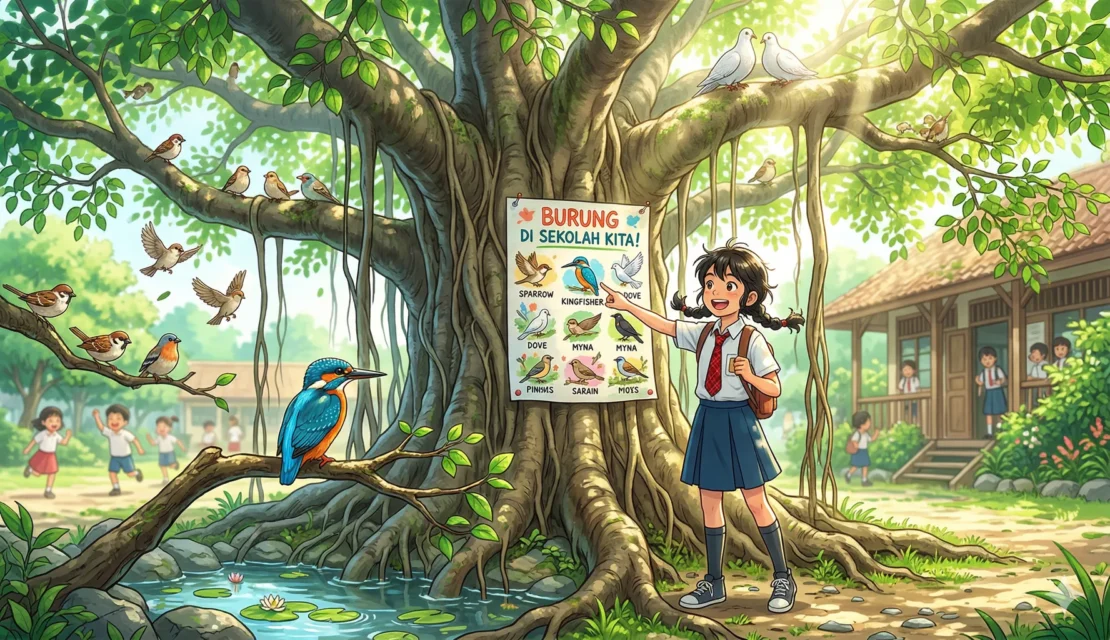
In the schoolyard of a small elementary school in Bandung stood an enormous banyan tree that everyone called Kakek, which means grandfather. It had been there longer than anyone could remember.
The children discovered something peculiar about Kakek. Depending on the time of day, different birds would perch on specific branches. At 7am, the sparrows arrived on the lowest branch. At noon, a kingfisher visited the branch overlooking the pond. At 3pm, a pair of doves cooed from the highest limbs.
A clever girl named Bulan mapped the entire schedule. She pinned a chart to the classroom wall: “Kakek’s Living Clock.” The teachers were amazed.
But one week, the birds stopped coming. Every branch was empty. The children panicked. “Kakek is sick!” Bulan investigated and discovered that someone had been dumping chemical waste behind the school fence, and it was seeping into the soil near the tree’s roots.
Bulan rallied her classmates. They wrote letters to the local government. They made posters. They even organized a small march around the school block, tiny feet stomping with enormous determination.
The waste was cleaned up within a month. And slowly, one by one, the birds returned. First the sparrows. Then the kingfisher. Finally, the doves.
The day Bulan heard the doves coo again from the highest branch, she looked at her watch. It was exactly 3pm. Kakek’s clock was running perfectly again.
Moral: When we protect nature, nature keeps its promises to us.
15. The Shoes That Walked Themselves
Adi owned exactly one pair of school shoes, and they were falling apart. The sole flapped like a tired mouth with every step, making an embarrassing “thwack thwack” sound in the hallway.
His family could not afford new ones. So Adi did something remarkable. He borrowed glue, thread, and a needle from his neighbor, and he fixed them himself. He watched three tutorial videos on his mother’s phone and stitched those shoes back together with the focus of a surgeon.
They were not pretty. The stitching was crooked, and there was a visible glob of glue on the left toe. But they held. And Adi walked into school the next day with his head high.
A classmate pointed and laughed. “What happened to your shoes?”
Adi looked down, then back up. “I fixed them myself,” he said, not with shame, but with quiet pride.
The teacher overheard and asked Adi to show the class during sharing time. He stood in front of everyone and explained how he repaired each part: the sole, the strap, the worn heel. By the end, the class was not laughing. They were clapping.
That afternoon, three other students brought in broken items from home, a pencil case with a torn zipper, a backpack with a missing buckle, a thermos with a loose cap. Adi helped fix them all.
By the end of the term, the school had started a “Fix It Club,” with Adi as the president. And those patched up shoes? They lasted two more years. Adi eventually outgrew them, but he never threw them away.
Moral: Resourcefulness is not a sign of poverty. It is a sign of strength.
16. The Grandmother Who Raced the Rain

Nenek Tuti was seventy-three, had a bad knee, and absolutely refused to carry an umbrella. Every afternoon, the tropical rain would roll in, and Nenek Tuti would try to walk home from the market before it hit.
She never made it. Every single day, she arrived home drenched, laughing like a child, bags of vegetables dripping.
Her granddaughter, Wulan, begged her to take an umbrella. “Nenek, please. You will catch a cold.”
Nenek Tuti winked. “The rain and I have a deal. It tries to catch me, and I try to outrun it. I always lose, but the game is the fun part.”
Wulan did not understand. Not until the year Nenek Tuti’s knee got worse, and she could no longer walk to the market at all. Wulan took over the shopping duties.
On her first trip back from the market, the sky darkened. Rain threatened. Wulan had an umbrella in her bag. But something made her leave it there. She walked faster. The first drops fell. She broke into a jog, bags bouncing, laughing as the rain soaked her hair.
She burst through the front door, dripping and grinning. Nenek Tuti, sitting in her chair by the window, clapped her hands with delight. “You understand now!”
And Wulan did. It was never about the rain. It was about finding joy in the small, silly, everyday moments that most people rush past.
Moral: Life is not about avoiding the storms. It is about learning to dance, or at least jog, in the rain.
17. The Library Fish
The school library had a fish tank with a single goldfish named Buku, which means “book.” Nobody remembered who put him there or why he was named after a book, but Buku had been swimming in lazy circles beside the reading corner for as long as anyone could remember.
Children swore that Buku could tell when someone was reading a good book. When a student read something exciting, Buku would swim in fast, happy loops. When someone struggled through a boring textbook, Buku would sink to the bottom and barely move.
The librarian, Ibu Mega, thought it was nonsense. But she kept a secret tally, and after three months, the correlation was alarmingly accurate.
One quiet afternoon, a boy named Galih sat in the corner reading a story about a pirate who sailed the seven seas looking for his lost parrot. Buku went absolutely wild, looping and splashing. Galih had never seen the fish so excited. He laughed so hard he snorted.
“Ibu Mega, Buku loves this book!”
The librarian walked over, looked at the fish, and smiled. “Then it must be a very good one.”
From then on, students started choosing their books based on Buku’s reactions. They would hold up different covers to the tank and watch. If Buku swam, they checked it out. If Buku sank, they moved on.
The library’s borrowing rate tripled that year. And Buku? He became the most popular literary critic in the entire school, possibly the only goldfish to ever hold that title.
Moral: Sometimes inspiration comes from the most unexpected places. Stay curious and open.
18. The Kite That Refused to Fall

Every August, the children of a coastal village in Bali held a kite festival. Hundreds of colorful kites filled the sky, dancing in the ocean breeze. But the competition was fierce, and the goal was simple: the last kite flying wins.
A girl named Citra entered with a kite she had built from newspaper and bamboo sticks, nothing compared to the fancy store bought kites with reinforced frames and aerodynamic tails.
Within the first hour, half the kites had crashed. Within two hours, only a dozen remained. By late afternoon, just three were left: two expensive imported kites and Citra’s newspaper creation.
The wind shifted and grew stronger. One imported kite snapped in half and plummeted. The crowd gasped. Minutes later, the second one tangled in its own string and spiraled into the ocean. The spectators turned to Citra’s humble kite, still wobbling but stubbornly airborne.
“How is that thing still up there?” someone shouted.
Citra grinned, her arms aching from holding the string. “She is light. She bends with the wind instead of fighting it.”
The newspaper kite won the festival. Citra received a small trophy and a round of applause that echoed across the beach. But the best prize was what an old kite maker told her afterwards: “The strongest thing in the world is not the thing that never bends. It is the thing that bends and does not break.”
Citra wrote that line on her trophy with a marker. She kept it on her shelf for the rest of her life.
Moral: Flexibility and resilience will carry you further than brute strength ever will.
19. Papa’s Burned Pancakes
Every Sunday morning, Dion’s father attempted to make pancakes. And every Sunday morning, they were burned. Not a little crispy around the edges burned, but charcoal black, smoke alarm screaming, windows thrown open kind of burned.
Yet every Sunday, Dion ate them. Every. Single. One.
His mother once whispered, “You do not have to eat those, you know. I can make you toast.”
Dion shook his head. “Papa makes them for me. That is the important part.”
His father worked long hours during the week. Sundays were the only mornings he had free. He would wake up early, tie on an apron covered in old stains, and try his absolute best. The batter was always lumpy. The heat was always too high. The results were always the same.
But the look on his father’s face when he placed that plate on the table, proud, hopeful, a little nervous, that was worth every burnt bite.
One Sunday, Dion left a note on the kitchen counter before going to school: “Dear Papa, your pancakes are terrible. But Sundays are my favorite day because of you. Love, Dion.”
His father found the note that evening. He laughed until he cried. The next Sunday, the pancakes were slightly less burned. Not good, but less burned. Progress.
And Dion ate every single one, just as he always had.
Moral: Love is not about perfection. It is about showing up, trying, and knowing someone appreciates the effort.
20. The Stars in Nola’s Ceiling
Nola was afraid of the dark. Every night, she would cry until her parents left the hallway light on, which meant nobody in the house slept well.
Her older brother, Rama, who was only nine himself, decided to help. He saved his pocket money for three weeks, bought a packet of glow in the dark star stickers, and spent an entire Saturday afternoon sticking them to Nola’s ceiling.
He did not just stick them randomly. He looked up actual constellations online and mapped them carefully: Orion, the Big Dipper, Scorpius. He even labeled them with tiny pieces of tape.
That night, when the lights went off, Nola’s ceiling came alive. Dozens of soft green stars glowed above her, forming patterns and shapes she had never seen before.
She did not cry. She stared. She pointed. She whispered, “Rama, which one is that?”
“That is Orion,” he said, lying on the floor beside her bed. “He is a hunter. He protects people at night.”
“He protects me?”
“Always.”
Nola fell asleep within minutes. And for the first time in months, the hallway light stayed off.
Over the following weeks, Rama taught Nola all the constellations. She became fascinated by space, by planets, by the idea that the universe was so much bigger than her dark room. The fear did not just go away. It was replaced by wonder.
On Nola’s birthday that year, she made one wish: “I want to see the real stars.” Her parents drove the family out of the city to a hill where the sky was clear and dark. Nola lay on a blanket, looked up, and saw the same constellations her brother had stuck on her ceiling, but this time they were infinite.
She reached over and squeezed Rama’s hand. “You gave me the stars,” she said.
He squeezed back. “You always had them. I just showed you where to look.”
Moral: The greatest gift you can give someone is not removing their fear, but replacing it with wonder.
Why Short Stories Matter for Your Child’s Growth
If you have made it through all twenty of those tales, you have probably noticed a theme: every single story is about connection, courage, and kindness. These are the exact values we nurture daily at Apple Tree Pre-School BSD. Short stories are not just entertainment. They build vocabulary, spark empathy, and help children understand their own emotions in a safe, playful way.
At Apple Tree, storytelling is woven into our Singapore based curriculum across multiple subjects, from English and Phonics to Social Studies and Moral education. We believe that when children hear good stories, they learn to write their own, both on paper and in life.
Whether your little one is a toddler just beginning to absorb language or a Kindergarten 2 student preparing for primary school, our programs are designed to meet them exactly where they are. Located in the Educenter BSD Building, our classrooms are warm, welcoming, and full of stories waiting to be shared.
Start Your Child’s Story With Us
We would love to be part of your family’s next chapter. If these short stories sparked something in you, imagine what a nurturing, story rich learning environment could do for your child every single day. Come play, learn, and grow with us at Apple Tree Pre-School BSD.
Register now and let your child’s adventure begin! Chat with us on WhatsApp or call us directly at +62 888-1800-900. We cannot wait to meet your little one.





Be the first to write a comment.