

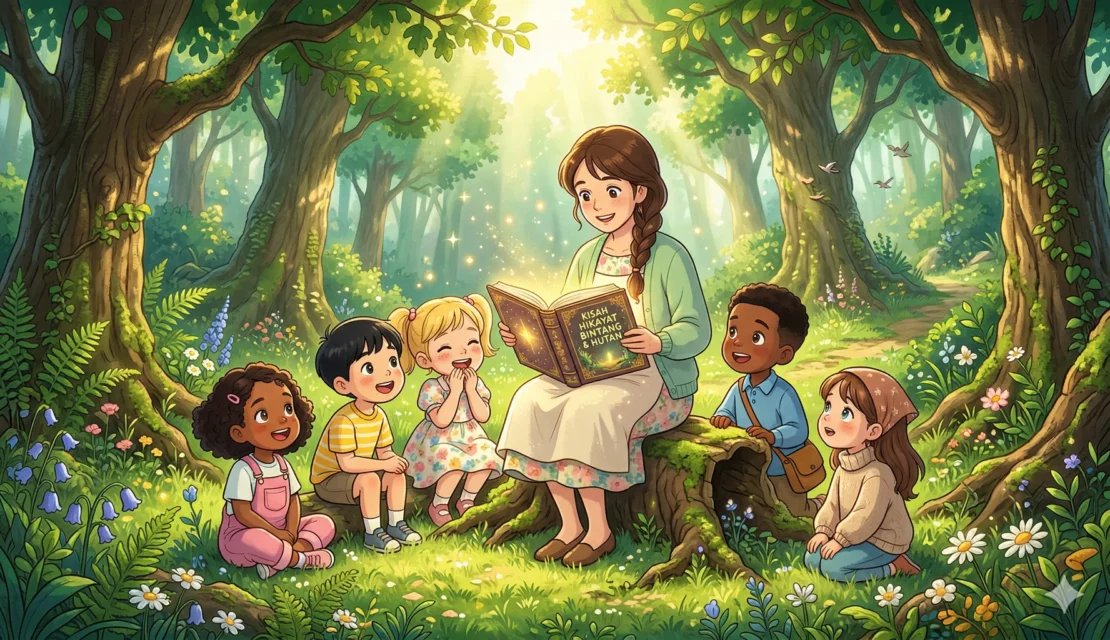
What if the most important lessons your child ever learns don’t come from a textbook, but from a story told at bedtime? We’ve seen it happen over and over again here at Apple Tree Preschool BSD. A child hears a story, their eyes go wide, and something just clicks. That’s the magic of moral stories.
Moral stories for kids have been around for centuries, and honestly, there’s a good reason they’ve stuck around. They reach children in a way that lectures and rules simply can’t. Whether your little one is 2 or 6, a well-told story plants a seed of values that can last a lifetime.
We’ve put together 10 of our favourite moral stories, each one expanded into a full, rich narrative you can read aloud, share at dinner, or snuggle up with before lights out. Let’s dive in!
10 Timeless Moral Stories for Kids
Explore kindness, honesty, courage, and more through these classic moral stories, fables, and short story with moral lessons for children of all ages.
1. The Boy Who Cried Wolf
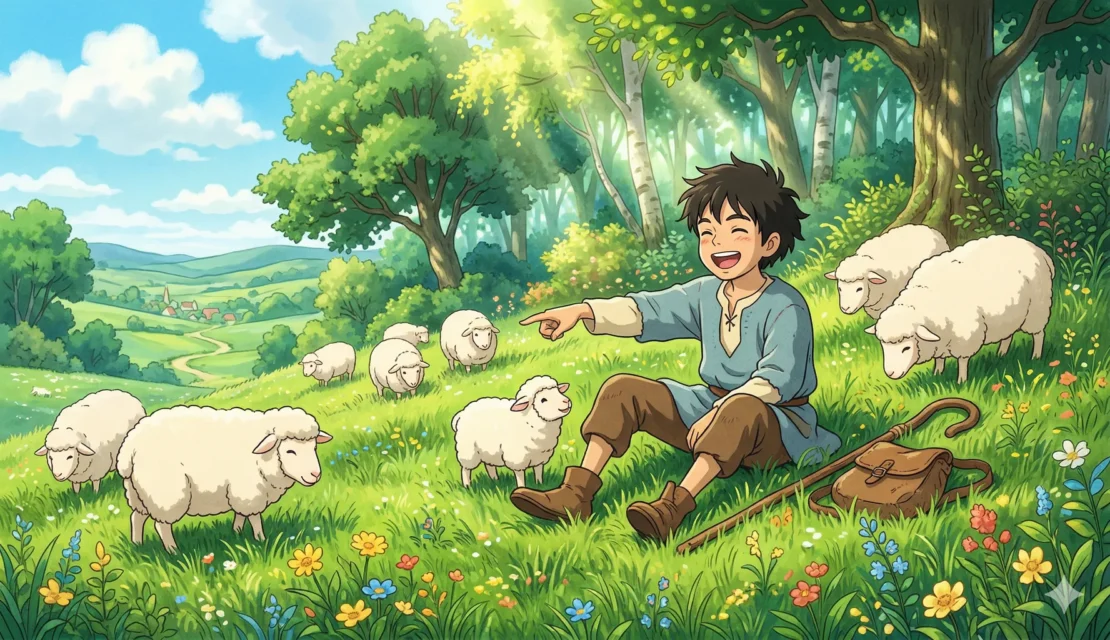
High up on a grassy hill just outside a small village, there lived a young shepherd boy named Theo. His job was simple: watch over the village sheep and make sure none of them wandered off or got eaten by wolves. It wasn’t exactly the most exciting job for a boy his age, and most days, all he had for company were a few dozen woolly sheep and the sound of the wind.
One quiet afternoon, Theo was so bored he could barely keep his eyes open. The sheep were just grazing, as they always did. Nothing was happening. Nothing ever happened. And that’s when the idea crept into his head like a mischievous little bug.
He took a deep breath and screamed at the top of his lungs, “WOLF! WOLF! There’s a wolf chasing the sheep!”
Within minutes, the farmers and villagers came sprinting up the hill, armed with rakes and sticks, faces red and puffing. They looked around. They looked behind the bushes. They checked behind every rock. And then they looked at Theo, who was doubled over laughing.
“There’s no wolf,” one farmer said flatly.
“He was just bored,” said another, shaking her head.
They trudged back down the hill, grumbling. Theo thought it was the funniest thing that had ever happened.
A week later, the boredom came back. And so did the prank. “WOLF! WOLF!” he screamed again. Again, the villagers came running. Again, there was no wolf. Again, Theo laughed. This time, the villagers didn’t even stay to scold him. They just turned around and walked back down, muttering to themselves.
Then one afternoon, while Theo was watching the sky turn orange, he heard a rustling in the bushes. His stomach dropped. Out from the shadows crept a large, grey wolf, its yellow eyes fixed on the flock. Theo scrambled to his feet.
“WOLF! WOLF! Please, there really IS a wolf this time!” he screamed, louder than he ever had before.
The villagers heard him. They paused, looked up at the hill, and went back to what they were doing.
“He’s at it again,” someone muttered.
By the time anyone bothered to climb up to check, the wolf was gone, and so were nearly half the sheep. Theo sat alone on the hill, crying. When the village elder finally came up and found him, the old man sat down beside him and said quietly, “You see now, don’t you? When you lie, even the truth sounds like a lie.”
Theo never forgot those words.
Moral: Lying destroys trust, and once it’s gone, it’s very hard to get back.
2. The Golden Touch
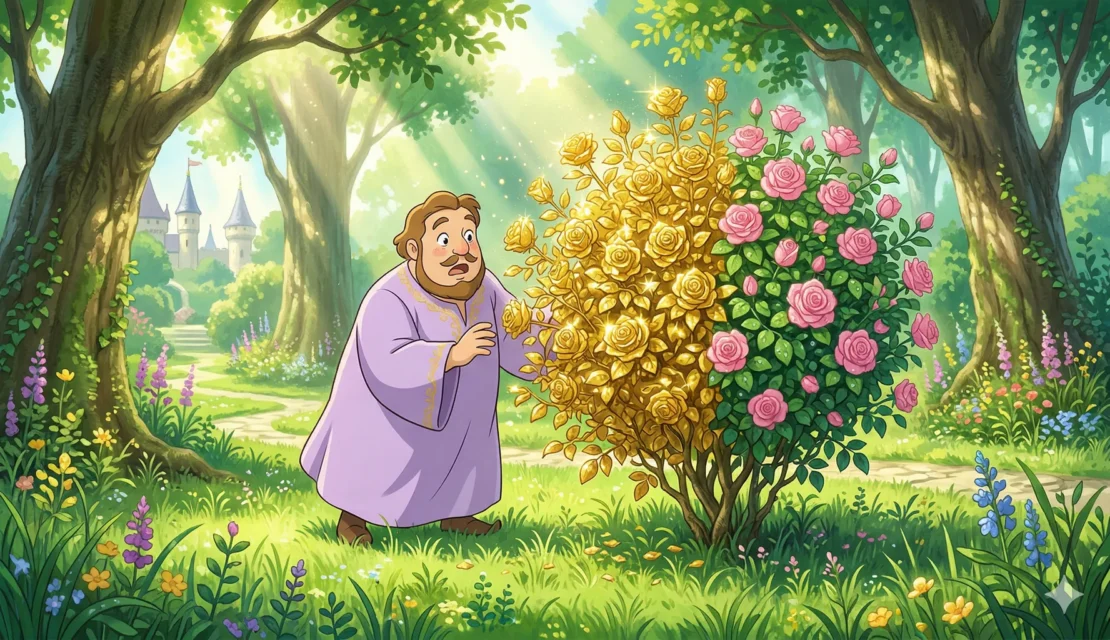
Long ago in ancient Greece, there lived a king named Midas who had everything a man could want: a grand palace, loyal servants, beautiful gardens, and a daughter he loved more than anything in the world. And yet, Midas was never satisfied. More than anything, he loved gold.
One day, while walking through his garden, Midas found a satyr, a magical creature, sleeping under a rosebush. Out of the goodness of his heart, Midas gave the satyr food and water and let him rest safely. When the satyr woke, he was so grateful that he told Midas his master, the great god Dionysus, would grant him any wish he desired.
Midas didn’t even need to think about it.
“I want everything I touch to turn to gold,” he said, beaming.
Dionysus looked at him sadly. “Are you certain, Midas? Please think carefully.”
But Midas waved away the warning. “Absolutely certain!”
The next morning, Midas woke up and reached for his bedsheet. Gold. He touched the bedpost. Gold. He ran into the garden laughing, turning flowers and fountain water and garden stones into gleaming, shining gold. He felt like the richest man who had ever lived.
Then he sat down to eat breakfast. He picked up a piece of bread and bit into it. His teeth clanged against solid gold. He reached for his cup of water. Gold the moment it touched his lips. His stomach growled. He was starving but couldn’t eat a single thing.
Just then, his young daughter came bounding into the room and threw her arms around him.
“Papa!”
Midas felt it instantly. A horrible stillness. He looked down. His daughter, his beloved girl, had turned into a golden statue, her arms still outstretched in a hug that would never be completed.
Midas sank to his knees and wept. No amount of gold in the world meant anything without her.
He begged Dionysus to take back his wish. The god, though saddened, agreed, and told Midas to wash his hands in the river to break the curse. Midas ran to the river and washed it all away. His daughter was restored. He held her so tightly that day.
From then on, Midas never complained about what he had. He had learned the hardest lesson of his life.
Moral: Greed can cost you everything that truly matters.
3. The Fox and the Grapes
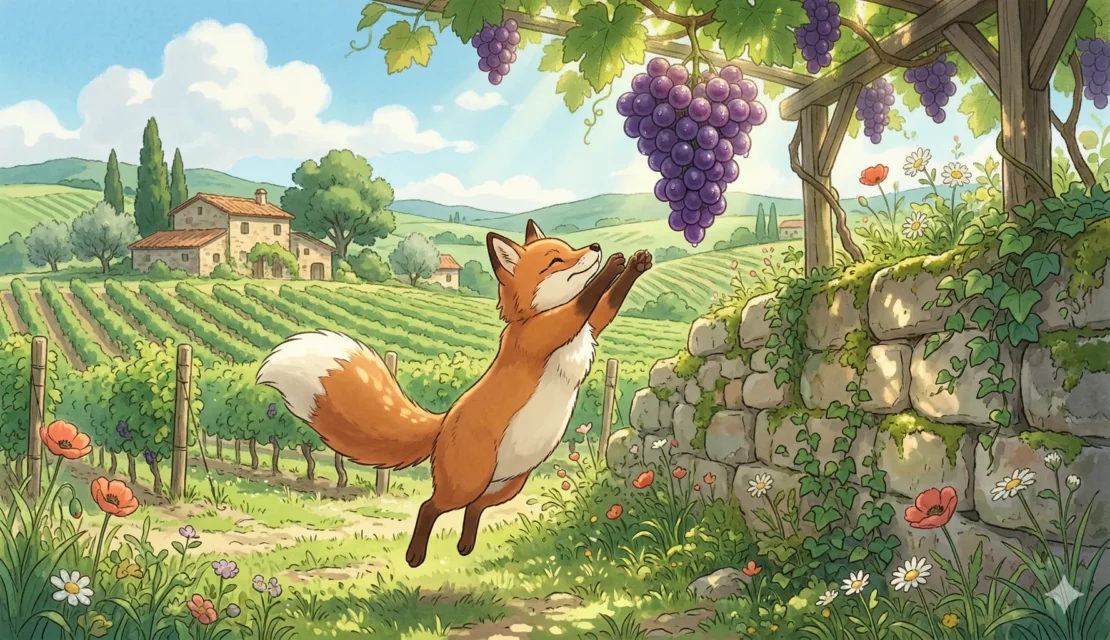
On a warm summer afternoon, a young fox was trotting through the countryside, his belly rumbling fiercely. He had been searching for food since morning and had found absolutely nothing. The sun was beating down on his rusty fur, and he was starting to feel rather sorry for himself.
Then, just as he rounded a bend in the path, he spotted it. Hanging over an old stone wall was the most magnificent bunch of grapes he had ever seen. They were plump and round, deep purple in colour, glistening like little jewels in the afternoon sunlight. His mouth began to water immediately.
“Perfect,” he said to himself, licking his lips. “Those grapes are exactly what I need.”
He trotted over to the wall and looked up. The grapes were hanging just a little too high. He backed up, took a running leap, and snapped his jaws shut. He caught only air. He landed in an undignified heap, shook himself off, and tried again.
This went on for quite some time. He leaped from the left. He leaped from the right. He tried to climb the wall, but it was too smooth. He backed up further for a bigger run and still missed.
After what felt like an hour of jumping, the fox was exhausted, embarrassed, and absolutely no closer to the grapes.
A passing crow watched from a tree branch with great amusement.
Finally, the fox stopped. He smoothed down his fur, stood up tall, and trotted away down the path with his nose in the air.
“Those grapes were probably sour anyway,” he called out to no one in particular. “I didn’t really want them.”
The crow raised an eyebrow. “You spent an hour trying to get them,” she pointed out.
“Sour,” the fox repeated firmly, and disappeared around the bend.
But deep down, the fox knew perfectly well that the grapes had looked absolutely delicious. He had simply found it easier to pretend he didn’t want what he couldn’t have, rather than admit he hadn’t tried hard enough.
Moral: It’s easy to pretend you don’t want what you can’t have. But real growth comes from trying harder, not making excuses.
4. The Proud Rose

In the middle of a wide, flat desert, where the sun was relentless and the sand stretched on forever, there grew a single red rose. She was strikingly beautiful. Her petals were the deepest crimson, her scent was intoxicating, and she knew it. Oh, she knew it very well.
Right next to her grew a cactus, round and bumpy, covered in sharp spines, as plain and unglamorous as a plant could possibly be. The rose took every opportunity to remind the cactus of this fact.
“You know,” the rose said one morning, looking the cactus up and down, “I don’t understand why you even bother existing. You’re prickly, you’re ugly, and you offer absolutely nothing beautiful to the world. I, on the other hand, am clearly the most magnificent plant in this desert.”
The cactus didn’t say much. The other desert plants would sometimes try to defend him, but the rose was too busy admiring her own reflection in a nearby puddle to listen.
This went on for months. The rose bloomed brilliantly and continued her commentary, and the cactus quietly went about his business.
Then came a summer so brutally hot that even the toughest desert plants began to struggle. No rain came for weeks. The puddles dried up. The sand shimmered with heat. The rose began to wilt. Her petals drooped. Her brilliant colour faded. She desperately needed water, but there was none to be found.
Then she noticed something. Every morning, a small sparrow would land on the cactus and peck at it gently. The cactus would release a tiny trickle of water, and the bird would drink, chirp happily, and fly away. Other birds came too. The cactus, quietly and without any fuss, was keeping them all alive.
The rose looked at him for a long moment. Then, very quietly, she asked, “Could I… could I have some water too? Please?”
The cactus, who had been insulted every day for months, looked at her gently and said, “Of course.”
Moral: True beauty is found in kindness and character, not appearance. Never judge others by how they look.
5. The Milkmaid and Her Pail
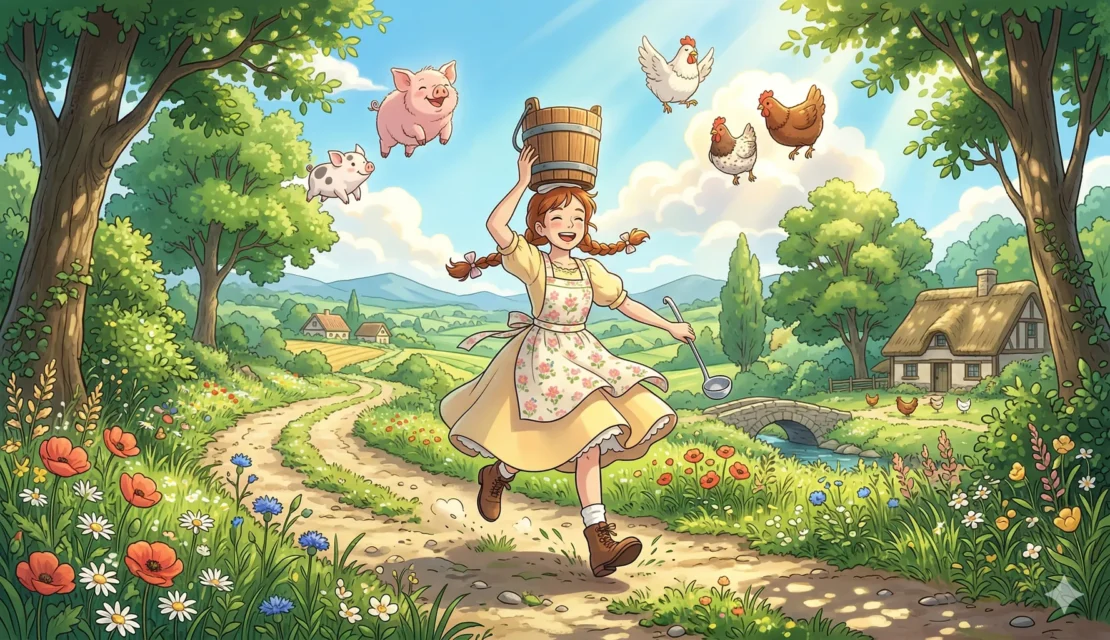
In a small green valley, there lived a cheerful young milkmaid named Molly. Every morning, without fail, she was up before the sun, out in the barn, and milking the cows with a song on her lips. She loved her work, even if it was simple.
One bright Tuesday morning, Molly had managed to fill her pail almost to the brim with fresh, creamy milk. She balanced it carefully on her head and set off down the winding road toward the market, her boots crunching on the gravel path.
As she walked, her mind began to wander. If I sell all this milk today, I’ll earn a nice bit of money. And with that money… I could buy some eggs. And if I bought eggs and hatched them, I’d have a dozen chickens!
She smiled to herself and walked a little faster.
And if I had a dozen chickens, I could sell their eggs every week. I’d earn twice as much! And then I could buy a piglet and fatten it up and sell it at the market!
She was practically skipping now, her head full of grand plans.
And with the money from the pig, I could buy a beautiful new dress. A yellow one, with ribbons. And when I walk into the village in my new dress, that snooty Margaret from down the lane will be so jealous, and I’ll just toss my head and walk right past her like this, and…
Molly tossed her head triumphantly.
The pail tipped. The milk splashed over her head, soaked her clothes, and poured down the road in a white river. She stood there, dripping, staring at the empty pail at her feet.
There was no milk. No money. No eggs. No chickens. No pig. No yellow dress with ribbons.
When she got home and told her mother what happened, her mother just sighed and said, “Oh Molly, love. Don’t count your chickens before they hatch.”
Moral: Don’t build plans on things that haven’t happened yet. Focus on what’s in front of you.
6. The Wise Old Owl
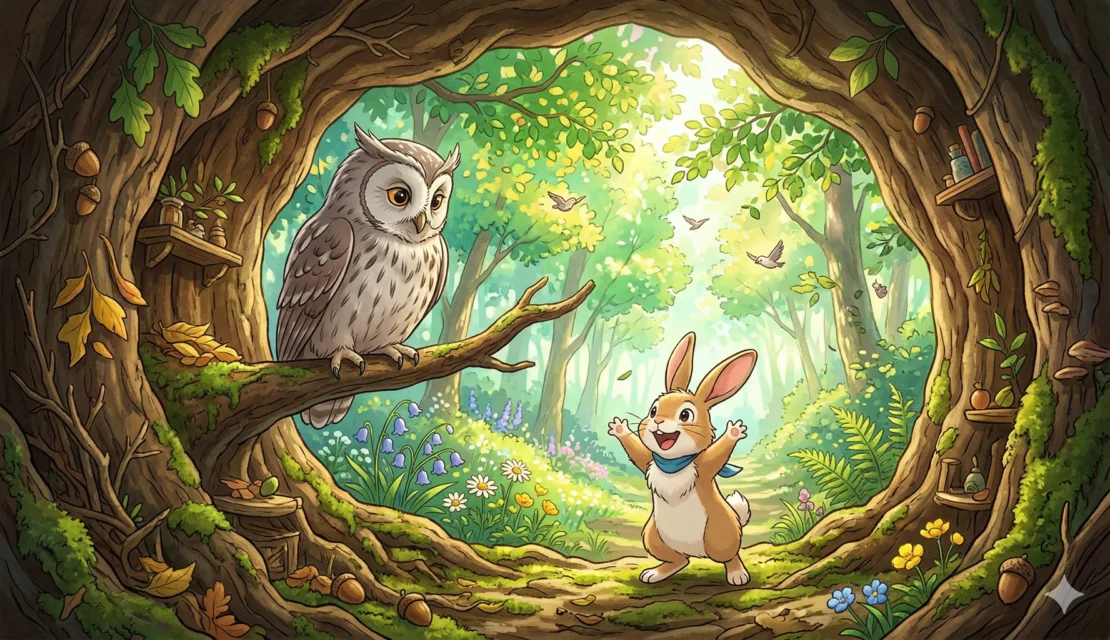
Deep in a forest of tall oak trees, there lived an owl who was known throughout the woods simply as Old Oliver. He had lived in his tree for so long that the bark had grown around the hollow he called home. His feathers were streaked with silver, and his eyes, though old, missed absolutely nothing.
What made Old Oliver famous was not his age, though. It was his wisdom. Animals came from far away to ask him questions and to seek his advice. And yet, if you spent a day watching him, you might wonder where all this wisdom came from, because Old Oliver spent most of his day doing two things: watching and listening.
A young rabbit named Pip came to visit him one afternoon. Pip was the type of rabbit who had an opinion about everything and was never shy about sharing it. He bounced up to Oliver’s tree, chattering away before he’d even said hello.
“Oliver! Oliver! I’ve been all over the forest today and I have so much to tell you. I saw the deer arguing over the meadow again, and the squirrels are hiding nuts in the wrong spots, and the beaver’s dam looks like it might fall, and honestly, everyone in this forest is making terrible decisions and…”
Oliver blinked slowly from his branch.
Pip finally paused for breath. “Don’t you have anything to say?”
“Mm,” said Oliver.
“That’s it? Just ‘mm’?”
Oliver tilted his head. “I heard the deer. I’ve been watching the squirrels for three seasons. I noticed the dam last week.” He paused. “I just didn’t feel the need to announce all of it.”
Pip sat down slowly. “How do you know so much?”
“Because I spend more time watching and listening than I do talking,” Oliver said simply. “Every creature you pass has something to teach you, if you stop talking long enough to hear it.”
Pip’s ears drooped slightly. He sat quietly for a moment, actually quiet, and looked around the forest. He noticed things he’d never seen before.
Moral: You learn far more by listening and observing than by talking. Wisdom grows in the quiet.
7. The Golden Egg
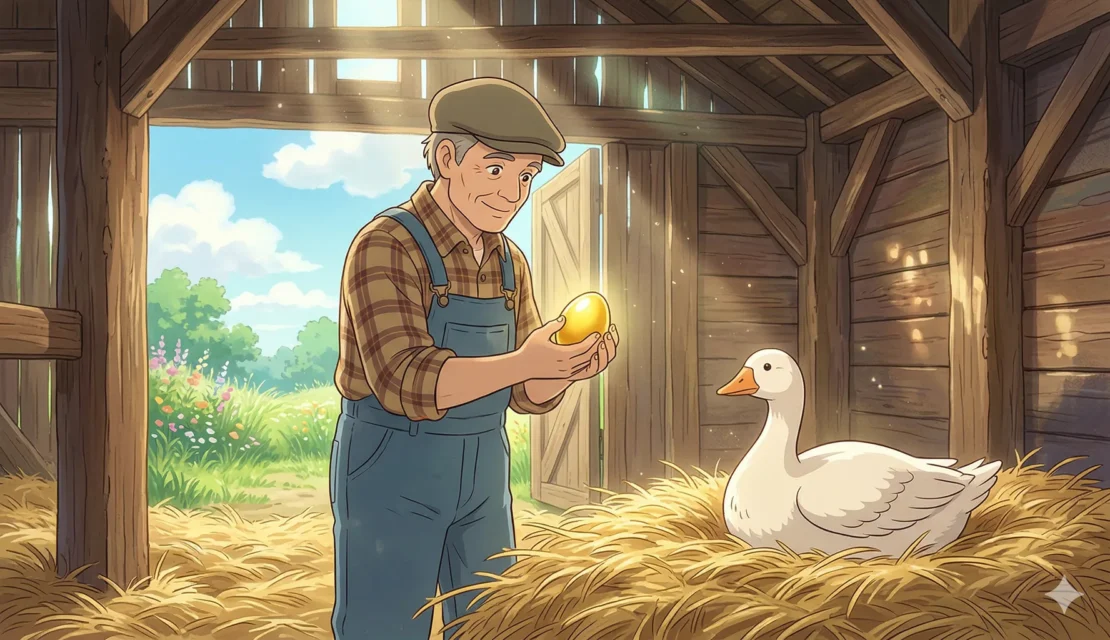
Once there was a farmer named Harold who had a rather ordinary life until the morning he went to check on his geese and found something extraordinary waiting for him in the nest. One of his geese, a plump and placid bird he called Ginger, had laid a perfect, gleaming golden egg.
Harold turned it over in his hands, certain he was dreaming. He wasn’t. He sold the egg that afternoon for more money than he’d made in a whole month.
The next morning, he ran to the barn before breakfast. Another golden egg. And the morning after that, another. Day after day, reliable as sunrise, Ginger produced one perfect golden egg.
Harold and his wife lived well. They fixed the roof, bought new boots, ate good meals. Life was comfortable. And for a little while, Harold was content.
But then one night, lying in bed, a thought crept into his head. One egg a day is wonderful. But imagine if I could get all the eggs at once. There must be dozens inside her. Maybe hundreds. We’d be the richest people in the county!
He nudged his wife awake and whispered the plan to her. She was half asleep and mumbled “if you think so, dear,” and that was enough for Harold to convince himself it was a good idea.
The next morning, Harold went to the barn with a determined look and a very sharp decision. He would not explain what happened next in great detail. But when he was done, he had no golden eggs, no golden nest inside, and no Ginger.
He sat in the barn for a long time. Then he walked slowly back to the house.
“Well?” asked his wife.
Harold sat down at the kitchen table. “We’ve made a terrible mistake,” he said quietly.
They never recovered what they had. The comfortable life, the golden eggs, the steady happiness. It was all gone, traded for a moment of impatience and greed.
Moral: Think carefully before acting out of greed. What you already have may be more precious than what you’re chasing.
8. The Needle Tree
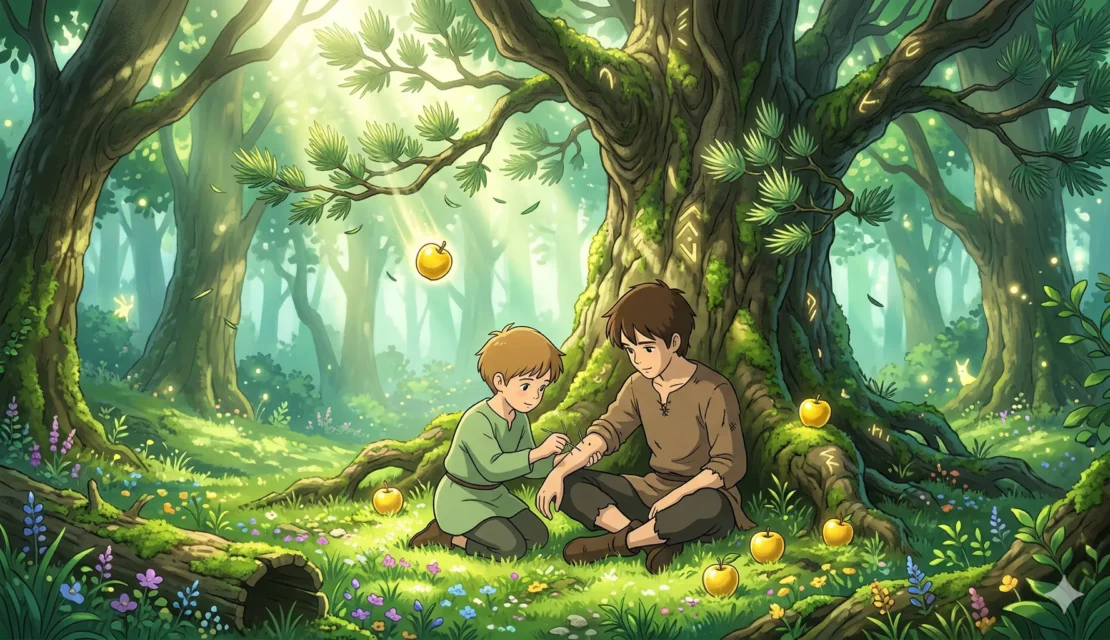
At the edge of a quiet village lived two brothers named Edmund and Eli. Edmund was the elder, and he had made it a lifelong habit to take full advantage of that fact. He borrowed Eli’s things without asking, took the bigger portion at meals, and never passed up an opportunity to remind his younger brother that he was, in his own opinion, the more impressive of the two.
Eli, for his part, had learned to be patient. He helped Edmund when he could, kept his complaints to himself, and tried to see the good in his brother, even when it was well hidden.
Both brothers made a living chopping firewood in the forest and selling it at the village market. One autumn morning, Edmund ventured deeper into the forest than usual, looking for the biggest trees. He found himself in a clearing he had never visited before, standing in front of the most enormous tree he had ever seen.
But before his axe could swing, the tree spoke.
“Please,” said the tree, in a voice like rustling leaves, “I am a magical tree. If you spare me, I will give you golden apples each day.”
Edmund lowered his axe, eyebrows raised. “Golden apples? How many?”
The tree produced five gleaming apples and placed them gently in Edmund’s hands.
Edmund looked at them. Then he looked at the tree. “That’s not enough,” he said flatly, and raised his axe.
The tree, without another word, let loose a shower of sharp needles that embedded themselves all over Edmund’s arms and legs. He yelped and collapsed in the undergrowth, unable to move.
Hours passed. When Edmund didn’t return, Eli went looking for him. He found his brother lying in the leaves, covered in needles, whimpering and proud in equal measure.
Without a word of reproach, Eli sat down beside Edmund and began, one by one, carefully removing every needle. It took a long time. Edmund winced with each one but didn’t speak.
When the last needle was out, Edmund looked at his brother. Really looked at him. “I’ve not been very kind to you,” he said at last.
Eli just smiled. “I know.”
The magical tree, which had witnessed everything, quietly placed a basket of golden apples at their feet.
Moral: Kindness, even when it isn’t deserved, is always worth giving. And it is always rewarded.
9. Controlling Anger
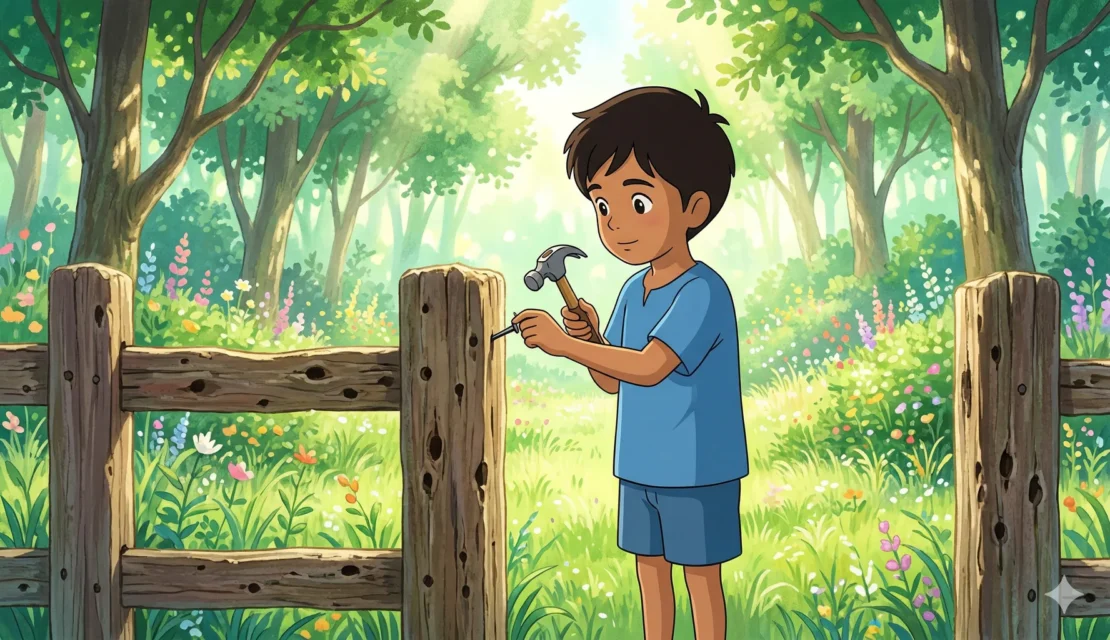
There once was a boy named Rajan who had a temper that arrived fast and left damage behind it. When things didn’t go his way, when someone said something he didn’t like, when he lost a game or couldn’t figure something out, the anger came rushing up like a wave and out it came in sharp, hurtful words. He didn’t mean to hurt people. The words just came out before he could stop them.
His father watched this for a long time. He didn’t scold. He didn’t lecture. One afternoon, he came home with a box of nails and a hammer.
“Come with me,” he told Rajan.
He led him to the wooden fence at the back of their garden.
“Every time you lose your temper today,” his father said, “I want you to come out here and hammer a nail into this fence.”
Rajan thought this was a slightly odd assignment but went along with it. That first day, he hammered in seventeen nails.
The days that followed saw fewer nails. Rajan noticed that it actually took real effort to stop himself from getting angry, and somehow, walking all the way to the garden and picking up a hammer gave him just enough time to calm down. After two weeks, some days passed with no nails at all.
“Good,” said his father. “Now, every day you manage to control your anger completely, come out and pull a nail out.”
Slowly, steadily, the nails disappeared. The day Rajan pulled out the last one, his father led him back to the fence.
The wood was riddled with holes.
“Those holes,” his father said gently, “that’s what your words leave behind. You can remove the nail, you can apologise, you can mean it with your whole heart. But the hole is still there.”
Rajan ran his fingers across the rough, pitted wood for a long time.
He was a different boy after that.
Moral: Angry words leave wounds that don’t disappear even after you say sorry. Control your temper before it controls you.
10. When Adversity Knocks
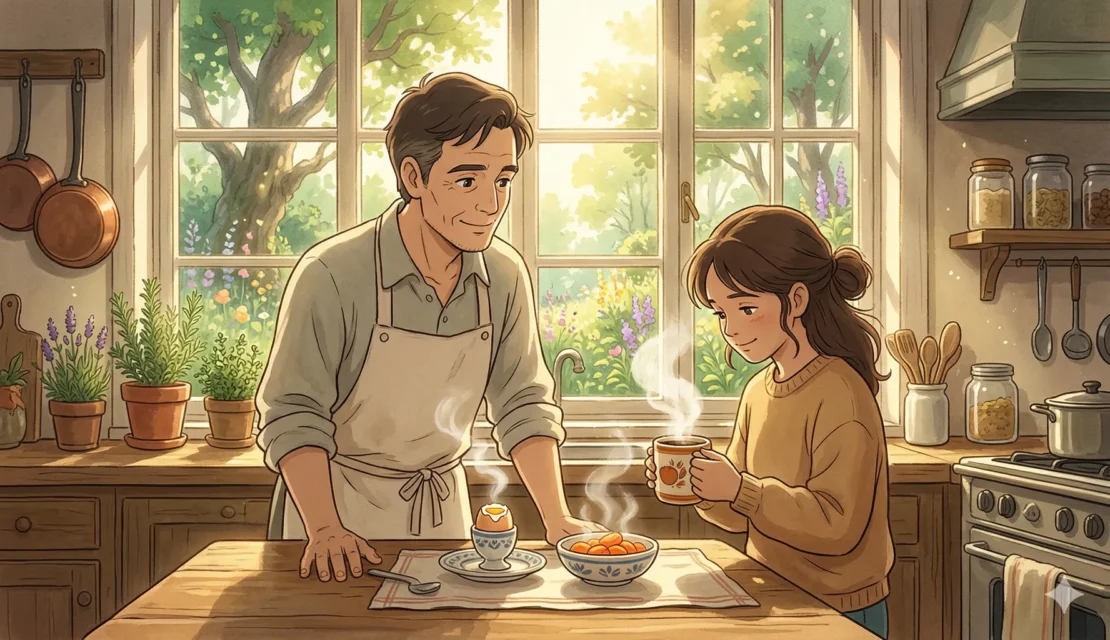
There was a girl named Priya, fourteen years old, who had decided that life was fundamentally unfair. She had failed her maths exam, fallen out with her best friend, and been cut from the school drama performance, all in the same week. She sat at the kitchen table looking, as her father described it, “like a thundercloud in a school uniform.”
Her father, a quietly wise man who worked as a cook, looked at her for a moment.
“Come help me in the kitchen,” he said.
Priya dragged herself off the chair.
He set three pots of water to boil on the stove. Into the first pot, he dropped an egg. Into the second, he placed a carrot. Into the third, he spooned in some coffee grounds.
They stood in silence and waited.
Priya stared at the pots. “What is this?” she asked.
“Just wait,” he said.
After fifteen minutes, her father turned off the stove. He lifted the egg out and peeled it, handing it to Priya. Hard boiled. Firm all the way through. Then he scooped out the carrot. It had gone soft and limp, barely holding its shape. Finally, he held up the pot of coffee and poured two cups, the warm, rich smell filling the kitchen immediately.
He looked at his daughter.
“Three things went into boiling water, facing the same heat, the same pressure,” he said. “The carrot went in tough, but the heat broke it down. The egg went in soft, but the heat made it hard and closed-off inside. The coffee grounds? They changed the water itself. They transformed everything around them.”
Priya looked at the three things on the counter.
“When difficulty comes for you,” her father said, putting his hand over hers, “you get to decide which one you are. Softened? Hardened? Or do you change the world around you a little?”
Priya picked up her coffee cup. She didn’t say anything for a while.
“I think,” she said eventually, “I want to be the coffee.”
Her father smiled and topped up her cup.
Moral: Adversity shapes us, but we decide how. We can let hard times weaken us, harden us, or transform us into something better.
Why Moral Stories Matter More Than You Think
We know you’re busy. Between school runs, meal prep, work, and the general wonderful chaos of parenting, finding time to sit and read feels like a luxury. But here’s what we’ve seen firsthand working with children every day at Apple Tree Preschool BSD: the children who regularly hear stories, especially moral stories with discussion afterward, develop empathy, emotional regulation, and social skills at a noticeably richer pace.
Stories Build Emotional Intelligence
When a child hears Theo lose the trust of his village, or watches Midas turn his daughter to gold, they feel those consequences in a safe space. They process emotions, ask “what would I do?”, and begin building the kind of inner moral compass that no worksheet can teach.
Stories Spark Conversations That Matter
Some of the best parenting conversations happen not with a direct question, but through the side door of a story. “What do you think Edmund should have done?” is a far easier question for a 5-year-old to answer than “tell me about your feelings on kindness.”
Stories Are For Every Age
Whether your little one is in our Toddler programme at 18 months, just starting Pre-Nursery or Nursery, or powering through Kindergarten, stories meet children wherever they are. A 2-year-old responds to the rhythm and repetition. A 5-year-old wants to debate the moral. All of it is learning, all of it matters.
Grow Smart and Happy at Apple Tree Preschool BSD
Here at Apple Tree, nestled in the Educenter BSD Building, we weave storytelling, values education, and character building into everything we do. Our Singapore curriculum approach means your child isn’t just learning to read and count. They’re learning to be good humans, curious thinkers, and kind friends.
We truly believe that the best lessons stick when they’re delivered with warmth, story, and a little bit of wonder. That’s the heart of what we do every single day.
If you’d love to find out more about our classes and how we bring moral stories and so much more to life in our classrooms, we’d love to hear from you. Come and see what we mean!
Register now and give your child the happiest, smartest start possible! Chat with us on WhatsApp or call us directly at +62 888-1800-900. We can’t wait to welcome your little one to the Apple Tree family!





Be the first to write a comment.