

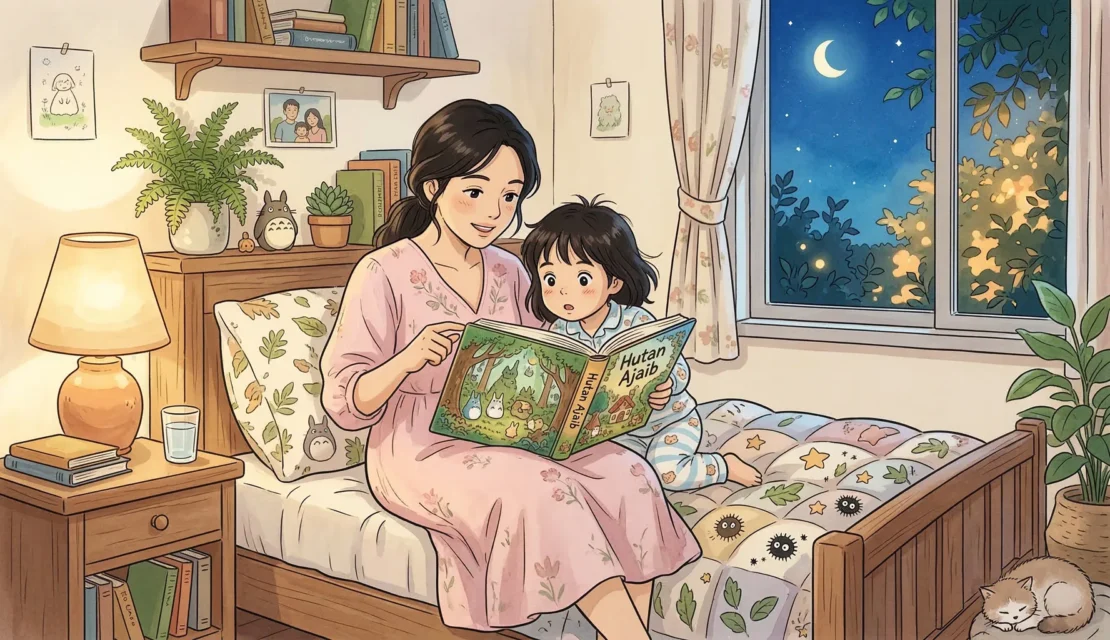
There is something magical about the moment your little one snuggles under the blanket, eyes wide open, waiting for a story. We have seen it hundreds of times at Apple Tree Pre-School BSD, and it never gets old. Bedtime stories for kids are not just a sweet nightly routine. They are one of the most powerful, gentle ways to plant the seeds of kindness, honesty, courage, and empathy deep in a child’s heart. And the best part? You do not need fancy props or a theater degree. You just need your voice, a cozy pillow, and a story worth telling.
At our school, located in the Educenter BSD Building, we weave storytelling into our Singapore curriculum every single day. We have watched children act out stories during free play, quote their favorite characters at lunchtime, and genuinely become kinder to their friends after hearing about a brave little turtle or a generous lion. That is the real magic. Stories shape who our children become.
So we put together seven beloved, timeless bedtime stories for kids that each spotlight a noble character trait. These are the classics parents and children around the world love most. Grab a warm drink, tuck your little one in, and let’s go.
7 Classic Bedtime Stories for Kids That Teach Noble Values
Below you will find seven of the most popular bedtime stories for kids, fully retold and ready to read aloud. From perseverance to honesty, these timeless tales are perfect for children ages 2 to 6.
1. The Tortoise and the Hare (Perseverance)
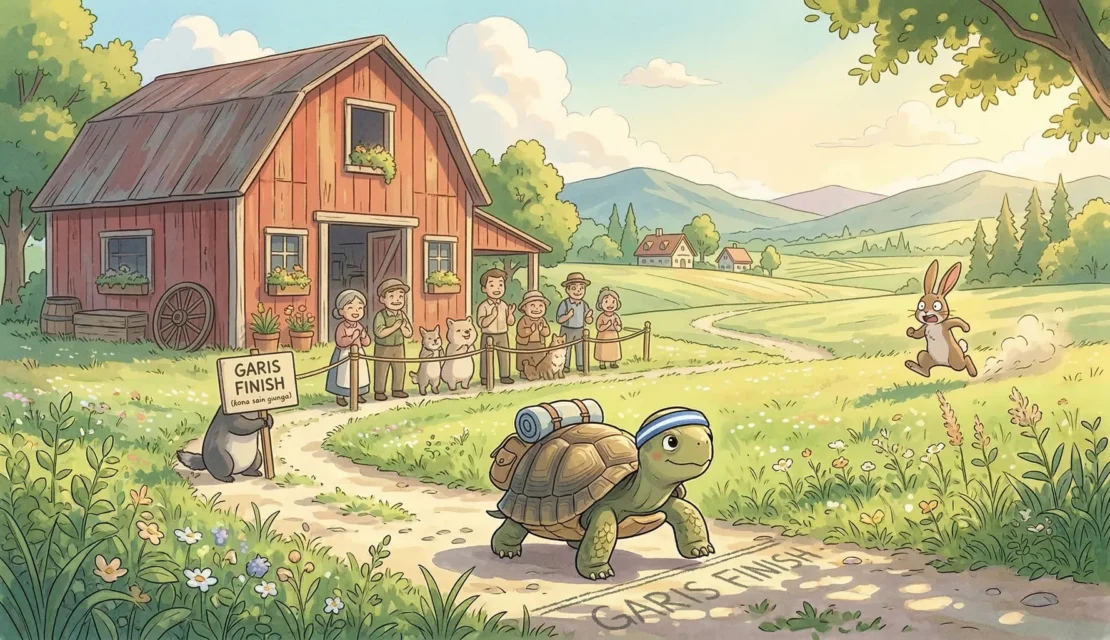
Once upon a time, in a sunny meadow at the edge of a green forest, there lived a hare named Harry. Harry was the fastest animal in the entire meadow, and he made sure everyone knew it. He would zip past the butterflies, race the wind, and then flop down under a tree, laughing. “Nobody can beat me!” he would say to anyone who listened. “I am the fastest creature alive!”
The other animals were tired of Harry’s bragging, but none of them dared to challenge him. He was, after all, genuinely fast. His legs were long, his jumps were powerful, and he could cross the meadow in what felt like three heartbeats.
One quiet morning, a small tortoise named Thomas was slowly making his way across the field, carrying a basket of strawberries. Harry spotted him and burst out laughing. “Thomas! You are so slow, I could take a nap, wake up, eat lunch, take another nap, and you would still not be halfway across this field!”
The other animals giggled nervously. Thomas set his basket down, looked at Harry calmly, and said something nobody expected: “I challenge you to a race.”
The meadow went silent. Harry blinked. Then he laughed so hard he fell over. “You? Race ME? Oh, Thomas, that is the funniest thing I have ever heard. But sure, why not? This will be the easiest win of my life.”
The race was set for the following Saturday. Old Owl agreed to be the judge. The course would run from the big oak tree, through the forest trail, around Bluebell Pond, and finish at the red barn on the far side of the valley.
When Saturday came, the entire meadow showed up. Animals sat on branches, rocks, and fence posts. Mrs. Rabbit sold acorn snacks. It was the event of the season.
Old Owl raised his wing. “On your marks. Get set. GO!”
Harry shot forward like a bolt of lightning. Within seconds, he was out of sight. Thomas took his first step. Then another. Then another. Slow, steady, and calm.
By the time Thomas reached the edge of the forest trail, Harry was already at Bluebell Pond. He looked back and could not even see Thomas. “This is ridiculous,” Harry chuckled. “He will not be here for hours. I might as well take a little rest.”
He found a soft patch of clover under a willow tree, stretched out, and closed his eyes. “Just five minutes,” he told himself. The warm breeze felt wonderful. The birds sang a gentle tune. Five minutes became ten. Ten became thirty. Thirty became an hour. Harry fell into a deep, comfortable sleep.
Meanwhile, Thomas kept walking. Step by step. Through the forest trail where roots tried to trip him. Around Bluebell Pond where the mud was thick and sticky. He was tired. His legs were sore. But he never stopped. “One more step,” he whispered to himself. “Just one more.”
As the afternoon sun began to dip, Thomas rounded the last bend. And there it was: the red barn. The finish line. He could hear the crowd cheering in the distance.
Harry woke with a start. The sun was low. “Oh no.” He leapt up and ran faster than he had ever run in his life. His heart pounded. His legs burned. He could see the red barn ahead. He could see the crowd. And then, he saw something that made his stomach drop.
Thomas, one tiny step away from the finish line.
“NO!” Harry screamed, sprinting with everything he had.
But it was too late. Thomas placed his foot over the line, and the crowd erupted. Animals cheered, clapped, and threw flowers. Thomas smiled, breathing heavily but standing tall.
Harry arrived seconds later, panting and stunned. He looked at Thomas, and for the first time, he did not feel like laughing. He felt something he had never felt before: respect.
“How?” Harry whispered. “How did you beat me?”
Thomas smiled gently. “I did not beat you, Harry. I just never stopped.”
Moral: Slow and steady wins the race. Talent means nothing without consistency and perseverance. Keep going, even when the odds seem impossible.
2. The Lion and the Mouse (Kindness)
Deep in the heart of a golden savanna, there lived a mighty lion named Leo. Leo was the king of all the animals. His roar could shake the trees and send birds flying for miles. Every creature respected him, and most, if truth be told, were a little bit afraid of him.
One hot afternoon, Leo found a cool spot beneath a baobab tree and lay down for his royal nap. He stretched his enormous paws, yawned so wide you could count all his teeth, and fell into a deep sleep.
While Leo slept, a tiny mouse named Mimi was scurrying through the grass, looking for seeds. She was in such a hurry that she did not notice the enormous sleeping lion until she ran right across his nose.
Leo’s eyes snapped open. In one swift motion, his huge paw slammed down and trapped little Mimi. She squeaked in terror, her tiny body trembling under his golden paw.
“Well, well,” Leo rumbled, his voice deep as thunder. “What do we have here? A tiny little mouse who dares to wake the king?”
“P-p-please, Your Majesty!” Mimi cried, her voice no louder than a whisper. “I am so sorry! I did not mean to disturb you! Please let me go, and I promise, one day, I will repay your kindness!”
Leo stared at her for a moment, then burst out laughing. The idea of a tiny mouse helping the king of the jungle was the most ridiculous thing he had ever heard. But something in Mimi’s earnest little eyes touched him. She was so small. So frightened. And yet so brave in her promise.
“Very well, little mouse,” Leo said, lifting his paw. “You have given me a good laugh. Go on your way.”
Mimi bowed so deeply her nose touched the dirt. “Thank you, Your Majesty! You will not regret this!” And she scurried away into the tall grass.
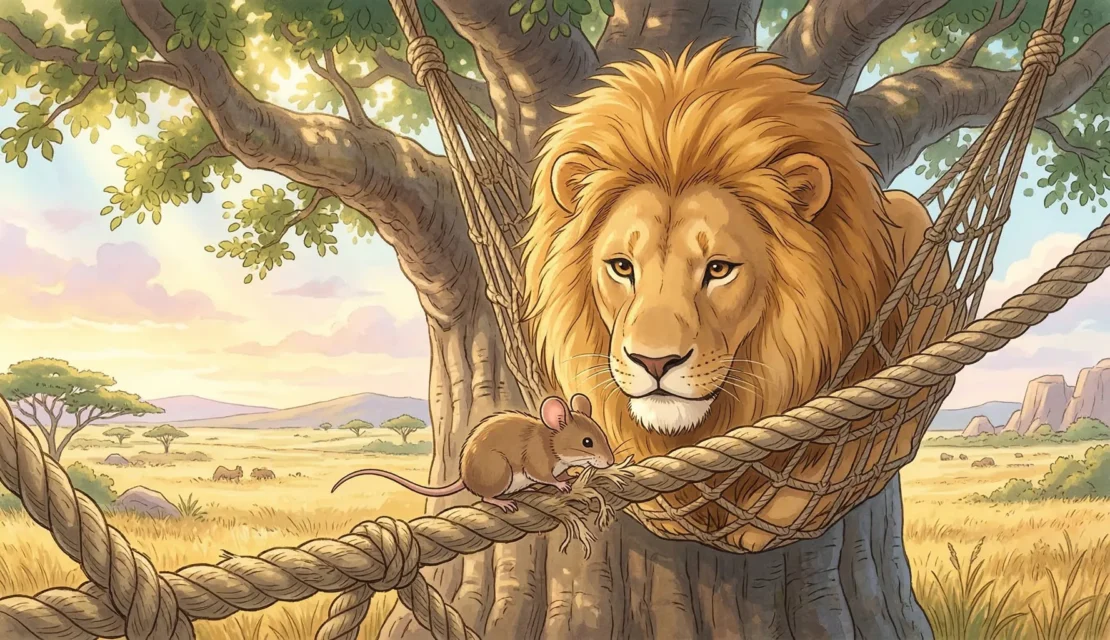
Several weeks passed. One evening, Leo was walking through a part of the savanna he did not usually visit. He did not see the hunter’s trap hidden beneath the leaves until the thick rope net sprang up around him. In an instant, Leo was tangled, trapped, and hanging from a tree branch.
He roared with all his might. The ground trembled. Birds fled. But the ropes were too strong. The more Leo struggled, the tighter they became. For the first time in his life, the mighty lion felt helpless. He roared again, this time not in anger, but in fear.
From far away, Mimi heard the roar. She recognized it immediately and ran as fast as her tiny legs could carry her. When she arrived and saw Leo trapped in the net, she did not hesitate for even a second.
“Hold still, Your Majesty!” Mimi called up. “I am going to get you out!”
Leo looked down at the tiny mouse and thought, “What can she possibly do?”
Mimi climbed the rope and began to gnaw. Her small, sharp teeth worked quickly, cutting through one strand, then another, then another. She chewed through the night. Her jaw ached. Her teeth hurt. But she did not stop.
By the time the first light of dawn appeared on the horizon, the last rope snapped. The net fell apart, and Leo tumbled gently to the ground, free at last.
He looked at Mimi, his eyes wide with gratitude. “You saved my life, little one. I thought a mouse could never help a lion. I was wrong.”
Mimi smiled. “Even the smallest act of kindness is never wasted, Your Majesty. You were kind to me, so I was kind to you. That is how it works.”
From that day on, Leo and Mimi became the most unlikely and the most famous friendship in the savanna. The mighty lion and the tiny mouse, proof that kindness connects us all, no matter how big or small we are.
Moral: No act of kindness, however small, is ever wasted. Be kind to everyone, because you never know when you might need help from the most unexpected friend.
3. The Boy Who Cried Wolf (Honesty)
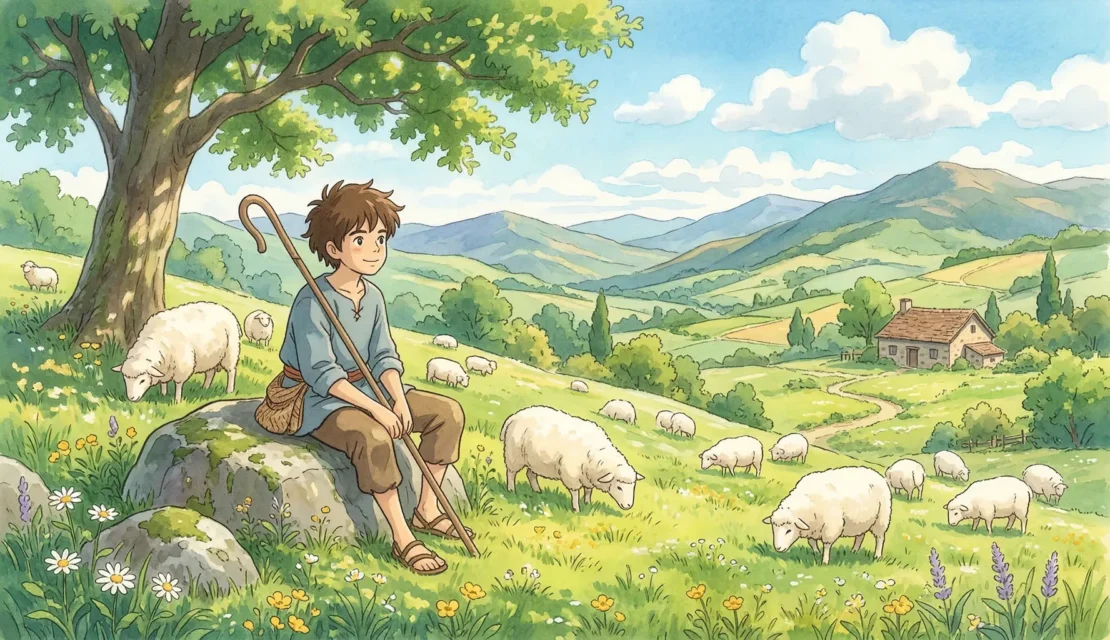
In a quiet little village at the foot of a green mountain, there lived a young shepherd boy named Sam. Every day, Sam’s job was to take the village sheep to the hillside and watch over them while they grazed. It was an important job, but Sam found it terribly, horribly, mind numbingly boring.
The sheep just ate grass. All day. That was it. They did not play games. They did not tell jokes. They just chewed and blinked and chewed some more. Sam sat on a rock, staring at the clouds, wishing something exciting would happen.
Then one afternoon, Sam had an idea. A terrible, wonderful, absolutely awful idea.
He jumped to his feet and screamed at the top of his lungs, “WOLF! WOLF! There is a wolf attacking the sheep!”
Down in the village, the farmers dropped their tools. The baker left his bread in the oven. The teacher dismissed her students. Everyone grabbed pitchforks and sticks and ran up the hill as fast as they could, ready to fight the wolf and save the sheep.
When they arrived, panting and sweating, they found Sam sitting on his rock, laughing hysterically. The sheep were fine. There was no wolf.
“Sam!” the village elder scolded. “That was not funny! We were terrified!”
“It was a little funny,” Sam giggled, wiping tears from his eyes.
The villagers grumbled and went back to their work, annoyed but relieved.
A few days later, Sam was bored again. And once again, he screamed, “WOLF! WOLF! Hurry, it is a big one!”
Once again, the villagers rushed up the hill. The blacksmith nearly tripped over his anvil. The old grandmother ran faster than she had in twenty years. They arrived, out of breath and red faced, only to find Sam rolling on the grass, laughing even harder than before.
“Sam, this is not a game!” the village elder said sternly. “If you keep lying, nobody will believe you when it really matters.”
Sam shrugged. “Relax, it is just a joke.”
The villagers went home, shaking their heads.
Then, one cold evening, as the sun was setting and the shadows grew long across the hillside, Sam heard a sound. A low growl. The hair on the back of his neck stood up. He turned slowly and saw two glowing yellow eyes in the bushes.
A real wolf. A big one. Bigger than Sam had ever imagined.
The wolf stepped out of the shadows, its teeth bared, its body low and ready to pounce. The sheep bleated in panic, running in circles.
Sam’s heart hammered in his chest. He jumped to his feet and screamed with everything he had. “WOLF! WOLF! PLEASE, THERE IS A REAL WOLF THIS TIME! PLEASE HELP!”
Down in the village, the farmer heard the cry and shook his head. “There goes Sam again.” The baker laughed. “I am not falling for that a third time.” The old grandmother closed her window. “Foolish boy.”
Nobody came.
Sam tried to protect the sheep by himself, waving his stick and shouting, but the wolf was too strong and too fast. By the time the wolf disappeared back into the forest, several sheep were gone.
Sam sat on the cold hillside, crying. Not because of the sheep, though that was terrible enough. But because he finally understood what he had lost. Trust. The most valuable thing a person can have, and he had thrown it away for a few laughs.
The next morning, Sam went to the village square. His eyes were red. His voice was small. “I am sorry,” he said. “I lied, and because I lied, you did not believe me when I told the truth. I understand now. I will never lie again.”
It took a long time for the villagers to trust Sam again. But he kept his word. Every single day, he was honest, even when it was hard, even when the truth was embarrassing. Slowly, day by day, trust was rebuilt.
Moral: Honesty is the foundation of trust. Once you lose people’s trust through lies, it is very hard to earn it back. Always tell the truth, especially when it matters most.
4. The Ugly Duckling (Self Worth)
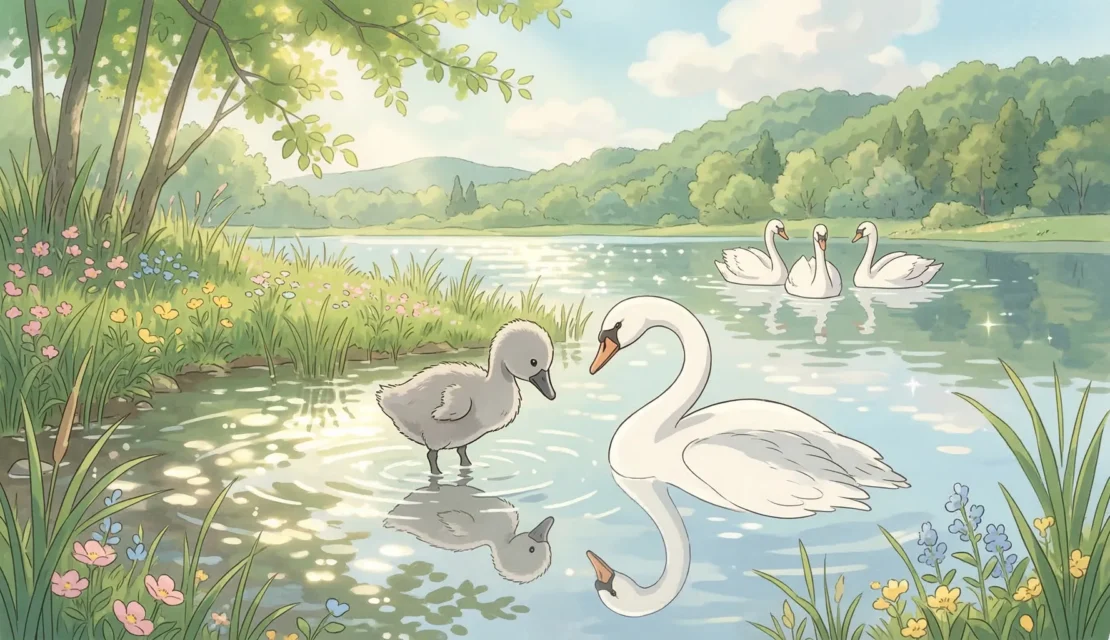
On a warm summer morning, beside a quiet pond surrounded by reeds and wildflowers, a mother duck sat on her nest, waiting patiently for her eggs to hatch. One by one, the eggs cracked open. Out popped six adorable, fluffy, golden ducklings. They were perfect.
But there was one egg left. The biggest egg. It took longer than the others. When it finally cracked, out tumbled a duckling that looked, well, different. He was bigger than his siblings. His feathers were grey instead of golden. His neck was too long. His feet were too big.
“Oh my,” whispered Mother Duck, trying to hide her surprise. “He is, well, he is unique.”
The other ducklings were not as polite. “Why does he look like that?” asked one. “He is so ugly!” laughed another. Even the other animals on the farm noticed. “That is the strangest duckling I have ever seen,” clucked the hen. “He does not belong here,” honked the old goose.
The grey duckling, who did not yet have a name because no one bothered to give him one, tried his best to fit in. He tried to swim like his siblings, but his big feet made too much splash. He tried to quack, but his voice sounded different. He tried to play, but the others always ran away from him.
Every night, he would look at his reflection in the pond and whisper, “What is wrong with me? Why am I so different?”
As the weeks passed, the teasing grew worse. The other ducklings pecked at him. The farm animals ignored him. Even strangers who passed by the pond would point and say, “What an ugly duckling.”
One cold autumn evening, the grey duckling made a difficult decision. He could not stay somewhere he was not wanted. With tears in his eyes, he waddled away from the pond, away from his family, and into the unknown.
The months that followed were hard. Winter came with bitter winds and icy rain. The duckling found shelter in a hollow log, shivering through the long, dark nights. He was lonely. He was hungry. And he still believed he was ugly.
But spring arrived, as it always does. The ice melted. The flowers bloomed. The sun warmed the earth again.
One morning, the duckling came to a clear, still lake. And on the lake, he saw the most beautiful birds he had ever seen. They were white as snow, with long graceful necks and elegant wings. Swans.
“They are so beautiful,” the duckling sighed. “I wish I could be like them.”
One of the swans noticed him and glided over. “Why are you standing there all alone? Come swim with us!”
“Me?” the duckling said, shocked. “But I am ugly. You would not want me.”
The swan tilted her head. “Ugly? Have you looked at your reflection lately?”
The duckling slowly looked down into the clear water. And what he saw took his breath away.
He was no longer grey. No longer awkward. Staring back at him was a beautiful white swan with a long, graceful neck, elegant feathers, and strong, powerful wings. He was not an ugly duckling at all. He had never been a duckling in the first place. He was a swan.
Tears filled his eyes, but for the first time, they were happy tears. The other swans welcomed him with open wings. Children on the shore pointed and said, “Look at that beautiful swan! He is the most magnificent one of all!”
The young swan spread his wings wide and, for the first time in his life, felt exactly where he belonged.
Moral: Never judge yourself or others by appearance. What makes you different today might be your greatest strength tomorrow. Everyone blooms in their own time.
5. The Thirsty Crow (Creativity and Problem Solving)
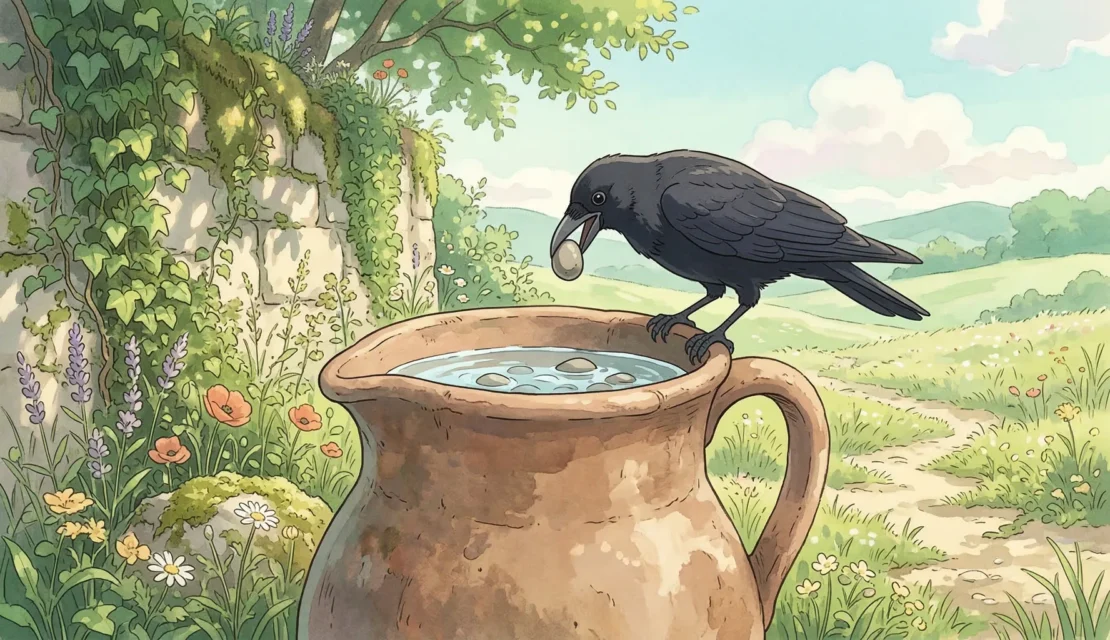
It was the hottest day of summer, and a lone crow named Clara had been flying for hours under the burning sun. Her wings ached. Her throat was dry as dust. She needed water desperately, or she would not survive much longer.
She flew over dry fields, empty riverbeds, and cracked earth. Everywhere she looked, there was no water. The ponds had dried up. The streams had vanished. Hope was fading fast.
Then, just as Clara was about to give up, she spotted something on the ground near an old stone wall. A pitcher! She swooped down, her heart racing with excitement. She landed on the rim and looked inside.
There was water at the bottom! But Clara’s joy quickly turned to frustration. The water level was so low that her beak could not reach it, no matter how far she stretched. She tried tilting the pitcher, but it was too heavy. She tried squeezing inside, but the opening was too narrow.
Clara sat on the rim, exhausted and defeated. “This is so unfair,” she croaked. “The water is right there, and I cannot reach it.”
She was about to fly away in despair when she noticed a pile of small pebbles scattered on the ground nearby. A thought flickered in her tired mind. She remembered something her grandmother had once told her: “Clara, when you cannot change the situation, change your approach. There is always a way if you think hard enough.”
Clara picked up a pebble in her beak and dropped it into the pitcher. Plop. The water level rose, just slightly. She picked up another pebble. Plop. And another. Plop. The water inched higher.
It was slow work. Her beak was sore. Her body was exhausted. But with every pebble, the water climbed a little closer. Ten pebbles. Twenty pebbles. Thirty. The sun blazed overhead, and Clara’s wings trembled with fatigue.
But she did not stop.
After what felt like forever, Clara dropped one final pebble into the pitcher, and the water rose all the way to the rim. She dipped her beak in and drank. The cool, fresh water flowed down her throat, and it was the sweetest thing she had ever tasted.
She drank slowly, savoring every drop. Then she sat on the edge of the pitcher, caught her breath, and smiled.
A sparrow who had been watching from a nearby branch flew over. “That was incredible, Clara! How did you figure that out?”
Clara ruffled her feathers. “I almost gave up. But then I remembered that giving up is the only thing that guarantees failure. As long as you keep thinking and keep trying, there is always a solution.”
Moral: Where there is a will, there is a way. Creative thinking and persistence can solve even the most difficult problems. Never give up before you have tried every idea.
6. The Ant and the Grasshopper (Responsibility)
In a golden meadow where wildflowers danced in the breeze, there lived an ant named Anna and a grasshopper named Greg. They were neighbors, but their lifestyles could not have been more different.
Anna woke up every morning before sunrise. She would stretch her tiny legs, eat a sensible breakfast, and head straight to work. All summer long, she carried grains of wheat, kernels of corn, and dried berries back to her underground home. Trip after trip after trip. She organized her food storage neatly, stacking supplies from floor to ceiling.
Greg, on the other hand, spent his days lounging on a sunflower leaf, playing his fiddle, and singing songs. He danced in the warm breeze, napped in the shade, and did not have a worry in the world.
One afternoon, Greg hopped over to Anna, who was struggling to carry a grain of wheat twice her size. “Anna, why do you work so hard? It is summer! The sun is shining, the flowers are blooming, and there is food everywhere! Come sit with me and enjoy the music!”
Anna wiped the sweat from her forehead. “I am preparing for winter, Greg. The cold months are coming, and there will be no food anywhere. You should start storing food too.”
Greg laughed and waved his fiddle in the air. “Winter? That is months away! Why would I waste this beautiful day worrying about something so far in the future? There will be plenty of time to prepare later.”
Anna shook her head but said nothing more. She picked up her grain and continued working.
Summer turned to autumn. The leaves changed from green to gold to red. The air grew cooler. Anna kept working, her storage room now overflowing with food. She had enough to last the entire winter and then some.
Greg kept playing. “Still plenty of time,” he told himself as the first cold wind blew through the meadow.
Then winter arrived. And it hit hard.
Snow covered the meadow like a thick white blanket. The flowers were gone. The trees were bare. The temperature dropped so low that the pond froze solid overnight.
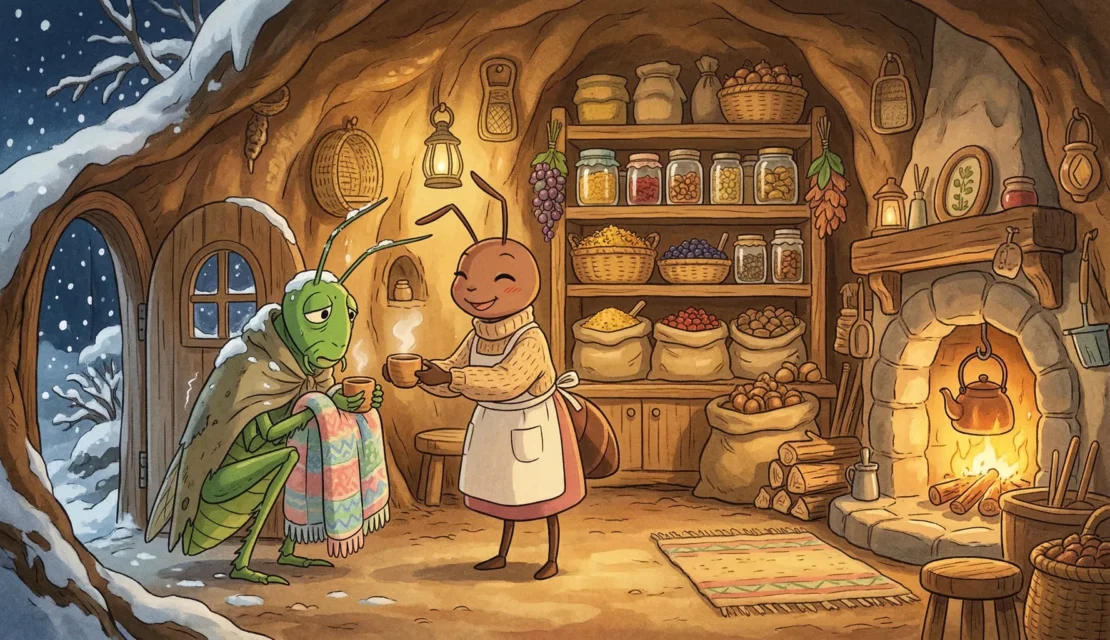
Anna was snug in her underground home, warm and well fed. She made herself a cup of hot acorn tea, wrapped herself in a tiny blanket, and listened to the wind howl outside. She felt safe. She felt prepared.
Greg was not. His sunflower leaf was buried under snow. He had no food. No shelter. No warmth. His fiddle strings were frozen, and his empty stomach growled louder than the winter wind.
Shivering and desperate, Greg knocked on Anna’s door. When she opened it, she saw a very different grasshopper from the one who had laughed at her all summer. He was thin, cold, and humbled.
“Anna,” Greg said quietly, his voice shaking. “I was foolish. I spent the summer playing while you worked. I have no food and nowhere to go. I understand if you turn me away.”
Anna looked at Greg for a long moment. She could have said, “I told you so.” She could have lectured him. But instead, she opened her door wider and said, “Come in, Greg. There is enough for both of us.”
Greg’s eyes filled with tears. He stepped inside, and Anna gave him warm food, a blanket, and a spot by the fire. That night, as they sat together in the cozy little home, Greg made a promise.
“Next summer, I will work alongside you. I will not waste another day. You taught me something important, Anna.”
“What is that?” she asked.
“That fun is wonderful, but responsibility is what keeps you safe when the storm comes.”
And the following summer, true to his word, Greg worked side by side with Anna, still singing his songs and playing his fiddle in the evenings, but never forgetting to prepare for the future.
Moral: There is a time for play and a time for work. Responsibility means preparing today for the challenges of tomorrow. Balance your fun with your duties, and you will always be ready.
7. Goldilocks and the Three Bears (Respect)
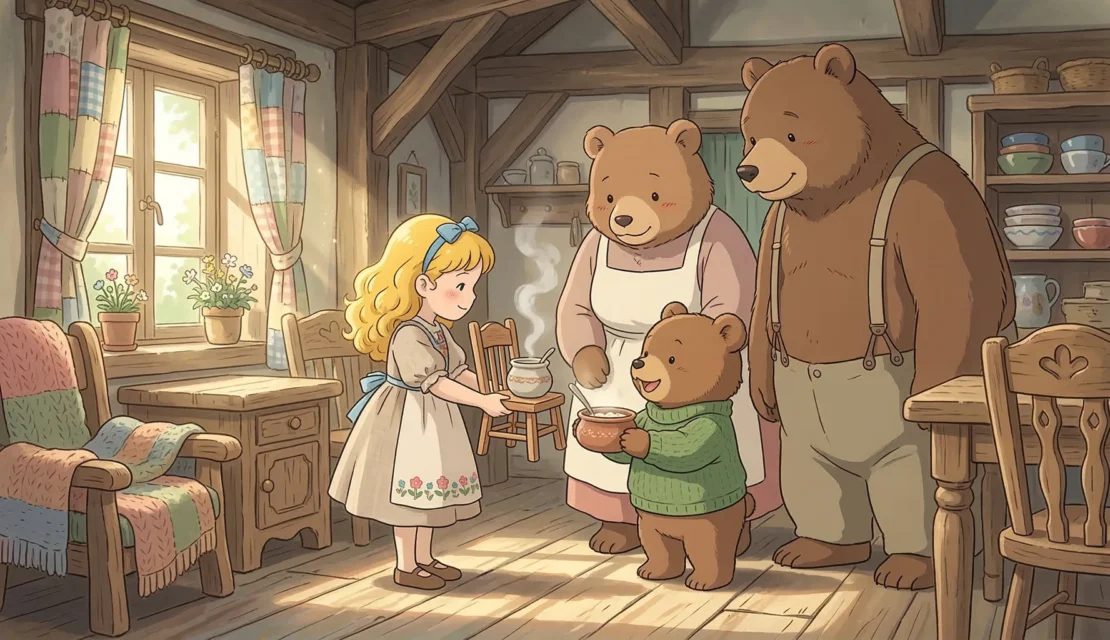
In a cozy little cottage at the edge of a deep green forest, there lived a family of three bears. Papa Bear was big and strong with a deep, rumbling voice. Mama Bear was warm and gentle with the softest fur you could imagine. And Baby Bear was small, curious, and full of giggles.
Every morning, Mama Bear made porridge for breakfast. She poured it into three bowls: a great big bowl for Papa Bear, a medium bowl for herself, and a cute little bowl for Baby Bear. But this particular morning, the porridge was too hot.
“Let us take a walk while it cools down,” Mama Bear suggested. So the three bears put on their scarves and headed out into the forest for a morning stroll.
While they were gone, a little girl named Goldilocks wandered through the forest. She had curly golden hair, bright blue eyes, and a habit of doing things without thinking about consequences. She was not a bad girl, not at all. But she was impulsive and never really considered how her actions might affect others.
Goldilocks came upon the bears’ cottage and peeked through the window. “Oh, what a lovely house!” she said. She tried the door. It was unlocked. Without even pausing to think whether she should, she walked right in.
The first thing she saw was the table with three bowls of porridge. Her stomach growled. She tasted Papa Bear’s porridge. “Ouch! Too hot!” She tasted Mama Bear’s porridge. “Brrr! Too cold!” She tasted Baby Bear’s porridge. “Mmm, just right!” And she ate every single bite.
Next, Goldilocks wandered into the living room where there were three chairs. She sat in Papa Bear’s chair. “Too hard!” She sat in Mama Bear’s chair. “Too soft!” She sat in Baby Bear’s little chair. “Just right!” But she rocked back and forth so carelessly that the little chair broke into pieces.
Feeling sleepy, Goldilocks went upstairs and found three beds. She lay in Papa Bear’s bed. “Too firm!” She lay in Mama Bear’s bed. “Too squishy!” She lay in Baby Bear’s bed. “Just right!” And she fell fast asleep.
Not long after, the three bears returned home. Papa Bear looked at his bowl. “Someone has been eating my porridge,” he growled. Mama Bear looked at hers. “Someone has been eating my porridge too,” she said. Baby Bear looked at his empty bowl and his little lip trembled. “Someone has been eating my porridge, and they ate it all up!”
In the living room, Papa Bear saw his chair. “Someone has been sitting in my chair.” Mama Bear noticed hers. “Someone has been sitting in my chair too.” Baby Bear saw his broken chair and cried, “Someone has been sitting in my chair, and they broke it!”
The three bears hurried upstairs. Papa Bear saw his rumpled bed. “Someone has been sleeping in my bed.” Mama Bear saw hers. “Someone has been sleeping in my bed too.” Baby Bear pointed to his bed and squealed, “Someone has been sleeping in my bed, and she is still here!”
Goldilocks woke up with a start. She saw three bears staring at her, one very big, one medium, and one very small with tears on his furry cheeks. Her heart pounded. She leapt out of the bed, ran down the stairs, and dashed out the front door into the forest.
She ran and ran until she could not run anymore. Finally, she stopped, catching her breath against an old oak tree. Her heart was still racing, but now a different feeling was creeping in. Not fear. Guilt.
She thought about Baby Bear’s empty bowl. His broken chair. His tearful little face. She had walked into someone else’s home without permission. She had eaten their food. Broken their things. Slept in their beds. She had not once stopped to think about how the bears would feel.
That evening, Goldilocks did something brave. She went back to the cottage with a fresh pot of porridge she made herself, a little wooden chair she had asked her father to help build, and a handwritten note that said, “I am truly sorry. I should have respected your home. Please forgive me.”
She left everything on the doorstep and hid behind a bush, nervous. When the bears opened the door and found the gifts, Baby Bear’s face lit up. Mama Bear read the note aloud, and Papa Bear nodded slowly. “Everyone makes mistakes,” he said. “But it takes real character to make things right.”
Goldilocks stepped out from behind the bush. “I am really sorry,” she said again, her voice small.
Baby Bear walked up to her and held out his paw. “Do you want to have porridge with us? Mama makes the best porridge in the forest.”
Goldilocks smiled, tears in her eyes, and took his paw. From that day on, she always knocked before entering, always asked before touching, and always thought about how her actions would affect others.
Moral: Respect other people’s belongings, space, and feelings. When you make a mistake, take responsibility and make it right. That is the true mark of good character.
Why Classic Bedtime Stories for Kids Shape Character from a Young Age
You might be wondering, “Do bedtime stories really make that much of a difference?” We can tell you from years of working with young learners at Apple Tree Pre-School BSD, absolutely yes. These classic tales have survived for generations because they work.
When a child hears a story about honesty through The Boy Who Cried Wolf, they do not just learn a vocabulary word. They feel what honesty looks like, sounds like, and why it matters. They connect emotionally with characters like Sam, Clara, and Thomas, and those connections become part of how they see the world. Research consistently shows that children who are regularly read to develop higher empathy, better emotional regulation, and stronger social skills.
The beautiful thing is that you do not need to be a professional storyteller. Reading these bedtime stories for kids in your own voice, at your own pace, cuddled up with your little one, is more than enough. The bonding matters just as much as the story itself.
How We Bring Classic Stories to Life at Apple Tree Pre-School
In our classrooms, storytelling is not a passive activity. Our teachers use puppets, voice acting, music, and even simple props to make every tale feel alive. After each story, we ask open ended questions: “What would you do if you were the Ant?” or “How do you think Baby Bear felt?” These conversations build critical thinking, emotional vocabulary, and moral reasoning, all disguised as fun.
Our Singapore based curriculum integrates character education into every subject, from English and Social Studies to Moral Education and Creative Arts. We believe that when children learn values through stories they love, those values stick with them for life.
Build Your Child’s Character with Stories, Love, and the Right Learning Environment
Every bedtime story you share is a tiny investment in the kind of person your child is becoming. Perseverance, kindness, honesty, self worth, creativity, responsibility, respect: these are not just words on a page. They are gifts you can give your child every single night.
If you are looking for a preschool that values character just as much as academics, we would love to welcome your family. At Apple Tree Pre-School BSD, located in the Educenter BSD Building, we create a warm, nurturing environment where children grow smart and happy, together with parents like you.
Come see the magic for yourself! Chat with us on WhatsApp or call us directly at +62 888-1800-900 to schedule a visit or register for our programs. Your child’s story is just beginning, and we would be honored to be part of it.



Be the first to write a comment.