

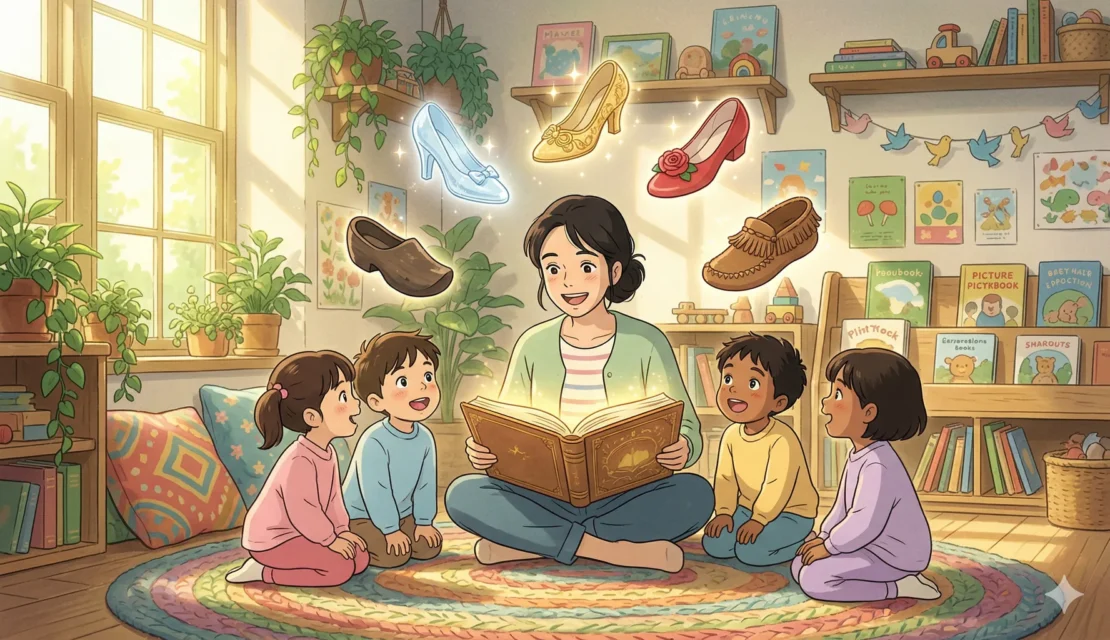
You probably think you know the Cinderella story inside and out. The glass slipper, the pumpkin carriage, the fairy godmother waving her wand right before midnight. We all grew up with that version, and honestly, we loved every sparkly second of it. But here is the thing most people never realize: there are roughly 700 versions of the Cinderella story scattered across the globe, and some of them are so wildly different from Disney’s take that you would barely recognize the tale.
At Apple Tree Pre-School BSD, we are huge fans of storytelling. We use stories every single day in our classrooms because we have seen firsthand how a good tale sparks curiosity, builds empathy, and gets little minds buzzing with questions. That is exactly why we wanted to share these five fascinating Cinderella story retellings from different cultures. Each one carries its own flavor, its own lessons, and its own kind of magic.
So grab a cup of coffee, settle in, and let us take you on a trip around the world, one glass slipper (or golden shoe, or fur moccasin) at a time.
Cinderella Story Retellings That Will Surprise You
Every culture seems to have its own version of the kind, mistreated girl who triumphs in the end. These Cinderella story variations remind us that the themes of resilience, kindness, and inner beauty are truly universal.
1. Yeh Shen, The Chinese Cinderella

Long before Charles Perrault ever put pen to paper in France, a young girl named Yeh Shen was living her own Cinderella story in ancient China. This tale dates all the way back to the Tang Dynasty, sometime around the 9th century, making it one of the oldest recorded versions in the world.
Yeh Shen was the daughter of a cave chief named Wu. She was bright, gentle, and remarkably skilled at working with gold. Life was good for a while, but then her father’s first wife passed away, and he remarried. Sadly, not long after, her father died too, leaving Yeh Shen completely at the mercy of her new stepmother.
Now, this stepmother was not exactly the nurturing type. She despised Yeh Shen because the girl was prettier and more talented than her own biological daughter. So she forced Yeh Shen into the hardest, most dangerous chores she could think of, hoping the work would break her spirit. But Yeh Shen found comfort in an unexpected friendship. Down by the pond behind her house, she discovered a beautiful golden fish. Every day, she would share her meager food with the fish, and every day, the fish would swim up to greet her like an old friend.
The stepmother eventually noticed Yeh Shen sneaking off to the pond. Suspicious and jealous of anything that brought the girl joy, she disguised herself in Yeh Shen’s clothes, lured the fish to the surface, caught it, and cooked it for dinner. When Yeh Shen discovered what had happened, she collapsed in tears beside the empty pond.
That is when something extraordinary happened. A mysterious old man appeared, dressed in rough clothes with long, loose hair. He told Yeh Shen not to weep. He explained that the fish bones had been tossed beneath the manure pile, and if she retrieved them and kept them in her room, she could pray to them whenever she needed something. Yeh Shen did exactly as he said, and sure enough, the bones granted her wishes, whether it was food, clothes, or precious stones.
When the spring festival arrived, the stepmother forbade Yeh Shen from attending and left with her own daughter. But Yeh Shen whispered to the fish bones, and instantly she was dressed in a stunning gown of green silk and a pair of tiny, exquisite golden slippers. She was the most beautiful girl at the festival, and everyone stared. But when she spotted her stepmother’s suspicious gaze across the crowd, she panicked and ran, losing one golden slipper on the way home.
The slipper was found and eventually reached the king of a neighboring island kingdom, who became fascinated by its impossibly small and delicate size. He searched the land until he found Yeh Shen, and when the slipper slid perfectly onto her foot, he knew he had found his bride. They married and lived in great happiness, while the stepmother and stepsister, well, let us just say karma caught up with them in a way that was not at all pleasant.
2. Rhodopis, The Egyptian Cinderella
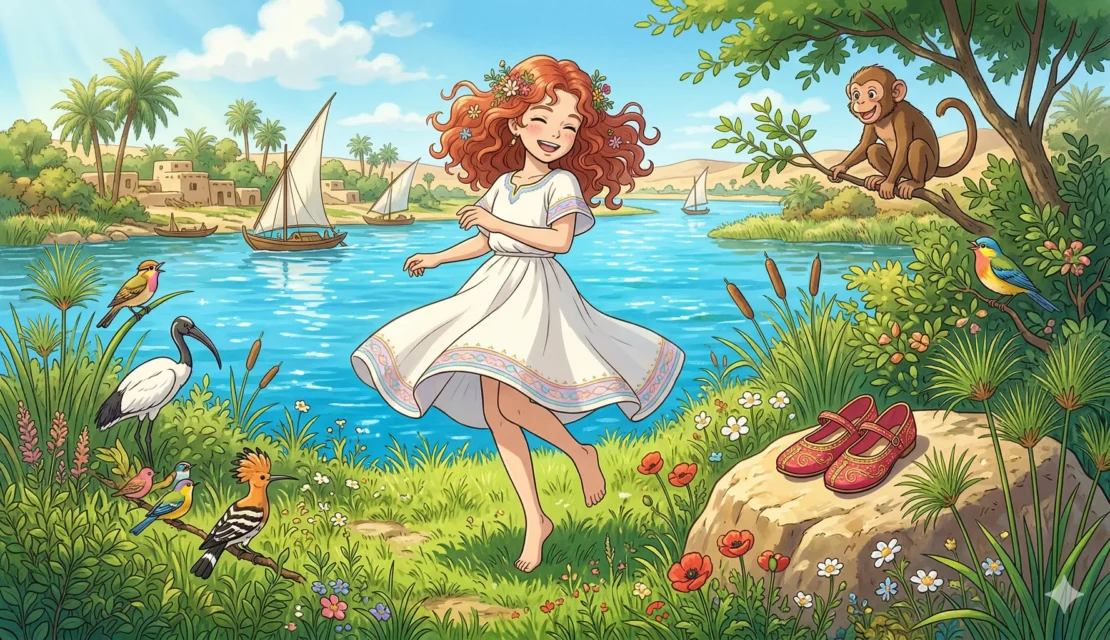
Travel even further back in time, and you will find what many scholars consider the very first Cinderella story ever recorded. This one comes from ancient Egypt, and the heroine’s name is Rhodopis.
Rhodopis was not originally Egyptian. She was a Greek girl who had been kidnapped by pirates as a child and sold into slavery in the land of Egypt. She ended up in the household of a kind old master in the colony of Naucratis along the Nile. Her master was a gentle man who spent most of his time sleeping under trees, so he never really noticed how cruelly the other servant girls treated Rhodopis.
The other girls mocked her constantly. They teased her for her pale skin, her green eyes, and her curly reddish hair, all features that made her look different from everyone around her. They called her names and gave her the hardest tasks. Rhodopis had no friends among the household, so she found companionship with the animals instead. She trained birds to eat from her hand, taught a monkey to dance, and even befriended a hippopotamus that lived along the riverbank.
One evening, while Rhodopis practiced a dance she had invented by the river, her master woke from his nap just long enough to notice. He was so charmed by her graceful movements that he ordered a special pair of rose red slippers made just for her, with gold stitching on the soles. The other servant girls seethed with jealousy.
When the Pharaoh announced a grand court celebration in the city of Memphis, every girl in the kingdom prepared to attend, hoping to catch his eye. The servant girls dressed in their finest linens and sailed off up the Nile, but not before dumping a mountain of chores on Rhodopis. “Wash these clothes in the river,” they laughed. “You are not coming.”
Heartbroken, Rhodopis knelt by the water and began scrubbing. She placed her precious red slippers on the bank so they would not get wet. Suddenly, a great falcon, the bird of the god Horus, swooped down from the sky, snatched one of her slippers in its talons, and soared away toward Memphis.
The falcon flew directly to the open air court where the Pharaoh sat, and dropped the tiny rose red slipper right into his lap. The Pharaoh held up the beautiful little shoe, stunned. He believed this was a sign from the god Horus himself. He declared that every maiden in the kingdom must try on the slipper, and the one whose foot fit perfectly would become his queen.
His servants searched high and low, from the grand houses of Memphis to the smallest villages along the Nile, until they finally arrived in Naucratis. The servant girls rushed forward, each trying to squeeze her foot into the slipper, but it was far too small. Then the servants spotted Rhodopis hiding behind the reeds. She was brought forward, trembling, and when she slid her foot into the rose red slipper, it fit perfectly. She then produced the matching shoe from behind her back. The Pharaoh took her hand, and Rhodopis, once a lonely slave girl, became the Queen of Egypt.
3. Aschenputtel, The Brothers Grimm Cinderella
If you think the Disney version is dramatic, wait until you hear the German Cinderella story collected by the Brothers Grimm. Published between 1812 and 1815, “Aschenputtel” keeps the sweetness of the tale we know but adds some rather shocking twists that Disney wisely left on the cutting room floor.
In this version, Cinderella’s real mother falls gravely ill. Before she dies, she calls her daughter to her bedside and whispers, “Dear child, be good and pious, and God will always take care of you, and I will look down from heaven and watch over you.” The girl wept at her mother’s grave every single day, and she kept her promise to be good.
Her father eventually remarried, and the new stepmother arrived with two daughters who were beautiful on the outside but absolutely rotten on the inside. They stripped Cinderella of her fine clothes, dressed her in an old grey smock, and forced her to sleep among the ashes of the kitchen hearth. That is how she got the name Aschenputtel, which roughly translates to “ash fool.”
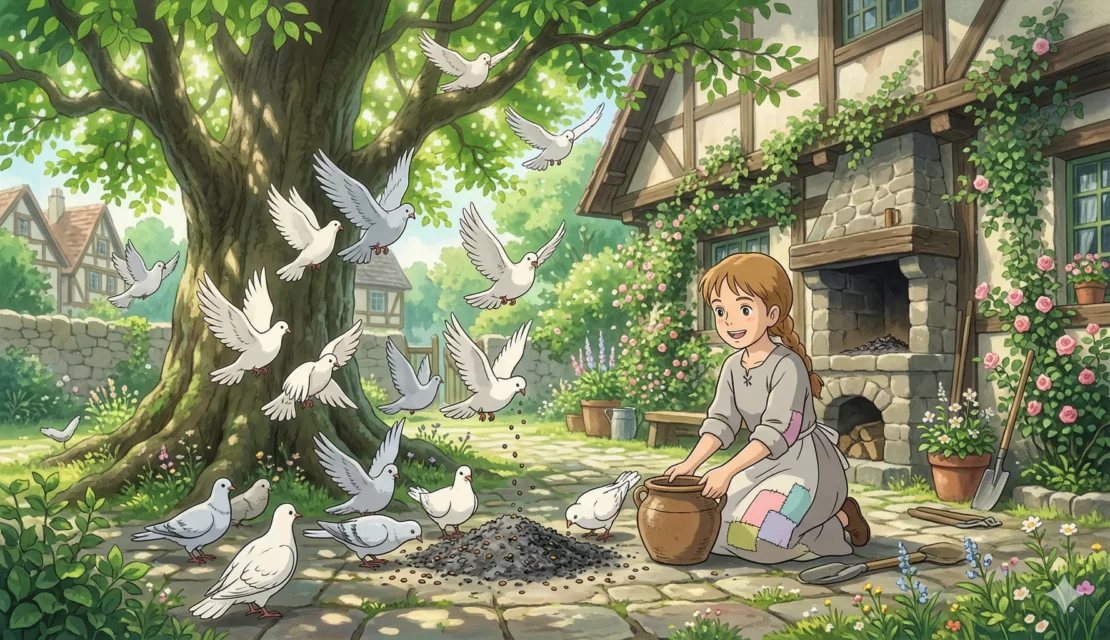
When her father traveled to a fair, he asked each girl what she wanted. The stepsisters demanded jewels and gowns. Cinderella asked only for the first twig that brushed against his hat on the way home. He brought her a hazel branch, and she planted it on her mother’s grave. She watered it with her tears every day until it grew into a magnificent tree. A little white bird came to perch on its branches, and whenever Cinderella wished for something, the bird would toss it down to her.
When the king announced a three day festival so his son could choose a bride, the stepmother told Cinderella she could not attend because she had no proper dress. But then she devised a cruel trick. She threw a dish of lentils into the fireplace ashes and told Cinderella that if she could pick them all out within two hours, she could go. Cinderella called to the birds, “You tame pigeons, you turtledoves, all you birds beneath the sky, come help me pick the good into the pot, the bad into the crop.” Within an hour, every lentil was sorted. But the stepmother simply threw another dish of lentils and repeated the challenge. Again, the birds helped. And again, the stepmother refused, sneering, “You have no clothes and cannot dance. You would only embarrass us.”
So Cinderella went to her mother’s grave and cried out to the hazel tree. The white bird threw down a gold and silver dress and silk slippers. She was so breathtakingly beautiful at the festival that the prince danced with no one else. When she wanted to leave, the prince tried to follow, but she escaped by leaping into the pigeon house on the first night, and climbing up a pear tree on the second. On the third night, the prince had the staircase coated with sticky pitch. As Cinderella fled, her left slipper, a shoe made entirely of gold, stuck fast.
The prince rode to Cinderella’s house with the golden shoe. The first stepsister went to her room and tried to squeeze her foot in, but her big toe was too large. Her mother handed her a knife and said, “Cut the toe off. When you are queen, you will not need to walk anymore.” The girl sliced off her toe, forced her foot into the shoe, and rode off with the prince. But as they passed the hazel tree on the mother’s grave, two pigeons cooed, “Turn and peep, turn and peep, there is blood within the shoe. The shoe is too small, the right bride waits for you still.” The prince looked down and saw the blood soaking through.
He returned the false bride and asked the second sister to try. Her heel was too large. The mother handed the knife again and said, “Cut a bit off your heel.” The girl obeyed, crammed her foot into the shoe, and rode away with the prince. But the pigeons sang the same warning, and once more blood seeped through the golden slipper.
Finally, the prince asked if there was another daughter. The father mumbled, “Well, there is a little stunted kitchen girl, but she cannot possibly be the bride.” The prince insisted. When Cinderella washed her face and came forward, she slipped her foot into the golden shoe, and it fit like a glove. The prince looked into her eyes and recognized the beautiful dancer from the festival. “This is the true bride,” he declared. The stepmother and stepsisters turned pale with fury. And on Cinderella’s wedding day, as the stepsisters walked beside her hoping to share in her fortune, the pigeons swooped down and pecked out one eye from each sister on the way to the church, and the other eye on the way back. And so, the Brothers Grimm remind us, wickedness is punished in the end.
4. La Gatta Cenerentola, The Italian Cinderella
Now we head to sunny Naples for what might be the wildest Cinderella story you have ever heard. Written by Giambattista Basile and published between 1634 and 1636 in his collection “Lo Cunto de li Cunti,” this version features a heroine named Zezolla who makes Disney’s Cinderella look like she was living a spa weekend by comparison.
Zezolla was the daughter of a prince, and she was beautiful and sweet. Her father had remarried, and her first stepmother treated her terribly. Zezolla confided in her sewing teacher, a woman named Carmosina, who seemed to truly care about her. One day, Carmosina whispered an idea to Zezolla that was, well, absolutely shocking. She told the girl that if she could convince her stepmother to reach into a large trunk to look for old clothes, Zezolla should slam the heavy lid down on her neck. Yes, you read that correctly.
And Zezolla did it. The stepmother was gone, and Zezolla immediately began begging her father to marry the kind sewing teacher instead. The prince, completely unaware of what had actually happened, agreed. For about a week, life was wonderful. Carmosina showered Zezolla with love and attention. But then, slowly, everything changed. Carmosina revealed six daughters of her own that she had been hiding, and one by one, she pushed Zezolla further and further into the background.
Before long, Zezolla went from being a princess to being a kitchen servant, covered in soot and ashes. The new stepmother and her six daughters took everything: the fine rooms, the beautiful clothes, the father’s affection. Zezolla was sent to the worst corner of the house and given the hardest chores. The father, wrapped around his new wife’s finger, barely noticed.
One day, the prince had to travel across the sea on royal business. Before leaving, he asked each of his stepdaughters what gifts they wanted. The six sisters rattled off lists of gowns, jewels, rouge, and hair ornaments. When he turned to Zezolla, she asked for just one thing: a date palm seedling from the fairies of Sardinia. If he forgot, she warned, he would not be able to move the ship forward or backward.
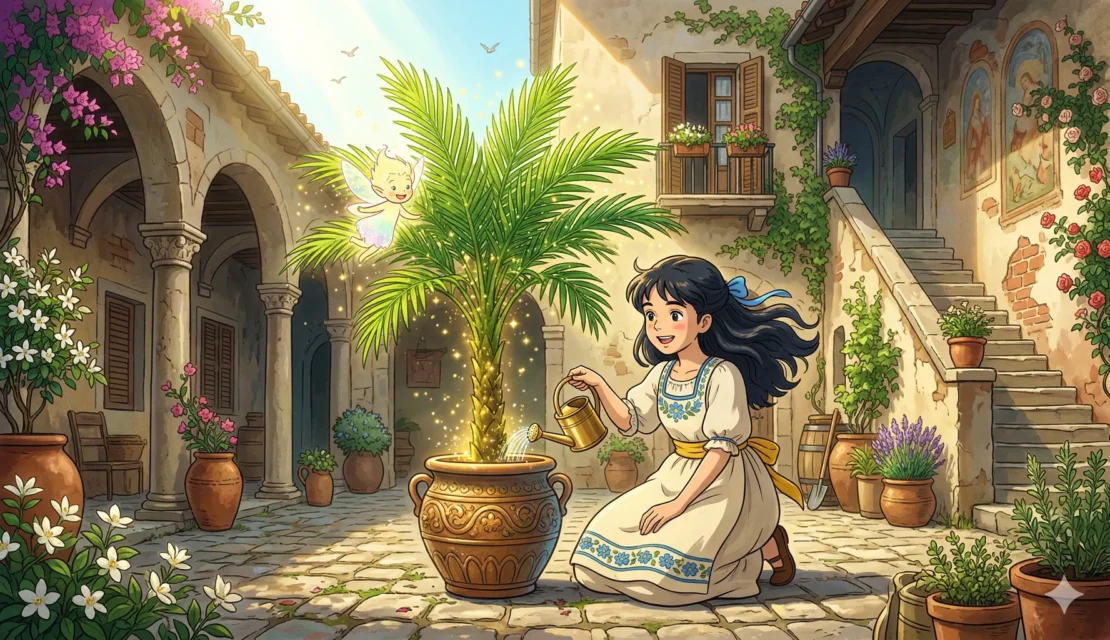
Sure enough, the prince forgot. His ship froze in the harbor and could not budge. He suddenly remembered Zezolla’s request, rushed ashore, found the fairies, and brought back the magical date palm. Zezolla planted it in a beautiful pot and tended it every day, watering it, weeding it, drying it with a silk cloth. Within four days, the tree grew as tall as a woman, and a fairy emerged from its branches.
When the king announced a grand feast, the stepsisters dressed in their finest and left Zezolla behind in the kitchen. But Zezolla went to her date palm, and the fairy outfitted her in a gown fit for a queen. She arrived at the feast looking like a vision, and the king himself lost his mind with admiration. He sent a servant to follow her, but Zezolla escaped by throwing a handful of gold coins on the ground, sending the servant scrambling.
The same thing happened on the second night, this time with a shower of pearls and jewels. On the third night, the king’s servant was more determined. As Zezolla fled, he could not catch her, but she lost one of her slippers, a truly magnificent, ornate “zoccolo” with a high heel typical of that era.
The king held the slipper to his heart and declared a great banquet, commanding every woman in the kingdom to attend. One by one, each woman tried the shoe. When it was Zezolla’s turn, the slipper practically flew onto her foot as if drawn by a magnet. The king bowed before her, placed a crown upon her head, and ordered everyone to pay her homage. The stepsisters, burning with envy, slunk away into the shadows, and Zezolla’s days of ashes were over forever.
5. The Rough Face Girl, A Native American Cinderella

Our final Cinderella story takes us far from castles and kingdoms, deep into the forests and lakeshores of the Algonquin people of North America. This version, known as “The Rough Face Girl,” is a tale passed down through oral tradition for generations and was beautifully retold by author Rafe Martin.
In a village by the shores of a great lake, there lived a mighty and powerful being known as the Invisible One. He was a great hunter and warrior, but no one could see him except his sister, who lived with him in a large wigwam at the edge of the village. The Invisible One had declared that he would marry the first woman who could truly see him. Many young women tried, because whoever married him would live in comfort and honor.
In the same village, there lived a man with three daughters. The two eldest were beautiful but vain and cruel. The youngest daughter had once been beautiful too, but her jealous sisters had burned her with hot coals and cinders from the fire. Her hair was singed short. Her face, arms, and hands were covered in rough, ugly scars. Everyone in the village called her the Rough Face Girl, and most people pitied her or turned away.
The two older sisters each dressed in their finest clothes and walked to the wigwam of the Invisible One to try their luck. His sister greeted them at the door and led them toward the lake at sunset. “Do you see my brother?” she asked. “Oh yes, I see him!” each sister lied eagerly. “And what is his shoulder strap made of?” the sister tested. One guessed rawhide. The other guessed a strip of braided leather. The sister shook her head sadly and sent them both home. They had not seen him at all.
Then one day, the Rough Face Girl decided she would go. Her sisters laughed cruelly. She had no fine clothes, only a tattered dress made of birch bark. She had no moccasins, only scraps wrapped around her feet. Her hair was burned, and her skin was scarred. The whole village whispered and pointed as she walked the path to the great wigwam. Children mocked her. But she held her head high and kept walking.
When she reached the lake at sunset, the sister of the Invisible One came out and asked, “Do you see my brother?” The Rough Face Girl looked out across the shimmering water. Her eyes grew wide. “Yes,” she whispered. “I do see him.” The sister leaned in, testing her. “And what is his bow string made of?” The Rough Face Girl gazed in wonder and answered softly, “His bow string is the rainbow.” The sister smiled, for this was the truth that no one else had ever seen.
“And what is the runner of his sled made of?” asked the sister. The Rough Face Girl replied, “It is the Milky Way, the great band of stars that stretches across the night sky.” The sister’s eyes filled with tears of joy. “You have truly seen him,” she said. She brought the Rough Face Girl inside the wigwam, bathed her, and combed her hair. As the scars were washed away, the girl’s true beauty was revealed, more radiant than anyone in the village had ever seen. When the Invisible One entered his wigwam that evening, he looked at her and smiled, for she was the one whose heart was pure enough to see what was truly there.
They were married, and the Rough Face Girl lived in happiness and plenty for the rest of her days. As for her two cruel sisters, the Invisible One turned them into aspen trees, and that is why, to this day, aspen leaves tremble and shake whenever someone walks by, forever ashamed.
Why Cinderella Stories Matter for Children
These five Cinderella story variations teach us something beautiful. No matter where you are in the world, people value kindness, courage, and the belief that goodness is eventually rewarded. Each culture wraps these lessons in its own unique setting, characters, and traditions, but the heart of the story stays the same.
At Apple Tree Pre-School BSD, we believe stories like these are more than just entertainment. When children hear tales from different cultures, they develop empathy, curiosity, and a wider understanding of the world around them. Our Singapore based curriculum, covering everything from English and Science to Social Studies and Creativity, uses storytelling as a powerful tool to help children grow into thoughtful, confident learners.
We are located in the Educenter BSD Building, and our programs welcome children from as young as 1.5 years old through Kindergarten 2. Whether your little one is in our cozy Toddler class or getting ready for big school in K2, every day is filled with stories, songs, laughter, and discovery. You can explore all of our class programs here.
If you love the idea of raising children who are both smart and kind, who see the world through curious, compassionate eyes, we would love to meet your family. Register now and come play and learn with us!Chat with us on WhatsApp or call us directly at +62 888 1800 900. We can not wait to hear from you.





Be the first to write a comment.