

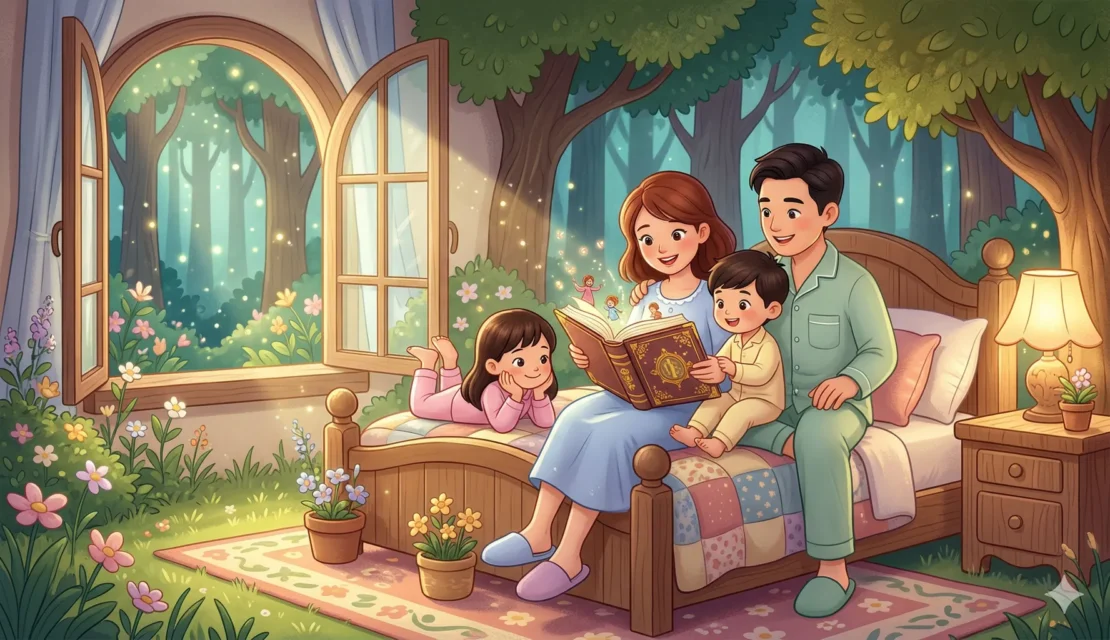
There’s something magical about the quiet moment before sleep when you curl up with your little one and begin, “Once upon a time…” Fairy tales have been enchanting children for centuries, and for good reason. They spark imagination, teach important life lessons, and create the most precious bonding moments between parents and children. At Apple Tree Pre-School BSD, we believe that bedtime fairy tales are one of the most powerful tools for nurturing your child’s language development, emotional intelligence, and creativity.
We’ve gathered fifteen timeless fairy tales that every child should hear before drifting off to dreamland. These stories are full of wonder, bravery, kindness, and adventure. Whether your child loves princesses, talking animals, or magical lands, there’s something here for every little dreamer. Grab a cozy blanket, dim the lights, and let the storytelling begin.
Classic Fairy Tales That Spark Imagination and Teach Life Lessons
These beloved fairy tales have stood the test of time for generations of children around the world. Each story carries meaningful lessons about kindness, courage, and perseverance that children absorb naturally through the magic of storytelling.
1. Cinderella
Once upon a time, in a land not so far away, there lived a kind and gentle girl named Cinderella. She lived with her stepmother and two stepsisters, who treated her very poorly. They made her do all the chores in the house, from sweeping the floors to washing the dishes, while they spent their days lounging about in fine dresses and jewels. Despite all the hardship, Cinderella remained kind and hopeful, never letting bitterness fill her heart.
One day, a grand invitation arrived at their home. The King was hosting a magnificent ball at the palace, and every young maiden in the kingdom was invited. Cinderella’s stepsisters squealed with excitement, immediately rushing to pick out their finest gowns. Cinderella dreamed of going too, but her stepmother laughed cruelly. “You? At the ball? Look at yourself!” she sneered. The stepsisters left in their carriage, leaving Cinderella alone, sitting by the fireplace with tears streaming down her cheeks.
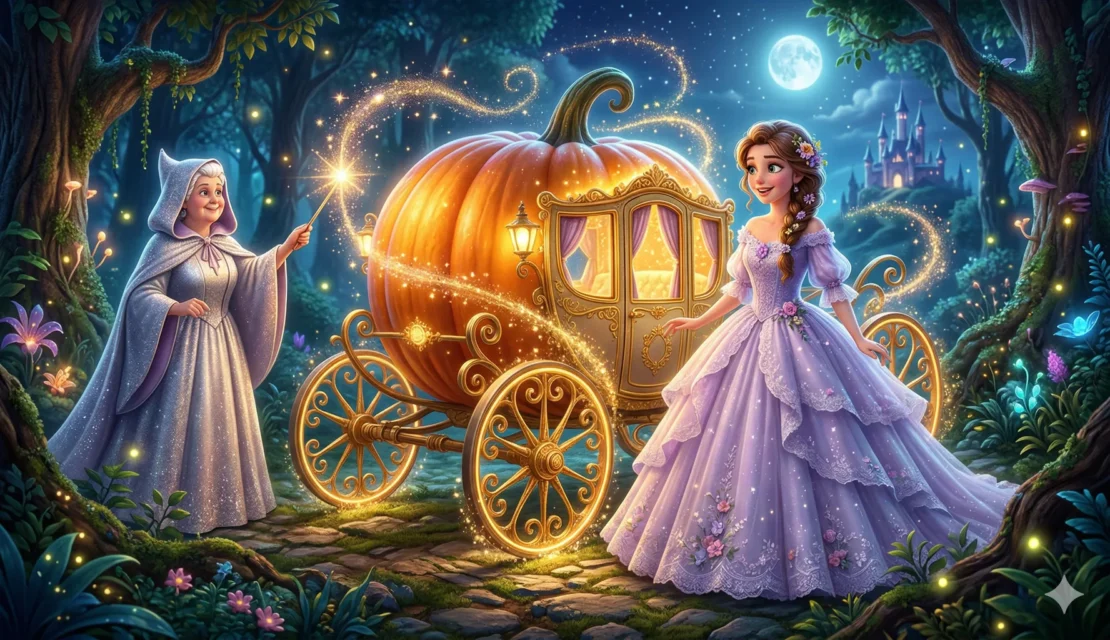
Just when all hope seemed lost, a shimmer of light filled the room, and a beautiful woman appeared. “Do not cry, dear child. I am your Fairy Godmother, and you shall go to the ball,” she said with a warm smile. With a wave of her wand, she transformed a pumpkin into a golden carriage and mice into elegant horses. Cinderella’s tattered dress became a breathtaking gown of silver and blue, and on her feet appeared a pair of sparkling glass slippers. “Remember,” the Fairy Godmother warned gently, “the magic will end at midnight. You must leave before the clock strikes twelve.”
Cinderella arrived at the ball and everyone gasped at her beauty. The Prince spotted her immediately and asked her to dance. They whirled across the ballroom floor, talking and laughing as if they had known each other forever. Cinderella felt like she was floating on air. But time passed quickly, and suddenly the clock began to chime. One, two, three… Cinderella’s eyes widened. “I must go!” she cried, pulling away from the Prince. She ran down the palace steps so fast that one of her glass slippers fell off behind her.
The Prince chased after her but found only the glass slipper on the steps. He declared that he would search the entire kingdom to find the maiden whose foot fit the slipper perfectly. His servants visited every home, and finally, they arrived at Cinderella’s house. The stepsisters tried desperately to squeeze their feet into the delicate slipper, but it was no use. Then Cinderella stepped forward quietly. She slipped her foot into the glass slipper, and it fit perfectly. The Prince recognized her instantly and took her hand. They returned to the palace together and lived happily ever after.
Moral of the story: Kindness, patience, and hope can carry you through the darkest times. True beauty comes from within, and goodness is always rewarded in the end.
2. Snow White and the Seven Dwarfs
Once upon a time, there lived a beautiful princess named Snow White. Her skin was as white as snow, her lips as red as roses, and her hair as black as ebony. She lived in a grand castle with her stepmother, the Queen, who was very beautiful but also very vain. Every day, the Queen would stand before her magical mirror and ask, “Mirror, mirror on the wall, who is the fairest of them all?” And the mirror would always reply, “You, my Queen, are the fairest of them all.”
But as Snow White grew older, she became more and more beautiful. One fateful day, the Queen asked her mirror the same question, and the mirror answered, “You are beautiful, my Queen, but Snow White is the fairest of them all.” The Queen’s face turned red with rage and jealousy. She ordered a huntsman to take Snow White deep into the forest and never bring her back. The huntsman, however, could not bring himself to harm the gentle princess. He told Snow White to run far into the forest and never return to the castle.
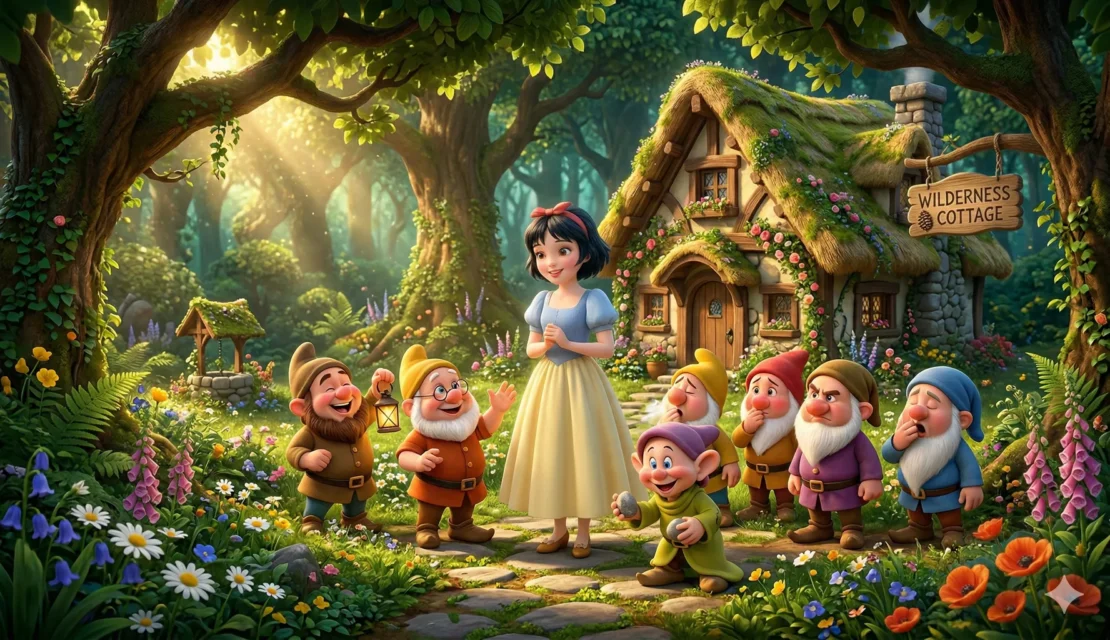
Frightened and alone, Snow White wandered through the dark forest until she stumbled upon a tiny cottage. Inside, she found seven small chairs, seven small beds, and seven small plates set at a table. Exhausted, she fell asleep across three of the little beds. When the owners returned, they were surprised to find the sleeping princess. They were seven dwarfs who worked in a nearby diamond mine. Their names were Doc, Grumpy, Happy, Sleepy, Bashful, Sneezy, and Dopey. When Snow White woke up and explained her story, the kind dwarfs invited her to stay. She would keep the cottage while they worked, and they would protect her from the Queen.
Meanwhile, the Queen discovered through her mirror that Snow White was still alive. Disguising herself as an old woman, she made a poisoned apple that was red and shiny on the outside but deadly on the inside. She traveled to the cottage and offered the apple to Snow White. Despite the dwarfs’ warnings to never let strangers in, Snow White was too kind to refuse the old woman. She took one bite of the apple and fell into a deep, enchanted sleep.
The dwarfs were heartbroken when they found Snow White lying still on the floor. They placed her in a glass coffin in the forest, unable to let her go. One day, a handsome Prince came riding through the woods. He saw Snow White in her coffin and was struck by her beauty. He leaned down and kissed her gently. At that moment, the spell broke. Snow White opened her eyes, smiled, and took the Prince’s hand. The wicked Queen, upon hearing the news, fled the kingdom forever. Snow White and the Prince returned to the castle, where they lived happily ever after surrounded by the seven dwarfs who visited every weekend.
Moral of the story: Jealousy and vanity only bring unhappiness, while kindness and purity of heart attract genuine love and loyalty.
3. Rapunzel
Once upon a time, a couple lived next to a garden owned by a powerful enchantress named Dame Gothel. The wife, who was expecting a baby, craved the rapunzel plant that grew in the enchantress’s garden so desperately that she grew ill. Her husband, unable to bear her suffering, sneaked into the garden to steal some. Dame Gothel caught him and struck a terrible bargain. She would let him take as much rapunzel as he wished, but in return, they must give her the baby when it was born.
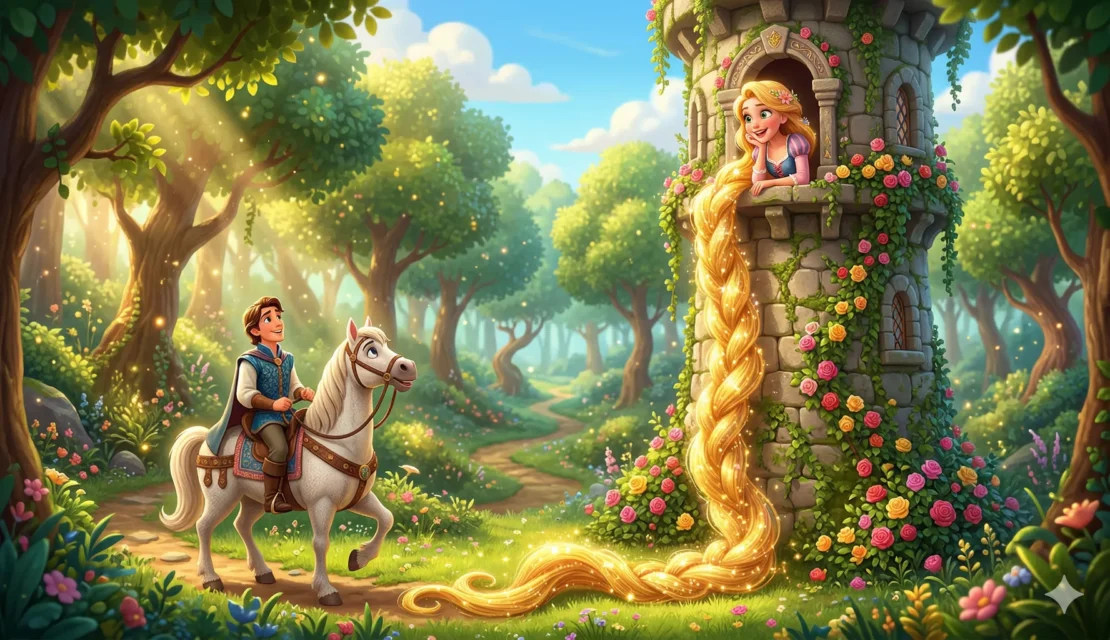
When the baby girl arrived, Dame Gothel took her away and named her Rapunzel. She locked the child in a tall tower deep in the forest with no doors and no stairs. The only way in or out was through a single window at the very top. As Rapunzel grew, her golden hair grew impossibly long, flowing down the tower like a river of sunlight. Every day, Dame Gothel would stand below and call, “Rapunzel, Rapunzel, let down your hair!” And Rapunzel would lower her braided hair so the enchantress could climb up.
Years passed, and Rapunzel grew into a beautiful young woman who spent her days singing. Her voice was so lovely that one day, a Prince riding through the forest heard her song and was enchanted. He watched secretly as Dame Gothel climbed the golden hair and learned the secret of the tower. After the enchantress left, the Prince called out, “Rapunzel, Rapunzel, let down your hair!” When Rapunzel let her hair fall, the Prince climbed up, and they met for the first time. Rapunzel was startled at first, for she had never seen another person besides Dame Gothel. But the Prince was gentle and kind, and they quickly became friends, then fell deeply in love.
The Prince visited Rapunzel every evening, and together they hatched a plan for her escape. Each visit, the Prince brought a piece of silk thread, which Rapunzel wove into a long ladder. But before the ladder was complete, Rapunzel accidentally revealed the Prince’s visits to Dame Gothel. The enchantress was furious. She cut Rapunzel’s beautiful hair and banished her to a desolate wilderness. When the Prince came that night and climbed the severed hair, he found Dame Gothel waiting instead of his beloved. She pushed him from the tower, and he fell into a thorn bush below, which scratched his eyes and blinded him.
Heartbroken and blind, the Prince wandered through forests and fields for many months, surviving on berries and roots. One day, he stumbled into the very wilderness where Rapunzel lived. He heard a familiar voice singing the same beautiful song that had first enchanted him. Rapunzel recognized him instantly and ran to embrace him. As her tears of joy fell upon his eyes, they healed his blindness completely. He could see again, and the first thing he saw was Rapunzel’s smiling face. Together, they returned to the Prince’s kingdom, where they married and lived happily ever after, free from towers and enchantresses forever.
Moral of the story: Love and hope can overcome even the most difficult obstacles. True connection cannot be imprisoned, and patience rewards those who never give up.
4. The Ugly Duckling

Once upon a time, on a beautiful farm near a peaceful lake, a mother duck sat patiently on her nest, waiting for her eggs to hatch. One by one, the eggs cracked open, and out came the cutest, fluffiest little ducklings you ever saw. They were yellow and soft and waddled around happily. But the last egg, which was the biggest of them all, took much longer to hatch. When it finally cracked open, out tumbled a duckling that looked very different from the rest. He was bigger, grey, and awkward. “What an ugly duckling!” the other farm animals whispered, and even his siblings kept their distance.
The poor duckling tried so hard to fit in, but no matter what he did, the other ducks teased him. The chickens pecked at him. The geese honked insults. Even the farmer’s wife shooed him away. His own mother would sigh and say, “I wish you looked more like your brothers and sisters.” The ugly duckling’s heart ached with sadness. One night, he decided he couldn’t take it anymore. He waddled away from the farm, through the hedge, and into the big, wide world, alone and frightened.
He wandered through marshes and meadows, looking for someone who would accept him. An old woman took him in, hoping he would lay eggs, but her cat and hen bullied him terribly. He escaped again and found a lake where wild ducks lived. “You’re really ugly,” they said bluntly, “but you can stay if you don’t bother anyone.” The duckling stayed, but he was still lonely and sad. When autumn came, he saw a flock of magnificent white birds flying south. They were the most beautiful creatures he had ever seen, with long graceful necks and brilliant white feathers. Something stirred deep inside him, though he couldn’t understand what it was.
Winter arrived, cold and harsh. The duckling nearly froze in the icy lake, but a kind farmer found him and brought him home to warm up. However, the farmer’s children scared him with their loud play, and he escaped once more into the bitter cold. It was the hardest winter the duckling had ever known. He survived by finding sheltered spots and eating whatever scraps he could find.
Finally, spring arrived. The sun warmed the earth, flowers bloomed, and the world came alive again. The duckling felt stronger than ever before. His wings felt powerful and wide. He flew to a beautiful garden lake and saw those magnificent white birds again, swimming gracefully on the water. “I would rather be near these beautiful creatures, even if they chase me away, than live alone forever,” he thought. He lowered his head and swam toward them, expecting rejection. But when he looked down at his reflection in the water, he gasped. Staring back at him was not an ugly grey duckling but a magnificent white swan, as beautiful as the others. The swans welcomed him warmly, and children on the shore pointed and exclaimed, “Look at that new swan! He’s the most beautiful one of all!” The swan who had once been the ugly duckling felt his heart swell with happiness. He had finally found where he belonged.
Moral of the story: Never judge yourself or others by appearances. Everyone grows and changes at their own pace, and true beauty reveals itself in time. What makes you different today might be your greatest strength tomorrow.
5. Goldilocks and the Three Bears
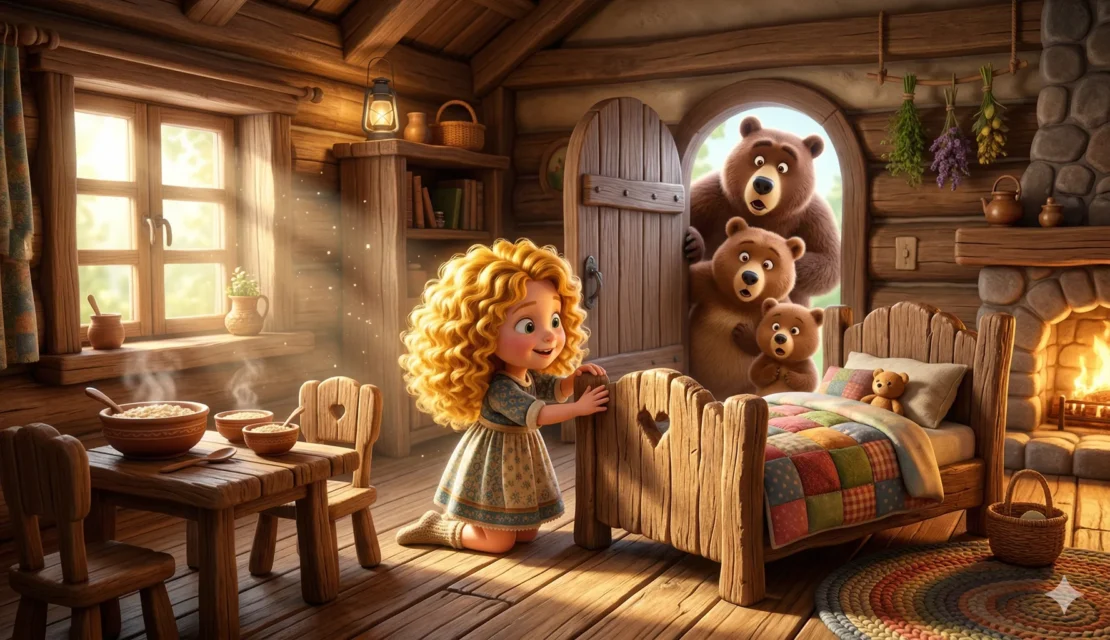
Once upon a time, in a cozy cottage at the edge of a great forest, there lived three bears. There was Papa Bear, who was big and strong. There was Mama Bear, who was gentle and kind. And there was Baby Bear, who was small and curious. One morning, Mama Bear made a delicious pot of porridge for breakfast. But the porridge was far too hot to eat. “Let’s go for a walk while it cools down,” suggested Papa Bear. And so the three bears headed into the forest, leaving their front door unlocked.
Not long after they left, a little girl named Goldilocks came skipping through the woods. She had golden curly hair and a nose for adventure, though she sometimes forgot her manners. When she saw the bears’ cottage, she peeked through the window and smelled the porridge. Without even knocking, she pushed open the door and walked right in. On the table sat three bowls of porridge. She tasted the big bowl first. “Too hot!” she cried. She tasted the medium bowl. “Too cold!” she frowned. Then she tasted the smallest bowl. “Just right!” she exclaimed, and ate every last bit.
Feeling full and a little tired, Goldilocks wandered into the living room where she found three chairs. She sat in Papa Bear’s big chair. “Too hard!” she grumbled. She tried Mama Bear’s medium chair. “Too soft!” she complained. Then she sat in Baby Bear’s small chair. “Just right!” she smiled. But she rocked back and forth so enthusiastically that the little chair broke into pieces beneath her. “Oops!” she said, but didn’t seem too concerned.
Now feeling very sleepy indeed, Goldilocks climbed upstairs and found three beds. She lay down on Papa Bear’s big bed. “Too firm!” she muttered. She tried Mama Bear’s medium bed. “Too squishy!” she groaned. Then she lay down on Baby Bear’s small bed. “Just right!” she sighed happily, and fell fast asleep.
Before long, the three bears returned home from their walk. Papa Bear looked at his porridge bowl. “Someone’s been eating my porridge!” he growled in his deep voice. Mama Bear looked at her bowl. “Someone’s been eating my porridge!” she said in surprise. Baby Bear looked at his empty bowl and cried, “Someone’s been eating my porridge, and they ate it all up!” They moved to the living room. “Someone’s been sitting in my chair!” said Papa Bear. “Someone’s been sitting in my chair!” said Mama Bear. “Someone’s been sitting in my chair, and they’ve broken it!” wailed Baby Bear. Upstairs they went. “Someone’s been sleeping in my bed!” rumbled Papa Bear. “Someone’s been sleeping in my bed!” said Mama Bear. “Someone’s been sleeping in my bed, and she’s still there!” squeaked Baby Bear. Goldilocks woke up, saw three bears staring at her, screamed, jumped out of bed, leaped through the window, and ran all the way home. She never went into a stranger’s house again without asking permission first.
Moral of the story: Always respect other people’s belongings and spaces. Good manners and asking permission before entering someone’s home are important values that keep everyone happy and safe.
6. The Little Mermaid

Once upon a time, deep beneath the sparkling blue ocean, there lived a beautiful mermaid princess named Ariel. She was the youngest daughter of the great Sea King and had the most enchanting singing voice in all the underwater kingdom. While her sisters loved exploring coral gardens and playing with dolphins, Ariel was fascinated by something different entirely. She dreamed about the world above the water, the world of humans.
On her fifteenth birthday, Ariel was finally allowed to swim to the surface. What she saw took her breath away: a magnificent ship sailing under a sky full of stars. On that ship was a handsome Prince celebrating his birthday with fireworks and music. Ariel watched him from behind the waves, her heart beating faster than it ever had before. But suddenly, a terrible storm arose. The ship was tossed and thrown by massive waves until it shattered apart. The Prince fell into the churning sea, unable to swim against the powerful currents.
Without hesitation, Ariel dove into the waves and rescued the Prince. She held his head above water and swam through the storm until she reached the shore. She laid him gently on the sand and sang to him until morning came. When she saw people approaching, she hid behind the rocks. A young woman found the Prince and helped him recover. He never knew it was Ariel who had saved his life. Heartbroken but determined, Ariel made a decision that would change everything. She visited the Sea Witch, a fearsome creature who lived in the darkest part of the ocean.
“I can give you human legs,” the Sea Witch said with a cunning smile, “but in exchange, you must give me your beautiful voice.” Ariel agreed, despite the terrible cost. The witch warned her that if the Prince married someone else, Ariel would turn into sea foam at dawn. Ariel drank the potion and felt her tail split into two legs. The pain was terrible, but her determination was stronger. She swam to the surface and collapsed on the shore near the Prince’s castle.
The Prince found her and was charmed by this mysterious, silent girl. He cared for her and they spent wonderful days together. Ariel tried to show him that she was the one who saved him, but without her voice, she couldn’t explain. The Prince was fond of her but believed the young woman on the shore was his true rescuer. When he announced his engagement to that woman, Ariel’s heart shattered into pieces.
Her sisters appeared at the water’s edge that night, their beautiful hair cut short. “We traded our hair to the Sea Witch for this magic knife,” they said with tears. “If you use it before sunrise, you can become a mermaid again.” Ariel took the knife and went to the Prince’s room. She watched him sleeping peacefully, and she simply could not hurt him. She threw the knife into the sea and waited for the sunrise. As dawn broke, instead of becoming sea foam, Ariel was lifted into the air by spirits of light. “Because of your selfless love and sacrifice,” they whispered, “you have earned an immortal soul.” Ariel smiled as she floated upward, knowing that true love means wanting happiness for others, even at a great cost to yourself.
Moral of the story: True love is selfless and puts others’ happiness before your own. Sacrifice made from genuine love is never truly lost, and kindness always finds its reward.
7. Sleeping Beauty

Once upon a time, a King and Queen longed for a child for many years. When a beautiful princess was finally born, they were overjoyed and held a grand celebration. They invited all the fairies in the kingdom to bless the baby, but accidentally forgot to invite one, the oldest and most powerful fairy. One by one, the fairies approached the cradle and gave their gifts. “She shall have beauty,” said the first. “She shall have grace,” said the second. “She shall have a voice like nightingales,” said the third.
Before the last fairy could give her blessing, the uninvited fairy burst through the doors in a furious rage. “You forgot about me!” she shrieked. “So hear my gift: before the princess turns sixteen, she shall prick her finger on the spindle of a spinning wheel and die!” The entire court gasped in horror. But the last fairy, who hadn’t yet given her blessing, stepped forward. “I cannot undo this curse entirely,” she said gently, “but I can soften it. The princess shall not die. Instead, she shall fall into a deep sleep that will last one hundred years, until she is awakened by the kiss of true love.”
The terrified King ordered every spinning wheel in the kingdom burned. The princess grew up kind, beautiful, and graceful, exactly as the fairies had blessed. But on the morning of her sixteenth birthday, while exploring a tower she had never visited before, she discovered an old woman sitting at a spinning wheel. “What is that?” the princess asked curiously, for she had never seen one. “Come, my dear, try it for yourself,” said the old woman, who was actually the wicked fairy in disguise. The moment the princess touched the spindle, she pricked her finger and collapsed into a deep, enchanted sleep.
The good fairy arrived quickly and cast a sleeping spell over the entire castle so the princess wouldn’t wake up alone. Everyone fell asleep, from the King and Queen on their thrones to the cook in the kitchen, to the dog in the courtyard, to the birds on the roof. Thick thorny vines grew around the castle, hiding it from the outside world completely. Years passed, decades went by, and a century slowly turned. The story of the sleeping princess became a legend, then almost a forgotten fairy tale.
Exactly one hundred years later, a brave young Prince was riding through the countryside when he heard an old man tell the tale of the sleeping castle. Intrigued and determined, the Prince rode to the castle. As he approached, the thorny vines parted magically before him, as if welcoming him inside. He walked through the silent halls, passing sleeping servants and guards, until he found the princess lying peacefully in the tower room. She was as beautiful as the stories described, with roses in her cheeks and a gentle smile on her lips. The Prince knelt beside her and kissed her softly. The princess opened her eyes and smiled. “I have been dreaming of you,” she whispered. At that moment, the entire castle woke up. The King yawned, the Queen stretched, the cook resumed stirring her pot, and the dog wagged its tail. The Prince and the princess married in a joyful celebration, and the kingdom rejoiced for days.
Moral of the story: Patience and hope reward those who wait. Dark spells and difficult times don’t last forever, and true love has the power to awaken even the deepest sleep.
8. Jack and the Beanstalk
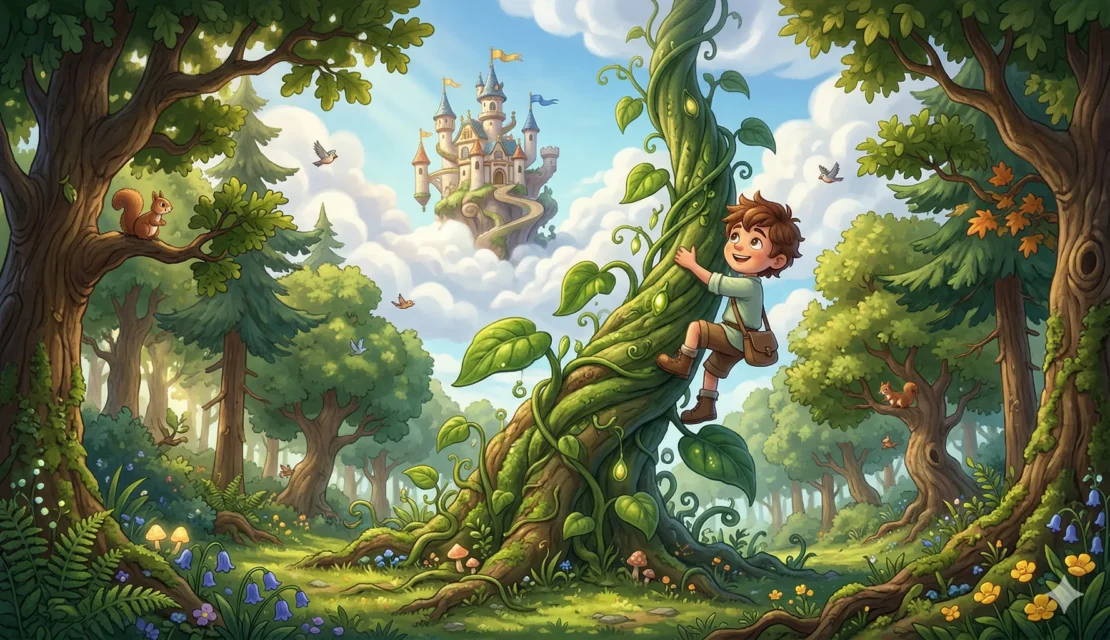
Once upon a time, there lived a poor boy named Jack and his widowed mother. They had very little, and their only source of income was a cow named Milky White. But one sad day, Milky White stopped giving milk, and Jack’s mother told him to take the cow to market and sell her. On the way, Jack met a strange old man who offered to trade him five “magic beans” for the cow. Jack, being young and adventurous, agreed immediately. When he got home, his mother was furious. “Magic beans? You foolish boy!” she cried, and threw the beans out the window.
The next morning, Jack woke up to find something incredible. A massive beanstalk had sprouted overnight, stretching so high that its top disappeared into the clouds. Jack’s curiosity got the better of him, and he began to climb. He climbed higher and higher, through the clouds, until he reached a strange land above the sky. There stood an enormous castle, bigger than anything he had ever imagined.
Jack crept inside and found a room with a table as tall as a house. Sitting at the table was a gigantic woman. “Please, I’m so hungry,” Jack said bravely. The giant’s wife, who was kind at heart, gave him bread and cheese. “You must hide!” she warned suddenly. “My husband is coming, and he eats little boys!” Jack hid inside the oven just as the ground began to shake with thundering footsteps. The giant stomped in, sniffing the air suspiciously. “Fee-fi-fo-fum! I smell the blood of an Englishman! Be he alive, or be he dead, I’ll grind his bones to make my bread!” But his wife convinced him it was just yesterday’s dinner he was smelling.
After eating, the giant pulled out bags of gold coins and counted them before falling asleep with tremendous snoring. Jack crept out from the oven, grabbed a bag of gold, and ran to the beanstalk. He climbed down as fast as he could and presented the gold to his astonished mother. They lived comfortably for a while, but eventually the gold ran out. So Jack climbed the beanstalk again. This time, he found a hen that laid golden eggs. He snatched the hen and escaped before the giant woke up.
But Jack, feeling bold, climbed the beanstalk a third time. This time he found a golden harp that played the most beautiful music all by itself. When Jack grabbed it, the harp cried out, “Master! Master!” The giant woke up with a roar and chased Jack toward the beanstalk. Jack climbed down faster than he ever had before, the giant close behind him. When Jack reached the ground, he shouted, “Mother, bring me the axe!” With three mighty chops, Jack cut down the beanstalk. The giant came tumbling down and landed with a crash that shook the entire countryside. Jack, his mother, the golden hen, and the singing harp lived happily and prosperously for the rest of their days.
Moral of the story: Courage and cleverness can overcome even the biggest obstacles. But remember to be wise with your adventures, and always know when it’s time to come home safely.
9. The Princess and the Pea
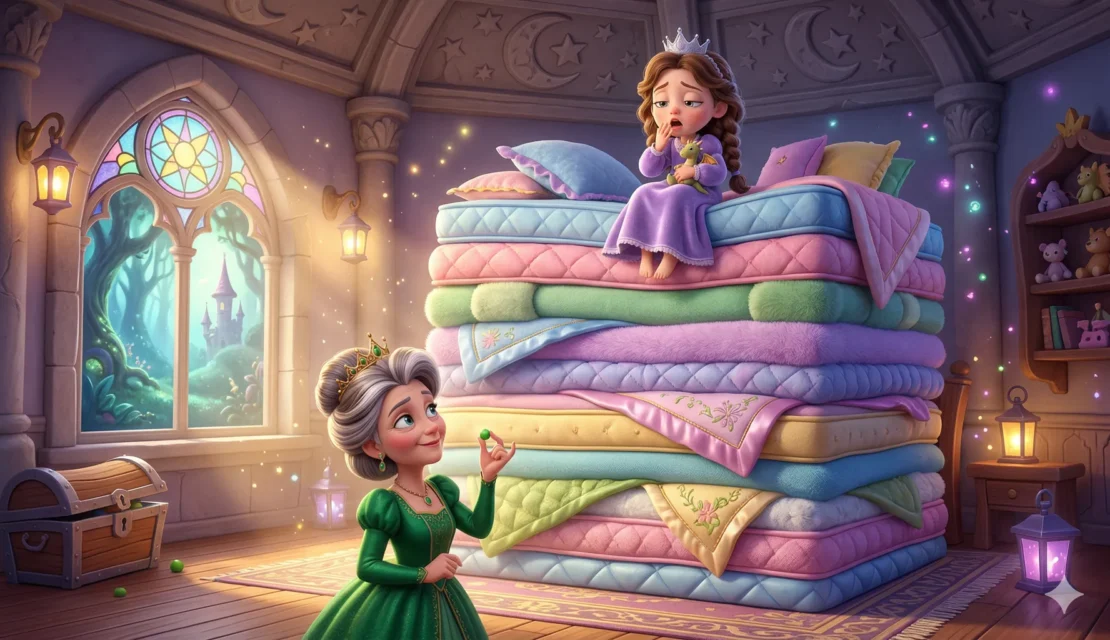
Once upon a time, there was a Prince who traveled the whole world searching for a real princess to marry. He met many princesses along the way, but something was always not quite right. Some were not kind enough. Some were not genuine enough. He could never be completely sure that any of them were real princesses through and through. He returned home feeling very sad and disappointed.
One stormy evening, thunder crashed and lightning flashed across the sky. Rain poured down in sheets, and the wind howled around the castle walls. In the middle of this terrible storm, there came a knock at the castle gate. The old King himself went to open it. Standing outside was a young woman, completely drenched from head to toe. Water ran down her hair and clothes, dripping from her elbows and flowing out of her shoes. Yet despite looking like a drowned cat, she claimed to be a real princess.
“We’ll soon find out about that!” thought the Queen, though she said nothing aloud. She went quietly to the guest bedroom, removed all the bedding, and placed a single tiny pea on the bottom of the bed frame. Then she piled twenty mattresses on top of the pea, and twenty thick quilts on top of the mattresses. This was where the princess would sleep for the night. The bed towered so high that the princess needed a ladder to climb up.
The next morning, the Queen asked how she had slept. “Oh, terribly!” said the princess. “I hardly closed my eyes the whole night. Something hard was in my bed, and I am black and blue all over. It was absolutely dreadful!” The Queen smiled broadly, and the Prince’s eyes lit up with joy. Only a real princess would have skin so delicate that she could feel a tiny pea through twenty mattresses and twenty quilts. The Prince knew he had finally found his true princess. They married in a grand ceremony, and the pea was placed in a museum where it can still be seen today, if nobody has taken it.
Moral of the story: True quality and sensitivity come from within and cannot be faked. Being genuine and authentic is more valuable than any crown or title, and the right people will recognize your true nature.
10. Hansel and Gretel
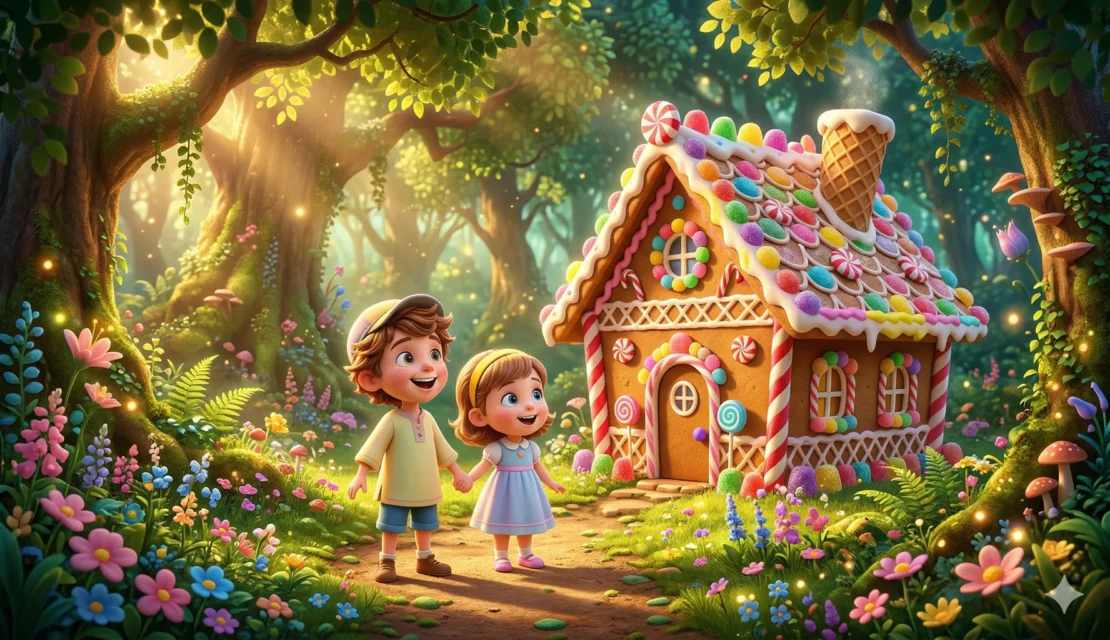
Once upon a time, near a vast, dark forest, there lived a poor woodcutter with his two children, Hansel and Gretel. Their mother had passed away, and their stepmother resented having to feed the children. When a terrible famine struck the land, the stepmother convinced the woodcutter to abandon the children in the forest. “There isn’t enough food for all of us,” she insisted coldly.
Little Hansel overheard their plan. That night, he sneaked outside and filled his pockets with shiny white pebbles that glowed like silver coins in the moonlight. The next day, as their father led them deep into the forest, Hansel secretly dropped pebbles along the path. When night fell and they were left alone, the children followed the trail of moonlit pebbles safely back home. Their father was secretly relieved, but the stepmother was furious.
She convinced the woodcutter to try again, and this time she locked the door so Hansel couldn’t collect pebbles. Instead, clever Hansel crumbled his piece of bread and dropped crumbs along the path. But when the children tried to follow the breadcrumb trail home, they discovered that birds had eaten every last crumb. They were truly lost in the deep, dark forest.
After wandering for three days, hungry and exhausted, they stumbled upon the most wonderful sight. A little house made entirely of gingerbread, with walls of cake, windows of clear sugar, and a roof decorated with candies and chocolates. The starving children began eating the house immediately. Suddenly, the door opened, and a very old woman appeared, smiling sweetly. “Come in, dear children! I’ll feed you properly.” She gave them pancakes, milk, apples, and nuts, and tucked them into soft beds.
But the old woman was actually a wicked witch who had built the candy house to lure children. The next morning, she grabbed Hansel and locked him in an iron cage. “I’m going to fatten you up and eat you!” she cackled. She forced Gretel to cook enormous meals for Hansel while feeding Gretel almost nothing. Every day, the witch checked Hansel’s finger to see if he was fat enough to eat. But clever Hansel stuck out a thin chicken bone instead of his finger, and the near-blind witch couldn’t tell the difference.
After weeks, the witch grew impatient. “Fat or thin, I’ll eat him tomorrow!” she declared. She ordered Gretel to light the oven. “Crawl inside and check if it’s hot enough,” the witch commanded. But brave Gretel saw through the trick. “I don’t know how,” she said innocently. “Show me first.” When the witch leaned into the oven to demonstrate, Gretel gave her a mighty push. She slammed the iron door shut and locked it tight. The wicked witch was gone forever.
Gretel freed Hansel from the cage, and together they discovered the witch’s treasure, chests overflowing with pearls, rubies, and diamonds. They filled their pockets and found their way home through the forest. Their father wept with joy when he saw them. The stepmother had gone away, and they never heard from her again. With the witch’s treasure, the family never went hungry again, and Hansel and Gretel grew up knowing that bravery and love for each other could conquer any danger.
Moral of the story: Courage, cleverness, and looking out for each other can overcome even the scariest situations. Things are not always what they seem, and trusting your instincts keeps you safe.
11. The Three Little Pigs
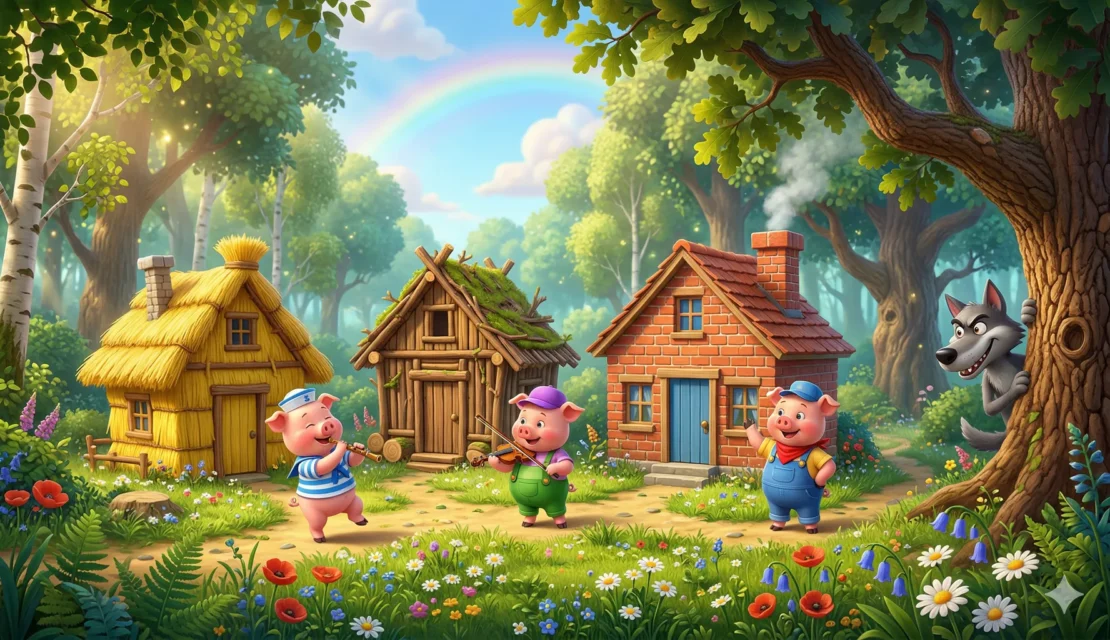
Once upon a time, three little pigs set out from their mother’s home to seek their fortunes in the wide world. “Build your houses strong,” their mother warned as she kissed each one goodbye. “You never know when trouble might come knocking.” The three brothers promised they would, but each had very different ideas about what “strong” meant.
The first little pig was lazy and wanted to play all day. He built his house out of straw because it was the quickest and easiest material he could find. “Done!” he announced proudly after just a few hours, then spent the rest of the day dancing and playing his flute. The second little pig worked a bit harder and built his house out of sticks. It took him a day to finish, and he was quite pleased with himself. He joined his brother to play and have fun in the sunshine. The third little pig was the most diligent of all. He carefully built his house out of solid bricks, mixing cement and laying each brick with precision. His brothers laughed at him for working so hard. “Come play with us!” they called. “You’re wasting your time!” But the third pig kept working until his house was sturdy, strong, and complete with a proper chimney.
One evening, a big bad wolf came prowling through the neighborhood. He was hungry and his eyes gleamed when he spotted the first little pig’s straw house. “Little pig, little pig, let me come in!” he growled. “Not by the hair on my chinny chin chin!” squealed the first little pig. “Then I’ll huff, and I’ll puff, and I’ll blow your house in!” roared the wolf. And he did exactly that. One mighty breath and the straw house scattered everywhere. The first pig ran squealing to his brother’s stick house.
The wolf followed and stood before the stick house. “Little pigs, little pigs, let me come in!” he snarled. “Not by the hair on our chinny chin chins!” they cried together. “Then I’ll huff, and I’ll puff, and I’ll blow your house in!” And with two enormous breaths, the stick house collapsed into a pile of twigs. Both pigs ran as fast as their little legs could carry them to their brother’s brick house.
The wolf followed once more, confident in his huffing and puffing abilities. “Little pigs, little pigs, let me come in!” he demanded. “Not by the hair on our chinny chin chins!” all three pigs shouted bravely from inside. The wolf huffed and puffed with all his might, again and again, but the brick house didn’t budge even slightly. Frustrated and furious, the wolf had another idea. He climbed onto the roof and began squeezing himself down the chimney. But the clever third pig had anticipated this. He had a pot of boiling water waiting in the fireplace. The wolf slid down the chimney and landed right in the hot water. He howled with pain, leaped out, and ran far, far away, never to bother the three little pigs again. From that day on, the first and second pigs learned their lesson, and all three brothers lived happily and safely in the strong brick house.
Moral of the story: Hard work and careful preparation always pay off in the end. Taking shortcuts might seem easier now, but building things properly protects you when challenges come.
12. Little Red Riding Hood

Once upon a time, there was a sweet little girl who was loved by everyone who met her. Her grandmother had given her a beautiful red velvet riding hood, and because she wore it everywhere she went, everyone called her Little Red Riding Hood. One sunny morning, her mother packed a basket with fresh bread, butter, and cake. “Take this to Grandmother’s house,” her mother said. “She’s been feeling ill and this will help her recover. Stay on the path through the forest and don’t talk to strangers.”
Little Red Riding Hood promised to be careful and set off through the woods. The birds were singing, the flowers were blooming, and the sunlight danced through the trees. She was enjoying herself so much that she almost didn’t notice the big, grey wolf standing right in her path. “Good morning, Little Red Riding Hood,” said the wolf, grinning widely and trying to look friendly. “Where are you going on this fine day?” Being a trusting and polite girl, she told him everything. “I’m going to Grandmother’s house on the other side of the forest. She’s sick, and I’m bringing her food.”
The wolf’s mind raced with a wicked plan. “Why don’t you pick some flowers for your grandmother?” he suggested sweetly. “She would love a fresh bouquet.” While Little Red Riding Hood gathered wildflowers, the wolf raced ahead to Grandmother’s cottage. He knocked on the door, imitating Little Red Riding Hood’s voice. “Come in, dear!” called Grandmother from her bed. The wolf burst in, swallowed Grandmother whole, then put on her nightgown, nightcap, and glasses. He climbed into bed and pulled the covers up to his chin, waiting with a hungry grin.
When Little Red Riding Hood arrived, something seemed different about Grandmother. “What big eyes you have, Grandmother!” she said. “All the better to see you with, my dear,” replied the wolf. “What big ears you have!” she continued. “All the better to hear you with, my dear.” “What big teeth you have!” she exclaimed. “All the better to eat you with!” roared the wolf, and he leaped out of bed.
Little Red Riding Hood screamed just as a woodcutter who was passing by heard the commotion. He burst through the door with his axe and chased the wolf away. With a few careful cuts, he freed Grandmother from the wolf’s belly, alive and well. They filled the wolf’s belly with heavy stones so he could never harm anyone again. Grandmother, Little Red Riding Hood, and the woodcutter shared the cake and bread together. From that day forward, Little Red Riding Hood always stayed on the path and never talked to strangers in the forest.
Moral of the story: Listen to your parents’ advice and be cautious around strangers. Not everyone who seems friendly has good intentions, and staying alert keeps you safe.
13. The Frog Prince
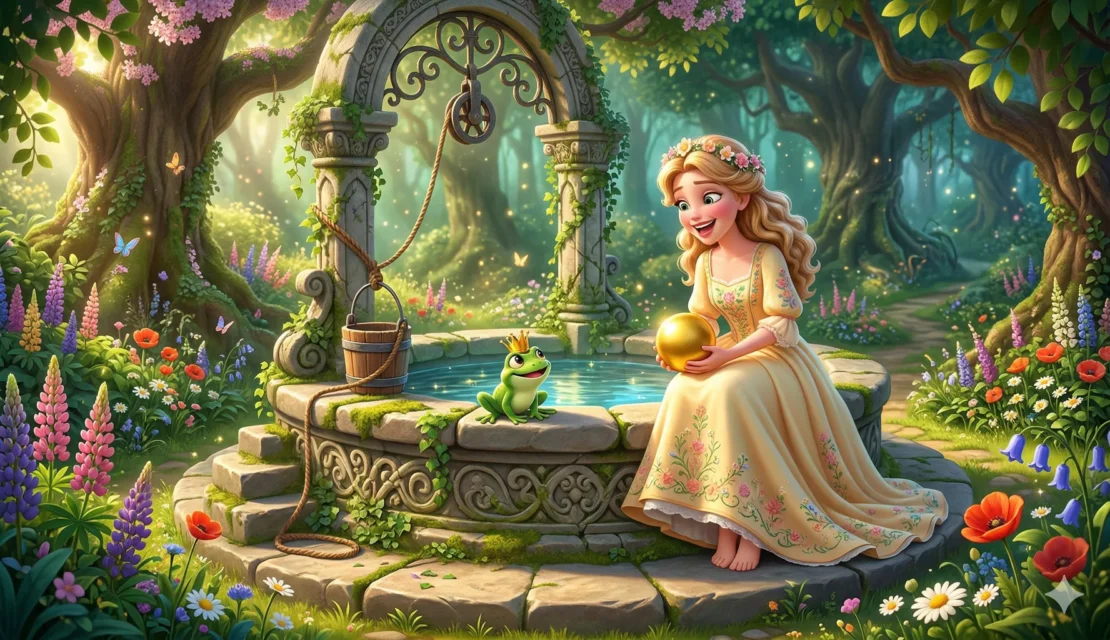
Once upon a time, a beautiful princess sat by a well in the palace garden, playing with her favorite golden ball. She tossed it high into the air and caught it, again and again, until one throw went wrong. The ball bounced off her fingertips and splashed into the deep well. The princess peered over the edge, but the well was far too deep. She began to cry, for the golden ball was her most precious possession.
“Why are you crying, beautiful princess?” asked a small voice. She looked down and saw an ugly green frog sitting on the edge of the well. “I’ve lost my golden ball,” she sobbed. “I can retrieve it for you,” said the frog, “but only if you promise to let me be your companion. I want to sit at your table, eat from your plate, and sleep on your pillow.” The princess thought, “This silly frog can never leave his well. I’ll promise him anything.” So she agreed.
The frog dove deep into the well and brought back the golden ball. The princess grabbed it joyfully and ran back to the palace without even thanking the frog. She completely forgot her promise. But the next evening, while the royal family was dining, there came a wet, slapping sound at the palace door. The princess opened it and found the frog sitting on the doorstep. “You promised!” he croaked. She slammed the door in his face and ran back to the table, trembling.
The King noticed her distress and asked what was wrong. When she explained, the King said firmly, “A promise is a promise, my daughter. You must keep your word.” Reluctantly, the princess let the frog sit at the table. He ate from her golden plate and drank from her crystal cup. She could barely hide her disgust. When bedtime came, the frog hopped up the stairs behind her. “You promised I could sleep on your pillow,” he reminded her. The princess was so frustrated that she picked up the frog and threw him against the wall.
But instead of splatting, something magical happened. A flash of golden light filled the room, and where the frog had been, there stood a handsome young prince. He explained that a wicked witch had cursed him to live as a frog until a princess showed him kindness and kept her promise. The princess felt terrible about throwing him, but the prince just laughed. “You broke the spell, and that’s what matters,” he said warmly. They became the best of friends, and eventually married. The prince always reminded her gently to keep her promises, and she always did from that day forward.
Moral of the story: Always keep your promises, even when it’s difficult. Appearances can be deceiving, and treating everyone with respect, regardless of how they look, reveals true character.
14. The Emperor’s New Clothes

Once upon a time, there lived an Emperor who loved fine clothes more than anything else in the world. He spent all his money on the most elaborate outfits and changed clothes every single hour. He barely cared about governing his kingdom because he was too busy admiring himself in mirrors. His wardrobe was the largest room in the entire palace, filled from floor to ceiling with robes, capes, and costumes.
One day, two clever swindlers arrived in town, claiming to be the finest weavers in all the world. “We can make the most magnificent fabric ever created,” they announced. “But this fabric has a special quality. It becomes invisible to anyone who is foolish or unfit for their position.” The Emperor was thrilled and immediately hired them, providing them with gold thread, silk, and a fortune in payment.
The swindlers set up their looms in the palace and pretended to work day and night. They moved their hands as if weaving, but there was nothing on the looms at all. When the Emperor sent his wisest minister to check on their progress, the old man saw nothing. But he was terrified of being thought foolish or unfit for his position. “It’s magnificent!” he reported back, describing patterns and colors that didn’t exist. Another official visited and did exactly the same thing. Nobody dared admit they couldn’t see anything at all.
Finally, the Emperor himself went to see the fabric. He saw nothing, absolutely nothing on the looms. His heart raced with panic. “Am I foolish? Am I unfit to be Emperor?” he thought. But he refused to admit it. “Wonderful! Extraordinary! The finest fabric I have ever seen!” he declared loudly, and all his courtiers nodded enthusiastically, seeing nothing but pretending they did.
The swindlers announced they would make the Emperor a complete outfit for the upcoming grand procession through the city. They spent all night pretending to cut and sew invisible fabric. “Raise your arms, Your Majesty,” they said, miming the act of dressing him. “Here are the trousers. Here is the coat. And here is the magnificent train.” The Emperor posed in front of his mirror, wearing absolutely nothing, while everyone around him praised his “beautiful new clothes.” Not a single person spoke the truth.
The Emperor walked proudly through the streets while his attendants pretended to carry his imaginary train. The crowds lined the streets, and everyone cheered and clapped, too afraid to admit they saw nothing. Then a small child tugged his mother’s sleeve and said loudly, “But the Emperor has no clothes on!” A ripple of whispers spread through the crowd. “The child is right! He has nothing on!” Soon everyone was saying it. The Emperor heard them and realized the terrible truth. He had been fooled by his own vanity and pride. But instead of turning back, he held his head high and continued walking, having learned the hardest lesson of all: that honesty matters more than appearances, and sometimes it takes a child to speak the truth that adults are afraid to say.
Moral of the story: Honesty and courage to speak the truth are more valuable than going along with the crowd. Vanity and pretending can make fools of even the most powerful people. Sometimes the bravest voice belongs to the smallest person.
15. Beauty and the Beast
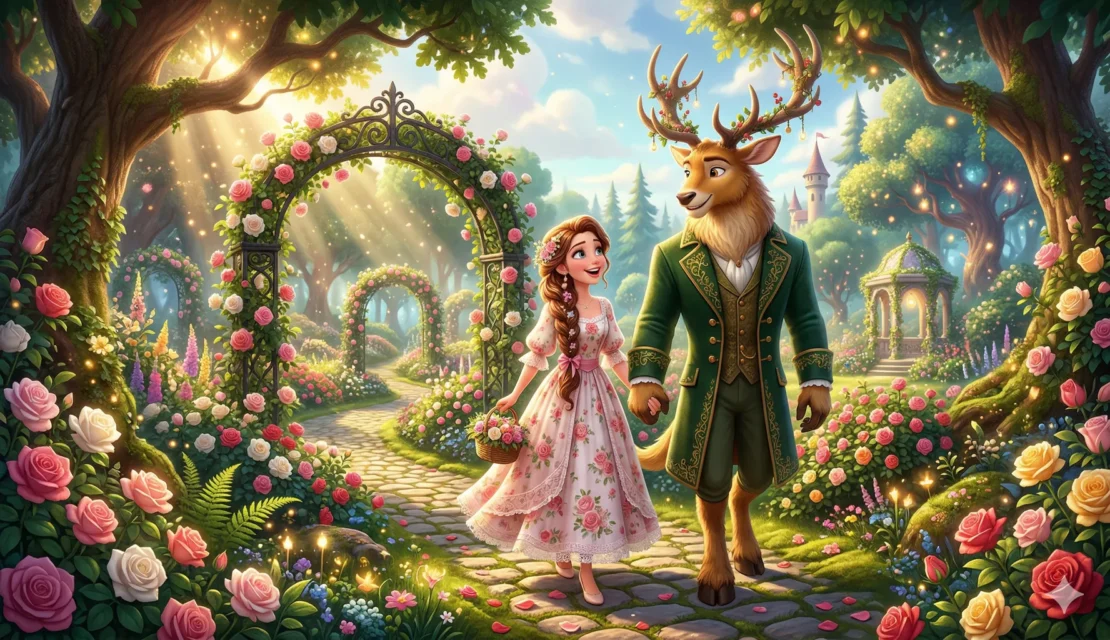
Once upon a time, a wealthy merchant lived happily with his three daughters. The youngest, Belle, was not only beautiful but also kind, intelligent, and humble. Unlike her older sisters, who craved fine dresses and jewels, Belle asked only for a single red rose when her father traveled. Sadly, the merchant lost his fortune in a storm at sea. The family moved to a small country cottage, where Belle worked cheerfully while her sisters complained endlessly.
One day, news arrived that one of the merchant’s ships had survived. He rode off to the city hoping to reclaim his wealth, but found nothing waiting for him. On his way home through a dark forest, he got lost in a terrible snowstorm. Just when he thought all was lost, he stumbled upon a magnificent castle surrounded by magical gardens that bloomed despite the winter cold. The doors opened on their own, and inside he found a table set with a delicious feast. He ate, rested, and in the morning, remembered Belle’s simple wish. He picked a beautiful red rose from the garden.
At that moment, a terrifying Beast appeared, roaring with fury. “I offered you shelter and food, and you repay me by stealing my roses?” the Beast thundered. “For this, you must die!” The merchant begged for mercy, explaining the rose was for his daughter. “Then send her to me,” said the Beast. “If she comes willingly, I will spare your life. If not, you must return yourself within three months.”
The merchant returned home devastated. Belle, upon hearing the story, insisted on going to the Beast’s castle. “I would rather live with a Beast than let my father suffer,” she said bravely. Her father wept, but Belle’s mind was made up. She traveled to the castle, terrified of what she would find. The Beast was indeed frightening in appearance, with sharp claws, wild fur, and enormous teeth. But to her surprise, he spoke gently. “This castle and everything in it is yours,” he said. “You will want for nothing here.”
Days turned into weeks, and Belle discovered that the Beast was kind, thoughtful, and generous. He gave her a magnificent library filled with thousands of books, knowing she loved reading. They ate dinner together every evening, talking about literature, philosophy, and the world. They walked through the enchanted gardens, and the Beast showed her magical rooms where she could see any place in the world through a special mirror. Every night, the Beast asked Belle the same question: “Will you marry me?” And every night, Belle gently declined, unable to see past his fearsome appearance.
One day, Belle looked into the magic mirror and saw her father lying ill at home. “Please let me visit him,” she begged with tears. The Beast agreed reluctantly. “But you must return within one week, or I will die of grief.” He gave her a magic ring that would transport her home instantly. Belle found her father and nursed him back to health. Her jealous sisters, seeing Belle’s fine clothes and hearing about the castle’s wonders, convinced her to stay longer than a week, hoping the Beast would be angry and devour her.
On the tenth night, Belle had a terrible dream. She saw the Beast lying in his garden, dying of heartbreak. She woke up in tears and used the magic ring to return immediately. She found the Beast collapsed among the roses, barely breathing. “Beast! Please don’t die!” she cried, holding his massive head in her arms. “I didn’t realize it until now, but I love you!” At those words, something extraordinary happened. The Beast’s body began to glow with golden light. His fur disappeared, his claws became hands, and where the Beast had been, there lay a handsome young Prince. “A witch cursed me to live as a Beast until someone could love me truly, despite my appearance,” he explained with tears of joy. Belle and the Prince were married in a celebration that lasted for days. Her father came to live in the castle, and even her sisters were forgiven. They all lived happily ever after.
Moral of the story: True beauty lives in the heart, not in appearances. Love grows when we take time to know someone beyond what our eyes can see. Kindness, patience, and compassion can break even the strongest curses.
Why Fairy Tales Matter for Your Child’s Development
These fifteen fairy tales carry timeless wisdom that shapes young minds in beautiful ways. When you read bedtime stories regularly, your child develops stronger language skills. Their vocabulary grows naturally through rich storytelling language. Their imagination expands with every magical adventure you share together.
Fairy tales also teach emotional intelligence through character experiences. Children learn about bravery from Jack and courage from Gretel. They understand kindness through Cinderella and honesty through the boy who told the Emperor the truth. These lessons sink deeper through stories than through direct instruction because children connect emotionally with the characters and their journeys.
At Apple Tree Pre-School BSD, storytelling forms a vital part of our Singapore curriculum. We use fairy tales to teach English language skills, moral values, and creative thinking through our programs at the Educenter BSD Building. Our educators bring these classic stories to life through dramatic play, puppet shows, and interactive reading sessions. Children don’t just hear stories in our classrooms, they live them, act them out, and create their own magical tales.
Reading fairy tales before bed creates the most precious bonding moments between you and your child. These stories become shared memories that your family treasures forever. They comfort children during difficult times and inspire courage when facing new challenges. Every “once upon a time” opens a door to wonder, and every “happily ever after” teaches hope. Start tonight and watch your child’s imagination soar with these magical fairy tales.
Ready to give your child a world of stories, learning, and magical experiences? At Apple Tree Pre-School BSD, we bring fairy tales and learning to life every single day through our engaging programs. Chat with us on WhatsApp or call us at +62 888-1800-900 to learn more about our Toddler, Pre-Nursery, Nursery, and Kindergarten programs.
Come play and learn with other children, because every child deserves a story-filled childhood full of wonder, magic, and happily ever afters! 📚👸🏰✨





Be the first to write a comment.