


There is a particular kind of magic that happens when you sit a young child down and begin with the words, “A long time ago, there was a prophet…” Their eyes go wide, their body goes still, and suddenly you have their complete and undivided attention in a way that no toy or screen ever quite manages to achieve. Islamic stories carry something powerful within them, a combination of adventure, miracle, and meaning that speaks directly to a child’s heart.
At Apple Tree Pre-School BSD, located in the Educenter BSD building in BSD City, we know firsthand how deeply young children respond to stories rooted in faith and morality. The children in our classrooms light up when these tales are shared, and the values embedded in them show up naturally in how they treat each other throughout the day. We believe that moral education begins with a good story, told with warmth, and that the best Islamic stories don’t just teach children about history, they shape who they become.
Whether you’re looking for bedtime reading, weekend story time, or simply want to introduce your little one to the beautiful traditions of Islamic teaching, these 10 stories are the perfect place to begin.
10 Islamic Stories for Children That Inspire Faith, Kindness, and Courage
From prophets and companions to everyday acts of faith, these Islamic moral stories for kids carry lessons about patience, generosity, gratitude, honesty, and trusting in Allah’s plan.
1. Prophet Ibrahim and the Fire: The Story of Ultimate Trust in Allah
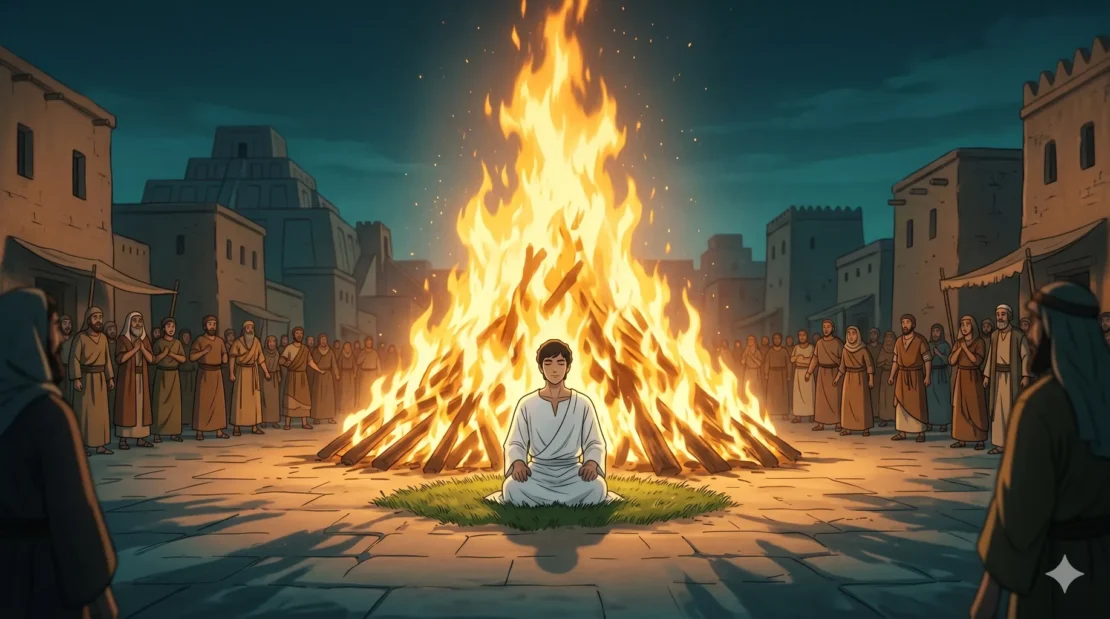
Long ago, in the ancient land of Mesopotamia, there lived a young man named Ibrahim who saw the world differently from everyone around him. While his father and his people carved idols from stone and wood and bowed before them, Ibrahim looked at the sky, the stars, the moon, and the sun, and felt deep in his heart that none of these things were worthy of worship. There had to be something greater. Something that created all of it.
One day, Ibrahim walked into the temple where his people kept their idols, rows and rows of carved figures that people brought food and offerings to every day. When everyone had left, Ibrahim took an axe and broke every idol in the room except the largest one. Then he placed the axe in the hands of the largest idol and walked away.
When the people returned and found their gods shattered on the floor, they were furious. “Who did this?” they demanded.
Ibrahim was brought before them. “Ask the big one,” he said calmly, pointing to the largest idol with the axe still in its hands. “Perhaps he did it.”
“You know perfectly well they cannot speak!” the people shouted.
“Then why do you worship things that cannot speak, cannot hear, and cannot help you?” Ibrahim replied.
The people had no answer for this. But their anger was immense. They could not accept that a young man had challenged everything they believed. The king, Nimrod, ordered that Ibrahim be punished in the most extreme way possible. They would build the largest fire ever constructed and throw him into it.
For days, the people gathered wood. The fire grew so large that birds flying overhead changed their path to avoid the heat. The flames reached so high they looked like a wall of orange and gold against the sky. No one could get close enough to even push Ibrahim in, so they built a catapult to launch him from a distance.
Ibrahim was placed in the catapult. The crowd gathered. The fire roared.
And in that moment, with the flames waiting below him, Ibrahim said words that have echoed through history: “Hasbunallahu wa ni’mal wakeel,” which means, “Allah is sufficient for us, and He is the best disposer of affairs.”
He was launched into the fire.
And Allah commanded: “O fire, be cool and peaceful for Ibrahim.”
The fire obeyed. Ibrahim landed in the middle of the blaze and sat there, unharmed, untouched, as comfortable as if he were sitting in a garden. The flames that could melt iron could not touch a single hair on his head. When the fire finally burned itself out, Ibrahim walked out completely unscathed.
The people were stunned. Some believed. Many did not. But Ibrahim’s story became one of the greatest examples in Islamic history of what it means to trust in Allah completely, even when every visible sign suggests there is no hope.
Moral: When you put your complete trust in Allah and stand firm in what is right, no force in the world can harm you. True courage is faith in action.
2. Prophet Yunus and the Whale: A Lesson in Patience and Repentance

Prophet Yunus was sent by Allah to guide the people of Nineveh, a city whose residents had turned away from goodness and fallen deep into wrongdoing. Yunus preached to them with sincerity and persistence, calling them back to the path of Allah, but they laughed at him, ignored him, and carried on with their lives as if he were invisible.
Day after day, month after month, Yunus tried. And day after day, they refused. Eventually, after years of effort with seemingly no result, Yunus grew frustrated. He felt he had done everything possible and that these people would never change. So he made a decision, one that he had not been given permission by Allah to make. He left.
He boarded a ship and sailed away from Nineveh across the open sea. But Allah’s plan is always larger than ours.
A terrible storm descended upon the ship. The waves rose like mountains, the wind tore at the sails, and the vessel was thrown about like a leaf in a river. The sailors, terrified and desperate, believed that someone on board had brought this misfortune upon them. They drew lots to find out who it was.
The lot fell on Yunus.
Then again on Yunus.
And a third time on Yunus.
Yunus understood. He had left his duty without Allah’s permission. He stood at the edge of the ship and, accepting what was happening, allowed himself to fall into the churning sea.
Allah sent an enormous whale that swallowed Yunus whole. Inside the belly of the whale, in complete darkness, with no light, no space, and no way out, Yunus found himself utterly alone.
It was in that darkness that Yunus turned back to Allah with complete sincerity. He made a dua that is remembered to this day: “La ilaha illa anta, subhanaka, inni kuntu minaz-zalimin,” which means, “There is no god but You, Glory be to You, indeed I have been among the wrongdoers.”
He repeated this prayer from the depths of the whale’s belly, acknowledging his mistake, asking for forgiveness, and returning to Allah with everything he had.
Allah heard him. The whale was commanded to release Yunus, and it deposited him, weak and ill, on a bare shore. Allah caused a gourd plant to grow over him, providing shade, nourishment, and protection as he recovered his strength.
And the people of Nineveh? After Yunus had left, they saw the signs of approaching punishment in the sky and were terrified. They repented sincerely, every one of them, and Allah forgave them. All one hundred thousand of them. Yunus returned to find his city transformed.
Moral: No matter how far you’ve gone from the right path, it is never too late to turn back to Allah. Sincere repentance is always heard, even from the darkest places.
3. Prophet Yusuf and His Brothers: Beauty, Jealousy, and Forgiveness
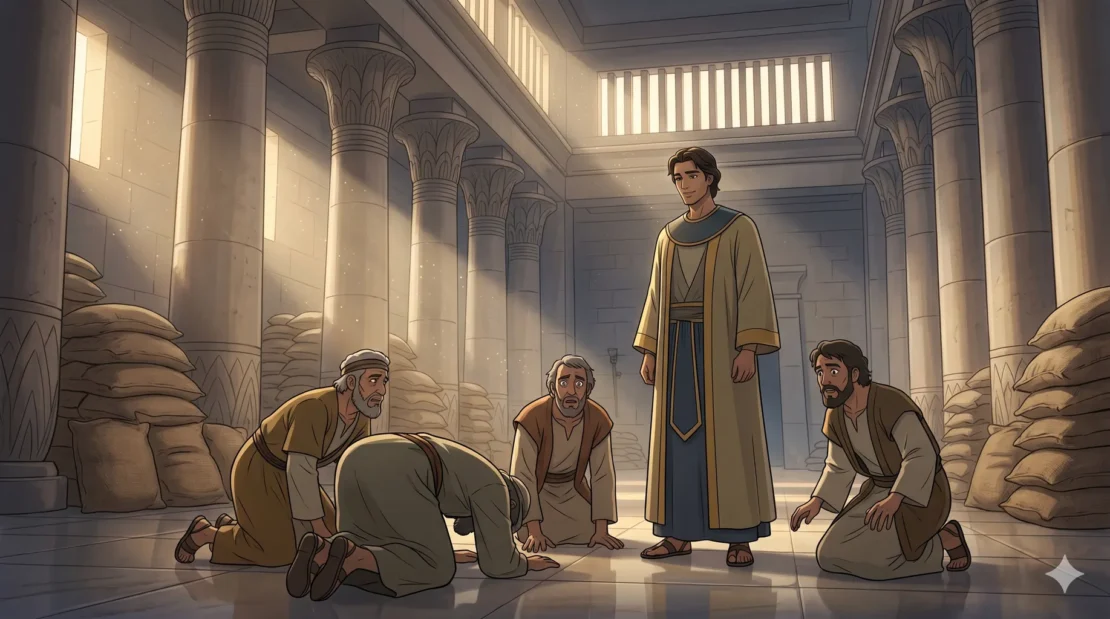
Prophet Yusuf was one of twelve brothers, and from a very young age, it was clear that his father, Prophet Yaqub, held a special love for him. Yusuf was gentle, beautiful in character and appearance, and had been blessed by Allah with the gift of interpreting dreams. When he was still a small boy, he dreamed that eleven stars, the sun, and the moon all bowed before him.
His brothers saw their father’s love for Yusuf and felt a jealousy so sharp it consumed them. They plotted together: “Let’s get rid of Yusuf. Throw him somewhere far away. Then our father’s attention will be ours.”
They convinced Yaqub to let Yusuf come with them on a trip, promising to protect him. Once they were far from home, they threw their young brother into a deep, dark well and left him there. They returned home with Yusuf’s shirt stained with false blood and told their father that a wolf had eaten him.
Yaqub wept. He wept so much and for so long that he lost his eyesight. But he never lost his faith. “I entrust my grief to Allah,” he said. “He knows what you do not.”
In the well, Yusuf was found by a passing caravan and sold into slavery in Egypt. He was purchased by a powerful minister named Al-Aziz and raised in his household. As he grew, his character and his beauty became known throughout the land. The minister’s wife attempted to seduce him, but Yusuf refused. “I seek refuge in Allah,” he said. He chose prison over sin.
In prison, Yusuf’s gift of dream interpretation became known. When the king of Egypt had a troubling dream that no one could explain, Yusuf was called upon. He interpreted the dream perfectly: seven years of plenty followed by seven years of famine. The king was so impressed that he appointed Yusuf as treasurer of Egypt, placing the entire nation’s food supply under his care.
During the famine, Yusuf’s brothers came to Egypt seeking grain, not knowing that the powerful minister they were begging from was the very brother they had thrown into a well decades earlier.
When Yusuf finally revealed himself to them, they were overcome with shame and fear.
“Do you know what you did to Yusuf and his brother?” he asked.
They trembled. “Are you… Yusuf?”
“I am Yusuf,” he said. “And this is my brother. Allah has been gracious to us.”
And then, in one of the most beautiful moments in all of Islamic scripture, Yusuf forgave them. Completely. Without condition. “No blame will there be upon you today,” he told them. “May Allah forgive you. He is the most merciful of the merciful.”
He brought his entire family to Egypt. When his parents entered, they bowed before him, and the dream of his childhood, eleven stars, the sun, and the moon, was finally fulfilled.
Moral: Patience through hardship, faith through injustice, and the willingness to forgive, these are the qualities that elevate a person in this life and the next.
4. The Generosity of Prophet Muhammad: The Hungry Neighbour
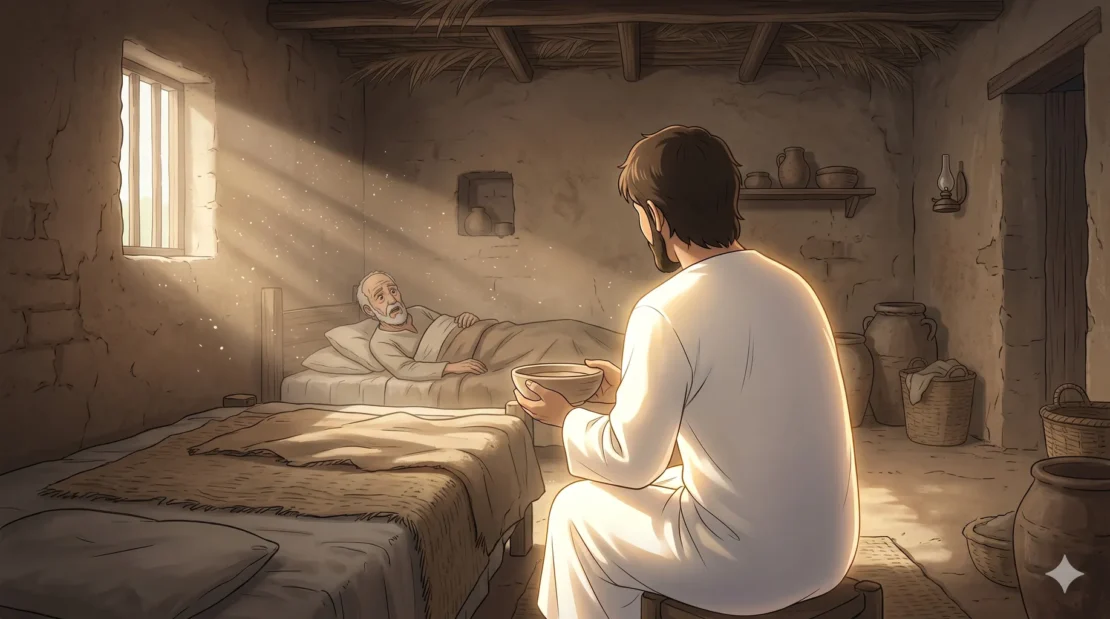
In the time of Prophet Muhammad, peace be upon him, there lived a man in Madinah who was known for being unkind to the Prophet. He was a neighbour who made his displeasure known at every opportunity. He would leave rubbish in front of the Prophet’s door. He would speak ill of him to others. He did everything in his power to make the Prophet’s daily life unpleasant.
And yet, every single day, Prophet Muhammad greeted this man with kindness. He never raised his voice. He never retaliated. He never spoke badly of him to others. He simply continued to be patient and gentle, the way a person of deep faith carries themselves regardless of how others behave.
One day, the Prophet noticed that no rubbish had been left at his door. The next day, the same. And the day after that. The man was nowhere to be seen. Another person might have been relieved. Prophet Muhammad was concerned.
He asked after his neighbour and was told the man had fallen ill. Without hesitation, without a trace of resentment, the Prophet went to visit him.
When the man opened his eyes and saw Prophet Muhammad sitting beside his bed, he could not believe what he was seeing. Here was the man he had tormented, the man he had tried to humiliate, sitting at his bedside with genuine care on his face.
“Why are you here?” the man asked weakly.
“You are my neighbour,” the Prophet said simply. “And you are unwell. Of course I am here.”
The man wept. In that moment, the kindness that he had been resisting for so long finally broke through. He understood that this was not a man who held grudges or returned cruelty with cruelty. This was a man who embodied mercy so completely that even his enemies could not help but love him eventually.
The neighbour became Muslim that day, not because he was argued into it or pressured into it, but because he had seen Islam lived in front of him so beautifully that denying it was no longer possible.
Moral: The best way to respond to unkindness is not with retaliation, but with consistent, unwavering kindness. Character speaks louder than any argument.
5. Prophet Nuh and the Ark: Patience That Lasted Centuries

Prophet Nuh was given a task that most of us cannot even begin to comprehend. Allah commanded him to call his people to the truth, and Nuh did so faithfully, consistently, and patiently for 950 years. Nine hundred and fifty years of preaching, of inviting, of explaining, and of being rejected, mocked, and ridiculed.
The people of Nuh were deeply attached to their idols. They had names for each one, Wadd, Suwa, Yaghuth, Ya’uq, and Nasr, and they refused to give them up. They put their fingers in their ears when Nuh spoke. They covered their faces with their garments. They whispered to each other, “Don’t listen to him.”
Nuh tried everything. He spoke to them in public and in private. He appealed to reason, to emotion, to the beauty of creation around them. He pointed to the sky and the earth and the seas and said, “Do you not see what Allah has made for you?” And still, generation after generation, almost no one believed.
After centuries of effort, Allah told Nuh that no more people would believe. It was time. He was commanded to build an ark, an enormous ship, in the middle of dry land, far from any sea.
The people laughed harder than ever. “A boat in the desert? He’s finally lost his mind!”
Nuh built it anyway, plank by plank, under the hot sun, while the people pointed and jeered. He gathered the believers, his small community, and a pair of every living creature.
Then the sky opened. Water poured from above and erupted from below. The flood came from everywhere at once. The water rose higher than the mountains. Nuh’s own son, who had refused to believe, was among those who drowned, calling out to climb a mountain that would not save him. Nuh cried out to Allah for his son, and Allah reminded him gently, “He is not of your family. He is one of unrighteous deed.”
The ark floated safely above the destruction, carrying the believers and the future of every living species on earth. When the water receded, the ark came to rest on Mount Judi, and life began again.
Moral: Patience is not passive. It is the active, deliberate choice to continue doing what is right even when the results are invisible and the ridicule is constant. Allah’s timing is perfect, even when it feels impossibly slow.
6. The Boy and the King: Standing for Truth No Matter the Cost
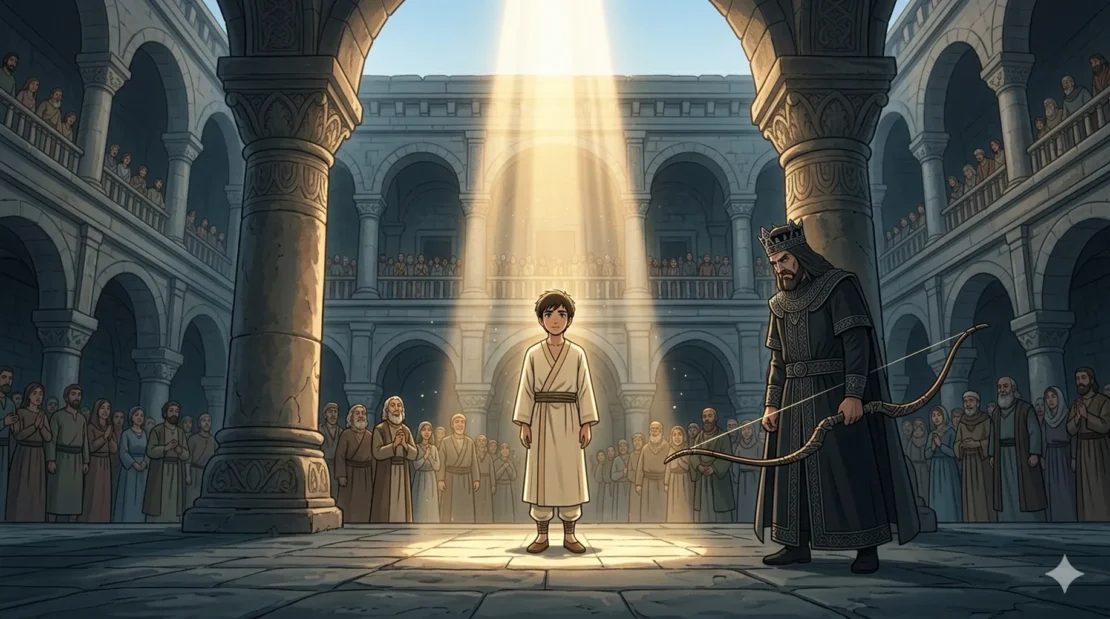
This is a powerful Islamic story from the Quran, Surah Al-Buruj, about a young boy who believed in Allah in a kingdom ruled by a tyrant sorcerer-king.
The king employed a sorcerer to maintain control over his people through fear and illusion. When the sorcerer grew old, he asked the king for a young apprentice to teach his dark arts to. A bright, intelligent boy was chosen and sent to the sorcerer daily for lessons.
On his way to the sorcerer’s house each day, the boy passed by the home of a monk, a quiet man of true faith who worshipped Allah alone. The boy began stopping to listen to the monk’s teachings, and something in his heart told him this was the truth.
He found himself torn between two teachers, one of deception and one of faith. Then one day, a great beast blocked the road, preventing all the people from passing. The boy picked up a stone and said, “O Allah, if the way of the monk is more beloved to You than the way of the sorcerer, then kill this beast so the people may pass.” He threw the stone and the beast died instantly.
From that day, the boy knew. He followed the path of the monk.
He began healing the blind and the sick through prayer to Allah, not through sorcery. Word spread throughout the kingdom. The people started believing in Allah. The king was furious. He had the monk killed. He tried to kill the boy.
He sent soldiers to throw the boy off a mountain. The mountain shook and the soldiers fell, but the boy walked back to the king unharmed. He sent soldiers to drown him in the sea. The boat capsized and the soldiers drowned, but the boy walked back to the king unharmed.
Finally the boy said to the king, “You cannot kill me unless you do as I say. Gather all the people. Tie me to a tree. Take an arrow from my quiver, place it in your bow, and say: In the name of Allah, Lord of this boy. Then shoot.”
The king, desperate, did exactly as the boy instructed. He said the words. He released the arrow. The boy died.
But in that moment, every single person gathered in the crowd heard the words “In the name of Allah, Lord of this boy,” and they understood. They all believed. Every one of them.
The boy had given his life, but in doing so, he had guided an entire nation to faith.
Moral: Sometimes standing for truth requires the greatest sacrifice. But a single act of sincere courage can change the world for countless others.
7. Abu Bakr and the Crying Old Woman: Quiet Service Without Recognition
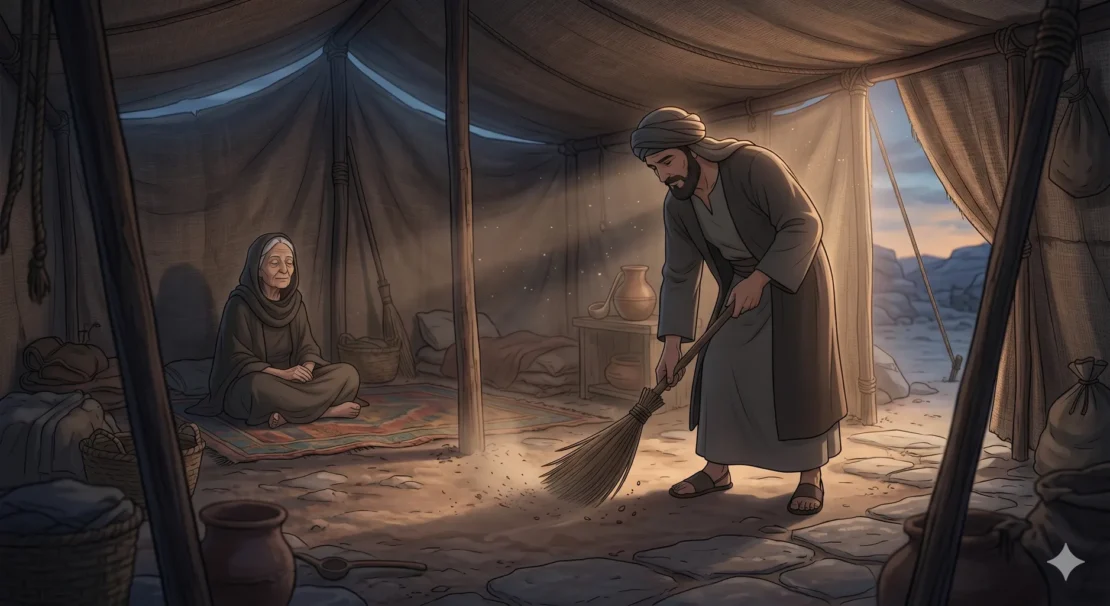
During the time of Umar ibn Al-Khattab’s rule as Caliph, he used to visit the outskirts of Madinah at night to check on the poor and vulnerable. One night, he arrived at the tent of a blind, elderly woman who lived alone on the edge of town.
When he entered, he found her home already cleaned, her water jug already filled, and her food already prepared. He was surprised. He had come to serve her, but someone had already been there.
The next night, Umar came earlier to discover who this mysterious helper was. He hid himself nearby and waited.
In the darkness before dawn, a figure approached the old woman’s tent. He entered quietly, swept the floor, filled her water, prepared her simple food, and tended to everything she needed, all in complete silence. The old woman didn’t even know who he was. She simply called him “my kind visitor.”
The figure finished and slipped away into the night.
Umar followed him. When the first light of morning caught the man’s face, Umar stopped dead in his tracks. It was Abu Bakr As-Siddiq, the previous Caliph, the most powerful man who had ruled before Umar.
Abu Bakr had been coming to this woman’s tent every single night, doing the most basic, humble household tasks for a woman who didn’t even know his name, without telling anyone, without seeking recognition, and without ever stopping even after his time as leader had ended.
Umar stood there for a long time. Then he said, quietly and with deep emotion, “May Allah have mercy on you, Abu Bakr. You have exhausted those who will come after you.”
He meant that Abu Bakr had set a standard of silent, humble service that would be nearly impossible for any future leader to match.
Moral: True generosity does not seek recognition or applause. The most beautiful acts of service are the ones no one ever sees.
8. Prophet Musa and the Man of Knowledge: Humility in Seeking Wisdom
Prophet Musa was one of the greatest prophets ever sent, a man who spoke directly with Allah. One day, someone asked him, “Who is the most knowledgeable person on earth?” Musa answered, “I am.”
Allah corrected him gently, revealing that there was a servant of His named Khidr who possessed knowledge that even Musa did not have. Musa immediately asked to meet this man and learn from him. Allah told him to travel to the junction of two seas.
When Musa found Khidr, he asked humbly to accompany him and learn. Khidr agreed but set one condition: “Do not question anything I do until I explain it to you myself.”
Musa promised.
They boarded a ship, and Khidr tore a plank from the bottom, damaging it deliberately. Musa couldn’t contain himself. “You’ve damaged the ship of people who gave us a free ride! You could have drowned them!”
Khidr reminded him of his promise. Musa apologised and they continued.
They came upon a young boy playing with other children. Khidr walked up to him and killed him. Musa was horrified. “You’ve killed an innocent child who has done nothing wrong!”
Again Khidr reminded him. Musa apologised, saying if he questioned again, Khidr could part ways with him.
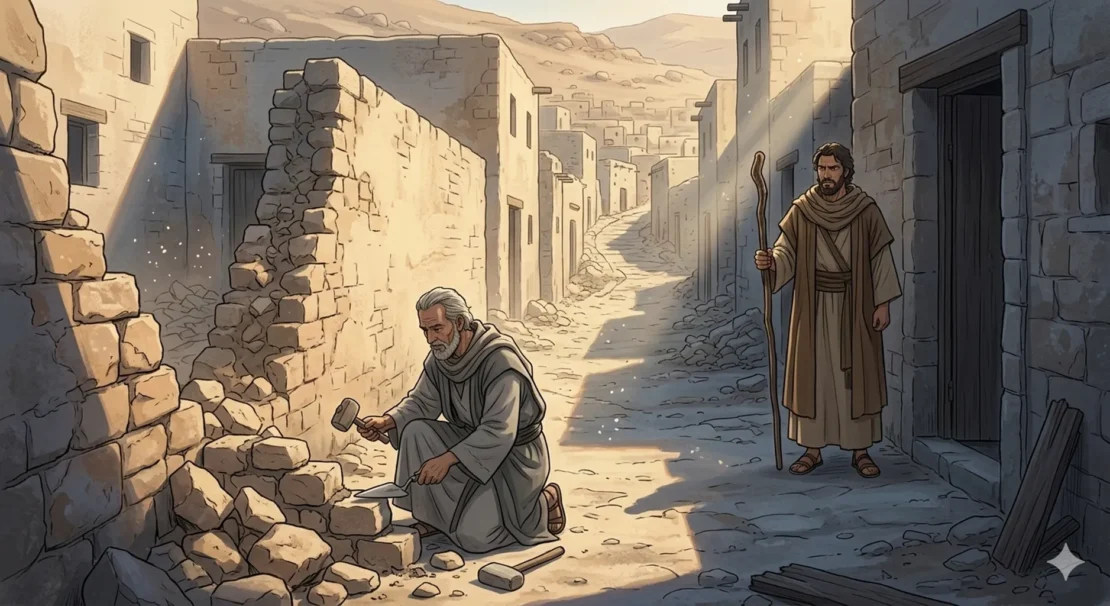
They came to a town and asked for food. The townspeople refused to host them, rude and inhospitable. Despite this, Khidr found a crumbling wall in the town and rebuilt it, spending great effort on people who had shown them no kindness.
Musa couldn’t help himself. “You could have at least asked for payment for that!”
Khidr said, “This is where we part. But I will now explain everything.”
The ship belonged to poor fishermen. A tyrant king was seizing every good ship by force. By damaging it, Khidr had made it worthless to the king, saving it for its owners.
The boy, though young and innocent-looking, was destined to grow into someone who would bring tremendous suffering to his righteous parents through disbelief and cruelty. Allah would replace him with a child better in purity and closer to mercy.
The wall concealed a treasure left by a righteous father for his two orphan sons. If the wall had collapsed, the town’s greedy people would have stolen it. By rebuilding it, Khidr ensured the orphans would find their inheritance when they came of age.
Musa stood in silence. Every act that had seemed wrong on the surface had carried a deeper wisdom he could not see.
Moral: We do not always understand why things happen the way they do. Humility means accepting that Allah’s wisdom is greater than our own, and that what seems like loss may be protection in disguise.
9. The Woman Who Fed a Thirsty Dog: Small Deeds, Infinite Reward
Prophet Muhammad, peace be upon him, told this story to his companions one day as they sat together in Madinah.
There was a woman, long ago, who had lived a sinful life. She had not been kind. She had not been righteous. By every measure that the people around her would have used, she was not a good person. And she knew it. She carried the weight of her choices heavily.
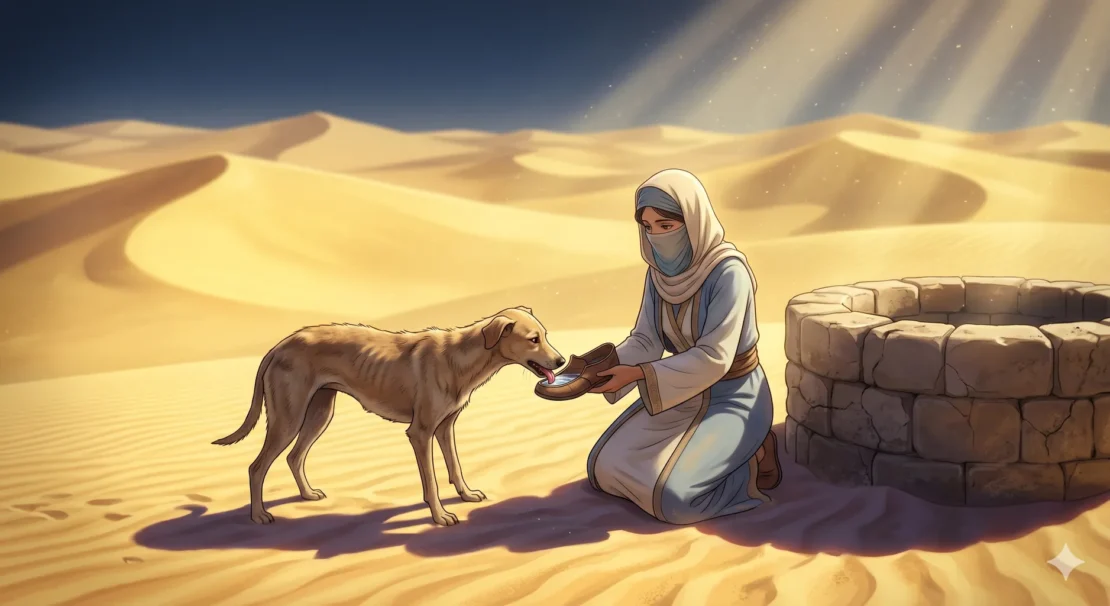
One blistering hot afternoon, she was walking through the desert, her throat burning with thirst. She came across a well and climbed down into it to drink. The water was cool and reviving, and she drank deeply until she was satisfied.
When she climbed back out into the harsh sunlight, she saw a dog, panting desperately, licking the damp sand near the edge of the well. The animal was on the verge of death from thirst. Its tongue hung out, its eyes were glazed, and it could barely lift its head.
The woman looked at the dog. She looked down at the well. She had no bucket, no rope, no container of any kind.
She took off her shoe, a leather slipper, and climbed back down into the well. She filled the shoe with water, held it carefully between her teeth, and climbed back up. She poured the water gently into the dog’s mouth.
The dog drank. Then it looked at her with something she could not quite name but felt deeply. It lived.
Prophet Muhammad told his companions that for this single act, this one moment of compassion toward a suffering creature, Allah forgave this woman all of her sins. Every single one.
The companions were amazed. “Messenger of Allah, is there reward for us in serving animals?”
“There is reward,” he replied, “for serving every living being.”
Moral: No act of kindness is too small in the sight of Allah. A single moment of genuine mercy can outweigh a lifetime of mistakes.
10. Prophet Sulaiman and the Ant: Greatness That Notices the Small
Prophet Sulaiman was given a kingdom unlike any other in human history. Allah granted him power over the wind, understanding of the language of animals and birds, and command over the jinn. His armies were vast, his wealth was immense, and his wisdom was legendary. He was, by any measure, the most powerful ruler the world had ever seen.
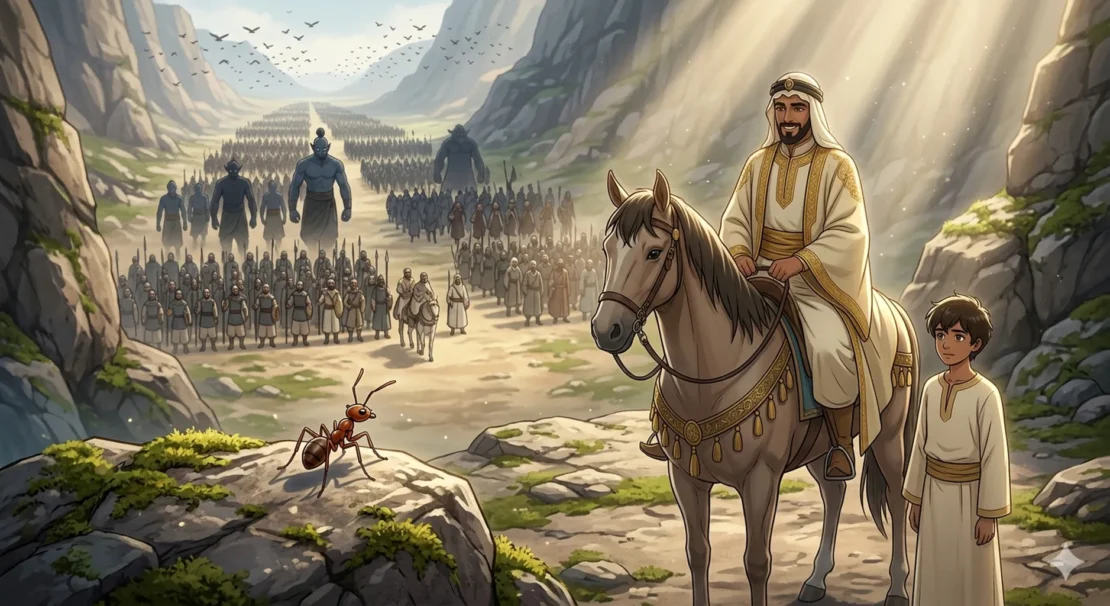
One day, Sulaiman was marching with his enormous army, a procession of men, jinn, and birds that stretched across the land as far as the eye could see. The ground shook with their movement. The sky was dark with birds. The display of power was absolute.
As they approached a valley, a tiny ant saw them coming. This ant, smaller than a grain of rice, looked at the approaching army and called out to her community, “O ants! Enter your homes so that Sulaiman and his soldiers do not crush you without even realising it!”
She was not angry at Sulaiman. She was not blaming him. She simply knew that something enormous was coming and her people needed to be safe.
And Sulaiman, this king with power over winds and jinn and nations, heard her. He heard one tiny ant speaking to her family in a valley, and instead of marching on, he stopped.
He smiled. And then he laughed, a warm laugh of genuine delight and gratitude.
He raised his hands in prayer and said, “My Lord, inspire me to be grateful for Your favour which You have bestowed upon me and upon my parents, and to do righteousness of which You will approve. And admit me, by Your mercy, among Your righteous servants.”
The most powerful king on earth stopped his entire army because of one ant. He did not crush forward. He did not ignore her. He noticed, he appreciated, and he remembered that all his power was a gift from Allah, not something he had earned or deserved.
This is the mark of true greatness. Not power that ignores what is beneath it, but power that pauses, listens, and remains humble before the smallest of Allah’s creation.
Moral: True greatness is shown not by how you treat the powerful, but by how you treat the powerless. The greatest leaders are those who notice the smallest voices.
Why Islamic Stories Shape Better Human Beings
Every one of these islamic stories carries something that no lecture, no rule list, and no punishment can deliver: the quiet, lasting impact of a truth felt rather than told. When children hear about Ibrahim’s courage, or the woman who saved a dog, or the ant who protected her family, they don’t just understand a concept. They feel it settle into their bones.
Stories Build Iman and Character Together
Islamic stories for children do something remarkable. They build faith and character simultaneously, never separating the two. A child who grows up hearing these stories learns that being a good Muslim and being a good human are not two different things. They are one and the same.
The Right Environment Makes All the Difference
At Apple Tree Pre-School BSD, we integrate moral education into everything we do. Through our Singapore curriculum’s Moral and Social Studies components, children don’t just hear about values in isolation. They live them in community, practising kindness, patience, honesty, and generosity with real friends in real situations every single day.
Our classrooms, located in the Educenter BSD building, are designed to be warm, inclusive, and values-rich environments where children from all backgrounds grow smart and happy together. Explore our programs to find the right fit for your child, from Toddler through Kindergarten 2.
Start Your Child’s Story With Us
We hope these 10 islamic stories gave you something beautiful to share with your family tonight. The values they carry, patience, kindness, courage, humility, gratitude, and forgiveness, are exactly the kind of seeds that grow into extraordinary adults when planted early.
If you’d love for your child to grow up in a community that nurtures both heart and mind every single day, we would be honoured to welcome your family.
Register now and come play and learn with other children at Apple Tree Pre-School BSD! Chat with us on WhatsApp or call us at +62 888-1800-900. We can’t wait to meet your little one!




Be the first to write a comment.