

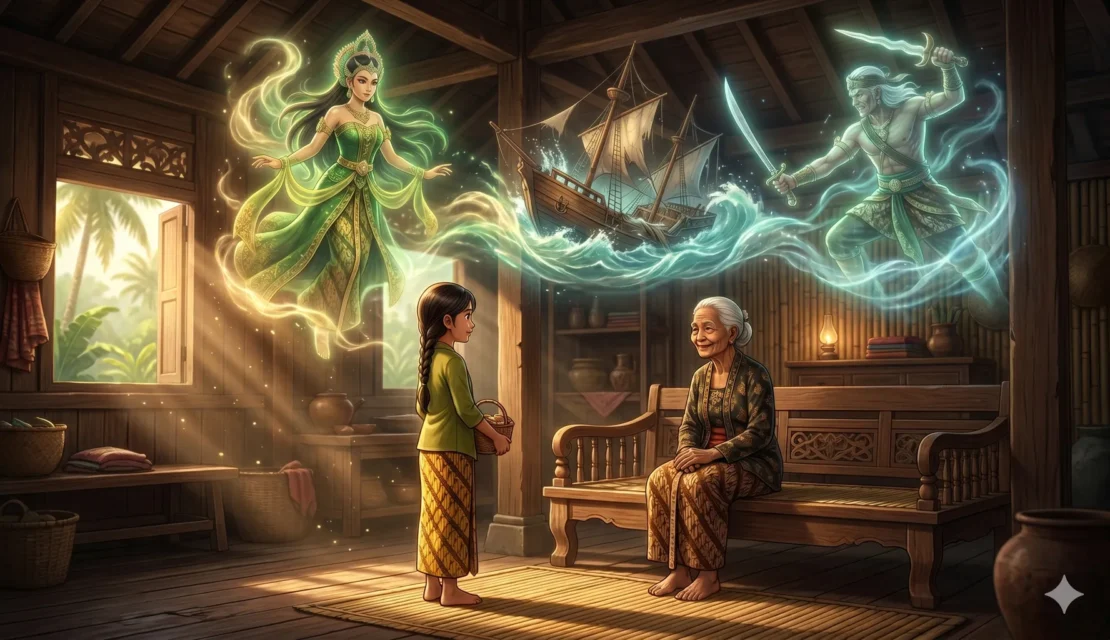
Long before bedtime apps and animated series, Indonesian children gathered around grandparents in dimly lit rooms and listened to stories that had been travelling from mouth to mouth for hundreds of years. These Indonesian folktales are woven into the fabric of the archipelago itself, each one rooted in a specific island, a specific mountain, a specific river, carrying the values, warnings, and wonder of the culture that created it.
At Apple Tree Pre-School BSD, located in the heart of Educenter BSD, we believe these stories are more than just entertainment. They are a child’s first introduction to empathy, to consequence, to the idea that the world is layered with meaning. We tell them in our classrooms, and we think you should tell them at home too.
Here are 7 of the most beloved Indonesian folktales, retold in full so you can share them tonight. Each one is rich with magic, ancient wisdom, and a lesson that will stay with your child long after the lights go out.
7 Timeless Indonesian Folktales Every Child Should Hear
From golden cucumbers to vengeful queens of the sea, these traditional Indonesian folk stories, legends, and fairy tales carry the soul of the archipelago across generations.
1. Timun Mas: The Golden Cucumber Girl from Central Java

In a small village at the edge of a vast Javanese forest, there lived an old woman named Mbok Srini. She had worked the land her entire life, growing vegetables and selling them at the local market to make ends meet. Her hands were rough from years of toil, and her house was modest. But the one thing she wanted more than anything, the thing no amount of hard work could produce, was a child.
One night, as the rain hammered the roof of her wooden house and the wind bent the banana trees nearly sideways, a thundering knock shook the door. She opened it and found herself staring up at the most terrifying figure she had ever seen: a giant named Buto Ijo. His skin was dark green, his eyes burned like hot coals, and when he spoke, the floor vibrated.
“I know what you want,” he said, crouching to fit his enormous head through the doorframe. He held out a single seed, golden and faintly glowing. “Plant this cucumber seed. Tend it carefully. It will give you a daughter. But when she turns seventeen, you must return her to me.”
Mbok Srini knew she should refuse. She knew what giants did. But the ache in her heart was older and louder than her fear. She took the seed.
She planted it the next morning in the softest patch of soil behind her house. She watered it with rainwater. She talked to it. She sang to it. And within weeks, a single enormous golden cucumber grew, luminous and warm to the touch. When it split open one dawn, inside lay a baby girl so beautiful that Mbok Srini wept.
She named her Timun Mas, Golden Cucumber, and loved her with a fierceness that surprised even herself.
The years went by as years do, too quickly for those who are watching. Timun Mas grew into a girl of extraordinary kindness and beauty. She helped her mother in the garden, she was gentle with the animals, and she had a laugh that made the neighbours smile even on bad days. Every year that passed brought Mbok Srini joy and dread in equal measure, because she knew what was coming.
As Timun Mas approached her seventeenth birthday, Mbok Srini could no longer sleep. She made a decision. She wrapped herself in a shawl and walked deep into the forest to find a holy hermit who was said to know the old magic.
The hermit listened to everything. Then, without a word, he disappeared into his hut and returned with four small cloth pouches, each tied with a different coloured string.
“Give these to your daughter,” he said. “When the giant comes, she must run. And when he is close, she must throw one pouch behind her. Each one will create an obstacle. But she must not stop running. Not until the last one is thrown.”
The morning of her seventeenth birthday, the earth shook. Trees cracked and fell. Birds scattered from the canopy in great dark clouds. Buto Ijo was coming.
Mbok Srini pressed the four pouches into Timun Mas’s hands, kissed her forehead, and told her to run south. Timun Mas ran like the wind itself was carrying her.
The giant followed, shaking the ground with every step, his roar echoing off the mountains.
When she heard him close behind her, Timun Mas threw the first pouch. The seeds inside exploded into a jungle of razor-sharp thorned vines that erupted from the earth and tangled around the giant’s legs. He bellowed in pain and ripped through them, bleeding and furious, but slowed.
She threw the second pouch. Needles scattered across the ground and instantly grew into a forest of towering bamboo, dense and sharp as a wall of swords. The giant crashed through it, roaring, snapping bamboo like twigs, but he was slower now.
The third pouch produced an enormous lake of boiling water that spread across the land with a hiss and a roar of steam. Buto Ijo waded in, screaming, his skin blistering, but still he came.
Timun Mas was terrified. She had one pouch left. She could feel the ground shaking beneath her feet. She threw the last pouch and prayed.
The contents scattered into a vast, deep swamp of sticky, pulling mud. Buto Ijo charged into it and immediately sank to his knees. He thrashed. He howled. He reached for Timun Mas with one enormous hand. But the mud was relentless. It pulled him deeper with every movement until only his eyes were visible, then nothing at all.
The forest went silent.
Timun Mas stood trembling, alone, in the sudden stillness. Then she turned around and ran all the way home.
When she burst through the door, Mbok Srini was standing right there, waiting. They held each other for a very long time without saying a word.
Moral: Love gives us the courage to face even the most terrifying obstacles. And preparation, guided by wisdom, can overcome raw power every time.
2. Malin Kundang: The Ungrateful Son of West Sumatra
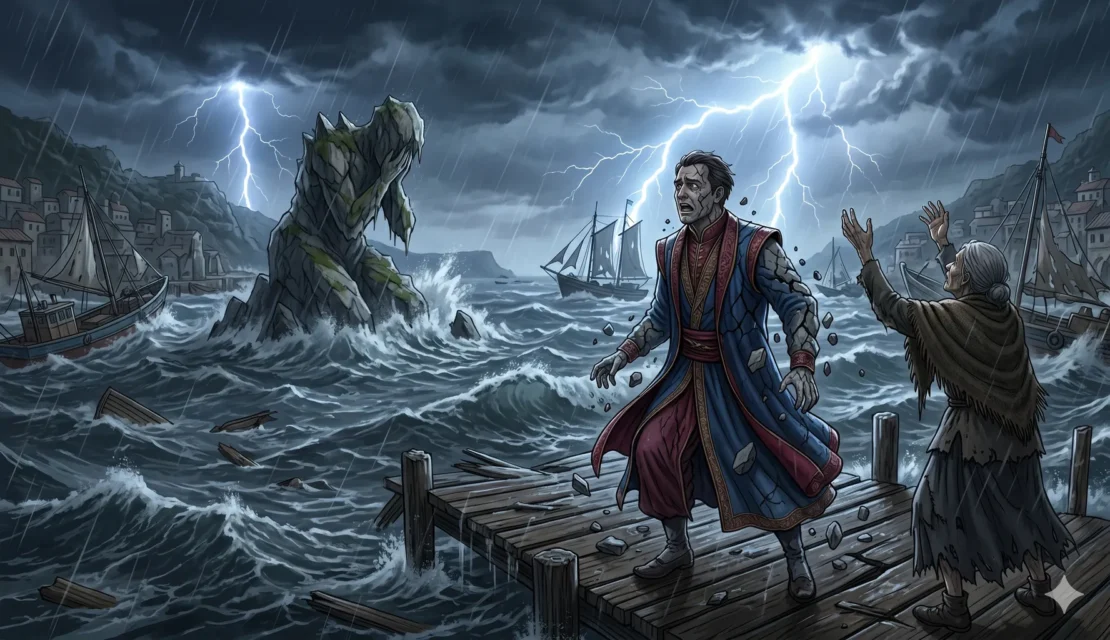
Along the rugged coastline of West Sumatra, where fishing boats with painted eyes bob in the harbour and the Minangkabau mountains rise like green walls behind the shore, the story of Malin Kundang has been told for so long that nobody remembers a time before it.
Malin Kundang was a boy born into poverty but blessed with cleverness, ambition, and a mother who would have given him the very air from her lungs if she could have. His father had been lost at sea years earlier, and it was just the two of them in a small wooden house near the water. His mother, a thin, weathered woman whose hands were calloused from mending fishing nets, worked from dawn until after dark to keep food on their table.
Malin was bright and restless. He watched the great merchant ships sail into port and out again, bound for kingdoms and cities he had only heard of in stories. He wanted to see them. He wanted to be on those ships. He wanted to become someone.
When he was old enough, he went to his mother and told her he wanted to leave. She wept, not because she wanted to hold him back, but because she knew, the way mothers do, that letting go of your child is the hardest kind of love there is. She gave him her blessing, a small pouch of coins she had saved for years, and a meal wrapped in banana leaf for the journey.
“Come back to me,” she said, holding his face in her hands.
“I will,” he said. And he meant it.
Malin sailed away and the years stretched on. He was smart and he worked hard. He found opportunity in the port cities, learned the trade routes, earned the trust of a wealthy merchant, and eventually married the merchant’s daughter, a woman of great beauty and considerable pride. He grew rich. He grew powerful. He wore silk where once he had worn patches.
And slowly, so slowly that he barely noticed it happening, the memory of his small house and his thin, tired mother began to blur at the edges.
His mother waited. She waited through every season. She walked to the harbour every afternoon and scanned the ships. She asked the fishermen if they had heard anything. She mended nets to survive, and she waited.
One morning, years later, the most magnificent ship anyone in the harbour had ever seen dropped anchor just offshore. It was enormous, with carved wooden dragons at the bow and sails dyed in rich colours. Word spread through the village like fire. On deck stood a man of obvious wealth and importance, beside a beautiful woman draped in gold.
The old woman pushed through the crowd. She had to be helped down the steep harbour steps because her legs were not what they used to be. But when she looked up at the man on the deck, her heart knew immediately what her eyes took another moment to confirm.
“Malin!” she cried, her voice breaking. “My son! You’ve come home!”
She reached for him. Her arms were thin and shaking and she was weeping openly. The crowd around them went quiet.
Malin looked at her. He looked at her worn-out clothes, her bare feet, her sun-darkened face, her calloused hands reaching for his silk sleeves. He looked at his wife standing beside him, watching with a cool, appraising expression.
Something ugly moved through him. Shame, vanity, the particular cruelty that comes from caring more about how you look than who you are.
“I don’t know this woman,” he said loudly, turning away. “She is not my mother. My mother is not a beggar.”
The crowd gasped. His mother’s hands dropped to her sides. She stood perfectly still, looking at her son, and something ancient moved behind her eyes.
She did not argue. She did not beg. She raised her face to the sky, and in a voice that carried across the entire harbour, she spoke.
“If this man is truly not my son, then let it be so. But if he is my son, and he has denied his own mother, then may God turn his heart to stone, as cold and unfeeling as the words he has spoken.”
The sky went dark. The sea rose violently. The great ship was thrown against the rocks with a sound like the world splitting open. When the storm passed and the waters calmed, where the ship had been there was only a formation of jagged rocks, roughly the shape of a kneeling man, frozen forever in the shallows.
The villagers say you can still see the rocks today at Pantai Air Manis near Padang. The shape is unmistakable. And when the tide comes in and the waves wash over the stone figure, it almost looks like he is weeping.
Moral: No amount of wealth or success will ever be worth more than the people who loved you when you had nothing. Honour your parents. Always.
3. Sangkuriang and the Birth of Tangkuban Perahu
In the highlands of West Java, where the mist clings to the tea plantations every morning and the volcanic soil gives everything a deep, rich green, there is a mountain called Tangkuban Perahu. Its summit is flat and broad, and from a distance it looks remarkably like an enormous boat turned upside down. The Sundanese people of West Java have known why for generations.
Long ago, a celestial being named Tumang was sent to earth in the form of a dog as punishment for a transgression in the heavens. Despite his animal form, he was noble and loyal, and he eventually became the companion and husband of a beautiful woman named Dayang Sumbi, who lived in a cottage in the forest. Together they had a son, Sangkuriang, a boy of wild energy and inherited power who grew up running through the forest like it was his own kingdom.
Sangkuriang loved his mother deeply, but he never knew that Tumang the dog was his father. Dayang Sumbi never told him, partly to protect him and partly because it was a truth too strange and sad to put into words.
One afternoon, while hunting in the deep forest, Sangkuriang took his dog Tumang into the hills to track a deer for his mother’s dinner. The deer was fast, and Sangkuriang grew frustrated. In a moment of reckless anger, he turned on Tumang and struck the dog down. When Tumang did not move again, Sangkuriang’s anger faded into something cold and confused.
He returned home and told his mother he had killed the dog. Dayang Sumbi’s scream could be heard across the valley. In her anguish, she struck Sangkuriang on the head with a heavy wooden ladle, leaving a deep wound, and banished him from the forest.
Sangkuriang wandered. He walked for months, then years. He crossed mountains and rivers and forests, growing taller and stronger and harder with each passing season. The wound on his head healed into a thick, distinctive scar, and the memory of his mother’s face faded, though never entirely.
Meanwhile, the gods took pity on Dayang Sumbi and granted her eternal youth. She remained as beautiful as the day her son had left, untouched by time, alone in her forest cottage.
Many years later, Sangkuriang wandered into a part of the forest that felt strangely familiar. There, in a clearing, he saw a woman of such extraordinary beauty that he lost his breath entirely. He approached her, they spoke, they walked together, and within days Sangkuriang was completely, desperately in love.
He asked her to marry him. Dayang Sumbi, who did not recognise this tall, powerful stranger as the small boy she had lost, said yes.
It was only when she was running her fingers through his hair and felt the scar on his head that the horror hit her like a physical blow. She knew that scar. She had put it there.
She pulled away. She could not tell him the truth outright, because the shock might destroy them both. Instead, she set an impossible condition.
“I will marry you,” she said, “if you can build me a vast lake and a great boat, both finished before the sun rises tomorrow.”
Sangkuriang, who carried divine strength in his blood without understanding it, agreed without hesitation.
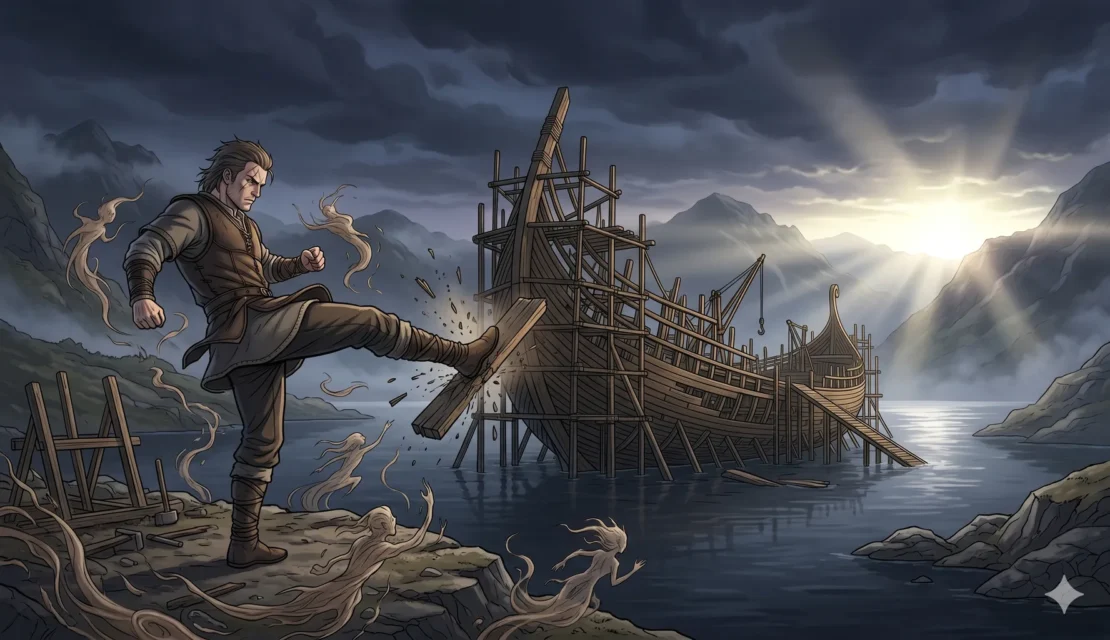
That night, he worked like nothing human. He called upon the spirits of the earth and the forest. He dammed the river with boulders. He shaped the hull of an enormous boat from the oldest trees. Water poured into the valley. The boat took shape under the stars. By the small hours of the morning, both the lake and the boat were nearly complete.
Dayang Sumbi, watching from the hilltop, felt a terror deeper than she had ever known. She could not let this marriage happen. She gathered every white cloth she could find and spread them across the eastern horizon. Then she pounded rice, over and over, the rhythmic sound filling the pre-dawn silence.
The white cloth caught the first hint of light and reflected it, creating the illusion of dawn. The roosters, fooled, crowed. The spirits, believing sunrise had come, fled back into the earth.
Sangkuriang stood in the half-finished lake, surrounded by the work of the night, and understood that he had been tricked. The rage that rose in him was volcanic.
He kicked the great boat with all his supernatural strength. It flew into the air, spinning, and landed upside down on the earth with a crash that shook the entire island. It became a mountain, broad and flat-topped, shaped exactly like an overturned boat.
The lake drained. Sangkuriang disappeared into the forest and was never seen again. Dayang Sumbi wept until the gods, unable to bear her grief, turned her into a flower.
The mountain is still there. Tangkuban Perahu, the overturned boat, stands above Bandung in the highlands of West Java, still gently smoking, still carrying its story in its shape.
Moral: Anger and deception create consequences that reshape the world around us. Some mistakes cannot be undone, only endured.
4. The Legend of Toba Lake: A Promise Broken in North Sumatra

In the mountainous interior of North Sumatra, surrounded by steep green cliffs and often shrouded in cloud, sits Lake Toba, the largest volcanic lake in the world. The Batak people who live on its shores have passed down the story of how it was made for more generations than anyone can count.
Long ago, in a time before the lake existed, there was a young fisherman named Toba who lived alone in a fertile valley. He was hardworking, quiet, and content with his simple life of fishing in the river and tending a small plot of rice.
One morning, he cast his line into the river and felt an immediate, powerful tug. He pulled with all his strength and hauled out the largest, most beautiful fish he had ever seen. Its scales shimmered gold and red in the sunlight, and its eyes were unusually bright and aware.
As Toba carried the fish home, something extraordinary happened. The fish began to shimmer, then glow, then dissolve into light. When the light faded, in his arms was no longer a fish but a young woman of breathtaking beauty. She looked at him calmly, as if this sort of thing happened regularly.
“I was cursed long ago,” she said simply. “You have freed me. If you wish, I will stay and be your wife.”
Toba, understandably, needed a moment. But when the moment passed, he said yes.
She agreed on one condition. He must never, under any circumstances, reveal her origin. He must never tell another soul that she had once been a fish. This was the one unbreakable rule.
Toba promised. They married. They built a home in the valley. Within a year, they had a son named Samosir, a bright, energetic boy who brought enormous joy to the household.
But Samosir, as he grew older, developed a trait that tested everyone’s patience: he ate constantly. He was always hungry, always reaching for more, and no amount of food seemed to satisfy him. The rice disappeared before lunch. The fish was gone before dinner. The neighbours noticed, and Toba quietly worried.
One particularly hot afternoon, Toba asked Samosir to bring him lunch in the rice field. Samosir, hungry as usual, ate half the lunch on the way there. When Toba opened the container and found it half empty, something snapped.
The heat. The exhaustion. The years of watching food vanish. It all boiled over in a single, reckless sentence.
“You eat like a fish! You are the son of a fish!”
The words left his mouth and hung in the hot, still air.
Samosir went quiet. He looked at his father with an expression that belonged on a much older face. Then he turned and walked away without a word.
The sky darkened. Thunder rolled across the valley from a sky that had been clear moments before. The river began to rise. Water bubbled up from cracks in the earth. Rain fell in sheets so heavy that Toba could barely see his own hands.
The valley flooded. It flooded with a speed and totality that was clearly not natural. The water rose and rose and did not stop. Within hours, the entire valley was submerged beneath a vast, deep lake.
Toba’s wife and son were gone, returned to the water from which she had come. The valley, once green and fertile, was now an enormous body of water stretching to the horizon in every direction.
In the centre of the lake, a single island rose above the surface. The Batak people named it Samosir, after the boy who was lost.
The lake itself, the largest of its kind in the world, they named Toba.
Both names remain to this day.
Moral: A promise broken in a moment of anger can destroy everything you’ve built. Words, once spoken, cannot be taken back.
5. Roro Jonggrang: The Princess Who Became a Temple
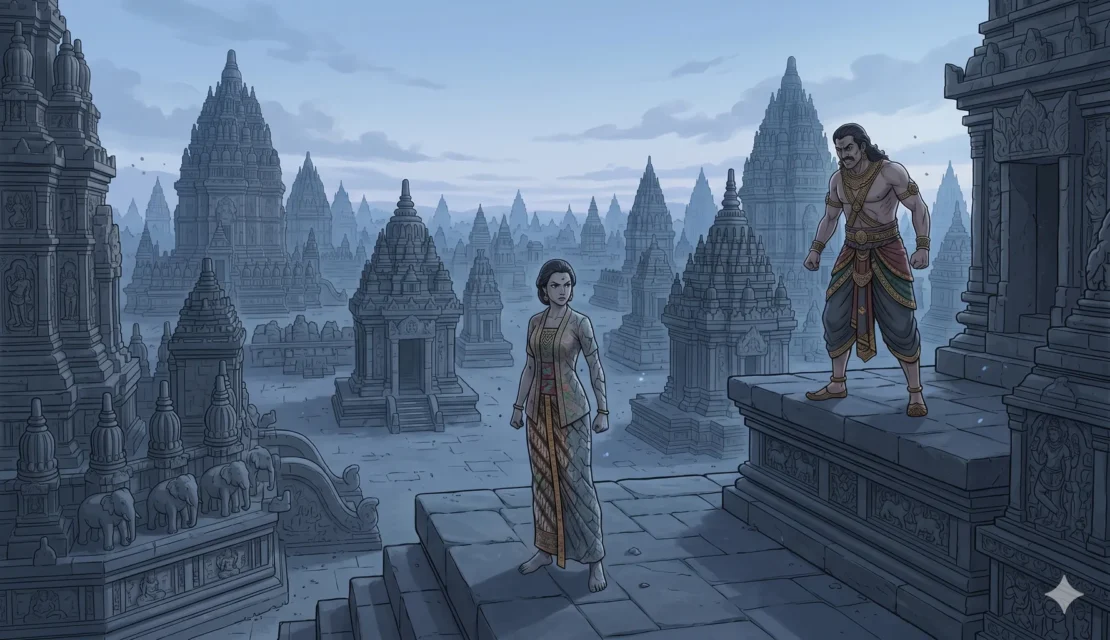
In the heart of Central Java, surrounded by rice paddies and the hum of village life, there stands a complex of ancient Hindu temples called Prambanan. The tallest tower rises nearly fifty metres into the sky, carved with exquisite detail, and at its centre sits a stone statue of a beautiful woman. The Javanese say she was not always stone.
Long ago, two kingdoms existed side by side in Central Java: Pengging, ruled by the noble Bandung Bondowoso, and Prambanan, ruled by King Ratu Boko, who was powerful, ambitious, and not particularly ethical.
War came between them. Bandung Bondowoso defeated Ratu Boko in battle and claimed the kingdom. When he entered the palace of Prambanan, he found the fallen king’s daughter, Roro Jonggrang, and was immediately struck by her beauty.
He proposed marriage on the spot.
Roro Jonggrang despised him. This was the man who had killed her father and conquered her kingdom. But she was intelligent enough to know that a direct refusal could be dangerous. So she did what clever people do when brute force is not an option. She set a condition she believed was impossible.
“I will marry you,” she said, “if you can build one thousand temples in a single night.”
Bandung Bondowoso was not an ordinary man. He had the power to command spirits, the jin and the demons of the Javanese underworld. That night, he summoned them all. Thousands of supernatural beings rose from the earth and set to work in the moonlight, carving stone, raising walls, sculpting gods and demons and heavenly dancers with impossible speed and precision.
Roro Jonggrang watched from her window in mounting horror. By midnight, nearly nine hundred temples were complete. The spirits were working faster than anything she had imagined.
She had to act.
She woke her handmaidens and ordered them to begin pounding rice in the great stone mortars outside the palace. The rhythmic pounding filled the air like a heartbeat. She ordered them to light fires all along the eastern horizon. The sky turned faintly orange.
The roosters, hearing the pounding rice and seeing the glow, crowed.
The spirits panicked. Dawn, they believed, was coming. The jin and demons fled back into the earth, terrified of the daylight. The work stopped. Nine hundred and ninety-nine temples stood complete. The thousandth was half-finished.
Bandung Bondowoso stood in the midst of his almost-accomplished miracle and understood what had happened. He turned to Roro Jonggrang with a fury that darkened the air around him.
“You tricked me,” he said.
“You killed my father,” she replied.
He raised his hand and cursed her. Roro Jonggrang’s body stiffened. Her skin turned grey, then hard. Her expression, proud and defiant to the last, froze into stone.
She became the thousandth statue. The final temple was built around her, the most beautiful and the tallest of them all.
The Prambanan temple complex still stands today, a UNESCO World Heritage Site visited by millions. And inside the main chamber of the tallest temple sits the statue of Durga, the Hindu goddess, but the Javanese have always known her by another name.
They call her Roro Jonggrang. The princess who refused, even when it cost her everything.
Moral: Resistance to injustice takes many forms. Sometimes courage is not a sword but a refusal to surrender, even at impossible cost.
6. The Legend of Banyuwangi: Fragrant Water of East Java

At the far eastern tip of Java, where the island narrows and the sea between Java and Bali is close enough to feel the other shore’s presence, there sits the city of Banyuwangi. The name means “fragrant water,” and behind those two simple words lies one of the most haunting Indonesian folktales ever told.
A prince named Raden Banterang ruled this land long ago. He was a skilled warrior, a respected leader, and a man deeply in love with his wife, Surati. She was not from his kingdom. She was a woman from the forest, gentle and devoted, who had left her own people to be with him. Their love, by all accounts, was genuine and deep.
But love, when mixed with pride, can become something dangerously fragile.
A minister in Banterang’s court, a man named Patih Sidapaksa in some versions of the tale, carried an old grudge and a patient hatred. He whispered lies to Banterang. He planted evidence of infidelity, a man’s kerchief hidden where it shouldn’t have been, a false witness who claimed to have seen Surati meeting another man in the forest.
Banterang, whose pride was larger than his patience, did not investigate. He did not ask questions. He did not sit with his wife and look into her eyes and listen, truly listen, to what she had to say. Instead, the jealousy took root in his chest and turned everything green and poisonous.
He confronted Surati. She denied it. She wept. She begged him to believe her. She told him, in every way a person can tell another person, that her heart belonged to him alone.
He did not hear her. Or perhaps he heard her and the jealousy was louder.
He took her to the river. The same river she had bathed in, that she had washed their clothes in, that she had sat beside on quiet evenings listening to the water move.
Surati stood at the bank and looked at her husband. She was calm now. The tears had stopped. What replaced them was something far more devastating: absolute, quiet certainty.
“I am innocent,” she said. “And I will prove it. When I enter this water, if I am guilty, the river will smell foul and putrid, as rotten as the lie that has poisoned your heart. But if I am innocent, the water will smell of flowers.”
Banterang said nothing. Perhaps he could not.
Surati stepped into the river. She walked forward until the water rose around her, and she did not look back. She disappeared beneath the surface as gently as a leaf falling from a branch.
Banterang stood on the riverbank and waited. The forest was completely silent.
Then the scent came. Not the smell of river mud and weeds and the mineral tang of stones. Something else entirely. A perfume of jasmine and frangipani and something unnamed and heartbreakingly sweet rose from the water and filled the air so completely that the entire forest seemed to exhale.
Banterang fell to his knees. He understood, all at once, with a clarity so total it felt like a physical wound, that she had been telling the truth. Every word. Every tear. Every plea he had dismissed.
He called her name. He called it again and again. The river did not answer. It only continued to smell of flowers, as beautiful and as final as a goodbye.
The city that grew around that river has been called Banyuwangi, fragrant water, ever since.
Moral: Trust is the foundation of love. When jealousy destroys trust, everything that mattered is lost. And some losses cannot be recovered, only mourned.
7. Nyi Roro Kidul: The Queen of the Southern Sea

No collection of Indonesian folktales would be complete without the most powerful, mysterious, and enduring figure in Javanese supernatural tradition: Nyi Roro Kidul, the Queen of the Southern Sea.
Her story begins not in the ocean but in a palace, which makes it all the more painful.
Long ago, a princess named Kadita, sometimes called Dewi Kadita, lived in the Sundanese kingdom in West Java. She was the king’s most beloved daughter, known for a beauty so remarkable that people travelled from distant regions just to catch a glimpse of her. She was kind, intelligent, and gentle, everything a princess in a story should be.
But the king had other wives, and those wives had daughters of their own, and jealousy is a living thing that feeds on comparison.
The other wives went to a practitioner of dark magic and paid dearly for a curse. They wanted Kadita’s beauty destroyed. The next morning, Kadita woke to find her skin covered in terrible sores and boils, painful and hideous and spreading. The transformation was shocking and total.
The court recoiled. The same people who had praised her beauty now could not look at her. Even her father, the king, weak and manipulated by the very wives who had ordered the curse, asked her to leave the palace. He could not bear, he said, the sight of her suffering. What he meant, though he would not say it plainly, was that he could not bear the shame.
Kadita left the palace with her head held high and her heart shattered into more pieces than she could count. She walked south. She didn’t know why south. She only knew that something was pulling her toward the coast, toward the sound of waves, toward the oldest and deepest part of the world.
She walked for days. Through villages that turned away from her. Through forests that were kinder than people. Through rain that stung her wounds and sun that baked them. She did not stop.
When she reached the southern coast of Java, she stood on the cliffs above the Indian Ocean and looked down at the water. It was wild and green and immense, crashing against the rocks with a sound like breathing.
A voice spoke to her. It came from everywhere and nowhere, from inside the waves and inside her own chest at the same time.
“Enter the water,” it said. “You will be healed. You will be transformed. You will become something greater than anything the palace could ever have made you.”
Kadita stepped off the cliff.
The sea caught her. The waves closed over her gently, like arms. When she surfaced, her skin was flawless, more luminous than it had ever been. But she was changed in a way that went far deeper than appearance. She carried the weight and the power and the unfathomable mystery of the ocean itself.
She became Nyi Roro Kidul. She was no longer a princess. She was a queen. The Queen of all the spirits and creatures of the Southern Sea, ruler of a kingdom vaster and more ancient than any human court.
Her presence is still felt along the southern coast of Java today. Fishermen leave offerings before they cast their nets. Hotels along the south coast keep a room, often on the top floor, permanently reserved for her, decorated in green, her colour. Visitors to the beaches are advised not to wear green clothing, because Nyi Roro Kidul is said to claim those who do, pulling them into the sea to join her court.
Whether you believe in the supernatural or not, there is something undeniably powerful about standing on the southern cliffs of Java, watching the Indian Ocean rage below, and knowing that every Javanese person beside you carries this story inside them like a second heartbeat.
Moral: Suffering does not define your destiny. Sometimes the greatest transformation comes from the deepest pain. The world that rejects you is not the only world there is.
Why Indonesian Folktales Deserve a Place in Your Child’s Life
Every one of these seven stories has survived for hundreds of years for a reason. Indonesian folktales don’t soften the world for children. They give children a way to understand it, through magic, through metaphor, and through the deeply human truths that live at the core of every tale.
Stories Build Cultural Roots and Emotional Depth
A child who grows up hearing the story of Malin Kundang doesn’t just learn to respect their parents. They learn, in a place deeper than logic, what ingratitude feels like from the outside. A child who hears Roro Jonggrang’s story begins to understand that courage comes in many forms. These are not lessons that can be taught with a worksheet.
Storytelling Is a Cornerstone of Early Childhood Learning
At Apple Tree Pre-School BSD, we make storytelling, cultural exploration, and values-based learning central to everything we do. Through our Singapore curriculum, children engage with Moral, Social Studies, and creative subjects in ways that bring stories like these to life every single day.
Our classrooms, from Toddler right through to Kindergarten 2, are designed so that learning feels like the most exciting part of the day. If you’d love to see how we bring the magic of stories and values into real learning, take a closer look at our programs.
Share the Stories Tonight, Join the Family Tomorrow
We hope these 7 Indonesian folktales gave you something meaningful to share with your child this evening. Whether your family’s roots are in Java, Sumatra, Bali, or anywhere across this incredible archipelago, these stories belong to all of us, and they deserve to be told again and again.
If you’re looking for a preschool where your child will grow smart, happy, and deeply connected to the world around them, we would love to welcome you to Apple Tree Pre-School BSD.
Register now and come play and learn with other children! Chat with us on WhatsApp or call us directly at +62 888-1800-900. We can’t wait to meet your little storyteller!





Be the first to write a comment.