


Ask any parent what they want most for their child, and the answers come quickly: kindness, resilience, honesty, the ability to handle difficulty without falling apart. We want children who grow into people of genuine character. And yet, the research and the experience of educators consistently point to the same surprising truth: the most powerful way to build these qualities is not through rules or reward charts or structured lessons. It is through family moral stories told at the right moment, in the right voice, with enough time to sit with what they mean.
Here at Apple Tree Preschool BSD, located in the Educenter BSD Building, we have watched children absorb values through stories in ways that no other method can replicate. A well-told family moral story reaches the part of a child’s mind that is open and imaginative and genuinely curious, long before the part that resists being told what to do has a chance to object. Tonight, we’re sharing six essential family moral stories for raising successful children, each one fully told and ready to read aloud together.
6 Family Moral Stories That Plant the Seeds of a Successful Life
From a family that learns to count its blessings to a grandmother whose wisdom saves her entire household, these family moral stories, values-based tales for children, and character-building stories for families carry lessons that successful people carry their whole lives.
1. The Family That Forgot to Be Grateful
In a comfortable house on a pleasant street in a town where most people had enough and some people had more than enough, there lived the Farhan family. There were five of them: a father who worked hard at a job he didn’t particularly love, a mother who managed the house and the children and approximately seventeen other things simultaneously, a teenage daughter named Rania who had strong opinions about everything, a ten-year-old son named Dani who was going through a phase of finding everything profoundly unfair, and a six-year-old named Mia who had not yet formed many opinions but was observing carefully and storing information.
They were, by any reasonable measure, doing well. The house was warm. The table was full at mealtimes. The children had schools to go to and shoes that fit and a television that worked and a mother who packed their lunches with small folded notes sometimes.
And yet.
“I don’t understand why we can’t go to Bali like the Santosos,” said Rania at dinner one Thursday evening.
“Dani got a better score than me and his prize was bigger,” said Dani about something that had happened at school three weeks ago and which he had not yet finished processing.
“I wanted the red cup,” said Mia, looking at her blue cup.
Their father put down his fork very quietly. Their mother pressed her lips together in the way she did when she was deciding how to respond rather than how she felt.
Their father said nothing at dinner. He was thinking.
The following Saturday morning, he woke all three children early, which they found deeply unreasonable, and told them to get dressed in comfortable clothes. They drove for forty minutes to a neighbourhood across the city that none of them had been to before. He parked the car and they walked for a while through streets that were different from their own in ways that the children absorbed without immediately having words for.
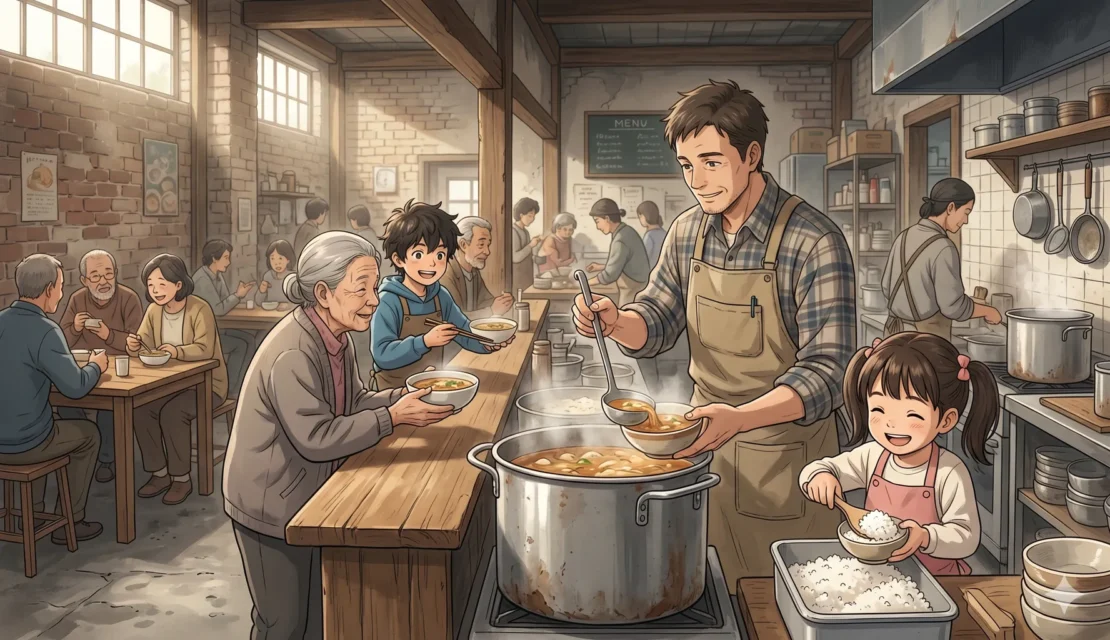
He stopped in front of a small community kitchen where volunteers were serving breakfast to people who had come from wherever they had spent the previous night.
“We’re going to help this morning,” he said.
Rania opened her mouth. She closed it again.
They helped for three hours. They served rice and soup. They poured drinks. Mia carried napkins with extraordinary seriousness. Dani helped a volunteer carry large pots from the kitchen and came back quieter each time.
On the drive home, nobody complained about anything.
At dinner that evening, before anyone had said a word, Mia picked up her blue cup, looked at it for a moment, and said very quietly, “I like this cup.”
Her father looked at her mother.
Her mother looked at her father.
After dinner, their father sat with all three children and they talked for a long time about what they had seen, what they had felt, and what the difference was between needing something and wanting something and being grateful for what you already had. Rania contributed more to the conversation than she usually did and made two observations that were genuinely insightful and which her father stored in his memory for later.
The Saturday morning kitchen visits became a monthly family event.
Gratitude is peculiar in that it cannot be taught through instruction but arrives very reliably through proximity to its opposite. The Farhan family discovered this together, on a Saturday morning, over three hours of soup and napkins and quiet observation.
Their house didn’t change. The table was still full, the shoes still fit, the notes were still in the lunchboxes. But something in the atmosphere of the house shifted, permanently and for the better, from that Saturday forward.
Moral: Gratitude is not a feeling that arrives on its own. It is built, deliberately, by choosing to see what you have rather than measuring what you don’t.
2. The Grandmother’s Bamboo Lesson

In a village in the highlands where the mornings were cold and the evenings smelled of wood smoke and roasting corn, there lived an extended family of three generations under one long roof: a grandmother named Nenek Sari, her two adult children with their spouses, and five grandchildren ranging in age from four to fourteen.
The family was close in the way that families who live under one roof become close, which is to say they loved each other deeply and drove each other completely mad at regular intervals. The two adult children, Pak Budi and Ibu Rani, had been arguing for months about a land decision that involved the family’s property, each convinced they were right, each unable to hear the other fully, each dragging their spouses into the disagreement until the whole household had sides and the dinners had become exercises in strategic silence.
The grandchildren observed all of this with the uncomfortable clarity of children who absorb the emotional temperature of a room the way plants absorb light.
Nenek Sari had watched this for three months without saying a word. She was a woman who believed that most things sorted themselves out if you gave them sufficient time and that the ones that didn’t needed a demonstration rather than an argument.
One morning, she called all five grandchildren to the back of the house where a stand of bamboo grew. She had cut five stalks of different sizes and laid them on the ground.
“Pick one up,” she told the oldest grandchild, Reza, who was fourteen and thought he understood most things.
He picked up the largest one easily.
“Now break it,” she said.
He tried. He couldn’t.
She handed him two stalks together. Same result. She added a third. He strained. Nothing. She kept adding until he was trying to break all five stalks bundled together and making no impression at all.
“Now,” she said, picking the bundle back up, “separate them.”
She pulled one stalk out and snapped it easily between her old hands. Then another, and another, until all five lay in pieces on the ground.
The grandchildren watched.
“Go get your parents,” she said.
When Pak Budi and Ibu Rani and their spouses were standing at the back of the house looking slightly confused, Nenek Sari picked up a new handful of bamboo pieces and handed one to each adult.
“Break it,” she said to each of them separately. Each snapped their single piece without difficulty.
She said nothing for a moment.
Then she said, “You have been arguing for three months about a piece of land. While you argue, your children are growing up in a house where the adults don’t speak to each other at dinner. I will not tell you who is right about the land.” She looked at both of them in turn with the particular look that grandmothers develop over decades of watching people make preventable mistakes. “I will tell you that whatever you decide about the land, you will do it better and live with it better if you do it together.”
She went back inside.
The grandchildren stood looking at the broken pieces of bamboo on the ground.
Reza picked one up and turned it over in his hands.
That evening, for the first time in three months, the dinner conversation was about something other than the land or the careful absence of the land. Nobody made a grand declaration. Nobody apologised with speeches. The shift was smaller and more genuine than that.
The land decision was eventually made together and was, by both parties’ later admission, better than either of their individual plans had been.
Nenek Sari never mentioned the bamboo again. She didn’t need to.
Moral: A family that stays united is stronger than any individual in it. The problems that seem impossible alone become manageable together.
3. The Two Brothers and the Candle

Once, in a small town where the streets were narrow and the neighbours knew each other’s business whether they wanted to or not, two brothers named Hasan and Hamid shared a house that had been left to them by their parents equally. The house had two floors: Hasan lived on the upper floor and Hamid lived on the lower.
They were not enemies. They had never been enemies. But they had, over some years of proximity and minor disagreements, developed the particular chill that sometimes settles between people who love each other but have stopped actively choosing each other’s company.
One winter evening, a power cut left the whole street without electricity. Hasan, upstairs, had candles. Hamid, downstairs, had none.
Hasan heard his brother moving around in the dark below. He sat with his candle and thought about the years of small silences and avoided conversations, and the voice in his head that had been constructing the case for why Hamid had been the one to let the relationship cool.
He sat with that for a while.
Then he got up, lit a second candle from his first, and walked downstairs.
He knocked on his brother’s door. Hamid opened it, looking slightly surprised.
Hasan held out the candle.
Hamid looked at it. He looked at his brother. The moment had a weight to it that neither of them acknowledged out loud, because they were both the kind of men who communicated through actions rather than speeches.
“Come in,” said Hamid. “I was about to make tea.”
They sat in Hamid’s kitchen by candlelight for two hours and talked with a ease that had been absent from their interactions for years, as though the removal of electricity had also removed some of the accumulated awkwardness.
“I’ve been meaning to ask,” said Hasan at one point, “how is your back? You mentioned it last year and I never followed up.”
Hamid looked at him for a moment.
“Better,” he said. “It took a while.”
These were not dramatic revelations. They were ordinary pieces of brotherly knowledge that had been left ungathered for too long, and the gathering of them felt like putting things back in their proper places.
When the power came back on, both of them blinked in the sudden brightness.
Hamid walked to the switch and, after a moment, turned it back off.
“Tea’s not finished,” he said.
Hasan nodded and sat back down.
Their children, who grew up in the two floors of that house and played freely between them from that winter onward, never fully understood what had changed. They only knew that their fathers sat together in the kitchen on winter evenings, that the relationship between the two families was warm and easy, and that candles were somehow always kept in the house even after no one could quite remember why they had started the habit.
Moral: Repairing a relationship rarely requires a big conversation or a formal apology. Sometimes it begins with a single, small act of choosing the other person.
4. The Mother Who Planted Honesty
In a neighbourhood where the houses were close together and the gardens shared a common wall, a mother named Ibu Dewi was raising three children on her own after her husband had taken a job in another city. The children were seven, nine, and twelve, old enough to be left for short periods, young enough to still need a great deal of everything.
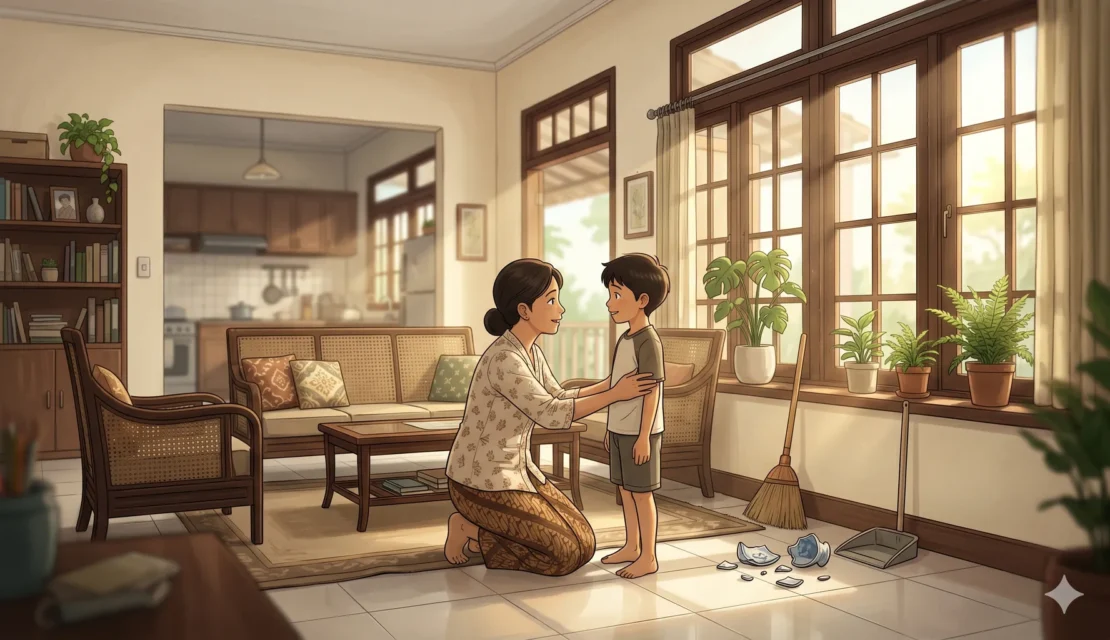
One afternoon, Ibu Dewi came home from the market to find a broken vase in the living room, pieces of it swept neatly into a corner in a way that suggested someone had tried to make it less visible rather than confess to it.
She knew which child. She had a strong instinct about these things, and also the nine-year-old had a scratch on his wrist from something sharp and was avoiding her eyes with the specific intensity of someone who has something to hide.
She called all three children to the living room.
“Someone broke the vase,” she said. She did not raise her voice. She had found, over nine years of parenting, that a quiet voice was more unsettling than a raised one.
Silence.
“I’m not angry about the vase,” she said. “Vases break. I am going to give whoever broke it the chance to tell me now, and I promise you the conversation will be short and the consequence will be small.”
More silence.
She waited.
The nine-year-old, Rizal, raised his hand in the slow, reluctant way of someone lowering themselves into cold water.
“I knocked it over,” he said. “I was running inside and you told me not to. I swept it up because I didn’t want you to see.”
Ibu Dewi looked at him for a long moment.
“Thank you for telling me,” she said. “That took courage.”
She paused.
“The consequence for breaking the vase is that you help me choose a new one at the market on Saturday. The consequence for hiding it would have been considerably bigger, because hiding things from me damages something that matters more than a vase.”
She looked at all three children.
“In this house, we tell the truth. Not because it’s always easy. Not because it’s always comfortable. But because a family that cannot trust each other cannot function. Do you understand?”
They said yes.
On Saturday, Rizal chose a vase, a slightly lopsided one that he had picked because he liked the colour. Ibu Dewi bought it without comment and put it in the same spot as the old one.
Years later, when Rizal was an adult and someone asked him what values his mother had passed on to him most clearly, he said without hesitating: “She taught me that honesty was more valuable than getting away with things. And she taught me that by never making the truth more expensive than the lie.”
The slightly lopsided vase sat on the shelf in his own house by then.
He had asked for it when his mother eventually moved to a smaller place.
Moral: Children learn honesty not from being punished for lies, but from experiencing that the truth is safe to tell and genuinely valued.
5. The Father Who Came Home on Time

In a busy, modern family in a city that never really slowed down, a father named Pak Arif had developed, over several years and through no particular intention, the habit of being late. Not dramatically late. Never catastrophically late. Just consistently, reliably, ten-to-twenty-minutes late for things that mattered.
He was late for the school sports day, arriving as the last race was finishing. He was late for the dinner that his wife had prepared for their anniversary. He was late for the father-daughter reading evening at his daughter’s school, arriving as the certificates were being handed out.
He always had reasons. He always meant it. He was genuinely sorry each time, in the sincere, slightly distracted way of a busy person who has not yet connected the individual incidents into a pattern.
His daughter Nayla was eight. She had his eyes and her mother’s directness, and one evening she said something that he was not prepared for.
They were sitting together after dinner and Nayla was telling him about an upcoming school presentation, describing it with the full energy of a child who has not yet learned to compress their enthusiasm.
She stopped mid-sentence.
“Will you come?” she asked.
“Of course,” he said.
She looked at him for a moment. Then she said, very carefully and very quietly, “Will you come on time?”
Pak Arif sat with that question for longer than the conversation required.
“Yes,” he said.
“Promise?”
“I promise.”
He went home that night and looked at his calendar. He moved three things. He had a conversation with his assistant about protecting certain hours. He drove the route to the school the weekend before the presentation to know exactly how long it took.
On the day of Nayla’s presentation, he arrived fifteen minutes early and sat in the front row.
Nayla came in with her class, scanning the room the way children scan for parents, with that specific mix of hope and protective preparation for not finding them. Her eyes landed on him. She stopped for just a moment. Then she smiled the particular smile of a child whose hope has been met.
She gave her presentation to the room, but she gave it primarily to her father in the front row.
Afterward, walking to the car, she slipped her hand into his.
“You came early,” she said.
“I did,” he said.
“You can do that again,” she said, as if granting permission.
He laughed. He also cried a little, quietly and sideways, in the way that parents cry when they have been shown something true about themselves by an eight-year-old.
He was early for most things after that.
Not because he had become a different person or because being punctual had suddenly become effortless. But because he had understood something that his daughter had shown him without any drama or resentment: that arriving on time is one of the clearest ways of telling someone that their time and their feelings matter to you.
Moral: Reliability is a form of love. When you consistently show up for the people who count on you, you are telling them, without words, that they matter.
6. The Family Jar

In the Siregar household, which was a warm and cheerful household most of the time and a loud and stubborn one the rest of the time, conflict was handled in a way that had evolved over years of trial, error, and several unsuccessful experiments with a whiteboard.
The current system was the jar.
The jar lived on the kitchen counter and it was large and made of clear glass so that everything inside it was visible. The rule was simple and had been agreed by the whole family, including both children, at a meeting that had taken forty minutes because everyone had opinions.
The rule was this: whenever there was a conflict, each person involved wrote their version of it on a small piece of paper, folded it, and put it in the jar. Then they waited twenty-four hours before opening it and talking.
This had been the idea of the mother, Ibu Laila, who had read about something similar in a parenting book and adapted it with the particular creativity of a person who has tried everything else.
The waiting period was the important part. In the first twenty-four hours after a conflict, nobody in the family was at their best. The feelings were too loud and too recent and the arguments made in that window tended to be the kind that left marks. The jar gave everyone time to move from the initial heat of the thing to something more honest and more considered.
The twelve-year-old, Faiz, had argued against the system at the family meeting, predicting that it would feel babyish and pointless.
Three weeks later, Faiz had the biggest argument of his life with his younger sister Siti, who was nine and who had, in his assessment, touched his things without permission and then catastrophically miscalculated the importance of this event. He wrote his paper in furious, large letters and slammed it into the jar.
Twenty-four hours later, he unfolded it and read what he had written.
He was quiet for a moment.
“This sounds dramatic,” he said.
“It does,” said his mother pleasantly.
Siti unfolded her paper, which described the situation from her perspective. She read it out. The accounts were, as they always are in these situations, two completely different stories about the same event.
They talked for twenty minutes. Not calmly, exactly, but genuinely, with the actual substance of what had bothered each of them rather than the amplified version that came out in the first twenty-four hours.
By the end, the resolution was simple and practical and agreed by both.
Over the years, the jar filled with hundreds of small pieces of paper, conflicts resolved, some of them almost embarrassingly minor in retrospect, some of them genuinely significant moments in the family’s shared life. Ibu Laila kept them all. She said they were a record of how the family worked things out.
When Faiz was grown and living in his own home and struggling with how to manage conflict with his own partner, he called his mother.
“Tell me how the jar works again,” he said.
She told him. He built one on his kitchen counter the same week.
The system, like most things that genuinely work, was simple. The results, like most things that come from patience, were deep.
Moral: A family that builds a system for handling conflict well is a family that can weather anything. The way you fight matters just as much as what you fight about.
Why Family Moral Stories Are the Heart of a Successful Childhood
Across all six of these family moral stories, something consistent emerges. The families that raise successful children are not the ones who shelter their children from difficulty or provide them with every advantage. They are the ones who actively build values, together, through the ordinary texture of daily life, through gratitude and honesty and reliability and conflict handled with patience and care.
Stories Are How Families Pass Values Down
Every family has its stories. The ones told at dinner, the ones that start with “do you remember when,” the ones that become the texture of a shared history. Family moral stories work the same way, they become part of a child’s inner library, a set of examples they carry into situations long after the bedtime reading is done.
Character Is Built in the Early Years
The years from birth to six are the most formative in a child’s life. The habits of heart and mind formed during this window will shape every relationship, every challenge, and every decision for decades. This is why at Apple Tree Preschool BSD, we take Moral and Social Studies and character development as seriously as Maths and English. Through our programs, from Toddler classes all the way through to Kindergarten 2, we partner with parents to raise children who are genuinely good as well as genuinely smart.
Because we believe, as deeply as we believe anything, that those two things grow best when they grow together.
Let’s Raise Remarkable Children Together
We hope these six family moral stories gave your household something rich and real to share this week. Read them together. Talk about them at dinner. Ask your child which character they felt most like and why. These conversations, small and unhurried and honest, are where the real work of raising a successful child happens.
If you would love for your little one to spend their days in a school that brings exactly this kind of values-rich, joy-filled, whole-child learning to life every single day, we would be genuinely honoured to welcome your family.Register now and come learn, grow, and discover with other children at Apple Tree Preschool BSD! Chat with us on WhatsApp or call us directly at +62 888-1800-900. We cannot wait to meet your little one and your family.





Be the first to write a comment.