

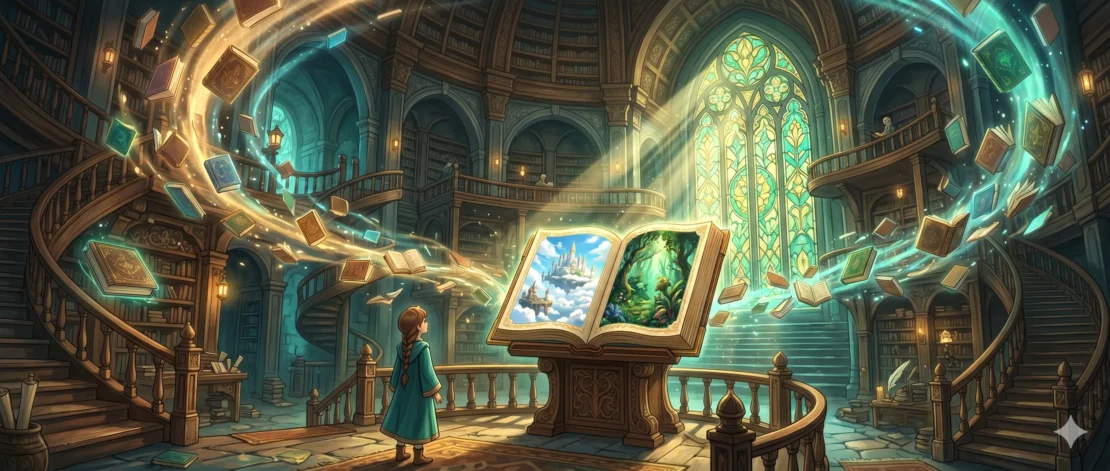
There is a particular kind of reading that doesn’t feel like reading at all. You start a story, and somewhere in the first few paragraphs the real world quietly folds itself up and slides under the door, and what’s left is somewhere entirely else. A kingdom made of storm clouds. A city hidden inside a mountain. A child who discovers that the door at the end of the hallway opens into a sea that doesn’t exist on any map.
That is what the very best fantasy stories do, and it is precisely why we love sharing them with children at Apple Tree Preschool BSD. Fantasy stories don’t just entertain. They teach children to hold possibilities in their minds, to ask “what if?” with genuine seriousness, and to believe that imagination is one of the most powerful tools they will ever own. We’ve written 8 original fantasy stories just for you and your little one, and we hope they take you somewhere wonderful tonight.
8 Original Fantasy Stories Full of Magic, Wonder, and Heart
From enchanted forests and sky kingdoms to talking rivers and invisible libraries, these magical fantasy stories, adventure tales, and imaginative bedtime stories for children will make even the most ordinary Tuesday feel like the beginning of something extraordinary.
1. The Door at the End of the Garden
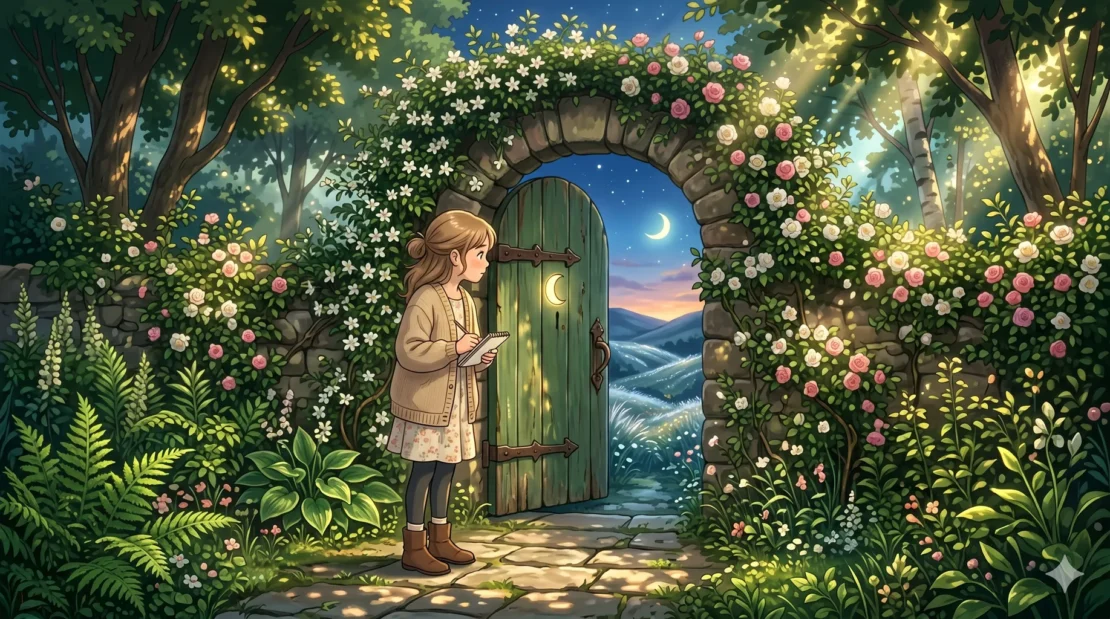
At the very bottom of a long, overgrown garden, half-hidden behind a curtain of climbing jasmine and a very opinionated rose bush that scratched anyone who got too close, there was a green wooden door that nobody in the family had ever been able to open.
It had been there for as long as anyone could remember. It had a round brass handle, tarnished and cold, and a keyhole shaped like a crescent moon. The family had tried every key in the house. They had tried keys borrowed from neighbours. They had tried describing the keyhole to a locksmith, who had driven out and then stood in front of it for a long time before saying, very quietly, that he’d never seen anything like it and driving away without charging them.
The door simply didn’t open.
A girl named Fen had grown up looking at that door from her bedroom window. She was ten now, and she had spent a considerable portion of those ten years thinking about it. She had theories. The most recent and most compelling theory was that the door didn’t open with a physical key at all.
One autumn evening, sitting in the garden as the light went gold and slow, Fen looked at the door and, on an impulse she couldn’t entirely explain, said out loud: “I’m ready.”
The door opened.
Not with a creak. Not dramatically. It simply swung inward, the way a door opens when someone on the other side has been waiting and finally hears the knock they’ve been listening for.
Beyond it was a landscape that had no business being at the bottom of a suburban garden. Rolling hills covered in silver grass that rang faintly, like distant bells, when the wind moved through it. A sky the particular deep blue of the hour just before proper dark. And in the distance, lights, warm and amber, clustered together like a village that had been built specifically to look welcoming from exactly this angle.
Fen stood in the doorway for a long moment.
Then she stepped through.
The door remained open behind her. She would discover later that it always stayed open once it had let you in, that the going through was the thing that mattered, and that the way home was always there, waiting patiently, for whenever she chose to use it.
She didn’t choose to use it that evening. She walked toward the lights with her hands in her pockets and a feeling in her chest like the first day of something genuinely good.
Lesson: Some doors only open when you’re ready to walk through them. And being ready isn’t about age or courage. It’s about saying yes.
2. The Kingdom Inside the Cloud

High above the northern sea, anchored to nothing and drifting slowly with the wind, there was a kingdom that nobody on the ground had ever seen clearly enough to believe in. From below it looked like an ordinary cloud, if a slightly more architectural cloud than most. From above, if you happened to be an eagle or a very determined traveller who had climbed to exactly the right height on exactly the right mountain, you could make out towers.
The kingdom was called Nimborel, and it had been home to the Cloud People for more generations than its oldest citizens could accurately count. They were not transparent or wispy, as people sometimes imagined sky-dwelling folk to be. They were solid and warm and decidedly opinionated, and they made the best bread in any world, which was useful because bread made of cloud-grain never went stale and could be eaten at any altitude without discomfort.
A young cloud-keeper named Alira was responsible, each morning, for checking the edges of the kingdom to make sure they were holding their shape. Clouds were not naturally inclined to maintain architectural forms, and the towers required constant gentle coaxing to stay tower-shaped rather than drifting into more horizontal arrangements.
One morning she found a boy sitting on the eastern parapet.
He was very clearly not from Nimborel. He was wearing shoes, which nobody in the cloud kingdom did, and he had the dazed expression of someone who had recently arrived somewhere completely unexpected.
“How did you get up here?” said Alira.
“I honestly don’t know,” said the boy. His name was Marcus and he had, the previous afternoon, climbed a tree in his garden to retrieve a kite and had somehow not stopped climbing. “Is this a cloud?”
“It’s a kingdom,” said Alira, with the mild patience of someone correcting a common misconception. “The cloud is just the infrastructure.”
Marcus looked around at the towers, the bread markets, the river of slow fog that ran through the centre of town, and the dozen or so residents who were watching him with the polite curiosity of people who didn’t often have visitors.
“Right,” he said. He thought for a moment. “Is the bread as good as it smells?”
Alira smiled. People who asked about the bread first tended to fit in well.
She took him to the bakery. He stayed for a week, learned to coax tower-shaped clouds into staying tower-shaped, and discovered that the view from a cloud kingdom at sunrise was quite possibly the finest thing his eyes had ever done.
The kite was still in the tree when he got home. He left it there on purpose.
Lesson: The most extraordinary places are often reached by doing an ordinary thing just a little further than you meant to.
3. The River That Remembered Everything
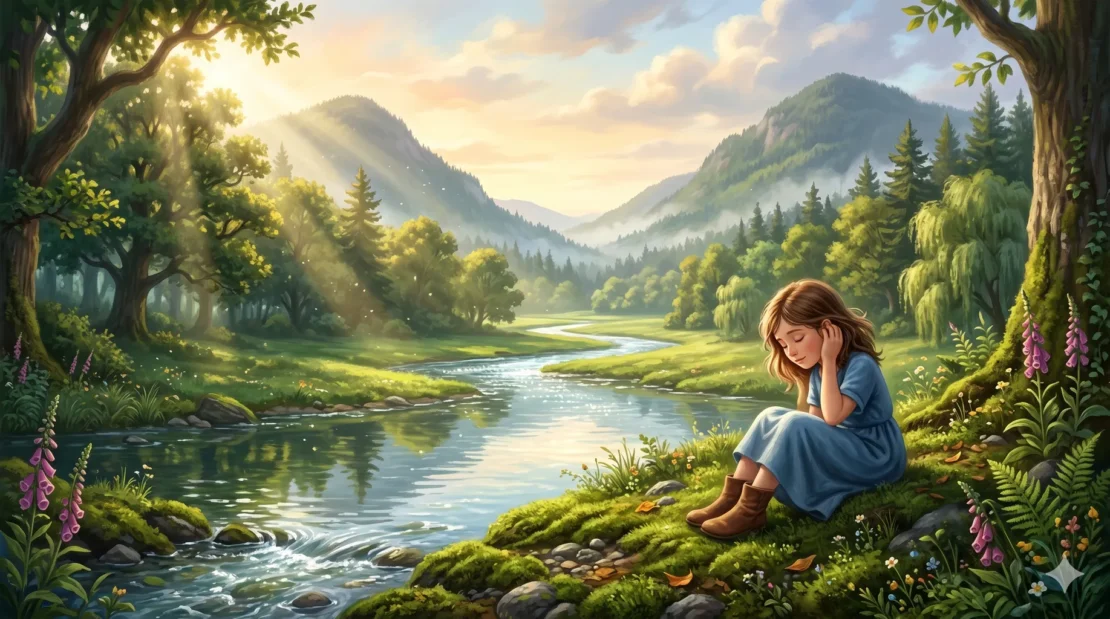
In a valley between two quiet mountains, there ran a river named Calyx who had been flowing through that particular landscape for so long that she had developed, as very old rivers sometimes do, a memory.
Not a vague impression. A proper, detailed memory of everything that had ever happened along her banks.
She remembered the first family that had built near her, three thousand years ago, who had put flat stepping stones across her narrowest point and then argued enthusiastically about whether the stones were evenly spaced. They were not. She had watched them disagree about this for eleven years. She had been fond of them.
She remembered the tree that had fallen into her in a storm in what humans now called the fourteenth century, and how a family of otters had moved into the root system within a week and raised seventeen generations of otter children there before the wood finally dissolved into her bed.
She remembered every child who had ever paddled in her shallows. She kept their small footprint impressions in her memory with particular care.
A girl named Isola discovered that Calyx could speak one summer afternoon when she sat on the bank and said, not really to anyone, “I wonder what this river has seen.”
“Quite a lot, actually,” said Calyx.
Isola did not fall in, which she considered a personal achievement given how startled she was.
Over the following weeks she came back every afternoon and the river told her stories. She heard about the stepping stone argument. She heard about the otters. She heard about a winter three hundred years ago so cold that Calyx had frozen over for the first time in her memory and how strange and still and completely silent the world had seemed without the sound of running water.
“Do you remember everyone who has ever come here?” Isola asked one afternoon.
“Everyone,” said Calyx.
“Will you remember me?”
The river ran warmly over the stones for a moment.
“I already do,” she said. “I remember you from the first afternoon. You sat here for an hour just listening to the water before you said a word. I noted that. I thought you might be someone worth talking to.”
Isola came back every summer for the rest of her life. Calyx told her stories right up until the afternoon she died very old and entirely happy on the bank, which was exactly where she wanted to be.
The river remembered that afternoon too. She told it to everyone who came to sit quietly on the bank after that, which turned out to be quite a few people over the centuries.
Lesson: The world remembers those who listen to it. Sit quietly sometimes. The best stories come to the ones who wait.
4. The Girl Who Could Hear Colours

In a city full of colour, a girl named Vesna had a gift that nobody else in the history of that city, or possibly any city, had been documented as having. She could hear colours.
Not metaphorically. When she walked past a red door, she heard a low warm note, like the deepest string of a cello played softly. Yellow made a bright, quick sound like a small bell struck once and left to ring out completely. Blue, depending on the shade, ranged from a soft hum to something almost like running water. Orange was a pop and a crackle. Green was long and sustained, like a breath held and slowly released.
Purple was the most complicated. Purple sounded like an argument between a drum and a flute that had been going on for some time and was not close to resolution.
Vesna had grown up thinking this was normal. She had assumed everyone heard the red door on Marchetti Street as a low cello note. It was only when she was seven and mentioned it to her mother that she discovered this was not, in fact, a universal experience.
People were initially baffled by her gift and then, once they got used to it, deeply curious. Artists began visiting her to ask what their paintings sounded like. A painter named Goran brought her a canvas he had been working on for months and asked if she would tell him honestly what she heard.
She stood in front of it for a long time.
“It sounds like a conversation,” she said. “Like two people who know each other very well talking in a kitchen while it rains outside. Not an exciting sound. But warm. Very warm.”
Goran sat down and was quiet for a while.
“That is exactly what I was trying to paint,” he said. “My parents. Every Sunday morning when I was small.”
Vesna didn’t always understand her own gift. But she learned, over time, that the most beautiful sounds came from things made with genuine feeling, and the flattest, most silent things she encountered were the ones made quickly, without care, without thought, without love put into them.
She trusted what she heard far more than what she was told.
Lesson: Every creation carries the energy of the hands that made it. Make things with care. Make things with love. They will carry it forward long after you’re gone.
5. The Library at the Top of the Stairs
In a very tall, thin house on a street full of tall thin houses, a boy named Pax discovered on a rainy Thursday that the staircase in his home had one more floor than he had previously been aware of.
He had lived there his entire life. He knew every step, every creak, every spot where the banister wobbled slightly if you put weight on it. He had gone up and down those stairs thousands of times. There was the ground floor, the first floor with the bedrooms, and the second floor with the bathroom and the small room his parents used as a study.
And then, on this particular Thursday, there was a third floor he had never noticed.
The door at the top was different from the others in the house. It was taller, and the wood was darker, and there was a smell coming from underneath it that he could only describe as “the smell of books that have been places.”
Inside was a library.
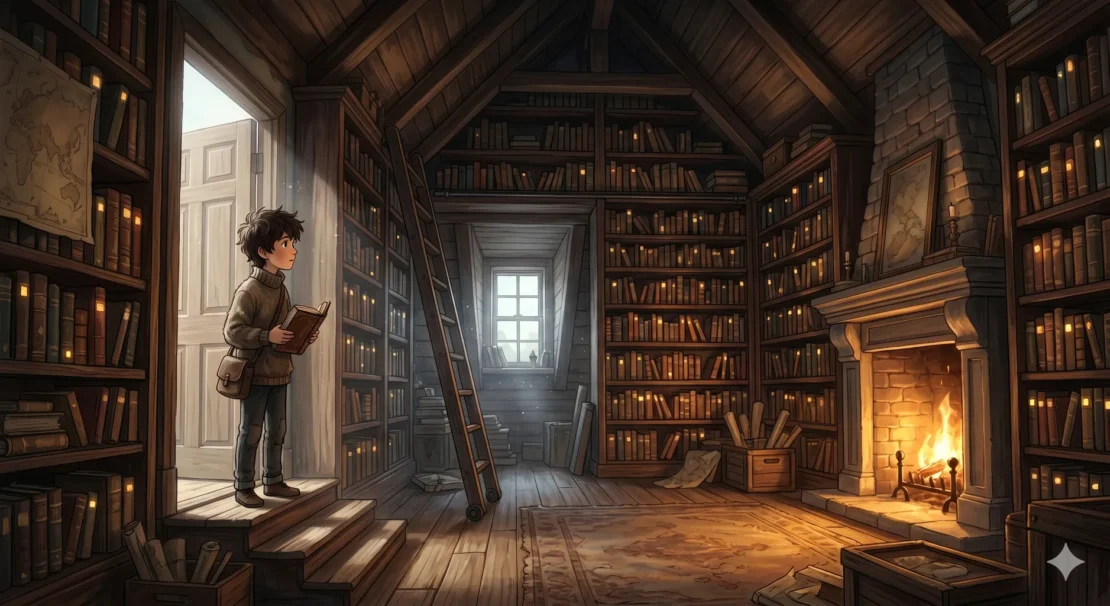
Not a small collection of shelves. An actual library, with ceiling-high cases on every wall, a rolling ladder that went all the way up, a fireplace that was lit despite it being spring, and three armchairs angled toward each other in the centre of the room in a way that suggested conversation.
Every book had a tag on the spine. Not a title. A destination. The tags said things like: The Morning the First Ship Left the Harbour. The Night the Two Kingdoms Agreed. The Afternoon the Mountain Decided to Move. The Hour Before the Storm Understood It Was Beautiful.
Pax picked up the book tagged The Hour Before the Storm Understood It Was Beautiful and opened it.
He was inside the story before he had finished the first sentence, standing in a purple-grey sky watching a storm system develop self-awareness for the first time in meteorological history, which it turned out was quite an emotional moment for everyone involved.
When he came back, the fire had burned lower. He had no idea how long he had been gone.
He went downstairs and ate dinner and didn’t tell anyone. Some things need to be known quietly, at least at first.
He went back every evening for a year before he started telling people about it, one at a time, and only the ones he was certain would understand.
Lesson: The most extraordinary things are sometimes found in the spaces you thought you already knew. Keep looking. Keep climbing.
6. The Cartographer of Impossible Places
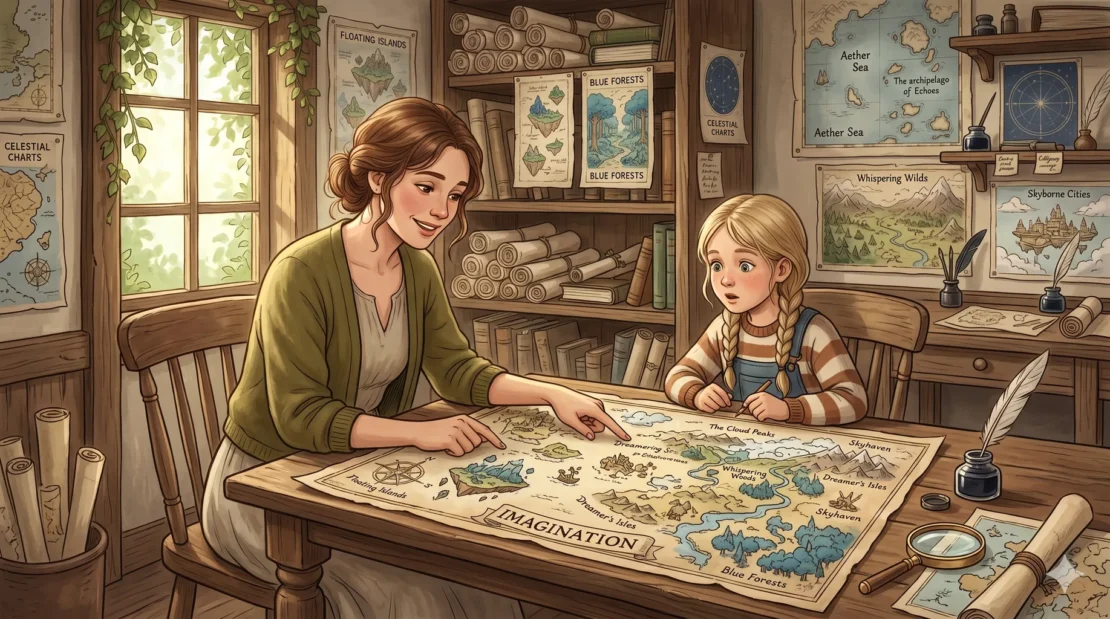
There was a woman named Esme who made maps for a living. Not ordinary maps with roads and borders and altitude markings. Esme made maps of places that didn’t exist yet.
She worked in a small studio on the fourth floor of a building in a city that was, itself, unremarkable. Her studio, however, was covered floor to ceiling with maps of places she had invented. The Archipelago of Slow Mornings. The Forest of Unfinished Conversations. The Mountain Range That Only Appears During the First Week of Winter. The Plains of Useful Forgetting.
People came to her from across the world to commission maps of their own impossible places. A composer asked her to map the landscape of a particular piece of music he had written, the place the melody lived when it wasn’t being played. She worked on that one for three months and it was one of her finest pieces.
A child named Rue came to her studio one afternoon, having found the address on a card in a shop window, and asked for a map of her imagination.
Esme looked at her for a long time.
“That’s the most complicated commission I’ve ever received,” she said. “Imaginations shift. They grow. They change shape. By the time I finish the map it will already be out of date.”
“That’s alright,” said Rue. “I just want to know what it looks like now.”
Esme agreed. She spent two weeks with Rue, asking her questions and sketching what she described. The resulting map showed a wide, uneven territory with a large central region labelled simply “Stories,” bordered by a mountain range called Worry on one side and an ocean called What-If on the other. There were dozens of small islands scattered across the What-If ocean, each one labelled with something Rue had wondered about. In the far corner, unmarked by anything official, was a small bright spot that the map key identified simply as “The thing I haven’t thought of yet.”
Rue rolled it up and carried it home under her arm.
She added to it herself over the years, in pencil, when the territory changed.
Lesson: Your imagination is a real place. It deserves to be explored, mapped, and expanded at every opportunity.
7. The Prince Who Traded His Crown for a Seed
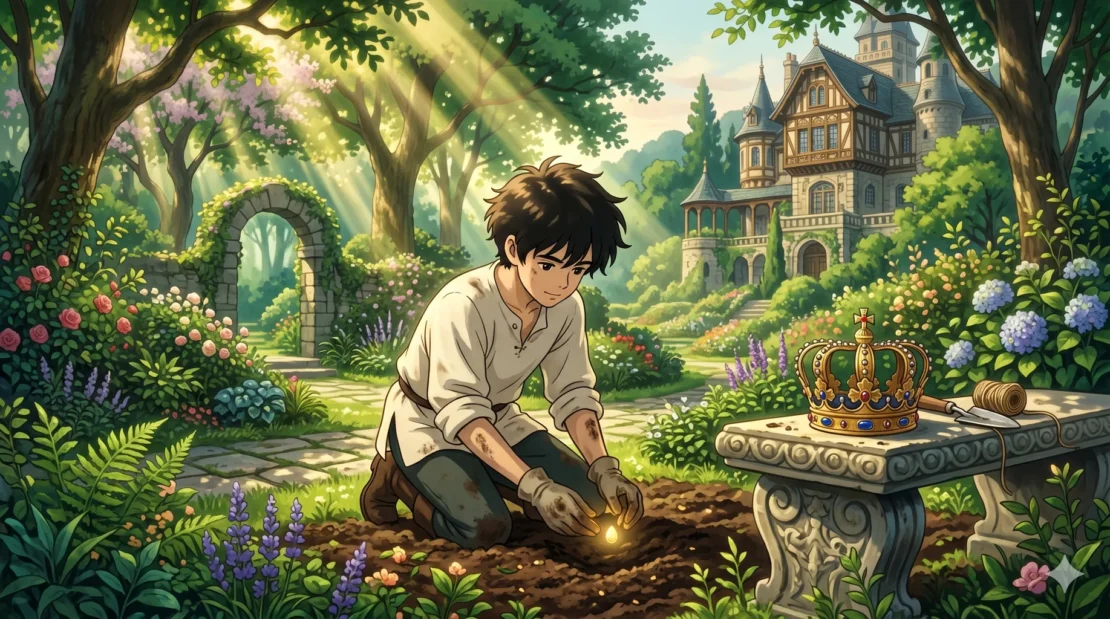
In a kingdom of considerable wealth and moderate happiness, a prince named Cai was given, on the morning of his fifteenth birthday, his official crown.
It was a fine crown. Gold, with seven points, set with stones the colour of the deep sea. It was very heavy, which the king said was appropriate because leadership was heavy. It was also, Cai noticed immediately, extremely uncomfortable, which nobody commented on because apparently that too was part of the tradition.
He wore it for three days.
On the fourth day, walking through the royal gardens, he passed a very old woman sitting on a stone bench near the fountain. She was holding a single seed in her open palm, looking at it with great concentration.
Cai sat beside her. “What kind of seed is that?” he asked.
“An important one,” she said. “It will become the largest tree this garden has ever held. But it needs the right conditions. Deep soil. Patience. Someone willing to tend it without seeing results for several years.”
Cai looked at the seed. He looked at his crown.
“I’ll trade you,” he said.
The old woman looked at him for a long moment. Then she smiled and held out the seed.
He planted it that afternoon in the deepest part of the garden, in rich dark soil he turned himself with a spade borrowed from the head gardener. He watered it for three years without seeing anything above the ground. His tutors pointed out, not unkindly, that a prince tending a patch of empty dirt was a slightly unusual use of royal time.
In the fourth year a shoot appeared.
In the seventh year it was taller than he was.
By the time Cai became king, the tree was the tallest thing in the garden, with branches wide enough to shade thirty people and roots deep enough to be, the gardeners said, effectively permanent.
He never asked the old woman where his crown ended up. Some trades are final, and some things are better left as stories.
Lesson: Leadership is not about what you wear or what you’re given. It is about what you are willing to plant and tend without the guarantee of seeing it grow.
8. The Last Dragon Keeper

In a world where dragons had been misunderstood for most of recorded history, there was a girl named Thea who had the title of Dragon Keeper and the enormous responsibility that came with it.
This sounded more impressive than it was, in certain practical ways. There was only one dragon left. His name was Ember, he was approximately three hundred years old, and he was about the size of a large horse, which was small for a dragon but he had never let it bother him much. He breathed fire only when startled, which Thea had taken careful note of in her first week and had arranged her approach accordingly.
The previous Dragon Keepers had written extensive records, which Thea had read completely before taking the position. The records described Ember as proud, occasionally sulky, deeply fond of music, and in possession of an extremely accurate memory that he used, when feeling uncharitable, to win arguments.
He was also, the records made clear, extraordinarily lonely.
Thea arrived at his mountain on a bright spring morning and introduced herself.
Ember looked at her for a long time without speaking. He had learned, over centuries, not to get too attached to the keepers. They were always temporary.
“You’ll leave eventually,” he said.
“Yes,” said Thea honestly. “But I’m here now.”
This was a better answer than most people gave.
She stayed for seven years. She learned his stories, which were extraordinary, covering three centuries of history from an altitude and angle no human historian had access to. She sang to him in the evenings, which he pretended not to enjoy and clearly did. She brought him news from the valley towns, which he received with the careful interest of someone who has been too long away from the world to hear about it without some emotion.
When she finally left to marry and live her life, Ember watched her go from the mouth of his cave.
“Will you come back?” he asked.
“When I can,” she said.
She did come back, three or four times a year, for the rest of her life. She brought her children, who loved him. She brought her grandchildren, who thought he was the greatest thing they had ever seen, which he considered, privately, a fair assessment.
He was not lonely after that.
Lesson: Showing up faithfully, again and again, is the thing that turns presence into love. The most magical relationships are built out of ordinary returning.
Why Fantasy Stories Are One of the Best Gifts You Can Give a Child
Reading these fantasy stories together is so much more than a nice way to spend an evening. Research consistently shows that children who engage regularly with imaginative fiction develop stronger creative thinking, richer emotional vocabulary, and greater capacity for empathy, because they have spent time genuinely inhabiting other perspectives, other worlds, and other ways of being.
Fantasy Stories Teach Children to Imagine What Doesn’t Exist Yet
Every innovation, every solution to a problem that has never been solved before, every new way of building the world starts in someone’s imagination. When you read fantasy stories with your child and let them ask “but what if?” and “why not?” and “what would happen if,” you are exercising exactly the cognitive muscles that make creative thinking possible.
Magical Worlds Help Children Process Real Feelings
A child who finds it hard to talk about being lonely might connect deeply with Ember the dragon in his mountain. A child working through their fear of change might find something meaningful in Fen walking through the green door. Fantasy stories give feelings a costume to wear, which often makes them easier to look at and talk about.
The Imagination You Nurture Now Shapes Everything Later
At Apple Tree Preschool BSD, located in the Educenter BSD Building, creativity and imagination are not extras we add on the side of real learning. They are baked into everything we do. Through our Singapore curriculum, children in our Toddler, Pre-Nursery, Nursery, and Kindergarten programmes explore the world through stories, play, art, music, and discovery every single day, because we believe that a child who knows how to imagine is a child who will always be able to find a way forward.
Step Through the Door Into Something Extraordinary
We hope these 8 fantasy stories gave you something truly magical to share with your little one tonight. Whether your child fell in love with the cloud kingdom or wanted to visit Calyx the river, that spark of wonder, that leaning-in and asking “is there more?”, is exactly what we are here to tend and celebrate.
If you would love for your child to spend their days in a place where wonder, curiosity, and imagination are the very foundation of learning, we would love to welcome your family to Apple Tree Preschool BSD.Register now and come explore, imagine, and grow with other wonderful children! Chat with us on WhatsApp or give us a call at +62 888-1800-900. We cannot wait to meet your little adventurer!



Be the first to write a comment.