

Some of the most important conversations we’ve ever had with children started with four simple words: “Let me tell you something.” The room goes quiet. Eyes get wide. And suddenly a child who couldn’t sit still for thirty seconds is completely, totally, magnificently absorbed.
That is the power of short stories for kids, and it never gets old no matter how many times we witness it. A well-told story doesn’t just fill a few minutes before bedtime. It stretches the imagination, plants a seed of empathy, and leaves something behind that textbooks simply can’t reach. The best short stories for kids do all of this while feeling effortless, like play rather than learning.
We’ve put together 10 original short stories, each written to spark curiosity, ignite creativity, and give you something genuinely wonderful to share with your little one tonight. Let’s go.
10 Short Stories for Kids That Fire Up Imagination and Heart
Dive into these imaginative short stories, creative children’s tales, and funny bedtime stories that take curious young minds on adventures they won’t want to leave.
1. The Boy Who Collected Clouds
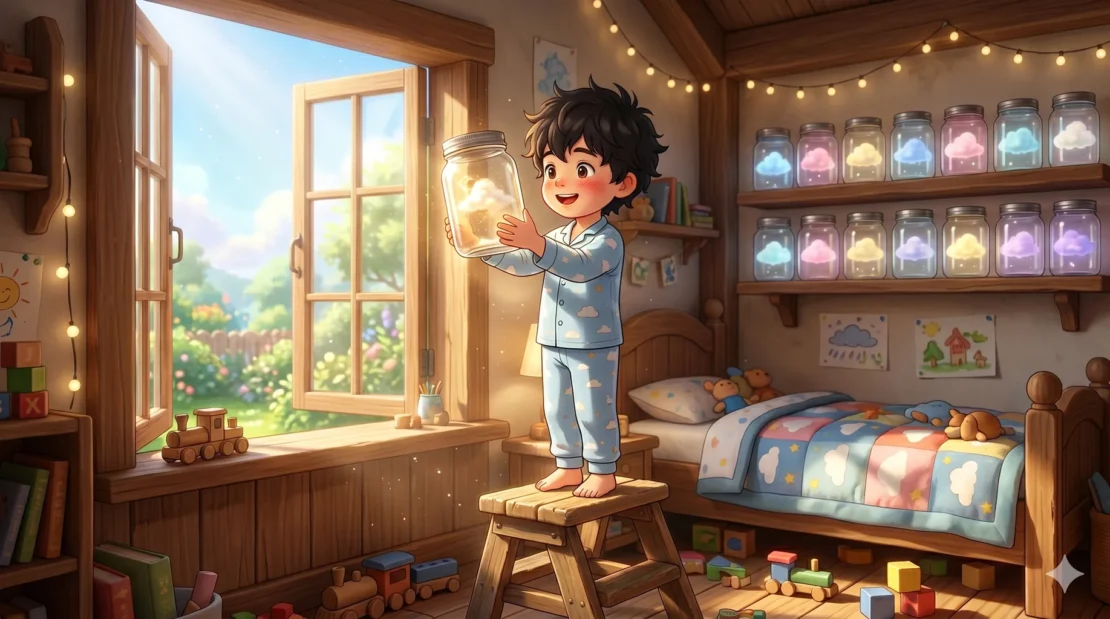
There are children who collect stamps, and children who collect rocks, and one very particular boy named Ezra who collected clouds. Not photographs of them, not drawings. Actual clouds, kept in jam jars he arranged on a shelf above his bed.
Most people would tell you this is impossible. Ezra would tell you those people had simply never tried hard enough.
He had started at age four when he noticed that certain clouds, the small trailing wisps that came apart from larger ones, seemed to hover particularly close to his bedroom window on still mornings. He opened the window one Thursday, held out his grandmother’s largest jam jar, and waited. The wisp drifted in. He screwed the lid on quickly.
The cloud inside the jar was softer than cotton and cooler than air-conditioning. When he shook the jar gently it swirled. When he held it up to the lamp it glowed faintly blue-white.
By the time he was six, he had eleven jars. Each cloud was slightly different. The one he caught in April was grey and smelled faintly of rain on warm concrete. The one from June was pure white and seemed to hum very quietly on windy days. His favourite, a small pink cloud he had caught just after sunset, glowed warm gold when he turned off the lights.
His younger sister Pip thought this was the best thing she had ever seen in her life. His parents thought it was a phase. His teacher asked to borrow the April one for science class and returned it slightly smaller, which Ezra considered deeply irresponsible.
One morning, he woke to find every jar empty. He ran to the window. Up above the neighbourhood, in the early pale sky, there were eleven small distinct clouds floating together in a loose cluster, all slightly different, all moving in the same direction.
He stood at his window and watched them until they disappeared over the roof of the house across the road.
He opened a new jar and set it on the windowsill.
Some collections are meant to be released. But that doesn’t mean you stop collecting.
Lesson: Creativity and curiosity are worth pursuing even when the results are temporary. The joy is in the noticing.
2. The Snail Who Wanted to Run
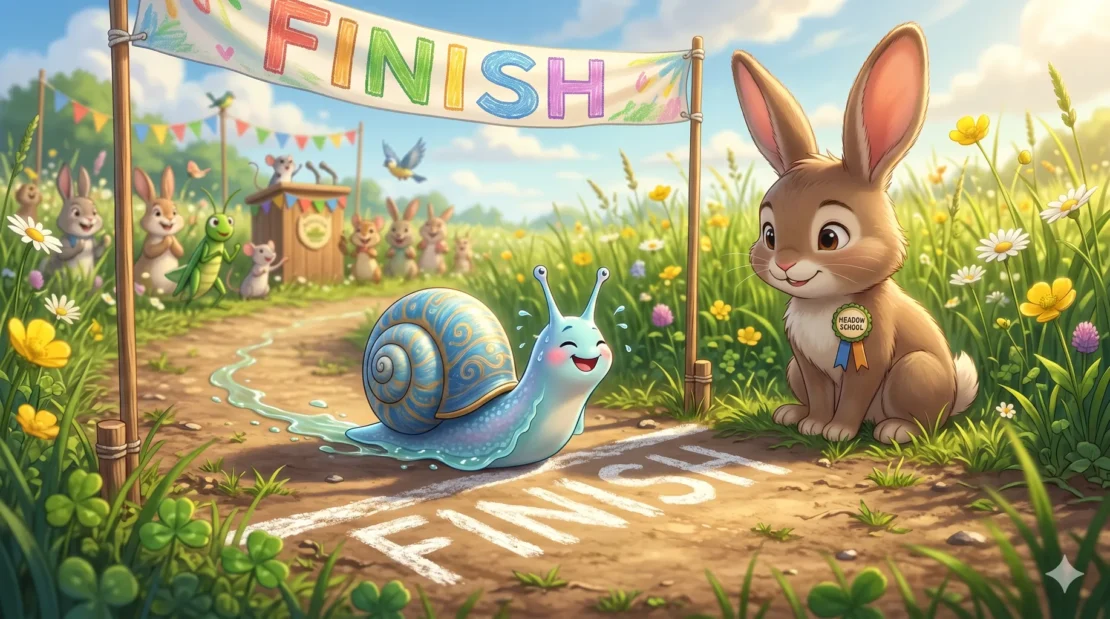
Everyone at Meadow School knew that Sylvie the snail was the slowest student in every class. She was slow at arriving, slow at leaving, and so slow at crossing the playground that by the time she reached the other side, most of the other students had gone in for lunch.
Sylvie was not unhappy about being a snail. She was, however, deeply interested in running.
She had watched the rabbits run. She had watched the grasshoppers leap. She had even watched the worms move, which was not technically running but was at least faster than she could manage. And every time the school held its annual Meadow Sprint, Sylvie signed up.
Every year she finished last. Not close to last. Last by a margin so significant that the winners had already gone home, showered, and eaten dinner by the time Sylvie crossed the finish line.
Every year, the crowd cheered for her anyway, because by the time she finished, the determination on her face was the most impressive thing anyone at the school had seen all day.
One year, a young rabbit named Fletcher was watching Sylvie cross the finish line at the very end of the race. He had won first place forty-five minutes earlier and had been waiting since then, mostly out of curiosity.
“Why do you keep entering?” he asked, genuinely puzzled. “You know you’ll come last.”
Sylvie thought about this for a moment. “Because last year I was eleven minutes slower than this year,” she said. “So in a way, I’m winning.”
Fletcher turned this over in his mind for a while.
“That’s actually a very interesting way to think about it,” he said.
“I have a lot of time to think,” said Sylvie pleasantly, and continued toward the finish line at her own steady pace.
The next year, she was eight minutes faster again. She still came last. She was also, by any meaningful measure, the most improved athlete at Meadow School, and she had the times written in her notebook to prove it.
Lesson: Progress is personal. Competing with your own previous best is the most honest race there is.
3. The Dragon Who Was Afraid of Fire

In a kingdom of tall grey mountains and very surprised villagers, there lived a dragon named Iggy who was afraid of fire. This was, as you might imagine, a considerable inconvenience.
Other dragons breathed fire as naturally as blinking. It came up from deep in their chests and rolled out in long beautiful orange-gold columns that lit up the sky and made everyone take three large steps backward, which dragons generally considered a satisfying reaction.
Iggy tried every morning. He took the deep breath. He felt the heat build in his chest. And then he thought about what fire actually was, hot and fast and impossible to take back once released, and he breathed out cold air instead.
It wasn’t that he thought fire was bad. He just worried about using it at the wrong moment, in the wrong direction, near the wrong thing. What if he misjudged? What if he got it wrong?
The other dragons were patient with him, mostly. His mother told him he’d get there. His father demonstrated the correct technique so many times he had accidentally singed the kitchen ceiling seven times in a row.
One autumn evening, Iggy was walking near the edge of the mountain when he heard a small sound below. A little fox had fallen into a deep crevice in the rock and couldn’t get out. The walls were too smooth to climb, and the crevice was too narrow for any of the bigger animals to reach in.
Iggy looked down at the fox. He looked at his own chest. He thought about the heat that was always there, waiting.
He thought less about getting it wrong this time, and more about what would happen if he didn’t try.
He breathed.
A precise, careful, warm stream of fire hit the crevice wall at exactly the right angle, melting a series of footholds into the rock face. The fox climbed out in under a minute.
It looked up at Iggy with enormous eyes.
“Thank you,” it said.
Iggy blinked. The fire had gone exactly where he meant it to go.
He breathed out slowly and felt something warm in his chest that had nothing to do with flames.
Lesson: Fear of getting things wrong can stop us from doing things very right. Sometimes the best way to find your courage is to need it for someone else.
4. The Library at the Bottom of the Lake

Nobody knew how long the library had been there. The fish didn’t know. The eels didn’t know. The old turtle who had lived in the lake since before anyone could remember knew that it had always been there, which wasn’t quite the same as knowing how long.
It was a proper library, with tall shelves and reading lamps that glowed with bioluminescent light and little brass labels on every shelf. The only unusual thing, apart from being at the bottom of a lake, was that all the books were made of water.
Not wet paper. Actual water, shaped into the form of books, perfectly legible, written in colours that shifted as you read, blue for sadness, gold for joy, green for the particular feeling of learning something new.
A girl named Marina discovered it one summer when she was eight and had gone underwater to retrieve her lost snorkel. She opened the first door she saw, the way curious children always do, and found herself standing between two long rows of water-books in what felt like ordinary air, breathing perfectly comfortably.
She stayed for three hours reading a water-book about a sea captain who had sailed to the edge of the world and found that it was round after all. When she finally surfaced, the afternoon had turned to evening and her mother was standing at the edge of the lake looking worried.
“Where have you been?” her mother said.
“Reading,” said Marina.
She went back every day that summer. By September she had read seventeen books, all of them made of water, all of them full of things she hadn’t known before.
When autumn came and the lake grew cold, she noticed something. Everything she had read had stayed with her perfectly. Not because the books were magical, exactly. But because she had wanted so much to remember them that she had read every single one twice.
The library was still there the following summer. She brought her little brother.
Lesson: The most extraordinary things are often found by the children who are brave enough to open unfamiliar doors.
5. The Cloud Painter

Above the city of Windmere, there was an artist named Aurelio who painted the sky.
Not on canvas. In the actual sky, using brushes made of wind and pigments mixed from sunrise light and storm grey and the exact blue that appears for about six minutes at the end of a clear summer afternoon. He painted from a studio that didn’t exist in the usual way, more of a feeling he could step into when the conditions were right, and he worked from just before dawn until the day had fully arrived.
Nobody in Windmere knew he existed. They just woke up every morning to a sky that was, without fail, beautiful in a different way than the day before. Some mornings it was dramatic, all sweeping purple and gold. Some mornings it was subtle, a thin wash of pale peach over grey that made everything look slightly more romantic than usual. Some mornings, on days when Aurelio was feeling mischievous, there were shapes, a very convincing giraffe, a running horse, a face that several people thought resembled the mayor of Windmere but was probably a coincidence.
One morning a small girl named Pea looked up and spotted Aurelio’s faint outline working in the pre-dawn sky. She watched him for a long time.
The next morning she put her finger to the air and tried to paint.
The morning after that, the sky above her house had one small additional cloud, shaped approximately like a lopsided star.
Nobody else noticed. But Aurelio did, and the next morning he left a small gap in his painting right at the spot where a child’s first attempt deserved some room.
Lesson: Even the most experienced artists leave room for beginners. The sky is big enough for everyone’s first try.
6. The Robot Who Learned to Rest

In a factory that made very useful things, there was a robot named Unit Seven who had never, not once, switched off.
The other robots took their maintenance breaks as scheduled. They powered down at night. They ran their diagnostics and came back the next morning running smoothly and efficiently. Unit Seven thought this was a waste of time. There was always more to do. More things to sort, more tasks to complete, more usefulness to generate.
Unit Seven worked through the nights. Unit Seven worked through the weekends. Unit Seven had never, technically speaking, experienced a dream, because dreams require something Unit Seven considered highly inefficient: sleep.
After several years of this, Unit Seven began making small errors. Not big ones, just the kind that crept in around the edges. A measurement slightly off. A label placed a fraction too high. Small things that a well-rested robot would have caught.
The factory engineer noticed. She looked at Unit Seven’s log and saw something she had never seen before in any robot’s history: not one single resting period in four years.
“You need to shut down,” she said.
“There is too much to do,” said Unit Seven.
“There will always be too much to do,” said the engineer patiently. “That is a permanent condition, not a temporary problem to be solved by not resting.”
Unit Seven processed this for a long time.
That night, for the first time, Unit Seven powered down.
In the morning, Unit Seven powered back up.
The world looked precisely the same as it had before. But Unit Seven’s processors ran cleaner and faster than they had in years, the errors disappeared immediately, and the tasks that had previously taken three hours were done in two.
Unit Seven powered down every night after that.
Rest, it turned out, was not time lost. It was how the work got done properly.
Lesson: Resting is not laziness. It is maintenance. Every good thing needs time to recharge.
7. The Map That Drew Itself
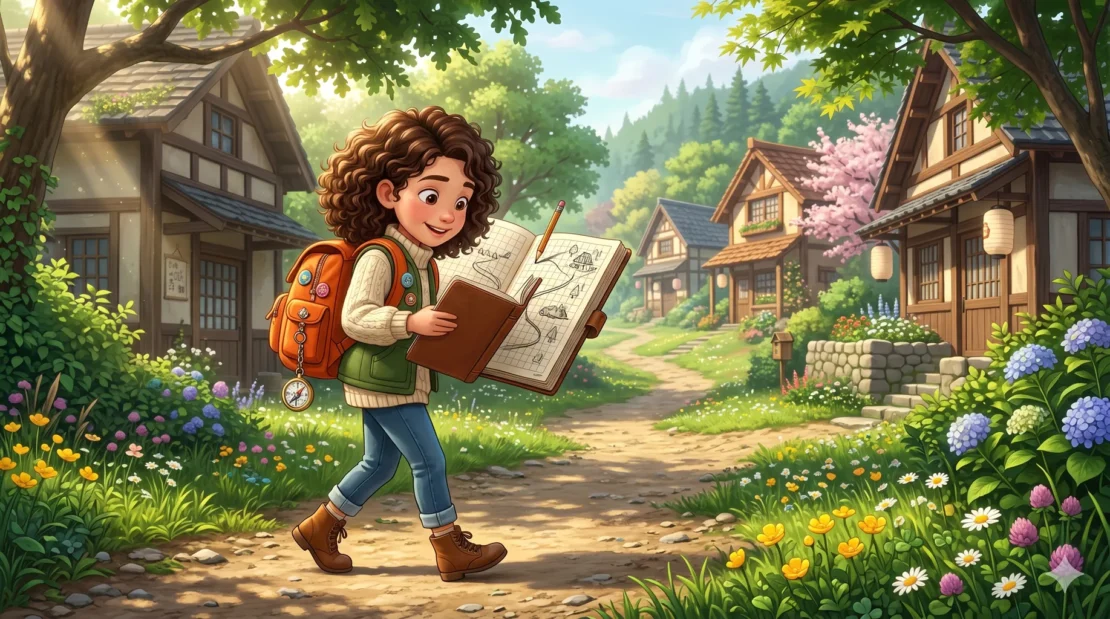
On the desk of a girl named Orla, there was a map that was never quite finished.
She had started it herself, in a large brown notebook with gridded pages, drawing her neighbourhood from memory with careful pencil lines. Her house was in the middle. The school was to the left. The park with the broken swing was to the north, she had checked with a compass.
But every morning when she opened the notebook, the map had grown slightly.
New streets had appeared overnight, drawn in a hand that wasn’t hers, in pencil lines slightly lighter than her own. The lines led away from her neighbourhood into parts of the city she hadn’t been to yet. Small notations appeared in careful script: “good mango trees here,” “the bakery with the blue door opens before sunrise,” “there is an old man here who knows seventeen card tricks and will teach you all of them.”
Orla followed the map. She spent an entire Saturday tracking one new street, then another. She found the bakery with the blue door. She found the old man with the card tricks, who taught her all seventeen and then, as a bonus, an eighteenth one he said he had only taught to two other people.
She never found out who was drawing the additions.
She did notice that the map only added new paths on weeks when she had actually followed the previous additions. On weeks when she stayed home and didn’t explore, the map stayed still.
She began to wonder whether the map wasn’t drawn by something outside her at all, but by some part of her own curiosity that activated when she acted on it.
She kept following it anyway. By the time she was twelve, she knew more about her city than most adults twice her age.
Lesson: Curiosity rewards itself. The more of the world you explore, the more the world opens up for you.
8. The Smallest Musician in the Orchestra
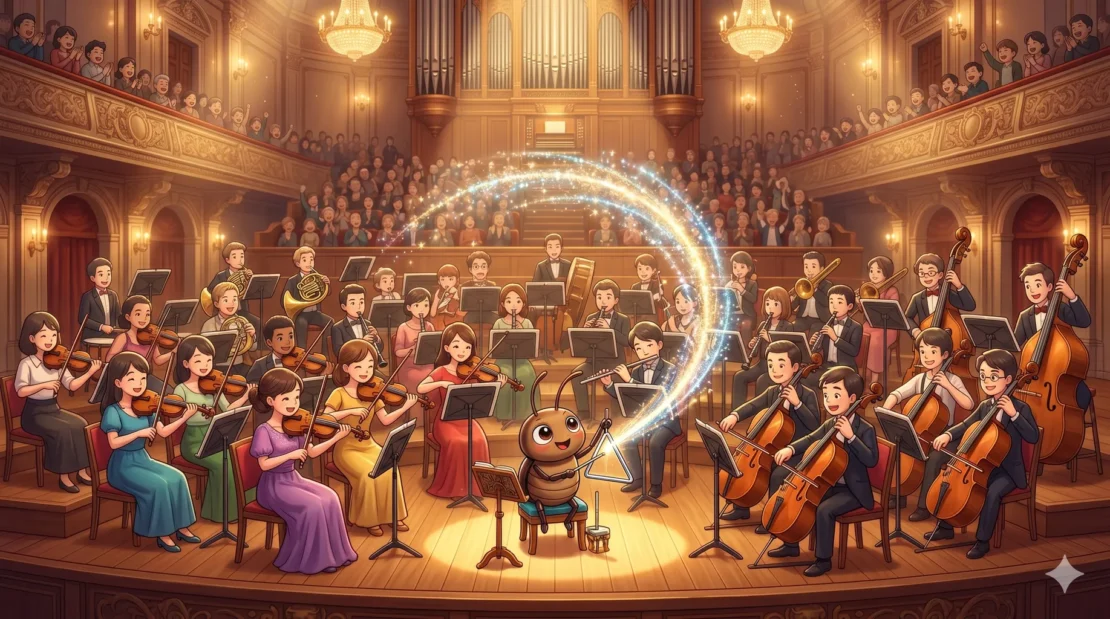
The Grand Windmere Orchestra had forty-seven members, and the smallest by a very significant distance was a beetle named Pip who played the triangle.
The triangle is, in the opinion of many, the least impressive instrument in any orchestra. It is small. It makes only one sound. It is played, at most, six times in a forty-minute performance. Between its moments, the triangle player sits very quietly while everyone else does all the interesting parts.
Pip loved the triangle with his entire heart.
He polished it every morning until it reflected his face back in clear silver. He practised the angle of his strike for hours, because a triangle struck at the wrong angle sounds flat and dull, but a triangle struck precisely right rings with a clarity that cuts through every other instrument in the room like a single, perfect thought.
The other musicians were kind but honest. “You know,” said the first violin once, not unkindly, “you could learn something with more notes.”
“I only need one note,” said Pip. “I just need it to be the right one.”
On the night of the Grand Concert, forty-six musicians played beautifully. And then, at the precise moment in the final movement when everything built to its highest point, Pip struck his triangle.
The note rang out clear and bright and absolutely perfect, and for one full second the entire audience felt it somewhere in their chest, a single clean sound that somehow made everything before it feel complete.
Nobody applauded the triangle specifically. But three audience members mentioned it to each other afterward, though none of them could say exactly why that moment had stayed with them.
Pip packed up his triangle and polished it one more time before putting it away.
One note. The right one. That was always enough.
Lesson: Every role matters when it is done with full commitment. A single perfect contribution can be the thing that makes everything else complete.
9. The Girl Who Asked Why Until She Found the Answer

Nadia asked why approximately forty times a day, which her family found endearing for the first few years and then progressively more exhausting as she got older and the questions got harder.
“Why is the sky blue?” “Why do onions make you cry?” “Why do we dream?” “Why is Wednesday spelled like that?” “Why do some people have more than others?” “Why does the moon look bigger near the horizon?” “Why are some jokes funny and some aren’t?”
Her parents answered what they could. They looked up what they couldn’t. They occasionally said “I genuinely don’t know, let’s find out” which Nadia considered the best possible answer.
When she was eight, her science teacher said something that Nadia wrote in the front of every notebook for the rest of her life: “The best scientists in the world are just the people who kept asking why long after everyone else stopped.”
By the time Nadia was nine, she had filled four notebooks with questions and their answers. Some answers led to three new questions, which she considered excellent value.
She wasn’t the best student at memorising. She was not the tidiest note-taker. But she was absolutely the most relentlessly curious person in any room she entered, and her teachers would later say, unanimously, that she was the one they always remembered.
When she grew up, she became a researcher. She spent her days asking why in a more formal and funded setting, which suited her enormously.
She still asked forty times a day. She just had more equipment now.
Lesson: Curiosity is not a childish habit to grow out of. It is the engine of every discovery ever made.
10. The Bear Who Made a Garden in Winter

Everyone told the small brown bear named Cosmo that you couldn’t grow a garden in winter. The ground was frozen. The light was too thin. Things didn’t grow in winter. That was just how it was.
Cosmo, who had been told things were impossible before and had found this to be unreliable information, decided to try anyway.
He didn’t have a greenhouse. He had a south-facing window, a collection of mismatched pots, some old compost he had saved from autumn, and a particular stubbornness that people who know bears well will recognise immediately.
He planted seeds that were supposed to like cold, cress and spinach and a type of miniature kale that the seed packet promised was “frost-tolerant, mostly.” He put the pots on the windowsill and talked to them, which he knew didn’t technically help but which he also didn’t believe could hurt.
Some seeds didn’t come up. Some came up and then gave up, which Cosmo noted without taking personally.
But by mid-winter, there were small green things growing on his windowsill with a determination that matched his own. By February, he had enough cress to put on sandwiches. By March, he had actual salad ingredients while his neighbours were still waiting for the ground to thaw.
“I thought you couldn’t garden in winter,” said his neighbour, eyeing his spinach with something between scepticism and appetite.
“You mostly can’t,” said Cosmo agreeably. “But mostly isn’t the same as completely.”
He handed her a handful of cress.
She put it on her sandwich and said nothing for a moment.
“Next year,” she said finally, “will you show me how?”
Lesson: “It can’t be done” is often just someone else’s experience, not a fixed law of the universe. Try anyway and find out for yourself.
Why Short Stories for Kids Are One of Your Best Parenting Tools
Reading these kinds of imaginative short stories with your child isn’t just a lovely way to end the day, though it absolutely is that. Short stories for kids build vocabulary, develop listening skills, and open conversations about emotions and values in a way that feels completely natural because it is wrapped in something your child genuinely enjoys.
Stories Build the Foundation for Lifelong Learning
At Apple Tree Preschool BSD, we weave storytelling, creativity, and imagination into everything we do. The children who come through our doors, from our Toddler programmes right through to Kindergarten 2, are surrounded by stories, language, and ideas every single day. Our Singapore curriculum approach develops children who don’t just memorise facts but who think, imagine, question, and create.
Every Story Becomes a Conversation
After you read one of these short stories for kids tonight, try asking one simple question: “What would you have done?” You might be surprised by what comes out. These conversations, small and unhurried and rooted in a story your child loved, are where the real learning happens and where you’ll find out what is going on in that wonderful, spinning mind.
We believe that the best preschool experience and the best home life work together, and storytelling is one of the most powerful places where those two worlds meet beautifully.
Explore everything we offer for children from 18 months to 6 years through our full range of classes and programmes, nestled inside the Educenter BSD Building.
Let’s Write the Next Chapter Together
We hope these 10 short stories for kids gave you something magical to share tonight, and many nights after. Whether your little one gasped at the dragon who breathed fire for the first time or giggled at the snail who kept entering the race, that reaction, that spark of feeling and imagining, is exactly what we are here to nurture.
If you would love for your child to spend their days in a place where that spark is tended and celebrated every single hour, we would genuinely love to meet your family.
Register now and come play, imagine, and grow with other children at Apple Tree Preschool BSD! Chat with us on WhatsApp or call us at +62 888-1800-900. We can’t wait to hear from you!




Be the first to write a comment.