

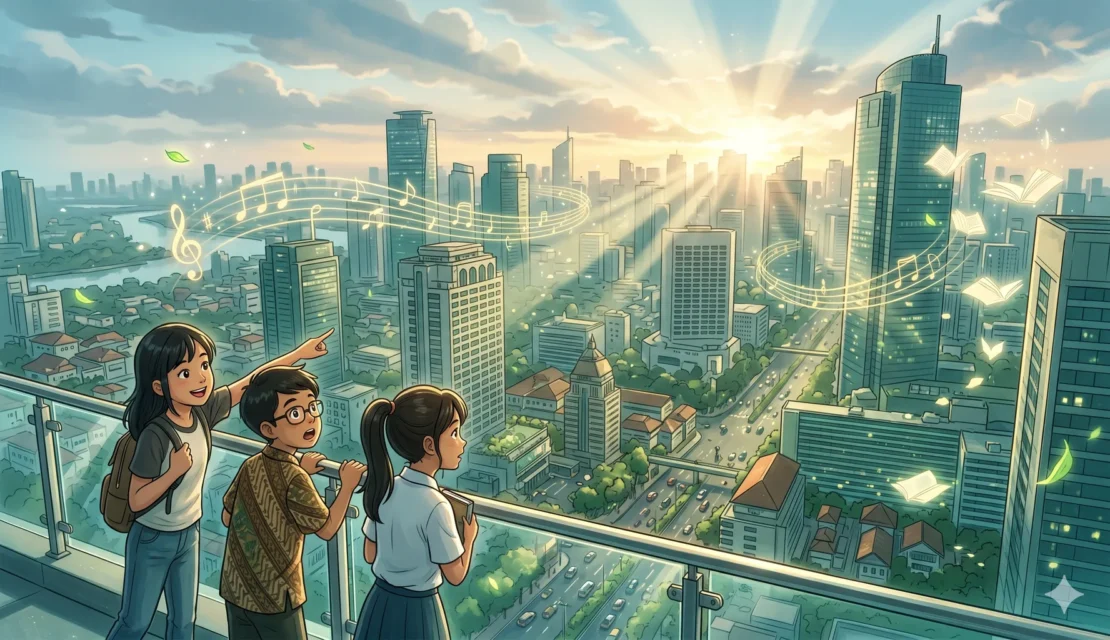
Every Friday afternoon at Apple Tree Pre-School BSD, something magical happens in our reading corner at the Educenter BSD building. Children gather with wide eyes and open hearts, ready to hear stories that transport them to places they’ve never been. But here’s what we’ve noticed over the years: the old fairy tales don’t always connect with today’s city kids the way they used to. Our children live in apartments, ride trains, and navigate busy streets. They need modern fairy tales that reflect their world, their challenges, and their incredible potential.
That’s why we created these seven original modern fairy tales featuring smart, resourceful kids in the big city. These stories celebrate curiosity, kindness, and the magic that happens when children use their brains and hearts together. Share them at bedtime, during car rides, or anytime your little one needs a dose of wonder and inspiration.
7 Original Modern Fairy Tales for Smart City Kids
These modern fairy tales blend the timeless magic of classic storytelling with the vibrant energy of urban life. Each story features a child who uses creativity, empathy, and intelligence to solve problems in their bustling city world.
1. Mira and the Singing Subway
In the heart of Jakarta, there lived a curious girl named Mira who heard music everywhere. She heard it in the honking of bajaj, in the sizzle of street food vendors, and especially in the rumble of the MRT train beneath her feet. But nobody else could hear what she heard. “You have too much imagination,” her older brother would say, rolling his eyes.
One rainy Tuesday morning, Mira was riding the subway to visit her grandmother across the city. The train was packed with commuters staring at their phones. Nobody talked. Nobody smiled. The air felt heavy and gray, even though the fluorescent lights buzzed overhead. Mira pressed her ear against the window and listened carefully. There it was again, a melody humming through the metal walls, soft and sweet like a lullaby she’d forgotten.
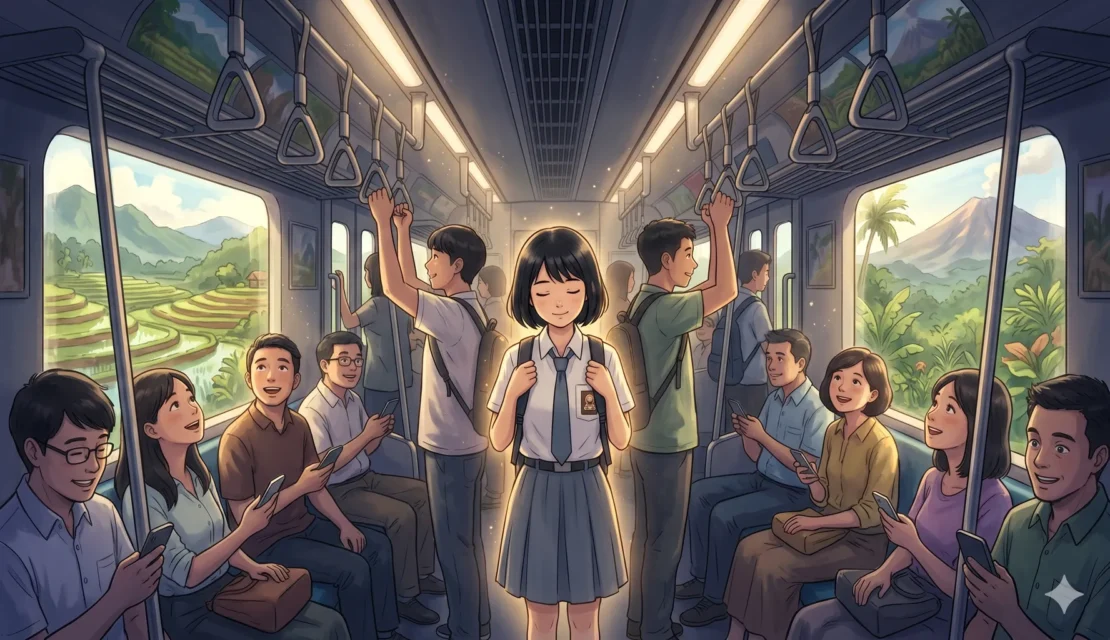
“Hello?” Mira whispered to the train. The melody changed slightly, as if answering her. Mira’s eyes grew wide. She began to hum along, matching the train’s secret song note by note. Something extraordinary happened next. The lights flickered gently, and a warm golden glow spread through the carriage. Passengers looked up from their phones, confused but not frightened. A little boy across the aisle started tapping his feet. An old woman began nodding her head to the rhythm.
Mira hummed louder, and the train seemed to respond. The rumbling beneath their feet transformed into a gentle beat. Windows that showed nothing but dark tunnel walls suddenly reflected images of beautiful gardens, mountains, and oceans. The entire subway car had become a traveling concert hall showing Indonesia’s most beautiful landscapes. Passengers gasped, then laughed, then started clapping along.
But then the train stopped suddenly between stations. The lights went dark. The music stopped. A voice crackled over the speaker: “Technical difficulties. Please remain calm.” Passengers groaned. A baby started crying. Fear crept into the carriage like cold water.
Mira didn’t panic. She remembered something her music teacher at school had told her: “Music connects what is broken.” She stood up in the dark carriage and began to sing. Not just humming this time, but really singing. She sang a song her grandmother taught her, about fireflies lighting up dark nights. Her voice was small but clear, cutting through the darkness like a golden thread.
One by one, passengers joined in. Those who didn’t know the words hummed along. The little boy across the aisle clapped a rhythm. The old woman sang harmony. The baby stopped crying and giggled. And then, something miraculous happened. The train’s lights flickered back on, brighter than before. The engine hummed to life, and the train glided smoothly into the next station.
When the doors opened, passengers filed out, but they were different now. They smiled at each other. They said thank you. A businessman shook Mira’s hand. “You fixed the train,” he said seriously. Mira shook her head. “We fixed it together,” she replied. “The train just needed to hear us being kind to each other.”
From that day on, Mira rode the subway every week. And every time she hummed, the train hummed back. Passengers learned to listen for it too. Jakarta’s subway became known as the happiest train in the world, and it all started because one small girl believed that music could fix anything.
The moral: When the world feels dark and broken, your voice matters. One person’s courage to sing can inspire everyone around them.
2. Budi and the Rooftop Garden That Grew Dreams
High above the busy streets of Jakarta, on the twentieth floor of a tall apartment building, lived a boy named Budi who loved dirt. Not the dirty kind that makes your mother frown, but the rich, brown, earthy kind that holds seeds and promises. The problem was, Budi lived in a concrete jungle where dirt was as rare as snow. His apartment had white tiles and his balcony was barely big enough for a chair.
“I want to grow something,” Budi told his mother every morning at breakfast. She’d smile sadly and say, “There’s nowhere to grow anything here, sayang.” But Budi refused to accept that answer. He’d seen pictures of rooftop gardens in a book at school, and the idea planted itself in his mind like a seed that wouldn’t stop growing.
One Saturday, Budi took the elevator to the rooftop of his building. Nobody went up there. It was just gray concrete, some rusty pipes, and an old water tank. The sun was blazing, and the city stretched out below like a sprawling puzzle. Budi looked at the empty space and saw possibility where everyone else saw nothing.
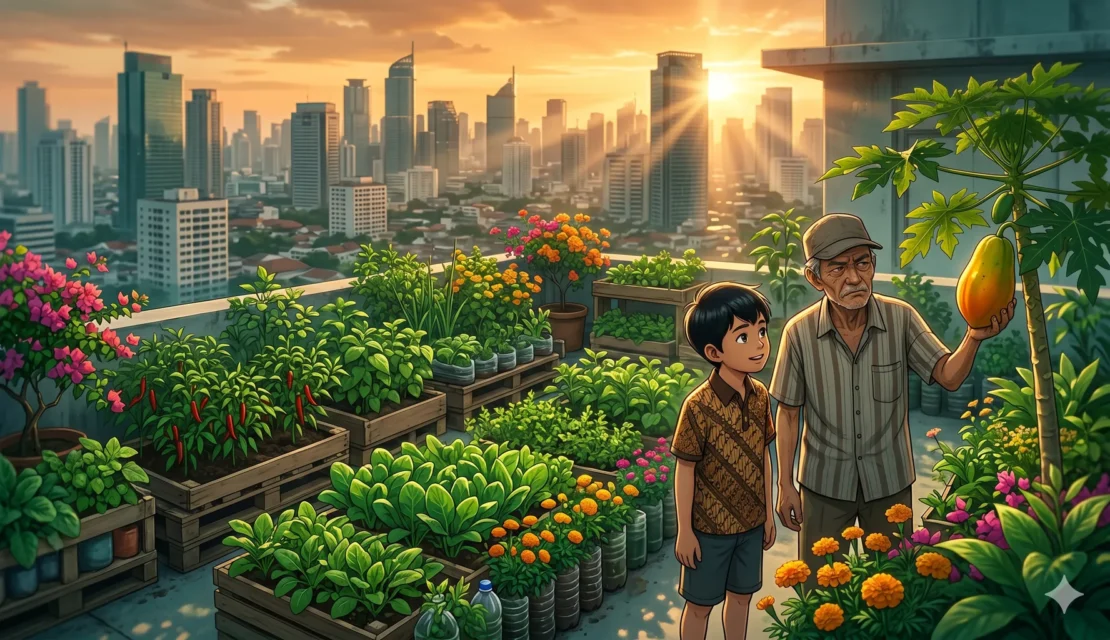
He started small. He found old plastic bottles in the recycling bin and cut them in half to make pots. He collected soil from the tiny patches of earth around the building’s entrance, carrying it upstairs handful by handful in his school bag. He saved seeds from the fruits his mother bought at the market: papaya, chili, tomato, and kangkung. Every morning before school, Budi climbed to the roof to water his little garden.
For two weeks, nothing happened. The soil sat stubbornly in the bottles, showing no signs of life. Budi’s neighbor, Mr. Tono, found him on the roof one evening, looking disappointed. “What are you doing up here, boy?” he asked gruffly. Budi explained his dream of a rooftop garden. Mr. Tono laughed. “Nothing grows on concrete,” he said, walking away.
But on day fifteen, Budi spotted a tiny green sprout pushing through the soil in one of his bottles. He nearly cried with happiness. He watered it extra carefully and whispered, “Keep growing. I believe in you.” The next day, three more sprouts appeared. Then five. Then too many to count.
Word spread through the building about the boy with the rooftop garden. Mrs. Lina from the eighth floor brought him proper soil from her cousin’s farm. The security guard, Pak Joko, helped him build raised beds from old wooden pallets. The twins from the fifteenth floor started their own section growing herbs. Even grumpy Mr. Tono showed up one morning with tomato seedlings and a sheepish smile.
Within three months, the rooftop had transformed into a lush green paradise. Vegetables grew in neat rows. Flowers attracted butterflies that had never visited the twentieth floor before. The building’s residents started gathering there in the evenings, sharing vegetables and stories. People who had lived next door for years without speaking became friends over watering cans and fresh chili peppers.
The building manager initially wanted to shut it down. “It’s against regulations,” he announced at a residents’ meeting. But when he saw the garden and tasted the sweet papaya that grew there, something changed in his expression. “Perhaps,” he said slowly, “we could make this official.” He allocated a small budget for proper gardening supplies, and Budi’s rooftop experiment became the building’s proudest feature.
One evening, as Budi sat among his plants watching the sunset paint Jakarta’s skyline in orange and gold, his mother found him there. “You grew more than vegetables,” she said, sitting beside him. “You grew a community.” Budi leaned against her shoulder and smiled. “I just planted the seeds, Mama. Everyone else helped them grow.”
The garden still thrives today, and every spring, Budi teaches the newest, smallest residents of the building how to plant their first seed. He tells them the same thing every time: “The world might be covered in concrete, but there’s always room for something green to grow if you’re willing to carry the dirt upstairs.”
The moral: When you start something good with passion and patience, others will join you. Even the smallest garden can grow a whole community.
3. Dewi and the Library That Opened at Midnight
Dewi loved books more than anything else in the world, but her family couldn’t afford to buy them. She’d read the same three picture books so many times that she could recite them with her eyes closed. Every week, she pressed her nose against the window of the big bookstore near her school, watching children walk out with colorful bags full of new stories. She never complained, but her heart ached quietly for new adventures between fresh pages.
One night, Dewi couldn’t sleep. The city outside her window hummed with the sounds of distant traffic and crickets. She noticed something strange through her bedroom window, a soft golden light glowing from the old community center down the street. That building had been abandoned for years. Nobody went there. Yet tonight, warm light spilled from its windows like liquid honey.
Dewi crept out of bed, slipped on her sandals, and tiptoed downstairs. The streets were empty and cool. She followed the golden light until she stood before the old community center’s door. It was open. She stepped inside and gasped.
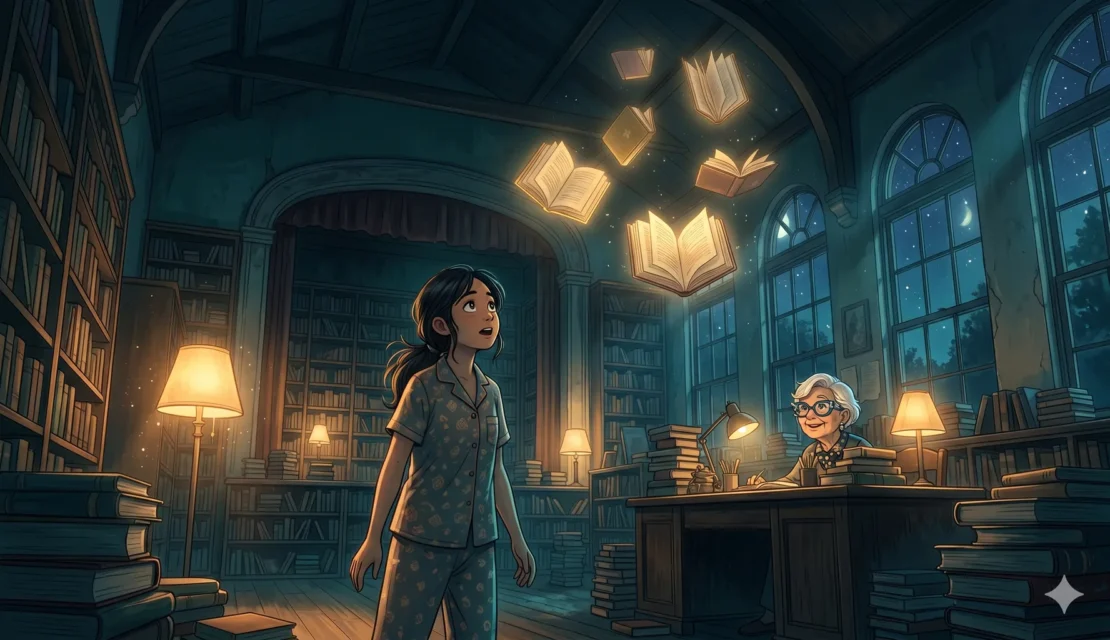
The entire building had transformed into the most magnificent library she’d ever imagined. Bookshelves reached from floor to ceiling, filled with thousands of books in every color. Comfortable reading chairs dotted the room, each with a small lamp and a plate of warm cookies. And the books, oh, the books! They weren’t just sitting on shelves. Some of them floated gently in the air, their pages rustling as if breathing. Others glowed faintly, pulsing with the stories inside them.
“Welcome, Dewi,” said a gentle voice. An elderly woman sat behind a wooden desk, wearing glasses that sparkled like tiny stars. “I’ve been expecting you. I’m Ibu Buku, the midnight librarian.”
Dewi’s mouth hung open. “How do you know my name?”
“I know every child who loves books but cannot find them,” Ibu Buku replied with a warm smile. “This library appears only for those children. You may read anything you wish, but there is one rule: every story you read here, you must share with someone else before you can return.”
Dewi spent that entire night reading. She read about dragons living in volcanoes, about princesses who became scientists, about a boy who traveled the ocean on a paper boat. Each story was more wonderful than the last. When the first light of dawn touched the windows, the library began to fade. “Come back tomorrow night,” Ibu Buku whispered, “but remember the rule.”
The next day at school, Dewi retold the dragon story to her classmates during lunch. Their faces lit up with wonder. She told the princess scientist story to her little brother at dinner. His eyes went wide and he asked to hear it again. She told the paper boat story to old Pak Rahmat who sat alone at the neighborhood warung every evening. He laughed for the first time in months.
That night, the golden light appeared again, and Dewi returned to find even more books waiting for her. This became her routine. Read at midnight, share during the day. But something unexpected started happening. The children she told stories to began telling those stories to other children. Parents overheard and started sharing stories at dinner tables. Pak Rahmat began telling stories to other lonely elders at the warung.
Within months, the entire neighborhood had become a storytelling community. Someone donated old books to the community center. Parents started a weekend reading group. The local government noticed and officially reopened the building as a real library, open to everyone, anytime.
On the night the real library opened, Dewi went to visit Ibu Buku one last time. The midnight library still glowed, but it was smaller now. “You’ve done it,” Ibu Buku said proudly. “You’ve shared enough stories that the magic doesn’t need to hide anymore. It lives in the real world now.”
“Will you still be here?” Dewi asked, tears in her eyes.
“I’m everywhere a story is being shared,” Ibu Buku replied, adjusting her starry glasses. “And thanks to you, that’s a lot of places now.”
Dewi never saw the midnight library again, but she never needed to. She had discovered something more powerful than any magical building: when you share a story, you give someone a gift they can carry forever. And the best part? You never run out.
The moral: Stories gain power when shared. One child who loves reading can light up an entire community with the magic of storytelling.
4. Raka and the Traffic Light That Granted Wishes
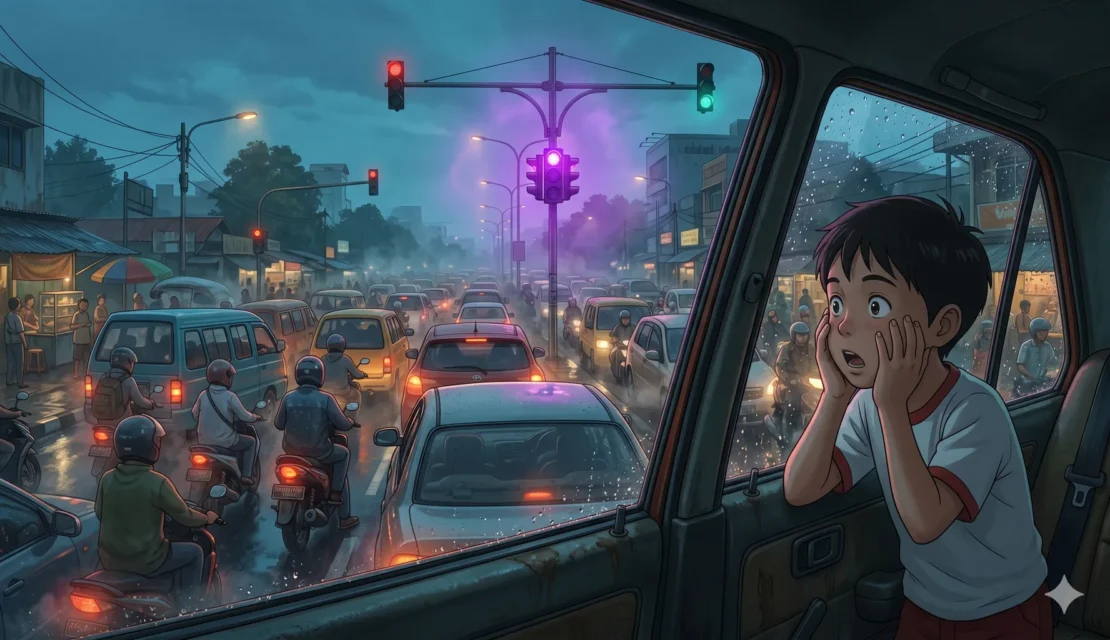
Raka hated traffic. Every morning, his mother’s car crawled through Jakarta’s legendary gridlock, and what should have been a twenty-minute drive to school took over an hour. He’d sit in the back seat, watching the traffic lights change from red to green to red again, feeling like time itself was stuck in traffic too.
“I wish this traffic would just disappear,” Raka muttered one morning, staring at the red light at the big intersection near his school. The light flickered strangely. Then it flickered again. Then, to Raka’s astonishment, it turned a color he’d never seen before: bright purple.
Nobody else seemed to notice. Cars continued waiting. His mother hummed along to the radio. But Raka saw the purple light pulse three times, and a tiny voice seemed to whisper from the traffic signal: “One wish per morning. Use it wisely.”
“I wish there was no traffic!” Raka blurted out. Instantly, the roads cleared. Every car except theirs vanished. His mother blinked, delighted. “Well, that’s unusual!” she said, speeding through empty streets. Raka arrived at school early for the first time ever.
But something was wrong. The schoolyard was empty too. No teachers. No friends. The bakso seller wasn’t at his usual corner. The city was completely deserted. Raka realized with horror that “no traffic” meant “no people.” He’d wished away every single person on the road, and apparently that meant everyone who’d been heading somewhere. The city felt cold and lonely.
The next morning, the purple light appeared again. “I wish everyone would come back and traffic would move faster!” Raka said quickly. Instantly, the streets filled again. Cars moved, but twice as fast. Motorcycles zoomed. Buses flew past. His mother gripped the steering wheel, terrified. “Everyone’s gone crazy!” she exclaimed. Horns honked, tires screeched, and it felt more dangerous than the traffic had ever been.
On day three, Raka thought very carefully before making his wish. He realized that big, selfish wishes created big, messy problems. The purple light appeared, pulsing patiently. “I wish,” Raka said slowly, “that everyone on this road would be a little more patient and kind to each other today.”
The light turned green, and traffic moved normally. But something subtle was different. A bus driver waved a motorcycle through. A car stopped to let pedestrians cross without honking. His mother let another car merge in front of them and the other driver waved thank you. Nobody was rushing or shouting. The traffic was still traffic, but it felt calmer, gentler, and somehow faster because nobody was blocking each other out of impatience.
Raka arrived at school feeling peaceful instead of stressed. His teacher noticed. “You seem happy today,” she said. “I think I figured something out,” he replied.
Every morning after that, Raka wished for the same thing: patience and kindness on the roads. He never wished for empty streets or impossible speed again. And slowly, something remarkable happened. The drivers who experienced kindness on Raka’s route started being kinder on other routes too. The ripple spread across neighborhoods. Jakarta’s traffic didn’t disappear, but the rage and frustration that came with it started to melt away, one intersection at a time.
Years later, Raka grew up and became a city planner. He designed better roads, better public transport, and better intersections. But he always said the same thing in interviews: “The best traffic solution isn’t engineering. It’s kindness. A wish for everyone to be a little more patient works better than any highway.”
The moral: You can’t wish problems away, but you can wish for the wisdom to handle them better. Small kindnesses create bigger changes than grand, selfish wishes ever could.
5. Ayu and the Cloud Painter Above the Skyscrapers
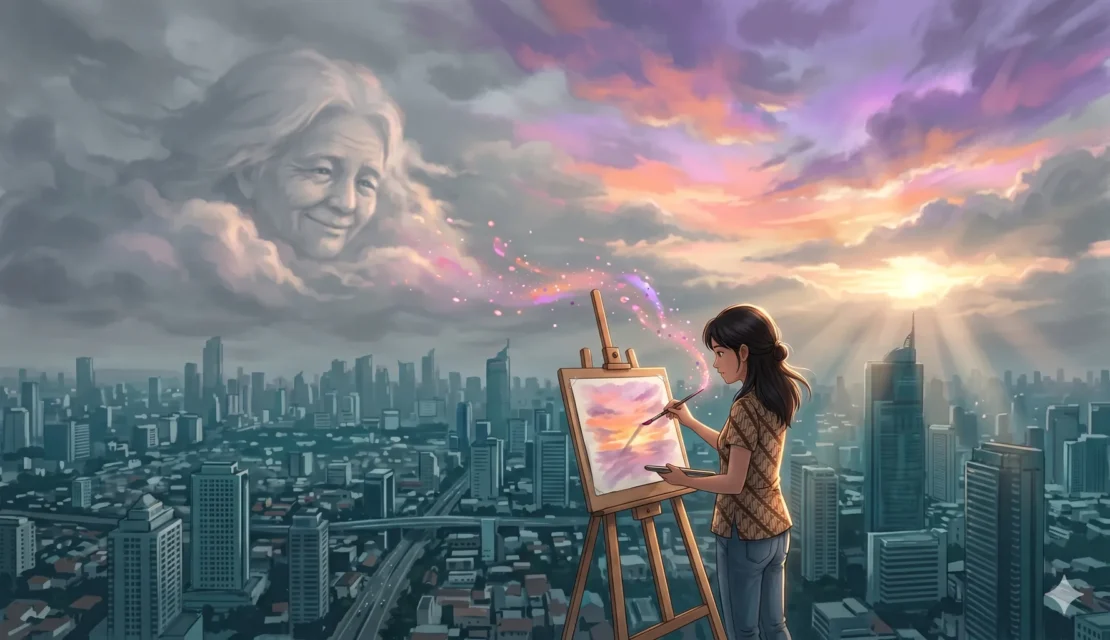
Ayu lived on the thirty-second floor of a shiny glass tower in the center of Jakarta. Her apartment was so high that clouds sometimes floated past her bedroom window like shy visitors. Most mornings, the sky was gray with pollution, and Ayu missed the blue skies she’d seen in her grandmother’s village in Central Java. “Why is the sky always sad here?” she asked her father one morning.
He looked up from his coffee and sighed. “Too many cars, too many factories, too much smoke,” he said gently. “The sky can’t breathe properly.” Ayu stared at the gray clouds pressing against her window and made a decision. If the sky couldn’t fix itself, she would help.
Ayu loved painting more than anything. Her bedroom walls were covered with watercolors she’d made, bright sunsets, green forests, blue oceans. That evening, she took her paints to the building’s rooftop observation deck. She set up her little easel facing the gray sky and began painting the most beautiful sunset she could imagine. Golden oranges, deep purples, soft pinks, all swirling together on her canvas.
As she painted, something peculiar happened. A gentle breeze picked up the colors from her brush and carried them upward, like tiny butterflies made of light. The paint particles drifted into the gray clouds and dissolved. Where they landed, the clouds blushed with color. A streak of orange appeared above the building across the street. A smudge of pink decorated the cloud near the television tower. It was faint, barely noticeable, but Ayu saw it clearly.
She painted every evening after that. Every sunset, she’d climb to the rooftop with her paints and add color to Jakarta’s sky. Some nights, only tiny patches of color appeared. Other nights, when her paintings were especially beautiful, the entire western sky would glow with impossible colors that made people stop on the streets below and look up in wonder.
Social media went wild. “Jakarta’s mysterious sunset phenomenon” trended for weeks. Scientists couldn’t explain it. Weather experts argued about atmospheric conditions. Nobody suspected a seven-year-old girl with a watercolor set.
But the colors attracted attention from the sky itself. One evening, as Ayu painted a particularly vivid shade of violet, a cloud descended and settled on the rooftop railing like a fluffy white cat. It pulsed gently, and a face formed in its surface, old and kind and made entirely of mist.
“I am Awan,” the cloud said in a voice that sounded like distant thunder wrapped in cotton. “I am the oldest cloud above Jakarta. Your paintings have been feeding us. We clouds eat color, you see. And we’ve been starving for years because the pollution blocks the sunset’s natural colors from reaching us.”
Ayu’s mouth fell open. “Clouds eat color?”
“How do you think we make rainbows?” Awan chuckled, and tiny raindrops scattered from his misty cheeks. “We need the sunset’s colors to stay alive. But the gray pollution has been blocking our food. Your paintings are the first real color we’ve tasted in decades.”
Ayu felt both proud and heartbroken. “What can I do?” she asked. “I’m just one girl with a paint set.”
Awan smiled wisely. “You’ve already done something remarkable. You noticed. You cared. And you acted. But if you truly want to help us, teach others to notice the sky. When people look up, they start caring. When they care, they change.”
Ayu began teaching art classes on the rooftop for neighborhood children. She taught them to paint skies, to notice clouds, to appreciate the colors of dawn and dusk. Those children went home and told their parents to look up. Parents started noticing the pollution differently. They started choosing to walk instead of drive sometimes. They started talking about clean air at community meetings.
The changes were small at first, like Ayu’s first faint streaks of color in the clouds. But small changes gathered strength, just like small clouds gather into rain. Within a year, her building’s community had launched a tree-planting initiative. Within two years, three nearby buildings had joined. The sky above their neighborhood grew incrementally bluer, not because of magic paint, but because people had finally started looking up.
Ayu still paints on the rooftop every evening. And sometimes, if you look carefully at Jakarta’s sunset, you can see colors that seem just a little too beautiful to be natural. Those are Ayu’s colors, feeding the clouds and reminding everyone that even the grayest sky holds the memory of blue.
The moral: When you notice what others ignore and act on what you see, you become a force for change. One paintbrush can inspire a whole community to look up and dream of bluer skies.
6. Farid and the Elevator That Traveled Through Time
Farid lived in an old apartment building that his grandfather had built forty years ago. While all the buildings around it had been demolished and replaced with gleaming towers, Farid’s building remained standing, stubborn and proud, with its cracked tiles and creaky elevator. Everyone wanted it torn down. The developer next door offered Farid’s family lots of money. “It’s just an old building,” people said. But Farid’s grandmother refused to sell. “This building has a heart,” she insisted.
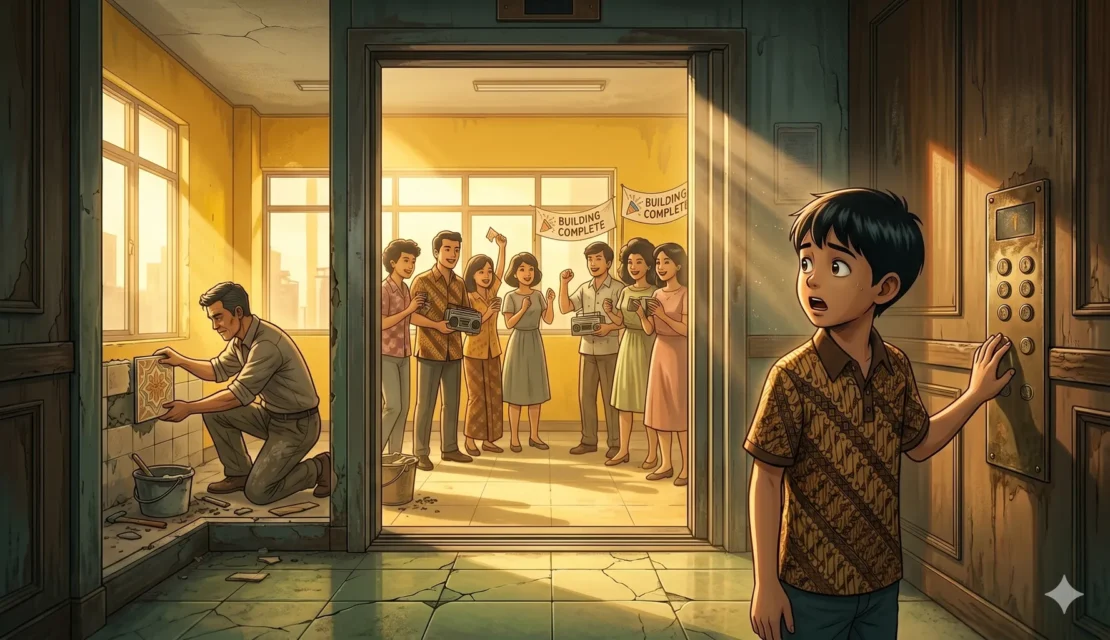
One afternoon, Farid stepped into the old elevator and pressed the button for the fifth floor. The elevator groaned, shuddered, and instead of going up, it seemed to go sideways. The number display flickered wildly: 5, 12, 3, 47, and then numbers that didn’t make sense at all. When the doors opened, Farid wasn’t on the fifth floor.
He was standing in the same building, but it looked brand new. The tiles gleamed. The walls were freshly painted bright yellow. And standing in front of him was a young man who looked exactly like the photographs of his grandfather as a young person.
“Welcome!” the young man said cheerfully. “I’m Hasan. I just finished building this place. First resident moves in tomorrow!” Farid realized with shock that he’d traveled back in time to the day his grandfather’s building was completed. Everything smelled of fresh paint and new beginnings.
Hasan gave Farid a tour, not knowing he was guiding his own grandson through the building that would become their family’s legacy. Farid saw the lobby where his grandmother would later put her favorite orchids. He saw the rooftop where his father would propose to his mother. He saw the courtyard where he himself would learn to ride a bicycle.
“Why did you build this?” Farid asked. Hasan’s eyes brightened. “Because everyone deserves a home that feels like family. Not just walls and floors, but a place where people know each other’s names, share meals, and watch each other’s children grow.”
The elevator dinged, and Farid stepped back inside. This time, the doors opened on a different era. The building was about fifteen years old now. He saw families celebrating Independence Day in the courtyard with flags and food. Children, including a young boy who looked like his father, played soccer in the parking area. Neighbors shared plates of food from apartment to apartment. The building was alive with love and connection.
The elevator took him to another time. The building was older now, paint peeling. Some apartments were empty. The courtyard was quiet. An elderly woman sat alone on a bench, and Farid recognized her immediately as his grandmother, younger than he knew her but carrying the same gentle sadness. The neighborhood was changing around her. New towers cast shadows over the old building. The developer’s offers came more frequently.
One more trip in the elevator, and Farid was back in present day. He stepped out with tears running down his cheeks. He found his grandmother in her apartment, watering her orchids as always.
“Nenek,” he said, “I understand now why you won’t sell the building.”
She looked at him curiously. “And why is that?”
“Because it’s not just a building. It’s a storybook. Every wall holds a memory. Every floor holds a family’s history. If we tear it down, we lose all those stories forever.”
His grandmother pulled him into a hug. “You’re the first person who truly understands,” she whispered.
Farid started a project that weekend. He interviewed every current and former resident of the building, collecting their stories, photographs, and memories. He created a beautiful book about the building’s history and presented it at the neighborhood meeting where the developer was pushing hardest for demolition.
By the time he finished reading the stories aloud, half the room was crying. The developer quietly withdrew his offer. The building was later designated a heritage site, protected from demolition. Farid’s family still lives there, and every new resident receives a copy of the storybook on their first day.
The old elevator still creaks and groans. Farid sometimes wonders if it actually traveled through time or if he simply dreamed it all. But every time the elevator shudders between floors, he pats the wall gently and whispers, “Thank you for showing me.”
The moral: Old things carry stories that new things can never replace. When we preserve our history, we preserve the love and connection that built our communities.
7. Sari and the Night Market of Invisible Kindnesses
Sari was a quiet girl who noticed things that other people missed. She noticed when her teacher looked tired but still smiled. She noticed when the security guard at school saved the best parking spot for the elderly neighbor. She noticed when the ojek driver waited an extra minute in the rain for his passenger to find an umbrella. Small, invisible acts of kindness that nobody celebrated or even acknowledged, and Sari saw them all.
One Friday evening, Sari’s mother took her to the night market near their home. The pasar malam was bursting with light, noise, and the irresistible smell of grilled satay. While her mother haggled over the price of mangoes, Sari wandered between stalls and spotted something unusual at the very end of the market.
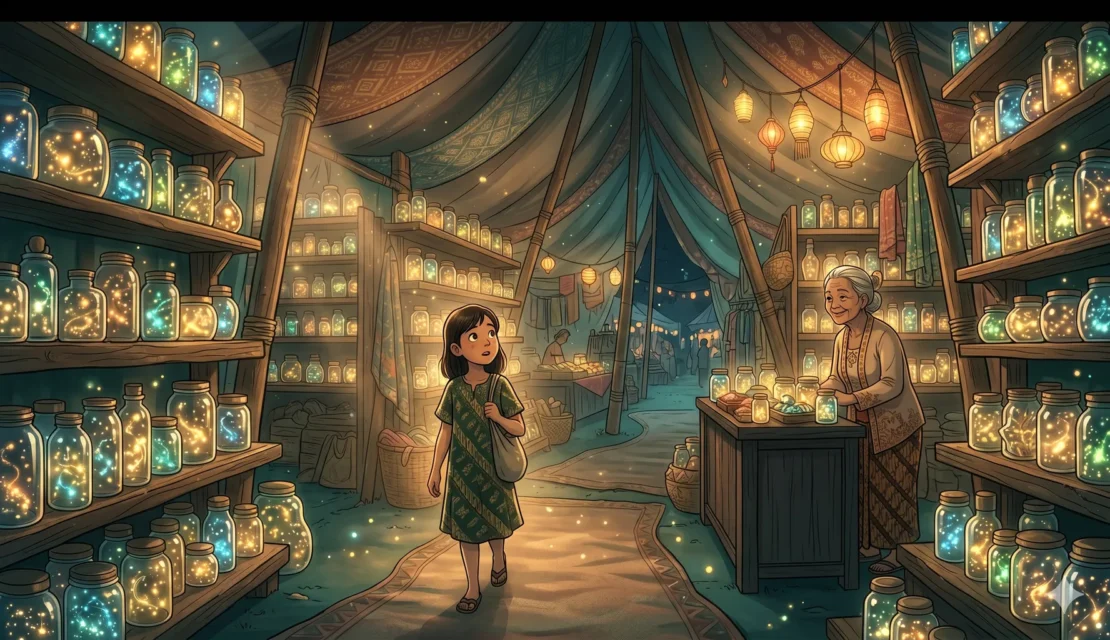
A small, tattered tent stood where she’d never noticed one before. A hand-painted sign read: “Pasar Kebaikan: The Kindness Market. Open only to those who can see.” Sari pushed through the fabric doorway and found herself in an impossible space.
The tent was bigger on the inside than the outside, stretching into a vast, beautiful marketplace lit by floating lanterns. Instead of food and clothing, the stalls sold something entirely different. Glass jars of every size lined the shelves, and inside each jar glowed a tiny, colorful light. Some were warm gold, others soft blue, a few sparkled green or pink.
“Each light is an act of kindness that nobody saw,” explained the stall keeper, a smiling woman with silver hair and kind eyes. “I collect them before they fade away. That golden one? A father who woke up early to make his daughter’s favorite breakfast. The blue one? A child who shared her last cookie with a crying friend. The green one? A stranger who picked up trash from the river when nobody was watching.”
Sari walked through the market in wonder. Thousands of glowing jars lined hundreds of stalls. Every jar contained someone’s quiet, unseen kindness. Tears formed in her eyes as she realized how much goodness existed in the world that nobody ever talked about.
“Why do you collect them?” Sari asked.
“Because kindness that goes unnoticed doesn’t disappear,” the woman said. “It becomes part of the invisible fabric that holds communities together. But sometimes people stop being kind because they think nobody notices or cares. That’s why I need someone to help me.”
“Help you how?”
“I need someone who can see what others miss. Someone who notices the small kindnesses and tells people that they matter. When you acknowledge someone’s quiet kindness, the light grows brighter. It multiplies. It inspires others to be kind too.”
Sari accepted the mission without hesitation. From that night on, she made it her purpose to notice and acknowledge kindness wherever she found it. She told her teacher, “I noticed you stayed late to help that student. That was really kind.” The teacher’s eyes filled with grateful tears. She told the security guard, “I saw you save that parking spot for Pak Hendra. That’s so thoughtful.” The guard stood a little taller and smiled all day.
She started a “Kindness Spotting” journal at school. Every day, children wrote down kind things they noticed others doing. The journal filled up within a week. Teachers reported that bullying decreased. Children started being kinder, not because they wanted to be noticed, but because they realized that kindness was happening all around them and they wanted to be part of it.
The invisible became visible. The quiet became celebrated. And every Friday night, Sari visited the Kindness Market. The stall keeper always greeted her with the same words: “The jars are glowing brighter than ever, thanks to you.”
One evening, Sari asked, “Will the Kindness Market always be here?”
The woman smiled and adjusted a glowing jar on her shelf. “The market will be here as long as there are people who choose to notice. The moment everyone starts seeing the kindness around them, I won’t need this tent anymore. The whole world will become a Kindness Market.”
Sari keeps spotting kindness every day. She’s taught her friends, her family, and now her own younger siblings to look for it too. And if you visit the pasar malam near Sari’s neighborhood, walk to the very last row of stalls. You might just find a small, tattered tent that’s bigger on the inside. But only if you can see what others miss.
The moral: The world is full of invisible kindness. When you notice it and celebrate it, you multiply it. Being a kindness spotter might be the most important job in the world.
Why Modern Fairy Tales Matter for Your Child’s Growth
These modern fairy tales do more than entertain your children at bedtime. They teach critical thinking, empathy, environmental awareness, and creative problem-solving. Unlike traditional stories where magic solves everything, these tales show children that their intelligence and kindness are the real superpowers. Each story connects to challenges your child actually faces in urban life, from traffic to pollution to building community in busy cities.
Reading and sharing stories with your children strengthens bonds and develops language skills naturally. At Apple Tree Pre-School BSD, storytelling forms a central part of our programs because we’ve witnessed how stories shape confident, compassionate, and curious learners. We encourage families to make storytelling part of their daily routines. These modern fairy tales are a perfect place to start.
Want to nurture your child’s love of stories and learning in a warm, creative environment? Chat with us on WhatsApp or call us at +62 888-1800-900 to discover how Apple Tree Pre-School BSD helps children grow smart and happy through the magic of storytelling, play, and exploration.
Come play and learn with other children, because every child deserves their own fairy tale adventure! 📚✨🌟





Be the first to write a comment.