

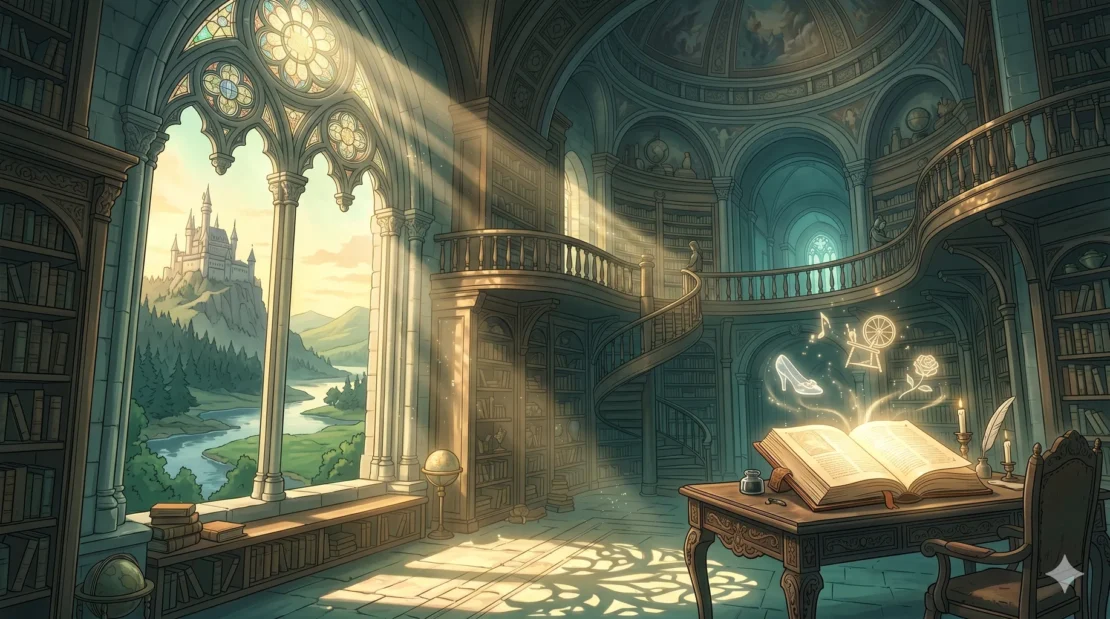
Ask any parent what stories they remember from childhood, and nine times out of ten, a classic fairy tale is the first thing that surfaces. Not a textbook. Not a worksheet. A story. Cinderella losing her slipper. A girl in a red hood making her way through the woods. A sleeping princess in a tower. These classic fairy tales have been told for hundreds of years, passed from grandmother to mother to child to grandchild, and they are still being read tonight in living rooms and bedrooms all over the world.
There is a reason for that staying power, and it goes well beyond nostalgia. At Apple Tree Preschool BSD, we revisit classic fairy tales regularly because they do something quietly extraordinary for young children. They introduce big emotions in safe, symbolic containers. They show that courage, kindness, and perseverance matter. And they do all of this while being genuinely, irresistibly enjoyable to read aloud.
Here are 8 beloved classic fairy tales, each retold in full and fresh for your family to enjoy tonight.
8 Classic Fairy Tales Retold With Heart and Wonder
From enchanted slippers and sleeping princesses to clever youngest sons and golden-haired girls, these timeless fairy tale stories, beloved children’s classics, and traditional bedtime tales carry the magic that never fades.
1. Cinderella

In a house that had once been full of warmth, there lived a girl named Ella who had lost her mother young and her father not long after, leaving her in the care of a stepmother and two stepsisters who had, between the three of them, a remarkable talent for making themselves comfortable at other people’s expense.
Ella did the cooking. She carried the water. She scrubbed the floors and tended the fire and mended the clothes and did all the invisible labour that kept a household running while those who benefited from it sat in the good chairs and complained that the fire wasn’t warm enough.
She was not bitter about this, which was either a sign of extraordinary character or the kind of patience that comes from having decided that the people making your life difficult are simply not worth the emotional energy of resentment. Either way, she went about her days with a quiet steadiness that the household mistook for contentment and that was, in fact, something rather more dignified.
When the invitation arrived from the palace for a royal ball, the stepsisters descended into preparations that consumed the entire house for a fortnight. New dresses. New shoes. New hair arrangements, three of them rejected before a fourth was settled on. Ella was expected to assist with all of this while receiving, in return, a very clear message that she would not be attending.
She had accepted this, because accepting it was the practical option, when something in the garden shifted.
An old woman appeared at the back gate. She was small and bright-eyed and she carried a walking stick she clearly didn’t need, and when she looked at Ella it was with the particular attention of someone who has been watching for a while and has formed decided opinions.
“You should go to the ball,” the old woman said.
“I have nothing to wear,” said Ella.
“That,” said the old woman pleasantly, “is a logistics problem, not an actual problem.”
What followed involved a pumpkin, six mice, two lizards, and a dress that Ella would later be unable to describe in any detail because its perfection had overwhelmed her ability to observe it objectively. The shoes were made of glass, which was impractical but undeniably beautiful.
“Be home by midnight,” said the old woman. “The magic has a curfew.”
At the ball, the prince danced with her twice and then a third time, which everyone noticed. At midnight she ran. One glass slipper stayed on the step because running in glass shoes was, it turned out, the one design flaw nobody had thought through properly.
The prince found her, as stories require. The slipper fit, as stories insist. The stepmother’s expression at that particular moment was, by all accounts, worth the entire preceding decade of inconvenience.
They were married in spring. Ella was not vindictive about her past, which the stepmother found more unsettling than punishment would have been.
Moral: Kindness and grace are not weaknesses. They are the things that make you the person a story wants to find its way back to.
2. Snow White
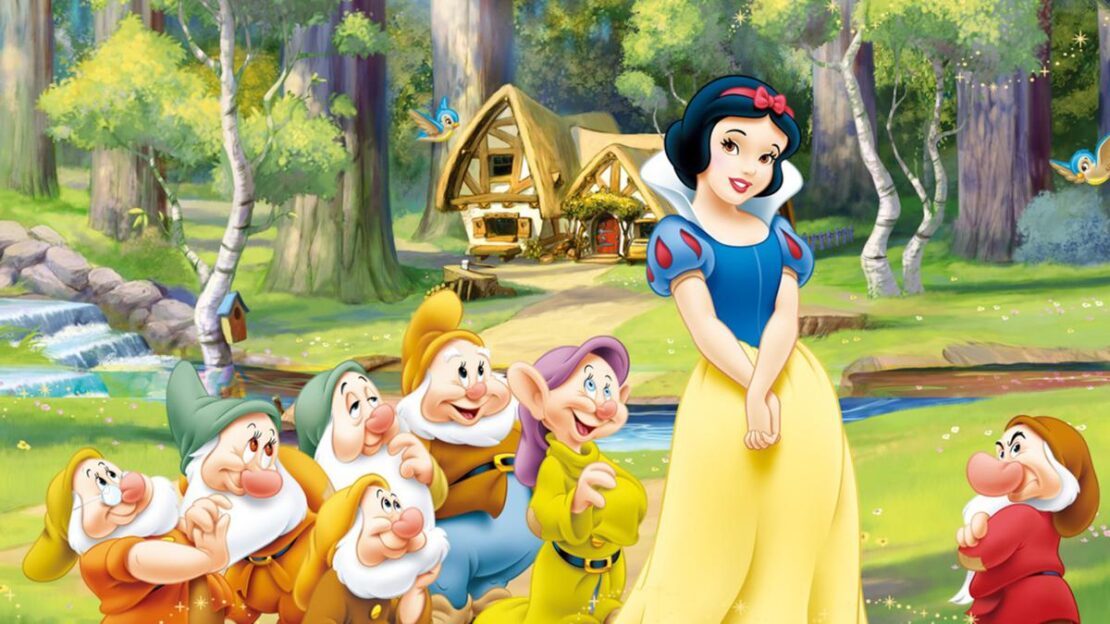
In a kingdom where the mountains were always white-capped and the forests were deep and full of old things, a queen looked out her window at the falling snow and wished, very specifically, for a daughter with skin as white as snow, lips as red as blood, and hair as black as the ebony frame of the window she was looking through. The wish was granted with the precision that wishes sometimes carry, and the baby was named Snow White, and the queen died not long after, which is the part of this classic fairy tale that the illustrated versions tend to rush past.
The king remarried. His new queen was beautiful in a cold, architectural way, and she possessed a magic mirror that she consulted every morning with the dedication of someone who has tied a considerable portion of their self-worth to a single variable.
“Mirror, mirror on the wall,” she said every day, “who is the fairest of them all?”
For years the mirror said: “You, my queen,” which was the answer she required.
Then Snow White turned seven, and the mirror changed its answer.
The queen’s response to this information was entirely disproportionate and involved a huntsman, a forest, and instructions that the huntsman, to his credit, could not bring himself to carry out. He took Snow White deep into the forest and told her to run and not come back, which was considerably kinder than what he had been asked to do and which Snow White appreciated, even as she ran.
The forest was frightening at first and then less so, because she moved through it with the practical adaptability of someone who has learned to find her footing wherever she finds herself.
She found the cottage. Seven small beds, seven small chairs, everything in miniature, perfectly kept. She cleaned it because she was herself and that was what she did, ate a little, and slept in three beds pushed together because none was quite long enough on its own.
The seven dwarfs came home and were startled and then charmed and then, after some debate that fell along predictable lines between the more cautious and the more hospitable members of the group, agreed that she could stay.
The queen found out, because magic mirrors are comprehensive in their reporting.
Three attempts followed. Two failed. The third, an apple, half red and half poisoned white, was accepted in a moment of lowered guard that Snow White would later consider her only real mistake. She fell. The dwarfs could not wake her. They put her in a glass case in the forest because they loved her and couldn’t bear to bury someone who looked only sleeping.
The prince came riding past, as princes in this forest region apparently did with some frequency. He asked to take her, because there is a particular kind of love that recognises someone even in stillness. The dwarfs agreed. The movement jostled the apple loose. Snow White woke.
The queen, upon receiving this update from the mirror, had a reaction that the story describes as severe and that we will leave at that.
Moral: Envy is its own punishment. And kindness extended freely, to strangers in small cottages, to lost girls in forests, tends to come back around.
3. Sleeping Beauty
A long time ago, in a kingdom that had waited many years for a child, a baby girl was born to great celebration. The king and queen, delighted beyond reasonable expression, threw a christening feast and invited the good fairies of the kingdom to bestow gifts upon the princess. There were thirteen good fairies but only twelve golden plates, and the thirteenth, overlooked in the catering miscalculation, was not invited.
Twelve fairies gave gifts. Beauty. Grace. Wit. Kindness. Music. Dance. The list continued in the manner of people who are given an open brief and a momentous occasion.
Then the thirteenth fairy arrived uninvited and furious and placed a curse: on her fifteenth birthday, the princess would prick her finger on a spindle and die.
The twelfth fairy, who had not yet given her gift, stepped forward. She could not undo the curse entirely, but she could soften it. Death became a deep sleep, to last a hundred years, ended by the kiss of a prince. The king, understandably rattled, had every spindle in the kingdom burned.
For fifteen years it worked.
On the princess’s birthday, while the king and queen were occupied with preparations for a celebration they believed they were in control of, the princess found a tower room, inside it an old woman spinning thread on the only spindle left in the kingdom, and reached out to touch it with the particular certainty of someone walking toward something inevitable.
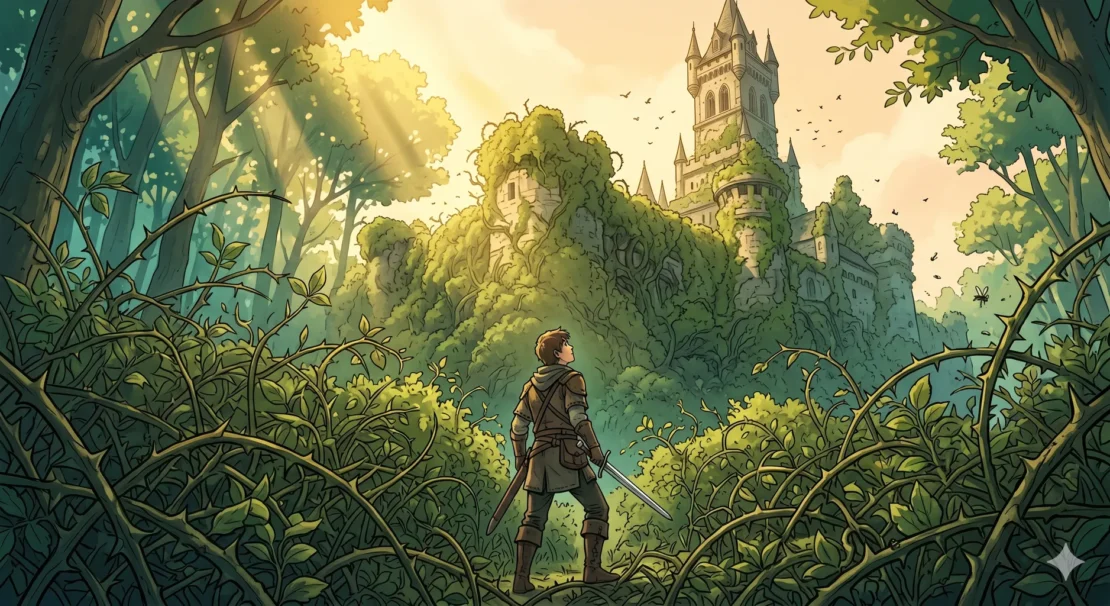
She slept. The whole castle slept with her. The good fairy, unwilling to leave the princess to wake among strangers, saw to that. A forest grew up around the castle, thick and thorned and centuries deep.
One hundred years passed. The forest grew and the world changed and the story became a legend and the legend became the kind of thing people weren’t quite sure was real.
A prince heard it anyway. He went looking not for the adventure of it, though there was that, but from the particular stubbornness of someone who believes in things other people have decided to stop believing in. The forest opened for him, as it was always going to. The castle was exactly as it had been stopped mid-motion for a century, dust-free because the fairy had seen to that too.
He found her. He knew her immediately, which is the part of this classic fairy tale that logic cannot fully account for and that stories have never felt the need to justify. He kissed her. She woke. The castle woke. The kingdom resumed.
The prince introduced himself. The princess, waking from a hundred years of sleep, had a great many questions about the current state of the world.
She asked them all.
Moral: Some things wait for the right moment and the right person. Patience, even the involuntary kind, has its own wisdom.
4. Rapunzel
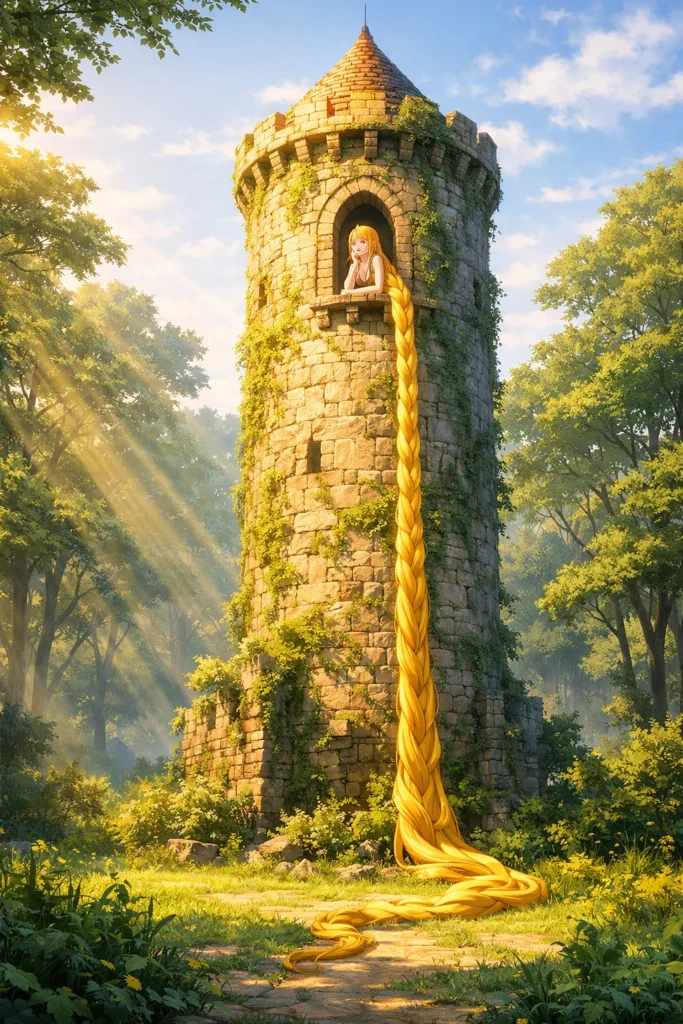
High in a tower in the middle of a forest that appeared on no map and was tended by a woman named Gothel who had specific opinions about the dangers of the outside world, there lived a girl named Rapunzel who had the longest hair anyone had ever seen.
It had started as a practical solution. The tower had no stairs and no door at ground level, and Rapunzel’s hair, which grew with an enthusiasm that defied normal biology, had become Gothel’s means of access. She called from below. Rapunzel lowered her braid. Gothel climbed it. This arrangement had been in place for as long as Rapunzel could remember and she had, until recently, accepted it as simply how life worked.
Recently she had started to notice the window.
From the window, especially on clear mornings, she could see the edge of the forest. On particularly clear days she thought she could see something beyond it, a glint of what might be buildings, a thread of smoke from a fire that someone lit and tended every morning. She had begun to understand, in the way that people understand things they aren’t ready to act on yet, that there was a great deal she didn’t know about.
Gothel brought her books. She brought her needlework and painting supplies and a lute that Rapunzel had taught herself to play with some proficiency. She brought her everything except the one thing Rapunzel actually wanted, which was the answer to what was out there.
A prince, travelling alone and off any sensible route, heard singing coming from a tower that had no door. He had been enough places and heard enough things to know that a singing voice of that quality deserved investigation. He watched. He saw Gothel. He noted the hair. He waited until Gothel left and tried it himself.
“Rapunzel,” he called, feeling slightly foolish, “let down your hair.”
There was a pause.
Then the braid came down.
He climbed. She was startled, because her visitor count had previously been exactly one. He was startled by how someone could be so simultaneously isolated and so entirely themselves.
They talked. He came back the next day. And the day after. They made plans that Gothel eventually discovered, because people who control others are exceptionally attentive to changes in their behaviour.
The ending involved a cut braid, a wilderness, a prince’s temporary blindness, and a reunion that was both long overdue and entirely worth the difficulty of getting there.
Moral: You cannot keep a curious mind in a tower forever. The window is always there, and eventually, someone starts looking through it.
5. The Little Mermaid

In the kingdom beneath the sea, where light filtered down in long blue columns and the gardens were made of coral and waving sea grass, the youngest daughter of the sea king was known for two things: the beauty of her voice and the intensity of her curiosity about the world above the surface.
She had five older sisters, all beautiful and accomplished in the manner of royal daughters, and all of them had visited the surface on their sixteenth birthdays and returned with stories about ships and sunsets and the smell of salt air from above rather than below. They told their stories and were satisfied and went back to their underwater lives with the uncomplicated contentment of people who have seen enough to feel complete.
The youngest mermaid listened to every story and became, if anything, more curious rather than less.
On her own sixteenth birthday she rose to the surface and saw a ship and on the ship a prince celebrating his birthday and in the prince something she had no framework to understand and couldn’t stop looking at. A storm came. The prince went overboard. She saved him, pulling him to shore while he was unconscious, sitting with him until she heard voices coming and slipping back into the water before he opened his eyes.
She went to the sea witch with a specific and costly request. The witch could give her legs in place of a tail, and with legs she could go to the surface and find him. The price was her voice, the most extraordinary thing she owned, paid for a chance that came with no guarantees. Every step on her new feet would feel like walking on sharp blades.
She agreed.
She went. He was kind to her, because she was clearly extraordinary and beautiful and he felt drawn to her in ways he put down to mystery. He introduced her to his court. He told her about the girl who had found him on the beach, whom he thought of as the one who had saved him.
She had been that girl. She had no voice to tell him.
He married someone else.
The original ending of this classic fairy tale is harder than the version most of us were told. But what remains is the image of a girl who chose love over safety and who paid a real price for the chance to try. Whether that was foolish or magnificent is a question each reader has to answer for themselves.
Moral: Loving something deeply enough to sacrifice for it is both the most beautiful and most dangerous thing a heart can do. Know what you are trading, and choose consciously.
6. Beauty and the Beast
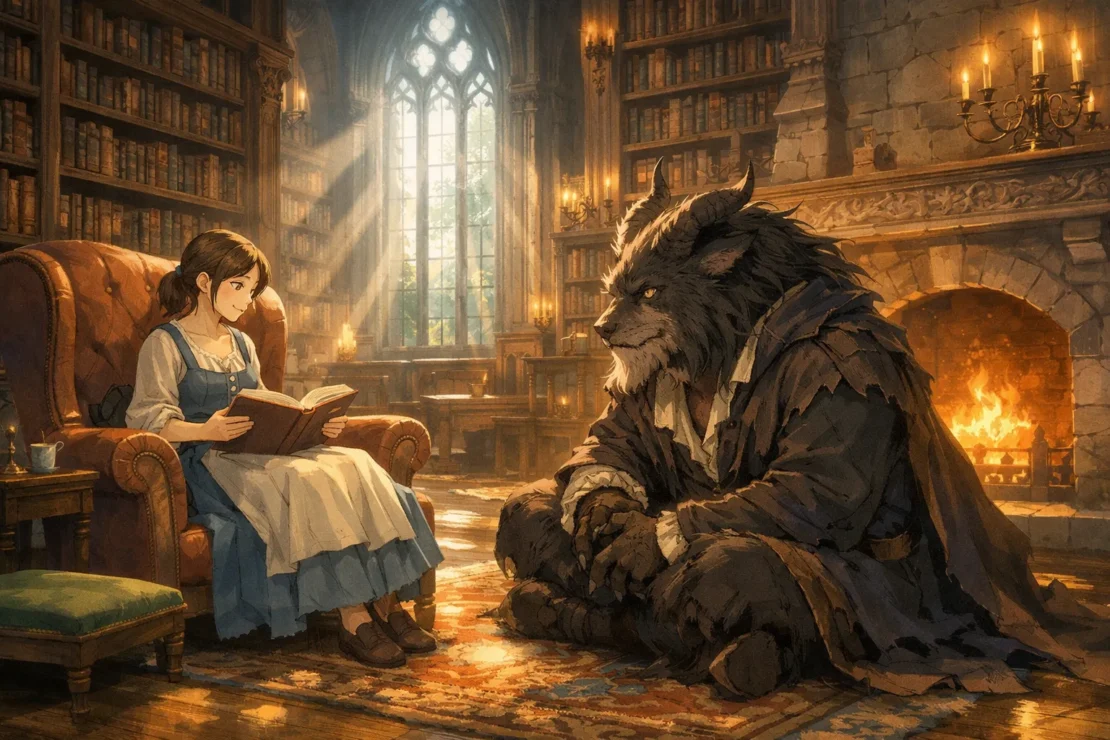
There was a merchant who had known better days, and among his children a youngest daughter named Belle who was known in the town for her reading habits and her tendency to find the ordinary world slightly less absorbing than the worlds inside her books. This was not a criticism. She was kind and practical and entirely capable in everything she put her hand to. She simply also had an interior life of considerable depth, which smaller towns sometimes struggle to accommodate.
When the merchant lost his fortune and then, searching for a way to recover it, stumbled into the castle of the Beast, the transaction that followed was not one he had planned or wanted. He had taken a rose from the castle garden for Belle. The Beast had appeared. The debt: the merchant’s life or the life of one of his daughters.
Belle came herself. Not sent. Not asked, after the full story was explained. She simply decided that her father’s life was not something she was prepared to accept in exchange for her freedom, and she went.
The castle was strange and the Beast was stranger, enormous and fierce-looking and burdened in ways she would come to understand gradually. But he was also honest in a way she hadn’t expected, and curious in a way that matched her own curiosity, and the library he showed her on the third day settled something in her chest that she didn’t entirely understand but recognised.
They talked every evening. He asked her questions that assumed she had thoughts worth hearing, which she appreciated more than she showed. She answered honestly, including on the evenings when honest meant difficult.
He asked her to marry him regularly, because asking was the only honest thing he could do. She said no with equal honesty, because she wasn’t there yet and she wouldn’t say something she didn’t mean.
She went home to her father and stayed past the promised time, because her family needed her and she trusted that the Beast understood the difference between choosing to leave and choosing not to return. She was right to trust this, which is the part of the story that mattered most.
She came back because she wanted to. He was dying because he had believed she wouldn’t. She told him what she felt. The curse broke. He was, underneath it all, exactly who he had been during the evenings in the library, which was the version of him she had fallen for.
Moral: Real love grows in the space between honest conversations. It recognises character before it notices anything else.
7. Jack and the Beanstalk
Jack was, by most objective assessments, not the most practically-minded boy in the village. His mother would have put it more directly, and often did. But what Jack had, in quantities that more than compensated for practical gaps, was the kind of instinctive, slightly reckless openness to possibility that makes for either very good or very terrible outcomes depending on the day.
On the particular day in question, his mother had sent him to sell their cow, Milky White, because they had run out of options and the cow was their last remaining asset of value. Jack set off with good intentions, which is always how these things begin.
He met a man with beans.
The man said they were magic beans. Jack, operating on the instinct that had served him variably throughout his young life, traded the cow for five beans and went home.
His mother’s reaction was not positive. The beans went out the window. Jack went to bed without supper, which he accepted as a fair consequence even if he privately still felt the beans had been correctly identified as magical.
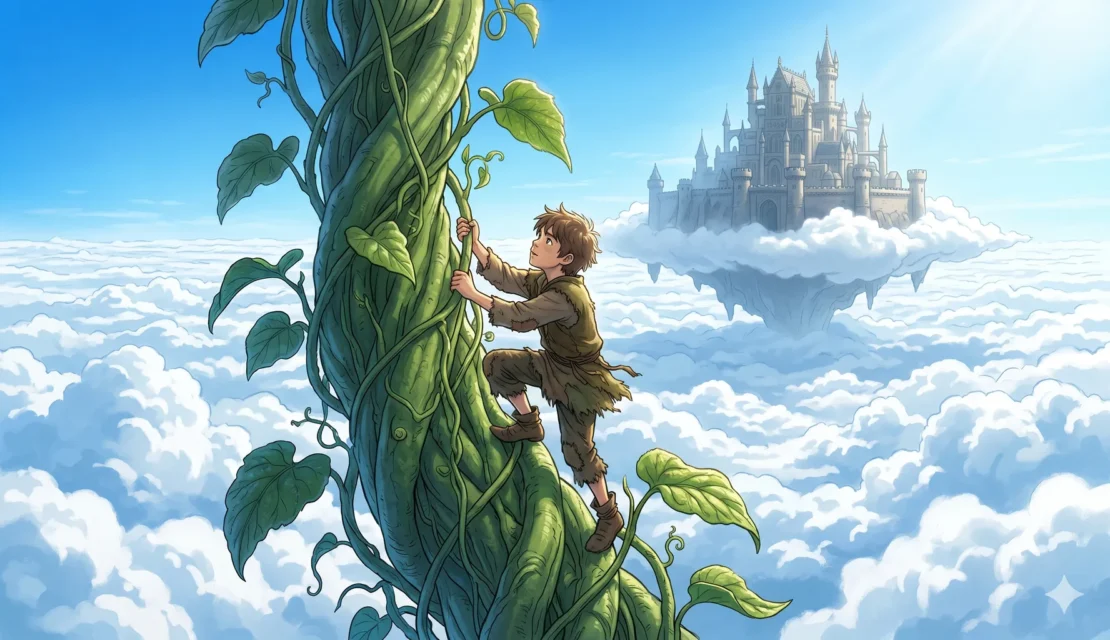
In the morning the beanstalk had grown from the garden to the clouds, which was the kind of evidence that tends to settle arguments retroactively.
Jack climbed it.
At the top was a land of giants, specifically the household of one giant and his wife, who was considerably more hospitable than her husband. The giant, Jack learned on his first visit, possessed a bag of gold coins that replenished itself. On his second visit he discovered a hen that laid golden eggs. On his third, a golden harp that played by itself and sang in a voice like water over stones.
The giant’s refrain on noticing small humans in his vicinity was consistent: “Fee fi fo fum.” His wife’s method of hiding Jack was a large oven, which was only marginally reassuring.
Jack took the coins on visit one. The hen on visit two. The harp on visit three, which made the loudest objection and woke the giant, and the final descent of the beanstalk was conducted at a speed that Jack later described as educational.
His mother had the axe ready by the time he reached the bottom, because she had learned from prior experience to be prepared for fast-moving consequences. The beanstalk came down. The giant did not survive the fall. The hen continued to lay golden eggs. The harp played on the kitchen table and made the house considerably more cheerful.
Jack became, with resources and the particular education that comes from having climbed something enormous and come back down, rather more practical than he had been before.
Moral: Boldness without wisdom is expensive. But boldness paired with learning from each adventure is how ordinary boys change the story entirely.
8. The Three Little Pigs
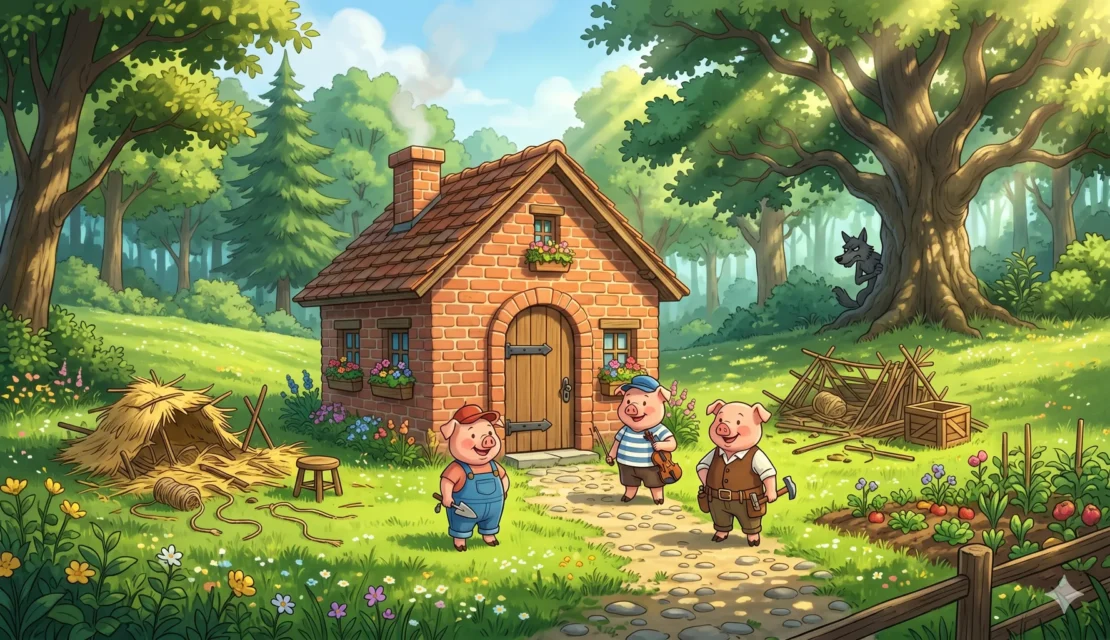
Three pigs went out into the world to build their houses and make their lives, which is a story that begins with the most ordinary kind of independence and arrives, via one very persistent wolf, at a lesson that has proven genuinely durable across centuries.
The first pig, who approached the project with the enthusiasm of someone whose goal was to finish quickly and move on to other things, built his house of straw. It went up fast. He was done by Tuesday afternoon and had the rest of the week free, which he considered the whole point.
The second pig was somewhat more considered. He chose sticks, which took longer than straw and held together better, though not, as it turned out, by the margin he had hoped. He was done by Thursday and felt reasonably good about the result.
The third pig was the kind of person who makes the first two feel slightly defensive simply by taking things seriously. He chose bricks. He planned carefully. He worked steadily. He was not done until the following week, and the process was not fast or easy or comfortable, and he went to bed each night with sore hands and the particular satisfaction of someone building something that will actually stand.
The wolf arrived with a proposal involving a considerable amount of lung capacity and a willingness to use it.
The straw house went first, on the first breath. The pig ran to his brother’s stick house, which the wolf reached the same afternoon. Two huffs. Three puffs. The stick house came down. Both pigs ran to the brick house, arriving breathless and slightly chastened at the door.
The wolf huffed. He puffed. The brick house was unmoved.
He tried the chimney, which was the kind of decision that seems reasonable in principle and plays out poorly in practice. There was a large pot of boiling water waiting at the bottom, placed there by a third pig who had done enough planning to anticipate most contingencies.
The wolf departed at considerable speed and was not seen again.
The three pigs lived together in the brick house, and the first two, having had the full educational experience of watching their housing decisions play out in real time, became meaningfully more interested in construction quality for all future projects.
Moral: The work that takes longest is usually the work that lasts. There is no shortcut to something solid.
Why Classic Fairy Tales Still Belong in Every Childhood
In a world of streaming services, interactive apps, and content designed to capture attention in thirty-second increments, the classic fairy tale is still sitting on the shelf, patient and unhurried, waiting to be picked up. And when it is picked up, it still does what it has always done. It pulls children in completely, holds them there, and leaves something behind.
Classic Fairy Tales Give Emotions a Safe Place to Live
The reason children are drawn to these timeless stories is the same reason they have always been drawn to them. Fairy tales don’t pretend the world is without danger or difficulty or unfairness. They acknowledge all of it, the jealous stepmother, the wolf at the door, the curse that cannot be undone, and then they show a way through it. That is deeply reassuring to a young child who is also navigating a world that doesn’t always feel safe or fair.
These Stories Build the Language of Values
Honesty. Courage. Kindness. Hard work. Loyalty. These are not concepts you can hand to a child in a bullet-pointed list. But a child who has heard Beauty choose to return to the Beast, or watched the third pig’s brick house stand firm while everything else fell, has a felt sense of what these values look like in action. That is how character is built, through story, through repetition, through the slow accumulation of examples.
The Best Learning Happens in a Story
At Apple Tree Preschool BSD, nestled in the Educenter BSD Building, we bring classic fairy tales and all kinds of storytelling into our classrooms because we know what research and every experienced educator has always known. The lessons that land are the ones delivered through narrative. Through our Singapore curriculum, children in our Toddler, Pre-Nursery, Nursery, and Kindergarten programmes engage with language, values, creativity, and emotional intelligence every single day in an environment where learning genuinely feels like something worth showing up for.
The Stories That Made You Are Ready to Make Your Child
Classic fairy tales have survived kings and revolutions and the invention of television and the arrival of the internet, and they are still here, still being read aloud in bedrooms tonight all over the world. That is not an accident. That is a testament to the fact that certain stories carry something true and necessary about being human, and that truth lands the same way in every generation that encounters it.
We hope these 8 classic fairy tales give you something wonderful to share with your little one tonight, and many nights after. And if you would love for your child to spend their days in a place where stories, wonder, and genuine learning go hand in hand every single day, we would love to meet your family.
Register now and come discover the magic of learning with other wonderful children at Apple Tree Preschool BSD! Chat with us on WhatsApp or give us a call at +62 888-1800-900. We cannot wait to welcome your little one!




Be the first to write a comment.