

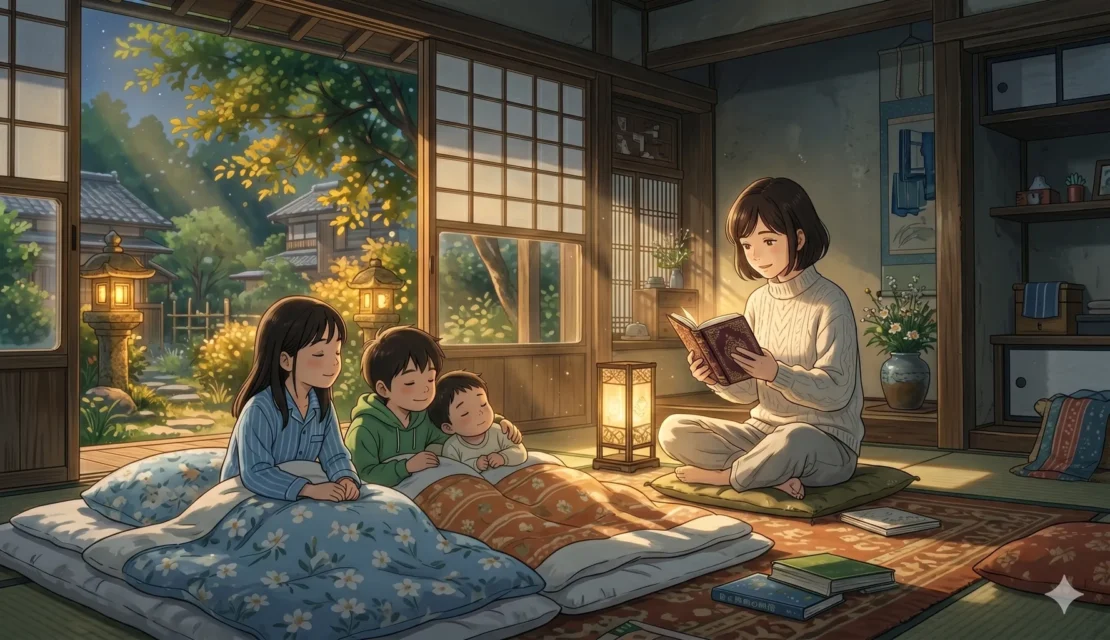
It is 11:47 PM. You are lying in the dark, staring at the ceiling, and your brain has decided that this is the perfect moment to revisit every mildly awkward thing you said in a meeting three years ago. Your to-do list has materialised unbidden in the space behind your eyes. You are tired, genuinely, deeply tired, and yet sleep is doing that thing it does where it stays just slightly out of reach, like a word you can’t quite remember.
If this is a familiar scene, you are in excellent company. Adults all over the world struggle to switch off at night, and the standard advice, put your phone down, dim the lights, breathe deeply, is all perfectly correct and also somehow insufficient when your brain is running at full operational speed at midnight.
Here is what actually works for a lot of people: bedtime stories for adults. Not children’s stories read in an adult voice. Proper, calm, beautifully paced short stories written specifically to slow the mind down, invite the body to relax, and create just enough gentle narrative interest to pull you away from your own thoughts and into somewhere quieter. At Apple Tree Preschool BSD, we know the power of a story told at exactly the right moment. These 9 bedtime stories for adults are written to be that moment for you tonight.
Turn the lights down. Get comfortable. Read slowly.
9 Bedtime Stories for Adults That Slow the World Down to the Right Speed
From slow rainy afternoons and quiet lakeside mornings to warm kitchens and long train journeys through gentle countryside, these calming adult bedtime stories, soothing sleep stories, and relaxing short tales are designed to ease you out of the day and into rest.
1. The Bakery at the End of the Road
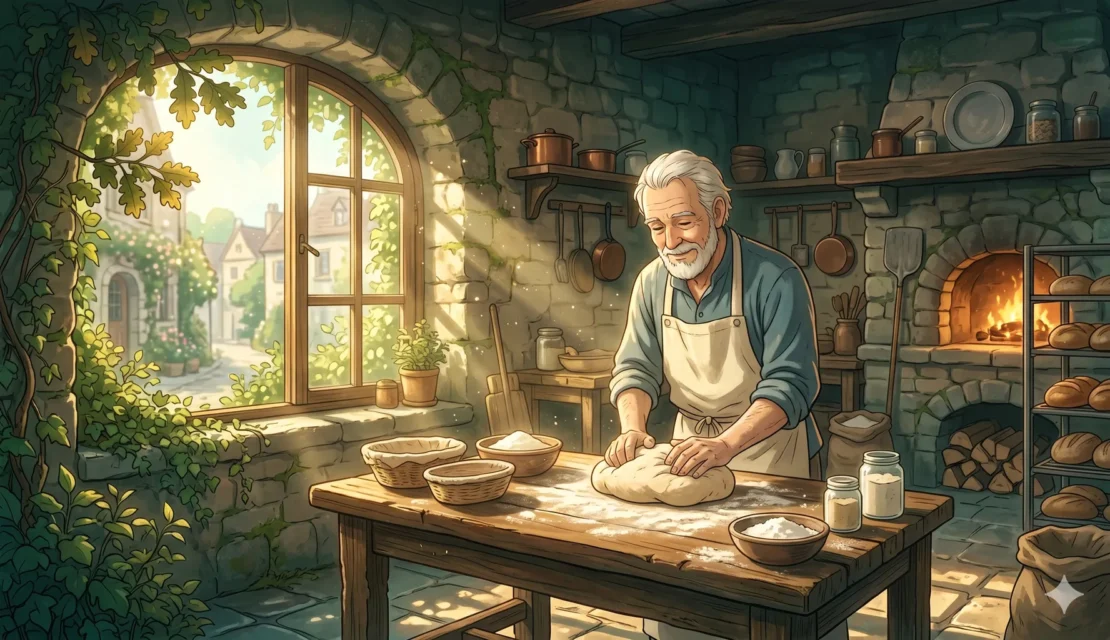
There is a bakery at the end of a cobbled road in a small European town that nobody from outside has ever found by looking for it. You find it only by following your nose at the right hour of the morning, which is the hour just before proper dawn, when the air is still dark and cool and the first suggestion of bread begins to travel outward from the bakery’s stone walls in slow, warm ribbons.
The baker’s name is Josef, and he has been making bread in the same kitchen for thirty-one years. He arrives at two in the morning when the town is entirely asleep, and the first thing he does, before he touches a gram of flour, is make himself a cup of strong coffee and stand at the back door of the bakery for exactly five minutes, watching the sky over the rooftops and thinking about nothing in particular.
He has been doing this for so long that the five minutes of morning quiet has become the most important part of his day. It is the hinge on which the whole thing turns.
Then he begins.
The flour comes first, measured by hand in the way he was taught, the way his mother was taught before him. The yeast is dissolved in water that he tests with his wrist rather than a thermometer, because his wrist has been doing this for three decades and is more reliable. The dough comes together under his hands with the particular satisfaction of something that has been done so many times it has become its own form of meditation.
He shapes each loaf with the same careful attention. Round loaves and long ones, plaited ones and flat ones, each one finished with a small press of his thumb at the base because that is how his mother did it and he has never stopped.
By five in the morning the bakery is full of warmth and the smell has extended considerably down the cobbled road and the first light is coming up over the rooftops and the coffee has been drunk and everything is exactly as it should be.
He puts the first loaves in the oven.
He sits in the wooden chair by the window with his second coffee and watches the street begin to lighten, gradually and without fuss, the way morning arrives in towns that have been waking up the same way for a very long time.
The first customer arrives at six. She is an old woman who buys the same loaf every morning and has done for twenty years. He has it wrapped and waiting before she reaches the counter.
She says: “The usual.”
He says: “Of course.”
They smile at each other in the way of people who have a relationship built entirely of small consistent kindnesses and have never found it necessary to make it more complicated than that.
Breathe slowly. You are in the warm bakery. The bread is in the oven. The morning is arriving gently, exactly on time.
2. The Afternoon on the Lake

The lake is perfectly still this afternoon.
It is the kind of stillness that only arrives on certain days, when the wind has decided to take a rest and the surface of the water becomes a second sky, reflecting clouds so precisely that the boundary between up and down becomes something you’d have to think about carefully if you were trying to explain it to someone.
A man named Thomas has been sitting in a small wooden rowing boat in the middle of this lake since two o’clock. He has not been rowing. He brought a book, which is open on the seat beside him and which he has not read. He brought his phone, which has been face-down in his jacket pocket since shortly after he pushed away from the dock.
He has been doing nothing in the most complete way that he has managed in years.
The boat rocks very gently, the lake producing the smallest possible motion, just enough to remind you that water is alive. The sound it makes against the wooden hull is entirely regular, a soft knock and give, a knock and give, the kind of rhythm that bypasses the thinking part of the brain and speaks directly to something older and deeper.
A heron is standing at the far edge of the lake, absolutely motionless, in the way that herons are motionless, which is different from the way that objects are motionless. There is intent in a heron’s stillness. A quality of presence that Thomas finds himself admiring.
He has nowhere to be until six.
He knows this intellectually, but it takes until about three o’clock for his nervous system to believe it. At three o’clock something releases, not dramatically, but in the way that a hand slowly unclenches after it has been holding something for a long time without noticing.
He closes his eyes.
The boat rocks. The heron waits. The lake reflects the sky.
A fish rises somewhere to his left, breaks the surface with a small clean sound, disappears.
Thomas breathes slowly.
By four o’clock he is asleep in the boat, head tipped slightly to one side, the open book still on the seat beside him, the afternoon light moving warm and amber across the still water in no particular hurry at all.
Let the boat rock you. The water is holding you. There is absolutely nowhere you need to be.
3. The Long Train Journey
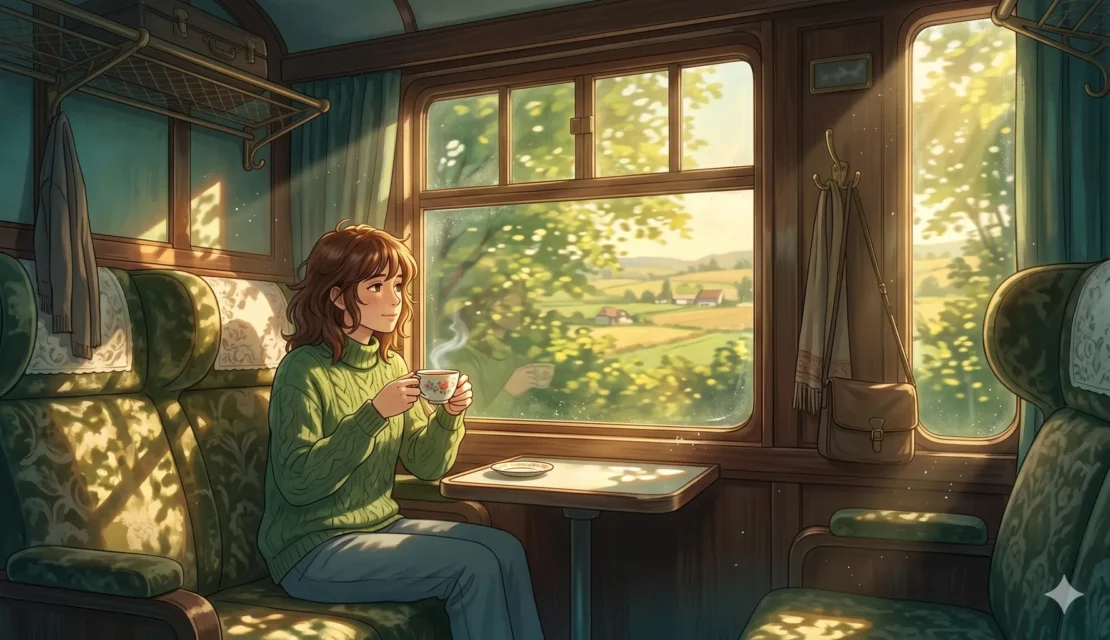
The train left the city at half past four in the afternoon, heading north, and by the time it cleared the suburbs and the landscape opened into fields, the light was already going golden and long.
You have a window seat, which you specifically requested. On the small fold-down table in front of you there is a cup of tea, still steaming. You have a book you may or may not read. You have four hours ahead of you and nothing that requires your attention.
The train moves with a steadiness that no other form of transport quite replicates, a consistent forward progress that is smooth enough to be soothing and present enough to be felt. The rhythm of the rails comes up through the seat, a low, regular pulse, like the heartbeat of something very large and entirely calm.
Outside the window the fields are doing what late-afternoon fields do in autumn, turning soft and amber, the trees at their edges holding the last of their colour in the particular way that makes you feel both the beauty of it and the season turning at the same time, without either being too much.
You watch a farmhouse pass. A barn. A stand of silver birch trees catching the light. A river that appears alongside the track for twenty minutes and then veers away on its own business.
The tea cools in the cup. You wrap your hands around it.
The carriage is quiet. Someone two rows ahead is asleep, their head against the window. A child further back is speaking softly to its mother. The words don’t reach you, just the tone of them, gentle and low and entirely unthreatening.
The train moves on.
The sky outside begins its slow shift from gold to the particular blue-grey that comes between day and dusk, the colour that doesn’t have a satisfying name in English, the colour that means the day is done and the evening is gathering itself.
You rest your head against the window. The glass is cool. The countryside moves past, softly lit, unhurried.
You have three hours left.
You close your eyes.
The train is moving. The fields are passing. You have nowhere to be until you arrive, and arriving is a long, gentle way away.
4. The Library on a Rainy Tuesday
It is raining outside and you are inside the public library and there is genuinely no better arrangement of circumstances.
The library is one of those old civic buildings with high ceilings and wooden floors and windows so tall that the grey sky outside becomes a kind of ambient light that is, despite the rain, entirely beautiful. The heating is on. Not aggressively, just enough to take the edge off the October damp. The air smells of paper and something faintly earthy that old books develop over time and that is one of the more comforting smells that exists.
You have no particular agenda.
You found a chair near the poetry section, a wide armchair with the kind of depth that suggests it has been in this library for decades and intends to remain. You have pulled three books from the shelf without reading the backs of any of them, which is either brave or lazy and you have decided not to determine which.
The rain against the high windows is consistent and unhurried. Not a storm. Just rain, doing its Tuesday afternoon thing, softening the edges of the world outside with a thoroughness that makes the inside feel more inside than usual.
A librarian wheels a trolley of returned books past your aisle with the particular quiet efficiency of librarians, which is a quality that deserves more appreciation than it gets. She glances at you and nods, a small acknowledgement of the silent agreement that exists between everyone who has chosen to be in a library on a rainy afternoon.
You open the first book.
A poem about autumn. Which is appropriate.
Then a poem about walking somewhere by a river. Then a poem about the specific quality of afternoon light in October, which is apparently something poets have been noticing for centuries, and you find yourself thinking that a feeling you have had every year of your adult life has been beautifully articulated by at least twelve different people before you.
That is a comforting thought.
Outside, the rain continues.
Inside, the heating ticks gently.
You turn a page.
You are in the armchair. The rain is on the windows. The poems are there whenever you want them. Rest your eyes.
5. The Garden After the Rain

The rain stopped about forty minutes ago and everything in the garden is still dripping.
You are sitting on the step at the back door with a cup of tea and bare feet on the warm stone, watching the garden recover itself after the afternoon shower. This is, in your estimation, one of the finest things you can do with twenty minutes.
The garden smells extraordinary. That particular after-rain smell, the one with the specific name that a word collector would know, coming up from the soil and the stones and the wet wood of the garden beds. The lavender at the edge of the path is holding drops of water along every stem, each one catching the late light in miniature.
A blackbird has landed on the lawn and is doing the blackbird walk, those quick, purposeful steps across the wet grass, stopping every few metres to tip its head and listen for something underground. It looks like a small, focused professional going about an important business, which it is.
The tomatoes against the south-facing wall are entirely pleased with the rain. You can tell, somehow, the way you can tell when plants have had exactly what they needed. They are deeper green than they were this morning, more upright, more themselves.
A snail has made it onto the path and is moving with the particular unhurried commitment of a creature who was not inconvenienced by the rain in the slightest.
You drink your tea.
The garden drips and settles. The blackbird finds what it was looking for and departs. The last light is doing that thing it does in late afternoon, coming in at an angle that makes ordinary things look as if they deserve to be painted.
A cat from next door appears on the fence, surveying the situation with the compressed dignity of a cat who was indoors during the rain and is now assessing whether conditions have returned to an acceptable standard.
It decides they have and drops into the garden.
Everything is very quiet and very all right.
The garden is settling after the rain. The air is warm and clean. Your tea is in your hands. Breathe it in and let your shoulders drop.
6. The Island with No Clocks

There is an island, small enough to walk across in an afternoon, where there are no clocks. This is not an oversight. It was a decision made, collectively and without particular drama, by the forty or so people who live there, at a meeting held many years ago when someone pointed out that the clocks in the town square and the clock tower and the clocks on every wrist were creating a low, persistent anxiety that the island had never been designed to accommodate.
They put the clocks away. Not threw them away. They are stored, carefully, in a building near the harbour, available to anyone who wants one for any specific reason. Very few people go to get one.
Time on the island is managed by the sun, and by meals, and by the simple biological fact of being tired and being rested, which it turns out is sufficient for most purposes.
You have come to stay for a week. You left your watch in the bedside drawer on the first morning on an impulse and haven’t gone back for it. The first day without it was mildly uncomfortable in the way of missing something habitual. The second day was fine. By the third day you stopped noticing.
Your days have taken on a quality of expansion that is difficult to describe to someone who hasn’t experienced it. The mornings feel longer. The afternoons have a depth to them. The evenings are not an event you’re racing toward as the end point of a day; they are simply the next part of the same long, unhurried thing.
You swim when you want to. You eat when you’re hungry. You read until you’re done reading and then you put the book down and look at the water.
Nobody here asks you what time it is.
On your last evening you sit on the rocks above the harbour and watch the light go out of the sky so slowly that you can observe it happening, which is a thing that is always occurring everywhere and that almost nobody ever notices.
The stars come out one by one.
You stay until the sky is full of them.
There are no clocks on this island. There is only the evening, moving gently, at its own pace, toward night.
7. The Old Bookshop and the Afternoon That Lasted

The bookshop is in a narrow building on a street that has been there longer than anyone can document, and it is the kind of bookshop that you do not visit efficiently.
You came in to look for one specific thing. You will leave, eventually, with three things you didn’t know you were looking for and a comfortable sense of having been somewhere genuinely good. This is the bookshop’s consistent effect on people and the owner, a woman named Constance who has run it for twenty-six years, has stopped trying to explain it and simply accepts it as a property of the space.
The shelves reach the ceiling. There is a wooden ladder on a rail that can be slid along the shelves, and using it is one of the small physical pleasures available to adults that should not be underestimated. The floorboards creak in a way that sounds like the building commenting on your presence, not intrusively, just acknowledgingly.
Constance is at the desk near the back, cataloguing something. She looks up when you come in, nods, and goes back to what she’s doing. The shop has the quality of a place where your company is welcome and your independence is equally welcome, and nobody is going to bother you with offers of assistance that you didn’t request.
You find the section that interests you and lose track of time.
Outside, the afternoon progresses. You are barely aware of it. Somewhere in the middle pages of a book you didn’t come in looking for, you find a passage that says something you have thought but never seen written down, and you stand in the aisle reading it twice and then a third time.
This is the specific thing that bookshops are for.
You stay until the light through the narrow windows shifts to the softer register of late afternoon. Constance puts on the reading lamps, which are warm and amber and very good.
You buy four things. She wraps them in brown paper because that is how things are wrapped in this shop.
You walk out into the cool street with the wrapped books under your arm and feel, unreasonably and correctly, that the afternoon was an excellent one.
You are in the bookshop. The lamps are warm. There is a book in your hands that has something in it for you. Take your time.
8. The Lighthouse Keeper’s Last Autumn
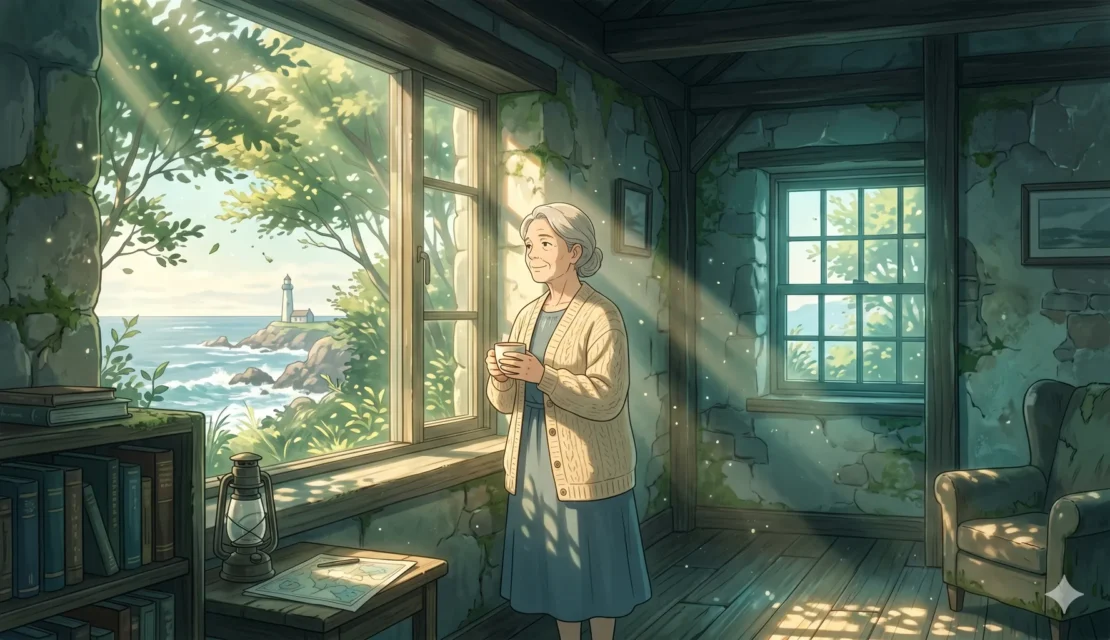
The lighthouse has been retired for six years, which means that the light no longer turns and the foghorn no longer sounds, but the building itself stands exactly as it always has on its rocky headland above the grey northern sea, and the woman who kept it for twenty-two years still lives in the keeper’s cottage at its base because the sea is the thing she is most at home near and leaving it was never seriously considered.
Her name is Agnes. She is sixty-four. Her days have a shape to them that she made herself, which is one of the privileges of a life lived somewhat outside the standard arrangement of things.
She is up before sunrise, which in October means she is up in the dark. She makes coffee and takes it to the window that looks out over the water, and she watches the sea in the dark for twenty minutes in the way of someone who has been having a long relationship with something and finds it requires regular attention.
Then the day begins. She tends a small garden behind the cottage, which is heroic given the wind, and she reads, and she walks the headland path that she has walked so many times her feet know it entirely without her involvement, and she sits sometimes on the bench at the highest point and watches the ships pass on the horizon.
In the evenings she lights a fire, because October on the coast warrants a fire from the first week, and she reads in the chair that has accommodated her evenings for two decades, and she is content in the particular way of people who have arranged their lives around what they actually value rather than what other people think they should value.
Tonight the sea is moderate, long rolling swells coming in from the north, and the sound of it comes up through the cliff and into the cottage walls as a low, sustained vibration that Agnes has always found the most reliable sleeping aid in existence.
She marks her page.
She turns off the reading lamp.
Outside, the sea moves on, as it has every night of her life here, neither knowing nor needing her attention, simply continuing.
The fire is low and warm. The sea is underneath the cottage, steady and enormous and entirely unconcerned. Let it take the weight of your thoughts tonight.
9. The Beekeeper’s Afternoon
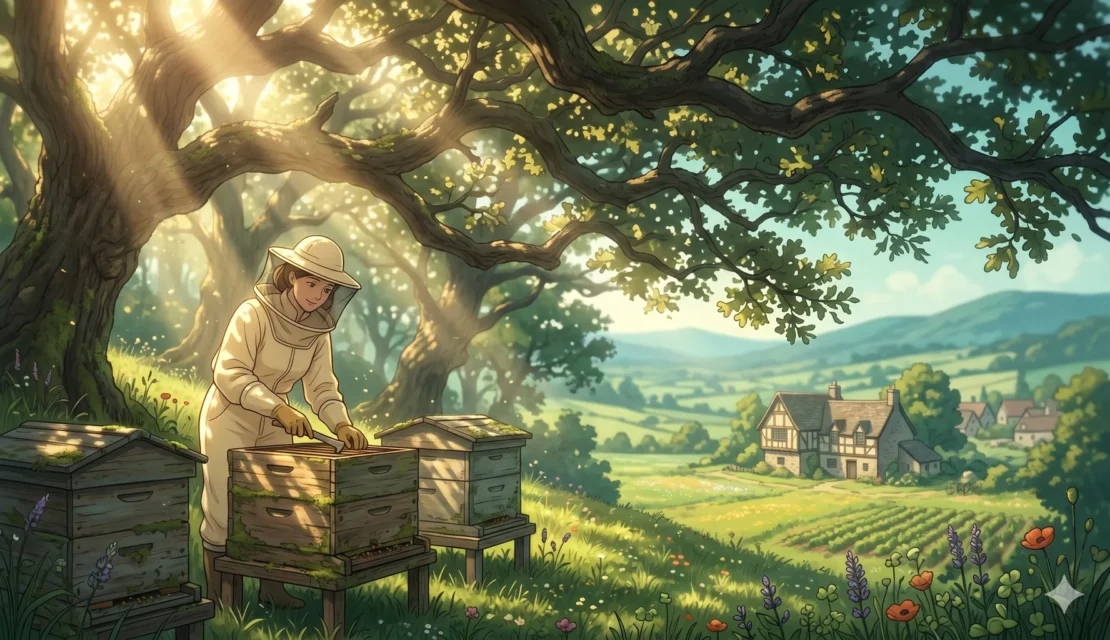
In a valley that sits below a ridge of old oak trees, there is a woman named Elsa who keeps forty-seven hives.
She visits them every afternoon in the same order, starting at the hives closest to the apple orchard and moving along the valley in a route that takes her about two hours and that she finds, every single time, genuinely restorative in a way that she has never been able to adequately explain to people who ask about it.
She wears her suit and her veil and her gloves, and she moves among the hives with a slowness that is not the slowness of reluctance but of someone who has learned that bees respond to the quality of your presence and that a calm body is the best thing you can bring with you.
The sound is the thing that people who haven’t been near bees don’t know about. It is not the angry, singular buzz of a single disturbed bee. It is a collective, layered hum, thousands of individual sounds combining into something that is remarkably like the sound a room full of people makes when everyone is working and nobody is in conflict. A productive, satisfied hum.
Elsa finds it deeply calming.
She opens hive after hive with the care of someone handling something genuinely precious, which she is. She checks and observes and makes notes in the small notebook that lives in her jacket pocket. She is not hurrying. There is no reason to hurry.
The afternoon sun comes through the oak leaves at the ridge and moves slowly across the valley floor as she works. The hum of the bees is consistent and full.
By the time she reaches the last hive the light is long and the shadows are stretching and the valley has gone to that particular gold that means the day has given everything it had and is now winding down with grace.
She closes the last hive.
She stands for a moment in the middle of the valley, still in her suit, listening to the hum.
It is, she thinks, as it always is, exactly the right sound for the end of an afternoon.
The bees are humming. The valley is golden. Everything is being tended. You can let go of the rest of it now.
Why Bedtime Stories for Adults Are One of the Best Sleep Tools You’re Not Using
You might be wondering how bedtime stories became a serious sleep remedy for adults, given that most of us stopped being read to somewhere around age eight. The answer is that the mechanism that made stories work at bedtime when we were children hasn’t actually gone anywhere. Our brains still respond to narrative in the same way, by following a thread, staying gently engaged, and gradually releasing the grip of active, anxious thought.
Stories Give the Restless Mind Somewhere Specific to Go
The biggest enemy of sleep for most adults is not physical tiredness. It is mental overstimulation. Bedtime stories for adults work by providing a gentle, interesting alternative to the loop of worries and to-do lists that the mind defaults to when the lights go out. Following a slow, calm narrative requires just enough attention to prevent rumination, but demands so little urgency that the body can simultaneously begin its descent into rest.
The Right Pace Is Everything
Notice that all nine of the bedtime stories in this collection move slowly on purpose. Long sentences. Descriptive detail. Present-tense sensory experience. These are deliberate techniques borrowed from mindfulness and narrative therapy, designed to slow your reading pace, regulate your breathing, and bring you gently into the present moment rather than the future-worry or the past-replay.
Good Sleep Is the Foundation of Everything
At Apple Tree Preschool BSD, located in the Educenter BSD Building, we think about wellbeing as a whole family concern, not just a child concern. A parent who sleeps well is more present, more patient, more joyful, and more able to give their child the engaged, connected attention that matters most in these early years. These bedtime stories for adults are our gift to you for the nights when you need the world to slow down just enough to let you rest.
Explore how we support the whole family’s journey through our full range of programmes, from our gentle Toddler classes through to Kindergarten 2.
Sleep Well Tonight, and Bring Your Child to Play Tomorrow
We hope these 9 bedtime stories for adults gave you exactly what you needed for tonight, a slower pace, a quieter mind, and a door out of the spinning thoughts and into somewhere restful. Bedtime stories are not just for children. They are for anyone who needs a gentle hand leading them away from the noise and toward the quiet.
And when morning comes and your little one is ready for their own adventure in learning and discovery, we would love to be the place they come to.
Register now and come grow, play, and learn together at Apple Tree Preschool BSD! Chat with us on WhatsApp or give us a call at +62 888-1800-900. We would love to welcome your family. Sleep well tonight.





Be the first to write a comment.