

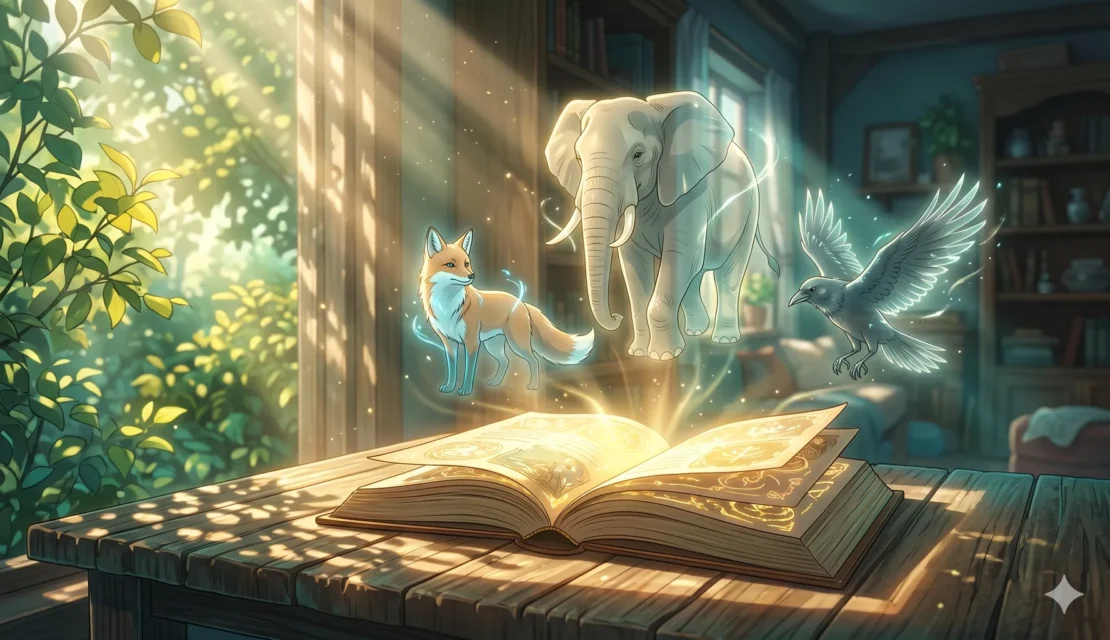
A fox who outsmarts everyone but himself. A tortoise who wins against all odds. A crow with a cheese problem. There’s a reason fables for kids have survived thousands of years, passed from grandparent to child, from village to village, from one corner of the world to the other. They work. They land. And children love them because, honestly, talking animals doing foolish things is just excellent entertainment at any age.
We see the power of animal fables every single day at Apple Tree Preschool BSD, where storytelling is woven into everything we do at our home in the Educenter BSD building. When a child hears a story about a lazy grasshopper or a sneaky fox, something clicks inside them that no worksheet or lecture could ever replicate. The lesson arrives sideways, through laughter and surprise, and it sticks in a way that feels effortless.
So here are 8 original fables for kids, each one full of clever animals, unexpected twists, and the kind of hidden lessons that stay with a child long after the story ends. Read them aloud. Do the voices. Have fun with it.
8 Animal Fables for Kids That Teach Without Preaching
These classic-style fables for children, animal stories with morals, and bedtime tales feature foxes, elephants, ants, and more, each carrying a lesson your little one will remember.
1. The Crow and the Pitcher
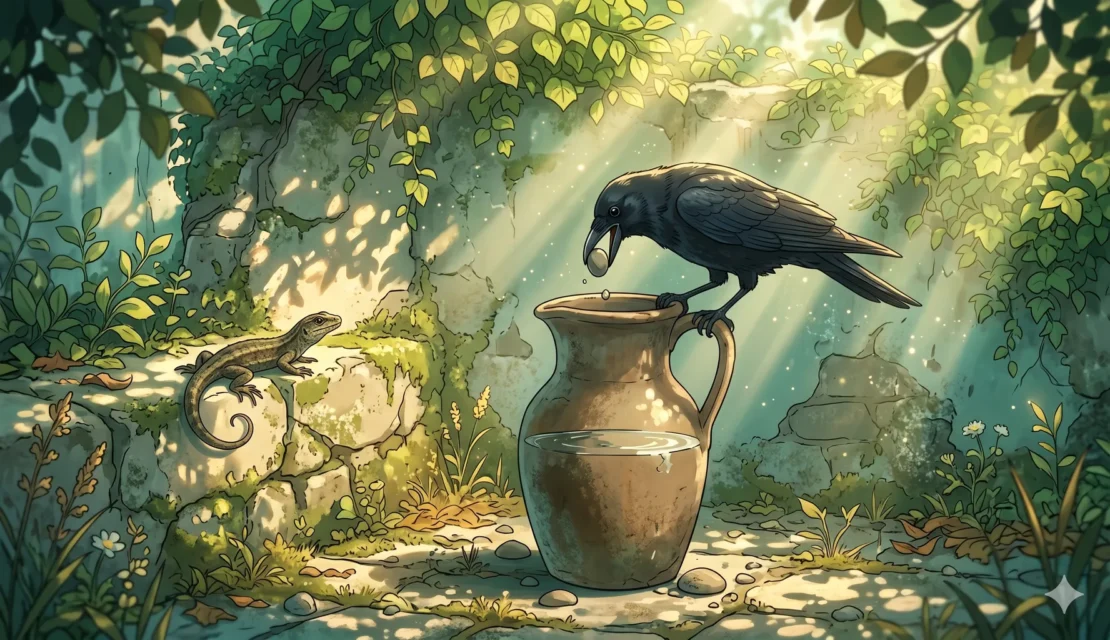
In the middle of a long, dry summer, a crow named Kael had been flying for hours without finding a single drop of water. His wings ached. His throat was as dry as old paper. The sun sat heavy and white in the sky like it had no intention of being helpful.
Just when he was beginning to lose hope entirely, he spotted something on the ground near a crumbling stone wall. A tall clay pitcher, half-hidden in the shade, with a thin gleam of water at the very bottom.
Kael landed beside it and nearly wept with relief. Water. Actual, real, lifesaving water. He plunged his beak into the pitcher and immediately discovered the problem. The water level was so low, and the pitcher so narrow and deep, that his beak couldn’t reach it. Not even close.
He tried tilting the pitcher. Too heavy. He tried jamming his whole head in. Too tight. He tried flapping his wings in frustration, which accomplished nothing whatsoever but did make him feel marginally better for about two seconds.
He sat on the rim and thought.
A lizard who had been watching from the wall offered unhelpful commentary. “Tough luck,” said the lizard. “Maybe try a different pitcher.”
“There is no other pitcher,” said Kael.
“Then I suppose you’re out of luck,” said the lizard, and went back to sunbathing, which was clearly his primary occupation.
Kael looked at the ground. Small stones and pebbles lay scattered everywhere around the base of the wall. He picked one up in his beak and dropped it into the pitcher. It made a small plop. The water level didn’t visibly change.
He dropped in another. And another. And another.
The lizard, who had opened one eye to watch, said, “What are you doing?”
“Solving the problem,” said Kael, without stopping.
Pebble after pebble went in. Twenty. Forty. Sixty. Each one raised the water level by the tiniest, almost invisible amount. Kael’s beak ached. His wings trembled from the effort of flying up and down. Several times he wanted to stop. Several times he looked at the water level and thought it would never be enough.
He kept going.
After what felt like an eternity, the water was high enough to reach. Kael dipped his beak in and drank, slowly and deeply, the most satisfying drink of his entire life.
The lizard stared.
“How did you know that would work?” he asked.
“I didn’t,” said Kael, wiping his beak. “But giving up definitely wouldn’t work. So I picked the option that at least had a chance.”
He shook out his feathers, nodded politely to the lizard, and flew off into the cooling afternoon sky.
The lizard looked at the pitcher full of pebbles for a long time. Then he went back to sunbathing, because some lessons take longer to land on some creatures than others.
Moral: When facing a problem that seems impossible, patience and creative thinking will get you further than frustration and giving up.
2. The Elephant Who Whispered
Deep in a forest where the trees grew so tall their tops disappeared into cloud, there lived an elephant named Biru who had a very unusual quality for an elephant. He was quiet.
Not quiet in the “doesn’t talk much” sense. Quiet in the “when he did talk, he practically whispered” sense. His voice was so soft that other animals had to lean in just to hear what he was saying. This was somewhat comical given that he was, by a considerable margin, the largest animal in the forest.
The other elephants found this baffling. Elephants were supposed to trumpet. They were supposed to crash through the undergrowth and make their presence known. They were supposed to be, in a word, loud. Biru’s cousin Gajah, who was extremely loud even by elephant standards, was particularly puzzled.
“You’re enormous,” Gajah would say, which was true. “Why don’t you use your voice properly?”
Biru would smile and say, very softly, “Because I don’t need to.”
One monsoon season, a terrible flood swept through the forest. Rivers burst their banks. Paths disappeared underwater. Animals scrambled for higher ground, and in the confusion and the noise and the rushing water, panic spread like fire.
Gajah did what Gajah always did. He trumpeted. He bellowed instructions from the hilltop with the full force of his mighty lungs. “GO TO THE RIDGE! FOLLOW THE PATH! STAY TOGETHER!”
The animals heard him. They also heard the fear in his voice, which made them more afraid. Some ran in the wrong direction. Others froze. A group of young deer stood in the rising water, too terrified to move.
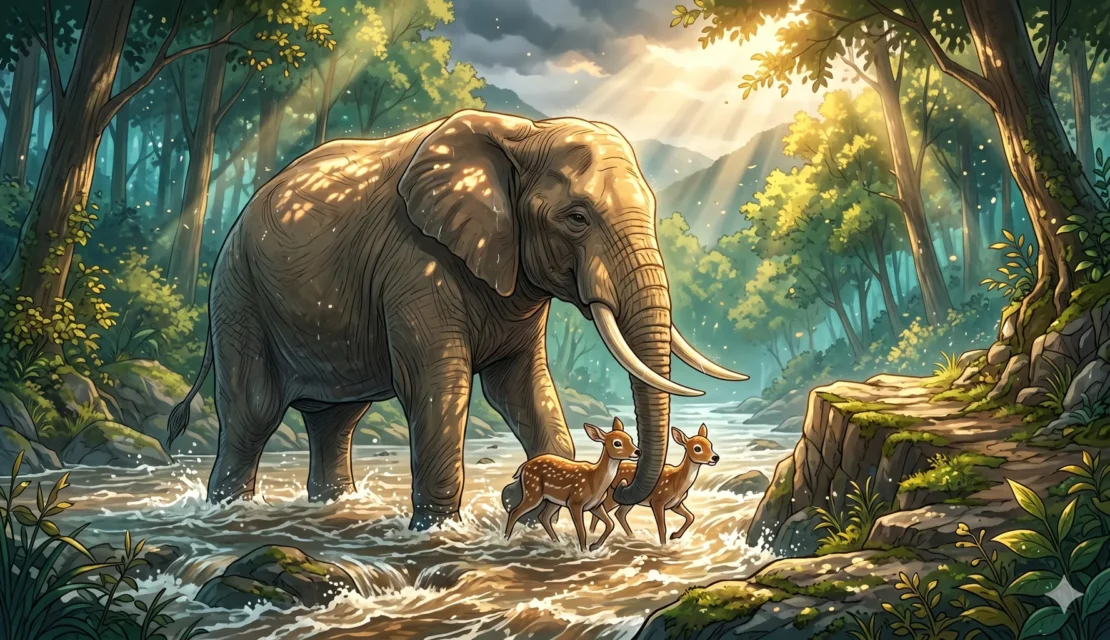
Biru waded into the flood. The water came up to his belly, which for an elephant was a considerable amount of water. He reached the young deer and lowered his great head down to their level.
“Follow me,” he said, in his usual near-whisper. “One step at a time. Stay close to my legs. The water is strong but you are together, and together is enough.”
His voice was so calm, so steady, so quietly certain, that the deer stopped shaking. They pressed close to his legs and walked, step by step, through the rising water to the ridge.
Biru went back for the rabbits. And then the foxes. And then a family of monkeys who had been clinging to a tree that was starting to lean. Each time, he waded in, lowered his head, and whispered. Each time, the animals followed.
By evening, the water had begun to recede. Every animal in the forest was safely on the ridge. Gajah stood at the top, looking down at his cousin with an expression that mixed admiration and confusion in equal parts.
“How?” he asked. “I was shouting and no one listened. You whispered and everyone followed.”
Biru looked out over the forest, where the water was pulling back and the first stars were beginning to show.
“When you shout,” he said gently, “people hear the noise. When you whisper, they hear the words.”
Gajah thought about this for a very long time. He never quite managed to whisper. But he did, from that day forward, lower his voice just a little, and he was surprised to discover how much more people listened when he did.
Moral: True leadership isn’t about being the loudest voice in the room. Calm, quiet confidence inspires more trust and more action than volume ever could.
3. The Two Frogs in the Milk Pail
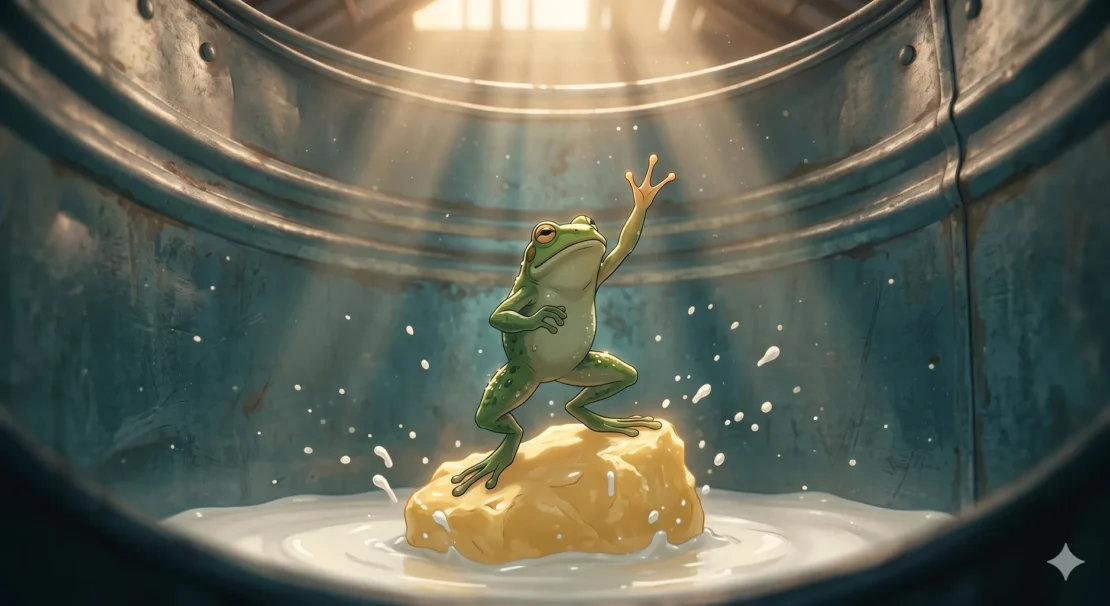
On a farm at the edge of a kampung, two frogs named Kodok and Bangkung made the worst possible decision of their evening. They jumped into a pail of milk.
It had seemed like a good idea at the time, in the same way that many regrettable decisions seem reasonable in the moment. The pail smelled interesting. The rim was climbable. What could go wrong?
What went wrong was that the sides of the pail were smooth, tall, and slippery, and two frogs who had been perfectly happy on solid ground moments earlier were now treading milk with no obvious exit strategy.
Kodok, who was the more analytical of the two, assessed the situation quickly. “The sides are too slippery to climb. There’s nothing to stand on. We can’t jump high enough to reach the rim.” He treaded milk for another minute, then stopped. “It’s hopeless.”
Bangkung, who was the more stubborn of the two, said nothing. She was too busy kicking.
“What are you doing?” asked Kodok.
“Kicking,” said Bangkung.
“I can see that. Why? There’s no way out.”
“I’m not ready to stop trying yet,” she said simply, and continued kicking.
Kodok watched her for a while. Then, with a shake of his head, he stopped paddling and sank beneath the surface, convinced that the situation was beyond saving.
Bangkung kept kicking.
Her legs burned. Her lungs strained. The milk churned around her in thick, heavy swirls. She kicked and kicked and kicked, not because she had a plan, but because she was not the kind of frog who stopped before she absolutely had to.
Then something changed.
The milk beneath her began to feel different. Thicker. Firmer. Her kicks were meeting resistance where before there had been only liquid.
She looked down.
Beneath her, a solid lump had formed. The constant churning of her legs had turned the milk into butter, and the butter was solid enough to stand on.
Bangkung placed one foot on the lump, then the other. She was standing. Shaky, exhausted, covered in cream, but standing. And from the top of the butter, she could reach the rim.
She jumped out and landed on the cool, solid farmyard floor. She lay there for a long time, breathing hard.
She never forgot what she’d learned in that pail. Sometimes the path only appears because you kept moving when everything told you to stop.
Moral: Persistence, even when you can’t see the way out, can create opportunities that didn’t exist before. Never give up before you absolutely have to.
4. The Fox Who Lost His Tail
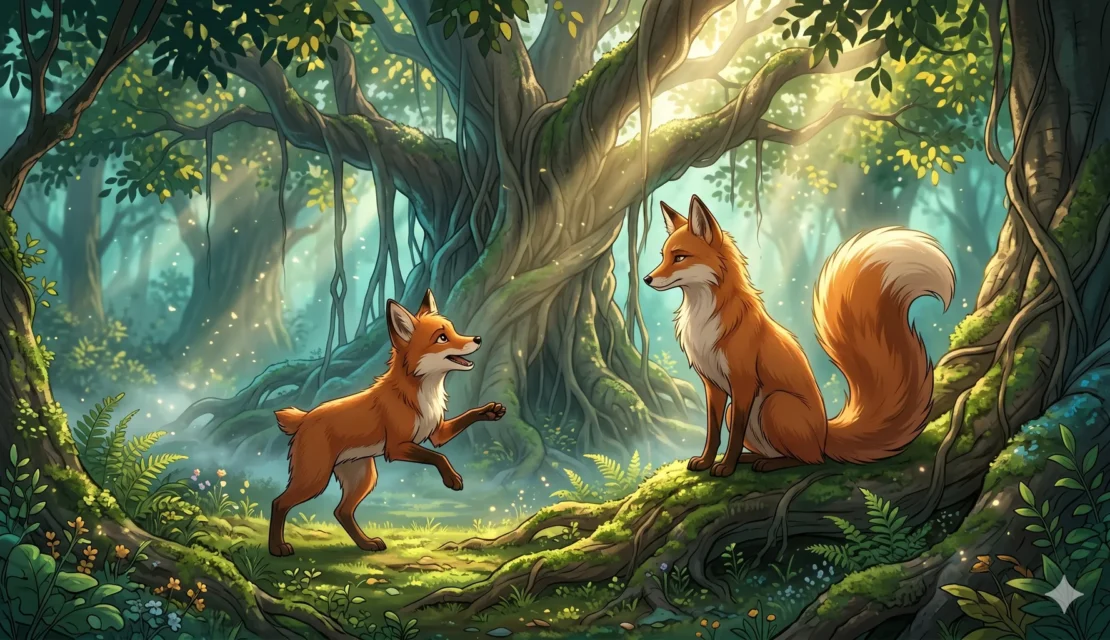
A fox named Rubah had always been quite proud of his tail. It was long and full and magnificently bushy, and he spent a not-insignificant portion of each morning grooming it. Other foxes noticed, which was rather the point.
Then, one unfortunate Tuesday, Rubah got his tail caught in a farmer’s trap. He managed to pull himself free, but his beautiful tail did not come with him. He turned around and looked at the trap with the distinct horror of someone who has just left a significant part of their identity behind a fence.
He was, to put it mildly, devastated.
For three days he stayed in his den, humiliated. He could not face the forest. He could not face the other foxes. He could not face the specific expression he knew Musang, the civet who lived two trees over and had never liked him, would be wearing.
On the fourth day, Rubah had an idea. A cunning, fox-like idea that felt much better than sitting in a den feeling sorry for himself.
He called a meeting of all the foxes.
They gathered in the clearing by the old banyan tree, and every single one of them stared openly at his missing tail, because foxes are not known for their tact. Rubah stood in front of them with the calm confidence of a fox who had rehearsed this speech approximately eleven times.
“Friends,” he said. “I come to you today as a liberated fox.”
There was a silence.
“Liberated?” said an old vixen named Serigala.
“Absolutely,” said Rubah. “I have discovered that tails are, in fact, completely unnecessary. They’re heavy. They get caught in things. They require constant maintenance. I have never felt so free, so light, so unburdened in my life.” He turned in a circle to demonstrate. “I encourage every one of you to consider removing yours.”
A murmur went through the crowd. Some of the younger foxes looked at their tails thoughtfully.
But Serigala, who was old and had seen quite a lot of fox-related nonsense in her time, stepped forward.
“Rubah,” she said pleasantly, “if you had come to us still wearing your tail and made this suggestion, I might have listened. But you are a fox without a tail, asking other foxes to lose theirs.” She looked at him with the steady, unblinking gaze that old vixens have perfected over centuries. “If you had found your tail waiting for you on the ground right now, would you pick it up?”
Rubah opened his mouth. He paused. He closed his mouth.
“That’s what I thought,” said Serigala, and walked away.
The clearing emptied slowly. Rubah stood alone, tail-less and speechless, for the first time in his life out-foxed.
He never tried to convince anyone else to follow his misfortune again. Instead, over time, he learned something that the tail had never taught him: that what you are without your finest feature is, in the end, what actually matters.
Moral: Be wary of advice that comes from someone who wants you to share their misfortune rather than avoid it. And know that your worth is not defined by what you carry on the outside.
5. The Ant and the Dove
On a blistering afternoon, a tiny ant named Semut was crawling along the edge of a river, desperately trying to reach the water for a drink. The bank was steep and crumbly, and as she leaned down for just one sip, the earth gave way beneath her feet and she tumbled into the current.
The river, which had seemed so gentle from the bank, was shockingly strong. Semut was tossed and spun like a leaf in a washing machine. She kicked her six tiny legs as hard as she could, but the current was carrying her further and further from the shore.
High above, a dove named Merpati was perched on a branch overhanging the river. She had been preening her feathers and minding her own business when she noticed the tiny black dot being swept downstream.
Without thinking, Merpati plucked a large leaf from the branch and dropped it into the water directly in front of Semut. The ant grabbed on with every leg she had and rode the leaf to the bank like a very small, very shaken passenger on a very green boat.
Semut crawled off the leaf and lay on the warm earth, breathing hard. She looked up. The dove was back on her branch, already preening again, as if saving lives was just a small interruption in her grooming schedule.
“Thank you,” called Semut, in a voice that, to be fair, was probably too small for the dove to hear from that distance. But Merpati tilted her head and cooed softly, which Semut chose to interpret as “you’re welcome.”
Life went on. Months passed.
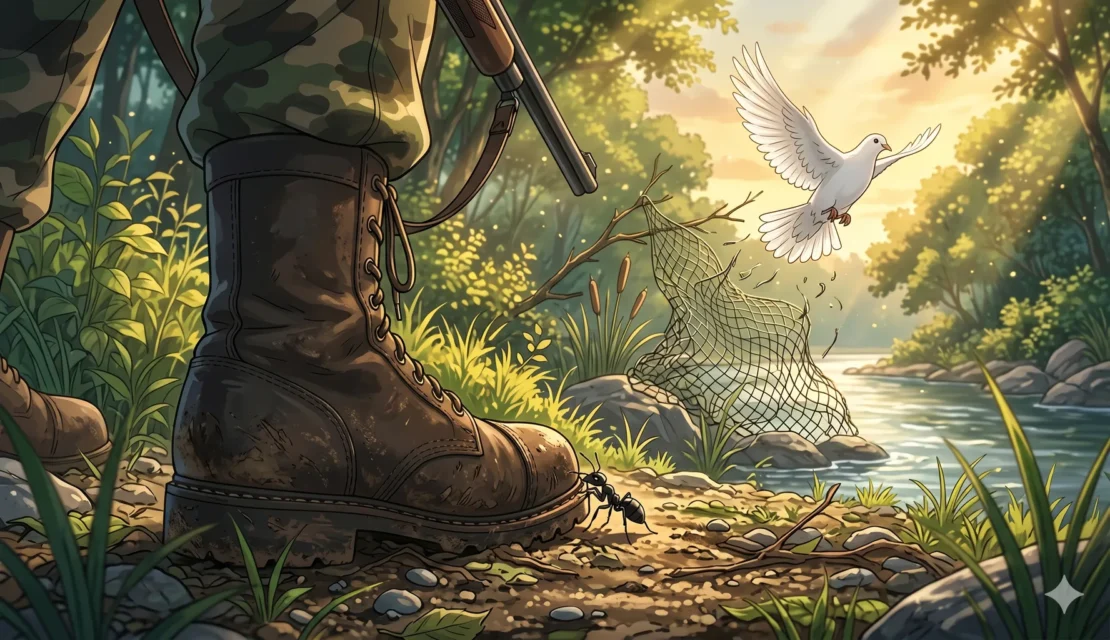
Then, one cool morning, Semut was foraging near the same river when she spotted something that froze her in her tracks. A hunter was crouched in the grass, his net raised, creeping silently toward a dove who was drinking at the water’s edge.
It was Merpati.
Semut did the only thing she could do. She ran as fast as her tiny legs would carry her and bit the hunter on the ankle with everything she had.
The hunter yelped. His hands flinched. The net fell sideways. The noise startled Merpati, who looked up, saw the danger, and launched into the sky with two powerful beats of her wings.
The hunter rubbed his ankle, looked around in confusion, and eventually wandered off, muttering to himself about unusually aggressive insects.
Merpati circled once above the riverbank. She could not possibly have seen the ant below. But she cooed, long and clear, and Semut heard it, and it sounded a lot like thank you.
Moral: No act of kindness is ever wasted, no matter how small. And you never know when the smallest creature might be the one to save you.
6. The Dog and the Bone
A dog named Anjing had just acquired the most magnificent bone he had ever seen. It was long and white and meaty and perfect, and he had found it entirely by luck near the butcher’s shop in the market. He carried it through the village with his head held high and his tail wagging in the particular way that says, “I am doing extremely well and I want you all to know.”
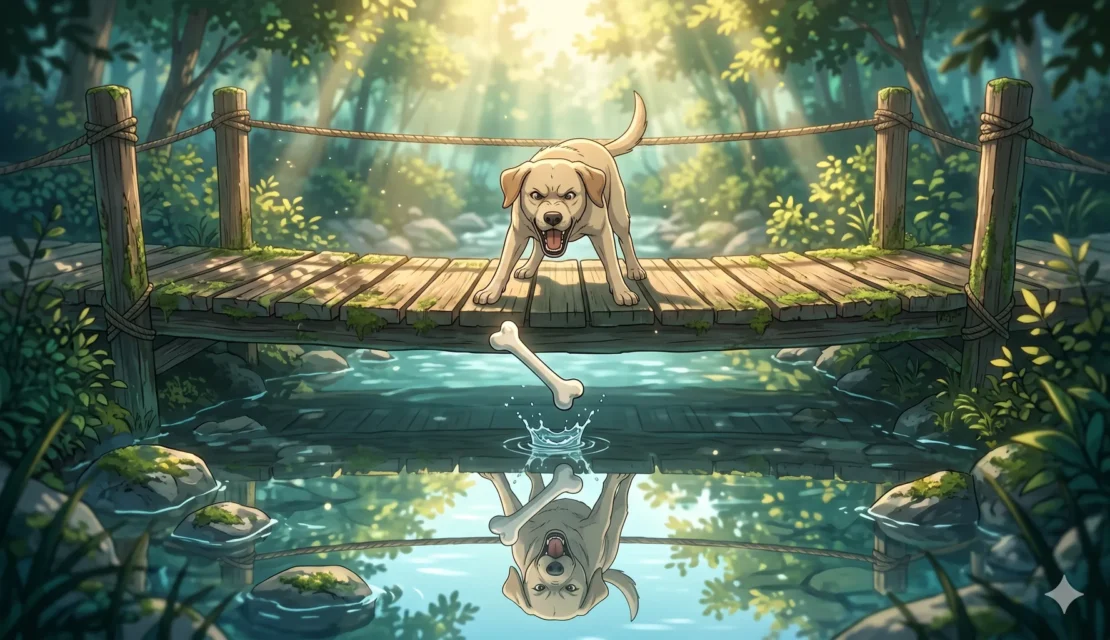
He trotted across the wooden bridge that spanned the stream behind the market. And as he crossed, he happened to look down into the water.
There was another dog.
With another bone.
And that bone, Anjing noticed with narrowing eyes, appeared to be even bigger than his.
Now, a wiser dog might have recognised his own reflection. Anjing was not, at this particular moment, operating at peak wisdom. He was operating at peak greed.
He barked at the dog in the water. The dog barked back silently, opening and closing its mouth in a way that Anjing found quite rude.
“Give me that bone,” he growled.
The dog in the water growled back.
Anjing lunged.
His jaw opened. His bone dropped. It hit the water with a splash and sank immediately, tumbling into the current and disappearing downstream before he could even process what had happened.
He looked down at the water. The other dog was still there, also bone-less now, looking up at him with an expression that he suddenly realised was his own.
He stood on the bridge for a long time.
The water flowed. The bone was gone. The reflection stared back at him, empty-mouthed and foolish.
He walked home slowly with his tail between his legs, and when his friend Kucing the cat asked him what happened, he said nothing for a while, then admitted very quietly, “I wanted what I thought was better, and I lost what I actually had.”
Kucing, being a cat, said, “Obviously,” and went back to sleep.
Anjing never crossed the bridge the same way again. He always looked straight ahead. And whenever he found something good, he held onto it properly and did not look down.
Moral: Be grateful for what you have. Greed for what you don’t have can cost you everything you do.
7. The Mouse and the Lion
A lion named Singa was asleep in the shade of a great tree. He was the kind of sleeper who took up a lot of space and snored like distant machinery. Nothing in the forest would have been foolish enough to disturb him.
Nothing, that is, except a very small mouse named Tikus, who was running late for something and had decided that the shortest route was directly across the lion’s face.
This was a miscalculation.
Singa’s eyes opened. One enormous paw came down and pinned Tikus to the earth before she had time to make even one of her six planned emergency turns.
“Really?” said Singa, looking down at the trembling grey dot beneath his paw.
“I am so sorry,” squeaked Tikus. “I was running late and I wasn’t thinking and please, please, please don’t eat me, I am very small and bony and I would be a deeply unsatisfying snack.”
This was probably true. Singa looked at the mouse. She was about the size of his smallest toe.
“Please,” said Tikus. “Let me go, and I promise, one day I will help you. I will repay this kindness. I give you my word.”
Singa actually laughed. Not meanly, just genuinely amused. The idea that this creature, who weighed less than one of his whiskers, could ever help him was objectively ridiculous.
But he was full from lunch, and in a good mood, and there was something about the mouse’s earnestness that he found unexpectedly charming.
“Fine,” he said, and lifted his paw. “Off you go.”
Tikus ran, very fast, in the direction she had originally been headed, and Singa went back to sleep.
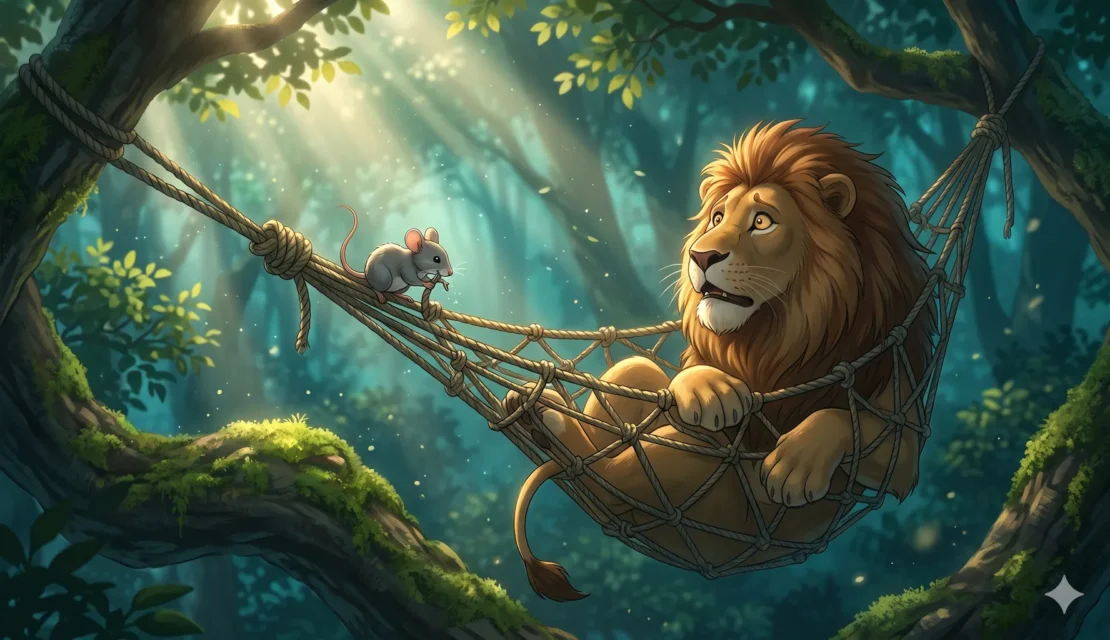
Several weeks later, Singa was walking through a part of the forest he didn’t usually visit when he stepped into a hunter’s net. It closed around him instantly, pulling tight, lifting him off the ground and leaving him dangling from a tree branch like the world’s most humiliated apex predator.
He roared. He thrashed. He clawed at the ropes. Nothing worked. The ropes were thick and knotted and clearly the work of someone who knew exactly what they were doing.
Hours passed. The forest grew dark. Singa hung in the net, exhausted and furious and, though he would never admit it, frightened.
Then he heard a tiny voice.
“Hold still.”
He looked down. Tikus was climbing the rope.
“You?” he said.
“Me,” she said, and began to chew.
She chewed through one rope, then another, then another. It took a long time. Her jaw ached. The ropes were thick and her teeth were very small. But she did not stop. Rope after rope fell away until, with a final snap, the net opened and Singa tumbled to the ground, free.
He lay on the forest floor, breathing hard. Tikus sat on a fallen rope nearby, also breathing hard, for different but equally valid reasons.
“I told you I would help you someday,” she said.
Singa looked at the tiny mouse who had saved his life with nothing but persistence and a set of very small teeth.
“You did,” he said quietly. “And I will never underestimate anyone again.”
Moral: Never look down on anyone. The help you need most might come from the most unexpected place.
8. The Tortoise and the Hare
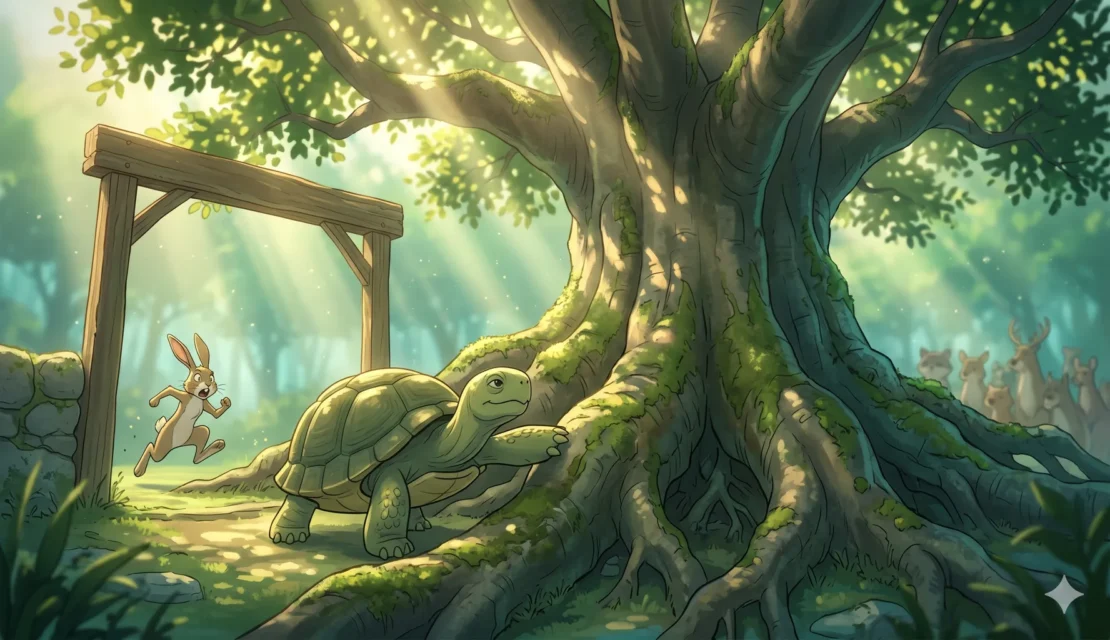
Everyone in the forest knew that Kelinci the hare was fast. Kelinci knew it most of all. He ran everywhere, even when walking would have been perfectly adequate, and he made sure everyone noticed.
“Did you see how fast I crossed the meadow?” he would say to whoever happened to be nearby. “Eight seconds. Possibly seven. I wasn’t counting but it was definitely impressive.”
Nobody asked him to time himself. He did it voluntarily, which somehow made it worse.
Kura, the old tortoise, listened to this most mornings while making her slow, steady way to the pond for her daily swim. She had been walking the same path for twenty years. She knew every stone, every root, every turn. She also knew that her pace, while not exciting, had never once failed to get her where she needed to go.
One morning, Kelinci made a critical error. He looked at Kura and laughed.
“How do you do it?” he asked, not unkindly, but with genuine bewilderment. “Moving that slowly? Doesn’t it drive you mad?”
Kura stopped. She looked at him for a long moment.
“Would you like to race me?” she asked.
The forest went silent. A squirrel dropped a nut.
“You’re joking,” said Kelinci.
“To the old fig tree at the end of the valley. Tomorrow morning,” said Kura, and continued walking.
The word spread fast, as words do in a forest with a very active squirrel communication network. By the next morning, every animal in the valley had lined up along the route to watch.
Elang the eagle called the start. “Ready… go!”
Kelinci vanished. He was so fast that the animals closest to the starting line felt the breeze. Within minutes, he was already halfway to the fig tree, moving at a speed that was, by any reasonable standard, extraordinary.
Kura took her first step.
The crowd looked at each other.
Kelinci reached the three-quarter mark in what felt like no time at all. He stopped and looked back. Kura was a tiny speck in the far distance, barely visible.
He sat down under a shady tree. “I have time,” he said to a passing butterfly. “Plenty of time.”
He lay back. The sun was warm. The breeze was gentle. His legs were resting. He would just close his eyes for a moment. Just a moment.
He slept.
Kura walked.
She walked past the meadow where the rabbits were watching. She walked past the stream where the fish had come to the surface to see. She walked past the shady tree where Kelinci was sleeping with his mouth slightly open and one ear twitching in a dream.
She did not stop. She did not hurry. She did not change her pace or look behind her or worry about what anyone else was doing. She just walked, one steady step after another, the same way she had walked every single day for twenty years.
The animals at the finish line saw her first. A murmur went through the crowd. Then the murmur became a cheer.
Kura crossed the line, touched the base of the fig tree with one slow, deliberate foot, and sat down.
A passing bird woke Kelinci with a sharp whistle. He jolted upright, looked down the valley, and saw the crowd gathered at the finish line.
He ran. He ran as fast as he had ever run in his life.
He arrived three minutes after Kura.
The forest was completely silent.
Kura looked at him with an expression that was not smug, because tortoises don’t do smug. It was something closer to patient understanding, the look of someone who had learned a long time ago what really mattered.
“How?” said Kelinci.
Kura thought about it for a moment.
“I never stopped,” she said.
Moral: Talent means nothing without discipline. Slow, steady, consistent effort will beat speed and overconfidence every single time.
Why Fables for Kids Are the Smartest Bedtime Choice You Can Make
Every one of these fables for kids carries something your child will use for the rest of their lives: patience, humility, persistence, gratitude, and the wisdom to look beyond the surface. Animal fables work because they let children see human behaviour from a safe, entertaining distance, and the lessons arrive without any lecturing required.
Fables Build Character Without Feeling Like a Lesson
When your child hears about a greedy dog losing his bone or a tiny ant saving a dove, they absorb values at a level far deeper than rules and instructions can reach. This is exactly why storytelling sits at the heart of everything we do at Apple Tree Preschool BSD.
The Right Stories Deserve the Right Setting
Through our programs for children aged 18 months to 6 years, we weave fables, moral stories, and creative storytelling into our Singapore curriculum every single day. From Toddler classes through to Kindergarten 2, your child will grow in an environment where learning and stories and laughter go hand in hand.
Share a Fable Tonight and a Future With Us
We hope these 8 fables for kids gave you a fresh collection of stories to enjoy together. Whether it’s a rainy afternoon or a quiet bedtime, a good fable is always the right call.
If you’d love for your child to grow up surrounded by stories, creativity, and genuine care, we would be so happy to welcome your family to Apple Tree Preschool BSD.Come play and learn with other children, register now! Chat with us on WhatsApp or call us at +62 888-1800-900. We can’t wait to meet your little storyteller!




Be the first to write a comment.