


If your child hates homework every day, you are probably very familiar with the afternoon version of household drama. One worksheet appears, one pencil rolls away, and suddenly your child looks as if you have asked them to climb a mountain in formal wear. At Apple Tree Pre-School BSD, close to Educenter bsd, we hear this from parents all the time, because learning at home can feel surprisingly tricky even when your child is bright, curious, and full of potential.
The good news is that homework battles are usually not a sign that your child is lazy or uninterested in learning. More often, they are a sign that something about the routine, timing, pressure, or task itself is not working yet. Once you understand what is sitting underneath the resistance, you can help your child build healthier learning habits without turning every afternoon into a small emotional opera.
Why a Child Hates Homework Every Day
When a child hates homework every day, the homework itself is not always the real problem. Sometimes your child is mentally tired after school. Sometimes they are hungry, overstimulated, or simply desperate to move their body after sitting still and following instructions all day.
Young children especially do not separate learning from emotion very neatly. If homework feels hard, boring, confusing, or too connected to adult pressure, they may start disliking all of it at once. That is why a child who enjoys stories, drawing, and asking questions can still react dramatically to one page of simple practice.
What may be causing the resistance
A few very common reasons children push back against homework include:
- They are tired after school and need a break first.
- The task feels too hard or too easy.
- They associate homework with correction and criticism.
- They struggle to focus in a noisy or distracting space.
- They want connection and play more than another structured activity.
- The routine changes from day to day, so it never feels predictable.
When you look at the situation this way, the goal becomes clearer. You are not trying to force better behavior. You are trying to make homework feel more manageable.
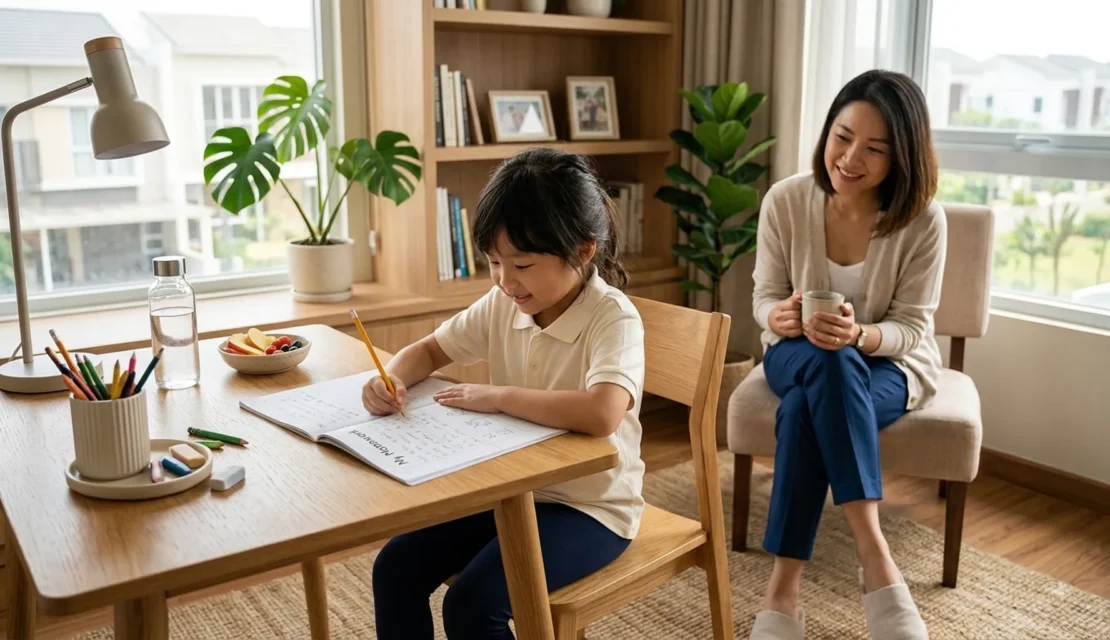
Child Hates Homework Every Day, Start With the Timing
One of the biggest mistakes families make is expecting children to jump straight from school mode into homework mode the second they get home. That sounds efficient in theory, but in real life it often goes badly. Even adults need a minute after a long day, and children are no different.
Give your child a reset before homework
Most children do better when they have a short transition first. That might mean a snack, a cuddle, some outdoor play, or simply ten quiet minutes to do absolutely nothing productive. Frankly, many great things begin after a snack.
A reset helps your child feel human again before asking their brain to work. It also lowers the chance that homework becomes connected with stress from the moment they walk through the door.
Watch your child’s natural rhythm
Some children focus better soon after school. Others do much better a little later, after food and movement. Pay attention to when your child seems most cooperative and mentally available.
Try testing a few options:
- Right after a snack
- After twenty minutes of outdoor play
- Before dinner
- After a short rest and reconnection time
You are not looking for the perfect universal rule. You are looking for what genuinely works for your child.
Make Homework Feel Smaller and More Doable
When a child hates homework every day, the task may feel too big before it even begins. Young children can become overwhelmed very quickly when they think something will take forever or when they cannot see where the finish line is.
Break the task into tiny steps
Instead of saying, “Finish your homework,” try guiding your child through one small part at a time. “Let us do the first two questions,” feels much safer than “Complete the whole page.” Small steps reduce panic and build momentum.
You can also use simple language like:
- First we read the instruction
- Then we answer one part
- Then we check it together
The brain loves a task that feels survivable.
Use short work periods
Many young children do better with brief, focused efforts rather than one long session. Ten minutes of steady attention can be far more productive than thirty minutes of complaining, staring into the middle distance, and asking for water four times.
A timer can help here. You might say, “Let us focus for ten minutes, then we take a short break.” Children often cooperate better when they know there is an end point.
Create a Homework Routine That Feels Calm
A regular routine gives children something to lean on. When homework happens at random times, in random moods, and in random places, it feels harder than it needs to.
Set up a simple homework rhythm
Keep the sequence predictable and easy to follow. It does not need to be fancy. It just needs to happen often enough that your child knows what comes next.
A helpful rhythm might look like this:
- Get home
- Have a snack
- Take a short break
- Do homework
- Play or relax afterward
That final step matters. Children work better when they know life continues after the worksheet.
Choose a low distraction space
Some children can work anywhere. Others need the world to calm down a bit before they can think. Try setting up homework in a space with fewer distractions, a clear table, and the supplies already nearby.
If possible, keep these ready:
- Pencils
- Eraser
- Crayons if needed
- Water
- Good lighting
The fewer little obstacles your child hits, the less emotional energy gets wasted before they even start.

Your Tone Matters More Than You Think
If homework has become a daily struggle, it is easy for everyone to sound tense. We understand. By the third refusal, even the gentlest parent may begin speaking through clenched teeth while holding a pencil like it has personally betrayed them.
Be supportive, not over controlling
Children usually respond better when we guide rather than hover. Sit nearby, help them get started, and stay calm, but try not to correct every tiny mistake immediately. Too much correction can make homework feel like a daily opportunity to get things wrong.
You can say:
- “Let us look at this together.”
- “Try the first one, and I will help if you get stuck.”
- “You are working hard, keep going.”
Encouragement builds confidence. Confidence makes resistance smaller.
Praise effort, not just results
If your child hears only what is incorrect, they may begin to avoid homework simply to avoid the feeling of failure. Notice their effort, persistence, and moments of independence.
Try phrases like:
- “You got started faster today.”
- “I like how you kept trying.”
- “You stayed with that even when it felt tricky.”
That kind of feedback teaches resilience, which matters far beyond homework.
When Homework Battles Point to a Bigger Need
Sometimes a child hates homework every day because the task is consistently mismatched to their development, attention span, or emotional state. If the struggle feels intense every single day, it may be worth stepping back and asking bigger questions.
Talk with the teacher when needed
If homework regularly leads to tears, shutdowns, or extreme frustration, a conversation with the teacher can be very helpful. There may be a mismatch between expectations and what your child can currently handle at home.
At this age, learning should still feel warm, engaging, and connected to curiosity. If it constantly feels heavy, something in the approach may need adjusting.
Helping Learning Feel Joyful Again
At Apple Tree Preschool BSD, we believe children learn best when structure and joy live side by side. Strong routines matter, but so do connection, confidence, and emotional safety. That is why our classrooms are designed to help children grow smart and happy together with parents, not just complete tasks.
If you would like to explore our programs, we would love to show you how we support children through playful learning, caring guidance, and age appropriate routines that truly make sense for young learners.
A Better Afternoon Can Start With Small Shifts
If your child hates homework every day, please remember that this is usually a skill building moment, not a character judgment. Better timing, smaller steps, calmer routines, and a more encouraging tone can change a great deal over time. You do not need a perfect homework session, you just need one that feels a little less heavy and a little more possible.
We would be happy to support your family with a warm preschool environment where learning feels joyful, steady, and meaningful from the very beginning. Chat with us on WhatsApp or call +62 888-1800-900 to learn more.
Register now, and come play and learn with other children.





Be the first to write a comment.