

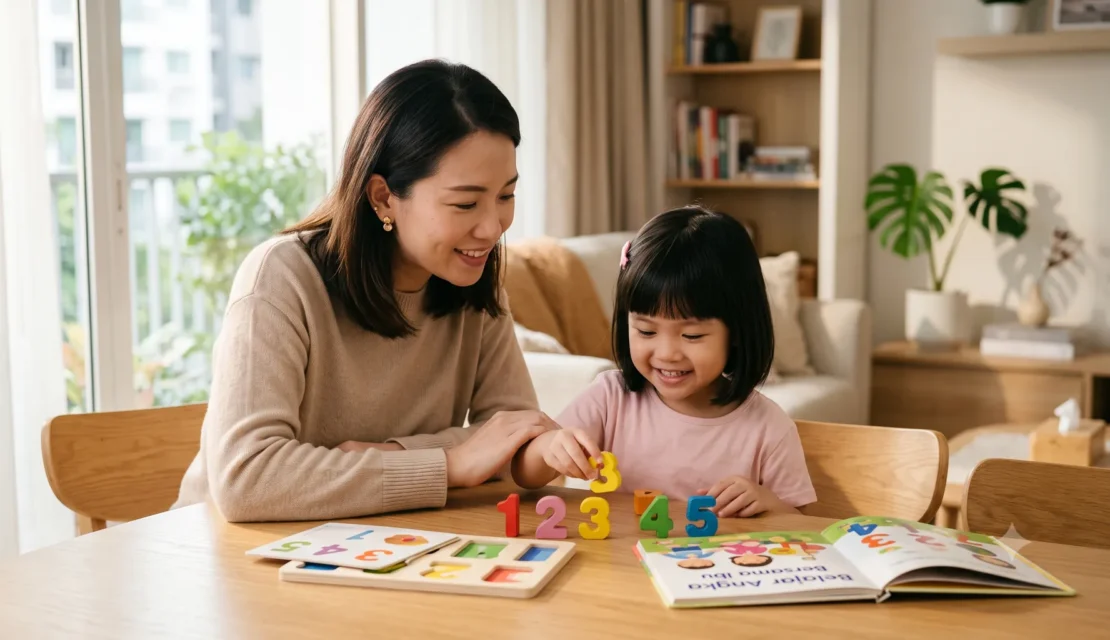
If teaching child study habits feels like negotiating with a tiny CEO who refuses your meeting invite, you are not alone. We see this every week at Apple Tree Pre-School BSD inside the Educenter BSD Building, where big learning goals often begin with very small attention spans.
You might be thinking, “My child is still little, do study habits even matter yet?” They do, because habits are not built when school gets hard, they are built when learning still feels like play. When you guide study habits early, you are really teaching your child how to focus, how to try again, and how to feel proud of effort.
We are going to keep this practical, realistic, and friendly to real family life. You do not need a perfect schedule, a silent home, or unlimited patience. You just need a few simple systems that you can repeat consistently.
Teaching Child Study Habits That Actually Stick
Study habits are not about making your child sit still for long periods, especially in the preschool years. The goal is to help you create routines and learning behaviours your child can repeat without a daily battle. When the habit is easy to start and easy to finish, it becomes something your child can own.
Start With the Real Goal, Not the Worksheet
A common trap is to measure “good studying” by how many pages your child completes. For young children, the real success is whether they can begin a task, stay with it briefly, and finish it with a calm brain. That is the foundation for literacy, maths, and problem solving later.
Try asking yourself one question: “What do we want our child to be able to do independently in six months?” That might be listening to a story without interrupting, tracing a few letters, or sorting objects by colour and size. Those are study habits too, just in a preschool-friendly form.
Keep Sessions Short, Then Quit While You Are Winning
If your child melts down at minute twelve, do ten minutes. If they thrive for six minutes, do six minutes. The best study routine is the one you can repeat tomorrow without dread.
A simple guide many families find helpful is:
- Ages 2 to 3: 5 to 10 minutes per activity
- Ages 3 to 4: 10 to 15 minutes per activity
- Ages 4 to 6: 15 to 25 minutes per activity, depending on the child
The magic here is stopping before your child is exhausted. Ending on success makes your child more willing to start next time, and that is how habits form.
Build a “Same Time, Same Place” Study Cue
Children learn through patterns. When the “study moment” happens in the same spot, at roughly the same time, your child’s brain starts preparing for focus automatically. It is like how you feel hungry when you smell food cooking, your body learns the cue.
Pick one simple location, like the dining table corner, a small desk, or a floor mat with a tray. Keep the supplies in a small box so setup takes less than one minute. The less friction you create, the less resistance you get.
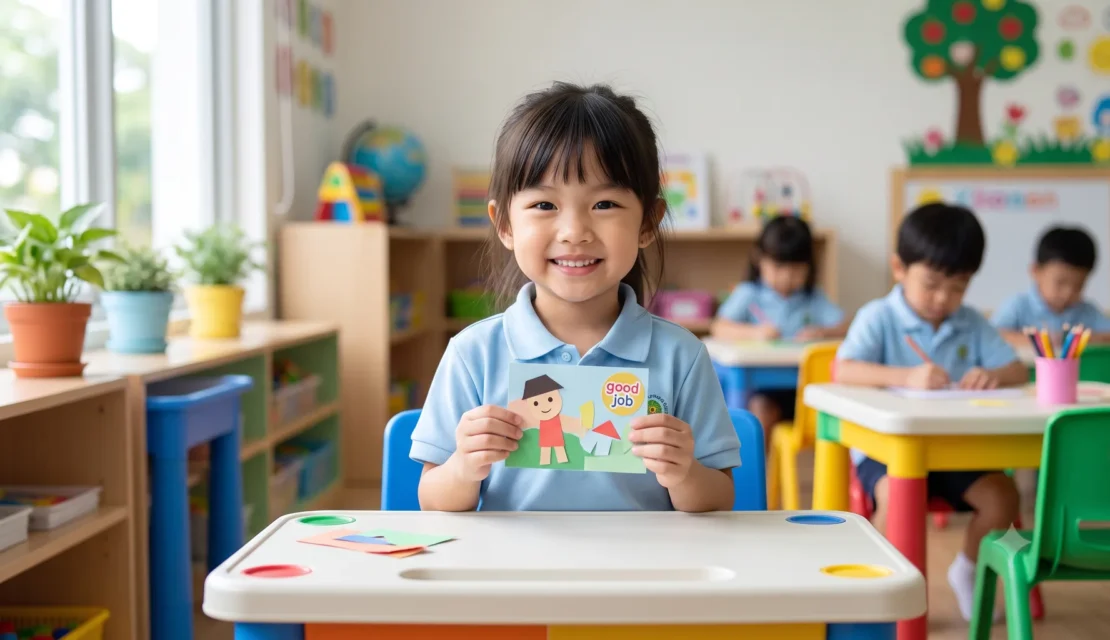
Make Study Time Feel Calm, Not Like a Punishment
If study time feels like a consequence, your child will treat it like a prison sentence. If it feels like a special routine with you, they lean in. The tone matters more than the content.
Use “First, Then” Language
Young children do best with clear, predictable sequences. “First, we do five minutes of letters, then we do stickers,” works better than “Please study now because I said so.” You are not bribing, you are structuring.
You can use “first, then” for everyday routines too. “First bath, then story,” and “First tidy up, then Lego,” strengthens the same habit loop your child uses for learning.
Praise Effort, Not Talent
When you say “You are so smart,” children often become afraid of mistakes. When you say “You worked hard on that,” children learn that effort is what matters. That makes them more willing to try, even when the task is challenging.
Try using phrases like these:
- “I like how you kept going.”
- “You fixed that mistake, that was brave.”
- “You stayed focused until the timer rang.”
This kind of praise builds resilience, which is one of the most valuable study habits your child can develop.
Teach Tiny Self Regulation Skills
A child who can calm down can learn better, period. You do not need complicated techniques. You just need repeatable micro skills your child can do with you.
Try one of these before study time:
- “Smell the flower, blow the candle,” two slow breaths
- A quick stretch, reach up, touch toes, shake hands
- A short choice question, “Do you want to start with letters or numbers?”
That last one is sneaky in the best way. Choice builds cooperation.
What to Do When Your Child Refuses to Study
Refusal is not always laziness. Often it is fatigue, frustration, or a task that is too hard. If you treat every refusal as defiance, you miss the real problem and you both end up angry.
Check the Difficulty Level
If your child is avoiding a task, it might be because it feels impossible. Drop the difficulty by one step and see what happens. If they cannot write the letter, let them trace it. If tracing is hard, let them form it with playdough. If playdough is hard, let them find the letter on a page and circle it.
The goal is to rebuild success quickly. Confidence is fuel.
Separate “Learning Time” From “Screen Time”
If your child learns that refusing study time leads to a screen, refusal becomes strategic. The simplest fix is to keep screens on a separate schedule and avoid using them as the immediate replacement for learning.
If you need a break, choose a non-screen reset. Offer water, a quick movement break, or a short independent play moment, then return to a simpler task.
Use Repair, Not Lectures
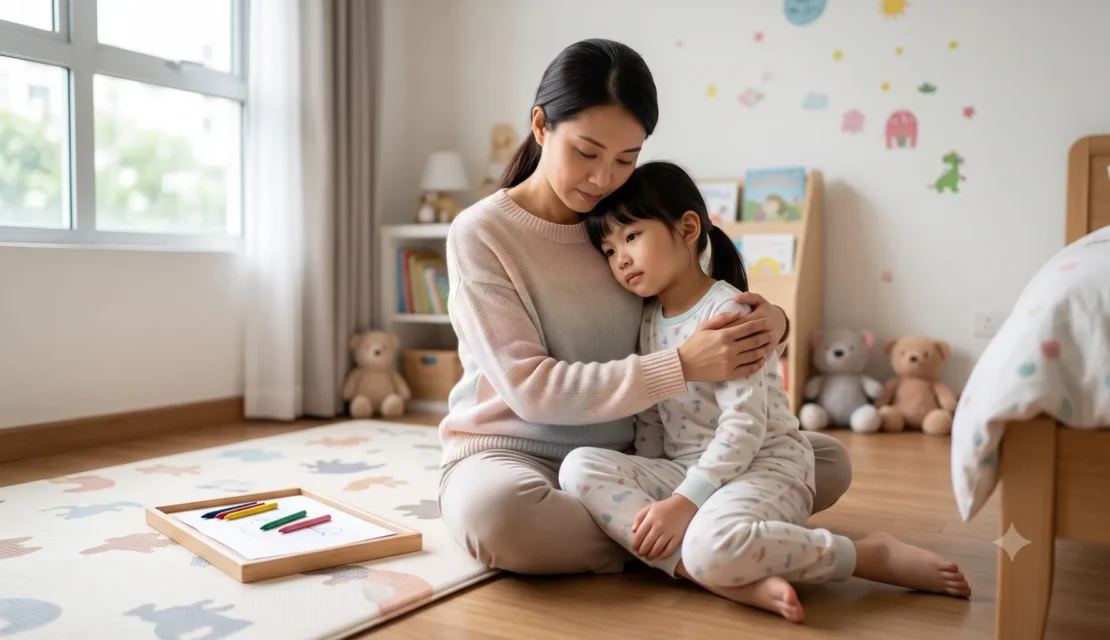
When things go off the rails, skip the long talk. Most young children cannot absorb a lecture when they are dysregulated. Focus on repair and reset.
You can say, “We had a tough moment. Let’s try again with an easier step.” That keeps your authority intact while keeping your connection strong.
How Apple Tree Supports Strong Study Habits Through Play
At Apple Tree Pre-School BSD, we build study habits into the day in a way that still feels like childhood. Our Singapore curriculum approach blends English, Mathematics, Chinese, Science, Bahasa, Phonics, Moral, Music, Physical Education, and more, but we deliver it through routines and experiences children can actually enjoy.
Study habits show up in simple classroom moments: listening to instructions, waiting for a turn, finishing a small task, asking for help, and trying again. Those are life skills, and they are also the invisible engine behind academic success.
If you want to see how we structure learning by age and readiness, you can explore our programs. It helps many parents match home routines with what children practise at school.
A Simple Weekly Plan You Can Copy at Home
If you want a low-stress starting point, here is a realistic weekly structure. You can adjust the timing based on your child’s age and mood.
- Monday: Phonics or letter sounds, 10 to 15 minutes
- Tuesday: Counting and sorting, 10 to 15 minutes
- Wednesday: Storytime plus one question, 10 minutes
- Thursday: Fine motor, cutting, tracing, sticker patterns, 10 to 15 minutes
- Friday: Review game, “find the letter,” “number hunt,” 10 minutes
- Weekend: Keep it light, practical learning through cooking, shopping, nature walks
The point is consistency, not perfection. If you miss a day, you do not “make up” by doubling time. You just return to the routine the next day.
Let’s Make Learning Feel Easier for You and Happier for Your Child
Teaching child study habits works best when your child feels safe, successful, and supported, and when you have a routine that does not drain your energy. You can start with short sessions, clear cues, and simple “first, then” structure, then build from there as your child grows.
If you would like a learning environment that reinforces these habits daily, we would love to welcome your family to Apple Tree. Come visit us at the Educenter BSD Building, see the classrooms, and ask all the questions you have, including the ones you think are “silly,” because those are usually the important ones.
Come play and learn with other children!
Chat with us on WhatsApp or call us at +62 888-1800-900.





Be the first to write a comment.