If child anxiety before tests has ever shown up in your home as sudden tummy aches, “I can’t do it,” or a dramatic meltdown over a perfectly innocent pencil, you are not imagining things. We see this often with young learners at Apple Tree Preschool BSD in the Educenter BSD Building, and the pattern is usually the same: your child wants to do well, but their worry gets there first.
You might be thinking, “But they’re still little, why are they stressed?” Because kids pick up pressure the way socks pick up crumbs. They absorb your tone, older siblings’ stories, and even random comments like “This is important,” then their imagination does the rest.
The good news is that test fear is learnable, which means confidence is learnable too. You don’t need a tough-love speech or a new set of flashcards that costs more than your monthly coffee budget. You need a calm plan you can repeat, plus a few simple tools that help your child feel safe while they try.
Child Anxiety Before Tests: What It Looks Like and Why It Happens
Test anxiety in young children rarely looks like “I am anxious about assessment outcomes.” It looks like stalling, tears, silly behaviour, or suddenly needing to pee the moment you say “Let’s review.” Your child is not trying to be difficult, they are trying to escape a feeling they do not yet know how to manage.
Common Signs of Test Anxiety in Kids
You might notice one or more of these, especially the day before a quiz, a performance check, or any “teacher will see what you can do” moment.
- Complaints like headache, stomachache, or feeling sick with no clear medical cause
- Avoidance, running away, refusing to start, or “forgetting” what they already know
- Perfectionism, crying over small mistakes, ripping paper, or erasing until the page disappears
- Sleep issues, clinginess, or big emotions that seem out of proportion
These are not proof your child is not ready. They are clues your child needs support with emotional regulation and confidence.
The Hidden Drivers Behind “I’m Scared of Tests”
In early childhood, fear often comes from interpretation, not reality. A test can feel like judgment, and judgment can feel like rejection, even if no adult meant it that way.
Common drivers we hear from families include fear of disappointing you, fear of being compared to friends, and fear of making mistakes in front of adults. Sometimes a child has had one rough experience, like being rushed or corrected harshly, and they assume it will happen again. Sometimes they simply have a sensitive temperament, meaning they feel things deeply and need more reassurance.
How to Talk to Your Child About Tests Without Adding Pressure
What you say matters, but how you say it matters more. Kids read your face before they process your words, which is honestly unfair but also very useful once you know it.
Swap “Results Talk” for “Process Talk”
When a child is anxious, “You’ll be fine” can feel dismissive. Instead, anchor them in actions they can do, because actions feel controllable.
Try phrases like these:
- “Let’s do one small step together.”
- “Mistakes help your brain grow.”
- “Your job is to try, our job is to help.”
This tells your child they are not alone and the goal is effort, not perfection.
Use a Calm Script You Repeat Every Time
Repetition is comforting for young children. Pick a short script and use it before practice and before test days.
For example: “We breathe, we try, we take our time.” Keep it consistent, and soon your child will start saying it back to you, which is when you know it’s working.
Practical Strategies That Reduce Test Anxiety Fast
You don’t need a massive overhaul. You need a few small changes that make the test feel familiar, manageable, and safe.
Make Practice Feel Like Play “Not Like an Interrogation”
If practice time feels like a spotlight, anxiety rises. If it feels like a game, the brain stays open.
You can try:
- A quick “teacher game” where your child pretends to be the teacher and quizzes you
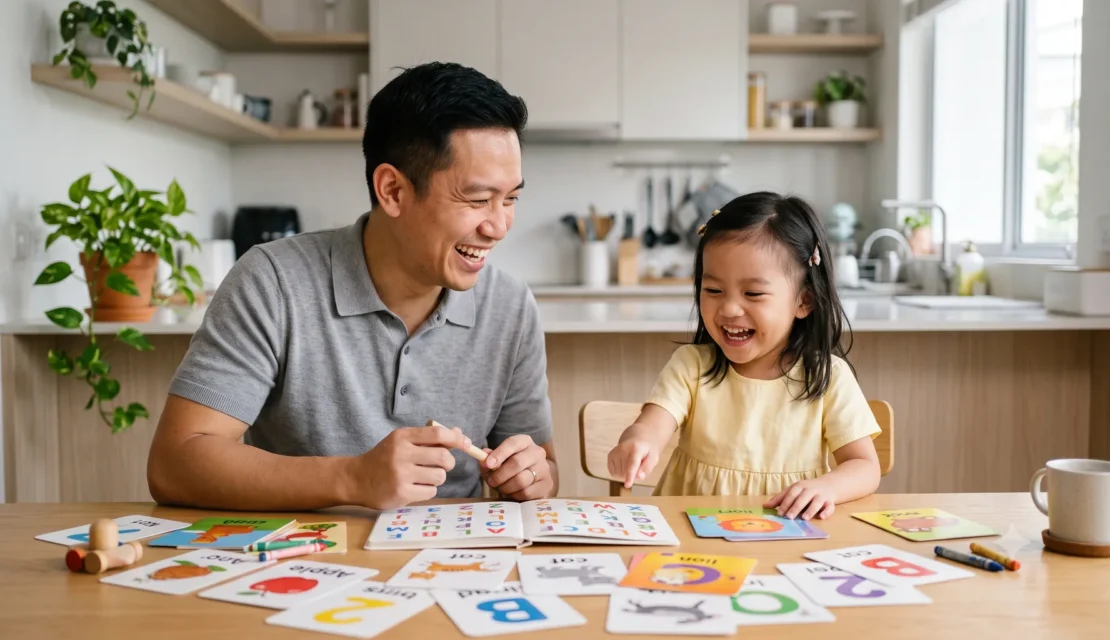
- Flashcards turned into a treasure hunt, “Find the letter S in the room!”
- A two minute “speed round” where silly answers are allowed first, then real answers
Play lowers the stakes, and lower stakes build confidence.
Create a Tiny Routine for the Night Before and Morning Of
A predictable routine reduces uncertainty, which is a major anxiety trigger. Keep it simple so you can actually maintain it on busy days.
Night before:
- Pack the bag together and choose clothes
- Do a short review, then stop before your child is tired
- Early bedtime with a calm story, not a last-minute drill
Morning of:
- A steady breakfast and water
- Two slow breaths together
- One encouraging reminder, then move on
The goal is “calm and consistent,” not “intense and perfect.”
Teach One Body Tool for Panic Moments
When your child’s body is in fight or flight, logic does not land. You need a physical tool that helps the body settle first.
Two simple options that work well for preschoolers:
- “Smell the flower, blow the candle,” two slow breaths
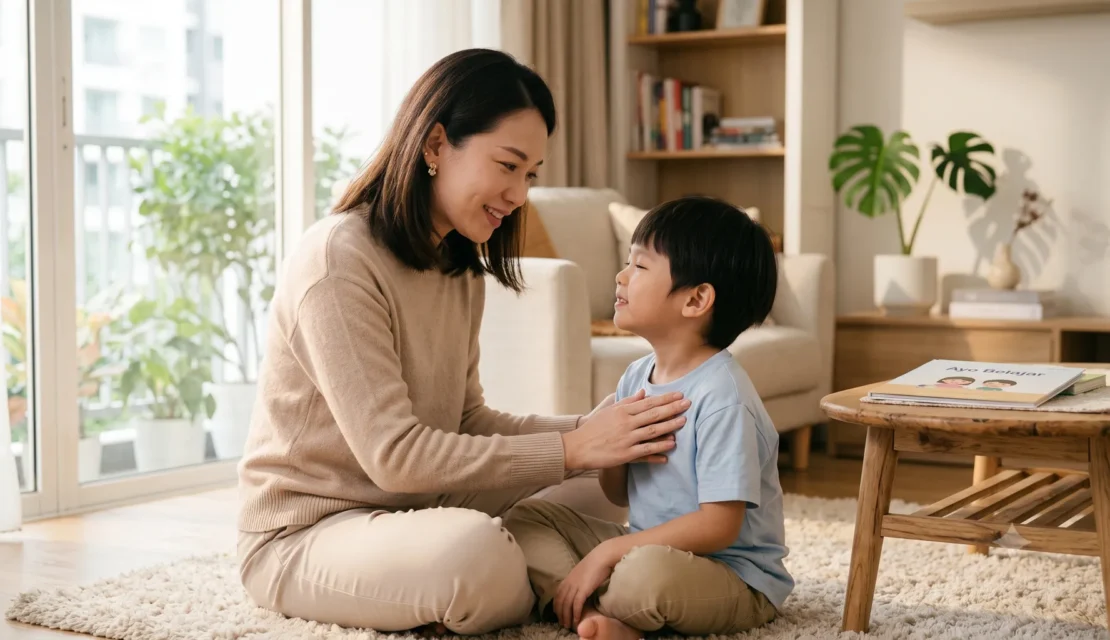
- “Butterfly hug,” cross arms, tap shoulders slowly while breathing
If you practise these when your child is calm, they are easier to use when your child is stressed.
What Not to Do When Your Child Is Anxious Before Tests
Some common parent instincts accidentally make anxiety stronger. This is not because you are doing it wrong, it is because parenting is basically improvisation with no rehearsal.
Avoid These Anxiety Amplifiers
- Threats or consequences like “If you fail, no screen time,” because fear is already the problem
- Over-reassurance like repeating “It’s easy,” because your child might think “Then why can’t I do it?”
- Last-minute cramming, because it tells the brain “We are not ready,” even if you are
- Comparing siblings or friends, even as motivation, because comparison creates shame fast
If you slip, just reset. Repair works better than guilt.
How We Support Confident Learners at School
At Apple Tree Preschool BSD, we build skills that prevent test anxiety from growing in the first place. We focus on routines, encouragement, and a classroom culture where mistakes are normal and trying again is celebrated.
Our Singapore curriculum approach covers English, Mathematics, Chinese, Science, Bahasa, Moral, Music, Physical Education, and Phonics, but the emotional foundation matters just as much as the academics. Children practise listening, taking turns, answering questions, and speaking up in low-pressure ways, so “being assessed” feels familiar rather than scary.
If you want to see how we structure learning by age and readiness, explore our programs. Many parents find it easier to support study habits and confidence at home when school and home routines feel aligned.
A Simple Home Plan for the Week Before a Test
If a test is coming up and your child is already spiraling, keep the plan small and consistent. Big plans often collapse under real life, and then everyone feels worse.
Here’s a simple approach:
- Day 1: Review for 10 minutes, end with something fun
- Day 2: Practise the hardest part first for 5 minutes, then an easy win
- Day 3: Do a pretend test as a game, then stop
- Day 4: Teach-back day, your child “teaches” you what they know
- Day 5: Light review only, early bedtime
Your child learns, “I can handle this,” because you are showing them that progress is built in small steps.
A Softer, Braver Test Day Starts With Support
Child anxiety before tests is not a character flaw, it is a skills gap. When you give your child a calm routine, a few coping tools, and a steady message that effort matters more than perfection, fear loses its grip. Over time, your child stops seeing tests as danger and starts seeing them as one more chance to show what they know.
If you want your child to practise confidence, communication, and learning readiness every day in a supportive environment, we would love to meet your family at Apple Tree. We are right here in the Educenter BSD Building, and we are always happy to talk through what your child needs.
Come play and learn with other children!
Chat with us on WhatsApp or call +62 888-1800-900 to ask about schedules, availability, and the best class for your child.





Be the first to write a comment.