
Teaching child emotional intelligence often starts at the exact moment you least feel like teaching anything at all, like when you are carrying groceries, your child is crying because “the banana broke,” and time is moving suspiciously fast toward bedtime. We see this every day at Apple Tree Preschool BSD in the Educenter BSD Building, and here’s the honest truth: emotional intelligence is not built in calm, perfect moments. It is built in real moments, messy moments, loud moments, and sometimes “we need five minutes” moments.
If you want your child to grow into someone who can manage feelings, handle frustration, communicate needs, and still be kind to others, you are in the right place. You do not need to raise a tiny therapist. You just need a few consistent habits that help your child understand emotions and respond to them with better choices over time.
Teaching Child Emotional Intelligence: What It Actually Means
Emotional intelligence is not “never crying” and it is definitely not “always being nice.” In young children, emotional intelligence means noticing feelings, naming feelings, and learning what to do with feelings without harming themselves or others. It also includes empathy, the ability to understand that other people have feelings too, even when your child thinks they are clearly being unreasonable, like when you will not let them eat candy for breakfast.
The Building Blocks of Emotional Intelligence for Kids
In practical terms, you are teaching your child five core skills:
- Recognizing emotions in themselves
- Naming emotions with simple words
- Calming their body when emotions get big
- Expressing needs respectfully
- Understanding others’ feelings and making repairs when needed
If you focus on these, you will see fewer explosive moments over time, and more “I’m upset” instead of “AAAAAA.”
Why This Matters More Than “Good Behavior”
Good behavior without emotional skill is fragile. It holds until your child is tired, hungry, or pushed by a tough social moment, then it falls apart. Emotional intelligence is what makes behavior stable, because it gives your child internal tools, not just external rules.

Why Kids Struggle With Big Feelings (And Why It’s Normal)
Young children have strong emotions and limited control. That is not a defect, it is development. Their brains are still building the wiring needed for impulse control, patience, and flexible thinking.
Your Child Is Not “Too Sensitive,” They Are Still Learning
When your child melts down over small things, it is often because their nervous system is overloaded. Adults call it “small,” but for a child, it can feel huge. If you treat every big emotion like a character flaw, your child learns shame, not regulation.
Common Triggers That Hijack Emotional Control
You will often see worse emotional regulation during:
- Transitions, like leaving the playground or stopping screen time
- Social conflict, sharing, waiting, being left out
- Low energy moments, late afternoon or before meals
- Overstimulation, loud places, crowded schedules, too many activities
Knowing triggers helps you plan ahead and support earlier, when your child is still reachable.
Practical Ways to Teach Emotional Intelligence at Home
You do not need a long daily lesson. You need small, repeatable micro habits that show up in everyday life.
Name Feelings Out Loud, Often
Children can’t manage what they can’t name. Start with simple emotion words and use them in real contexts.
Try phrases like:
- “You look frustrated because it’s not working yet.”
- “You feel disappointed because we have to go home.”
- “You’re excited, your body is moving fast.”
This teaches emotional vocabulary and also shows your child that feelings are normal and speakable.
Validate the Feeling, Hold the Boundary
Validation is not giving in. It is acknowledging reality. You can validate feelings while keeping limits firm.
A useful pattern is: “I see you feel X. The rule is Y. We can do Z.” Example: “I see you’re angry. We are not hitting. You can stomp your feet or squeeze a pillow.”
Teach One Calm Down Tool and Practice When Calm
Children cannot learn new skills in the middle of a meltdown. Practice regulation tools when your child is already calm, like a drill before the real game.
Simple tools that work well for preschoolers:
- “Smell the flower, blow the candle,” two slow breaths
- “Turtle body,” tuck arms in, hug yourself, breathe slowly
- “Hands on tummy,” feel it rise and fall for three breaths
The goal is not instant calm. The goal is a small shift toward control.
Teaching Child Emotional Intelligence Through Everyday Routines
Routines are emotional intelligence training in disguise. They teach predictability, flexibility, and recovery when things do not go perfectly, which is basically life.
Use “First, Then” to Reduce Power Struggles
Many emotional explosions come from transitions. “First, then” makes transitions predictable and reduces the feeling of sudden loss.
Examples:
- “First clean up, then story.”
- “First shoes, then playground.”
- “First bath, then pajamas.”
This helps your child practice patience and delayed gratification, both key emotional skills.
Give Choices That Are Real, But Limited
Too much control can overwhelm children, but zero control can trigger resistance. Offer two acceptable choices.
Try: “Do you want the red cup or blue cup?” or “Do you want to brush teeth first or wash face first?” You keep the boundary, your child keeps dignity, and everyone keeps their remaining sanity.
Empathy and Social Skills: The Other Half of Emotional Intelligence
Emotional intelligence is not only self-control. It is also understanding others. This is where friendships become easier and conflicts resolve faster.
Teach Perspective With Simple Questions
After a conflict, when your child is calm, ask short questions:
- “How do you think your friend felt?”
- “What could we do to help?”
- “What can we say next time?”
Do not force a perfect answer. You are training the habit of noticing.
Teach Repair, Not Perfection
Children will mess up. That is guaranteed. The goal is teaching repair skills, not demanding perfect behavior.
Repair phrases to practice:
- “I’m sorry.”
- “Are you okay?”
- “Can I try again?”
- “Do you want a hug or space?”
A child who can repair becomes confident socially, because mistakes stop being disasters.
What to Avoid When You Are Teaching Emotional Intelligence
Some common adult responses accidentally teach the opposite of emotional intelligence. This is not about blaming parents. It is about reducing friction.
Common Missteps That Backfire
- Saying “Stop crying” teaches suppression, not regulation
- Saying “You’re fine” can feel dismissive, especially to sensitive kids
- Punishing feelings instead of behavior teaches shame
- Over-explaining during a meltdown overloads the brain even more
When emotions are high, keep language short, calm, and repetitive.
How We Support Emotional Intelligence at Apple Tree
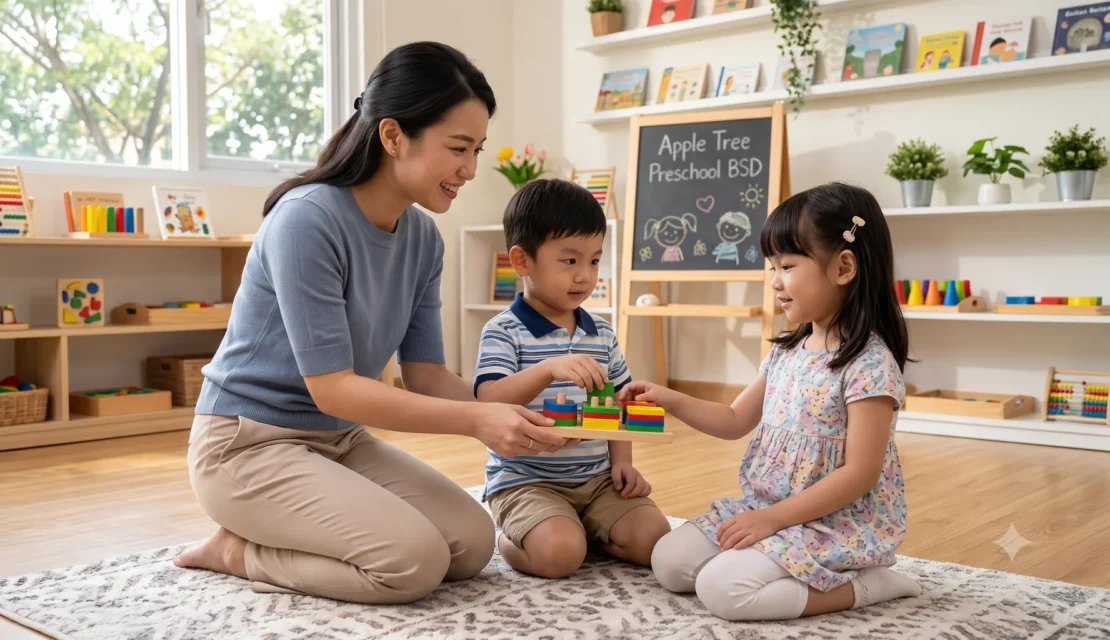
At Apple Tree Preschool BSD, we treat emotional intelligence as a core life skill, not an extra. In the classroom, children practice sharing, turn-taking, asking for help, handling disappointment, and repairing after conflict in real time, with teacher guidance.
Our Singapore curriculum covers English, Mathematics, Chinese, Creativity, Social Studies, Science, Bahasa, Moral, Music, Physical Education, and Phonics, and emotional learning fits naturally into all of it. Children learn best when they feel safe, connected, and understood, and social emotional skills are the foundation for that.
If you want to see how learning and social development are structured by age, you can explore our programs.
A Simple Weekly Plan You Can Start This Week
If you want to make teaching child emotional intelligence easier, keep it small and consistent.
- Pick one feeling word each day and use it in real moments
- Practice one calm down tool once daily when your child is calm
- Do one short empathy question after playtime or school
- Celebrate one repair moment, even if it’s tiny
This is how skills grow, through small reps that fit into real life.
Build a Calmer Home, One Skill at a Time
Teaching child emotional intelligence does not mean your child will never melt down again. It means meltdowns become shorter, recovery becomes faster, and your child starts using words and tools instead of getting stuck in big feelings.
If you want your child to practice these skills every day in a warm, structured environment, come visit us in the Educenter BSD Building and see how we support emotional growth alongside strong academics. We would love to help you find the right class fit and share routines you can use at home too.
Register now, or come play and learn with other children!
Chat with us on WhatsApp or call +62 888-1800-900.





Be the first to write a comment.