


If your sensitive child cries easily, you probably know how quickly a normal day can turn into a full emotional weather report. One sock feels funny, the banana breaks in half, a friend says something odd, and suddenly everyone in the house is blinking a little faster. At Apple Tree Pre-School BSD, located in the Educenter BSD Building, we meet many children who feel things deeply, and we also meet many parents who quietly wonder, “Is this normal, and am I handling it the right way?”
The short answer is yes, it can be very normal. Some children are simply wired to notice more, feel more, and react more strongly to what happens around them. The good news is that sensitivity is not a weakness, and with the right support, your child can grow into a thoughtful, confident, and emotionally strong little human.
Sensitive Child Cries Easily, What Does It Really Mean?
When a sensitive child cries easily, it does not always mean something is wrong. Often, it means your child has a strong emotional radar and a nervous system that picks up on changes, pressure, noise, disappointment, and even your mood faster than you might expect. In other words, your child is not trying to be difficult, your child is trying to cope.
As educators, we often tell parents that tears are communication. Young children do not always have the words to say, “I feel overwhelmed,” or “That change was too sudden for me,” so the feelings come out through crying, clinginess, silence, or dramatic floor level protests. Yes, sometimes the floor becomes their stage, and they perform like the audience paid for VIP tickets.
Some children feel everything more intensely
A child who cries over small things may actually be experiencing those “small things” as big things. A loud room, a rushed morning, a change in routine, or a confusing instruction can hit them hard. What looks minor to you may feel huge to them.
This is why comparing children rarely helps. One child shrugs things off, another needs time to process, and both are normal. Your job is not to toughen your child up overnight, but to help your child build healthy ways to handle big feelings.
Sensitivity can be a strength in disguise
Children who are emotionally sensitive are often deeply empathetic, observant, creative, and thoughtful. They notice when a friend is sad, they pick up on tone quickly, and they usually care a lot about fairness and connection. Those qualities are beautiful, even if they arrive with tears and a lot of dramatic sighing.
When we support sensitivity well, we are not “fixing” a child. We are teaching that child how to understand emotions without being completely knocked over by them.
Why Your Child May Be Crying So Often
Understanding the reason behind the tears helps you respond more calmly. If you only focus on stopping the crying, you may miss what your child actually needs.
Common triggers for a sensitive child who cries easily
Here are some common reasons children become emotional very quickly:
- Changes in routine
- Tiredness or hunger
- Overstimulation from noise or busy environments
- Separation from parents
- Feeling misunderstood
- Frustration when they cannot express themselves
- Social struggles with peers
- Pressure to do something before they feel ready
Sometimes it is one clear trigger. Sometimes it is a stack of tiny things that build up until one dropped cracker causes a full emotional collapse. We have seen it happen, and honestly, the cracker was never the real issue.
Your child may need help naming feelings
Many children cry because they do not yet know what they are feeling. They may be sad, disappointed, embarrassed, anxious, frustrated, or simply overwhelmed. When all those feelings get mixed together, crying becomes the quickest exit.
You can help by naming emotions in simple language. Try saying, “You look disappointed,” or “That felt too hard for you just now.” When children hear the words for their feelings again and again, they slowly learn how to identify and manage them.

What You Can Do at Home
A sensitive child cries easily, but that does not mean home has to feel like an emotional emergency room every day. Small changes in your response can make a big difference over time.
Stay calm first, solve second
When your child is crying, your calm matters more than your speech. If you immediately jump into lectures, corrections, or panic mode, your child usually becomes more overwhelmed. Start with connection, then move into guidance.
A simple rhythm often works best:
- Pause and stay close
- Acknowledge the feeling
- Keep your voice steady
- Offer a simple next step
You do not need a long speech. In fact, when children are upset, long speeches tend to float right past them like background music in a supermarket.
Create predictable routines
Sensitive children usually do better when they know what is coming. Predictability helps them feel safe, especially during transitions like waking up, leaving home, starting school, mealtimes, and bedtime. Routine lowers stress before stress has a chance to grow.
If mornings are hard, keep the routine simple and consistent. If evenings are chaotic, slow things down with a familiar sequence like bath, pajamas, story, cuddle, sleep. Repetition may feel boring to adults, but for children it feels comforting.
Teach recovery, not suppression
The goal is not to tell your child, “Stop crying.” The goal is to teach, “You can feel upset and still find your way back.” That is a very different lesson.
You can teach recovery skills like:
- Taking slow breaths together
- Hugging a pillow or comfort toy
- Asking for help with words
- Sitting in a quiet corner for a reset
- Drinking water and pausing before trying again
These tools help your child move through emotion instead of feeling trapped inside it.
How School Support Makes a Difference
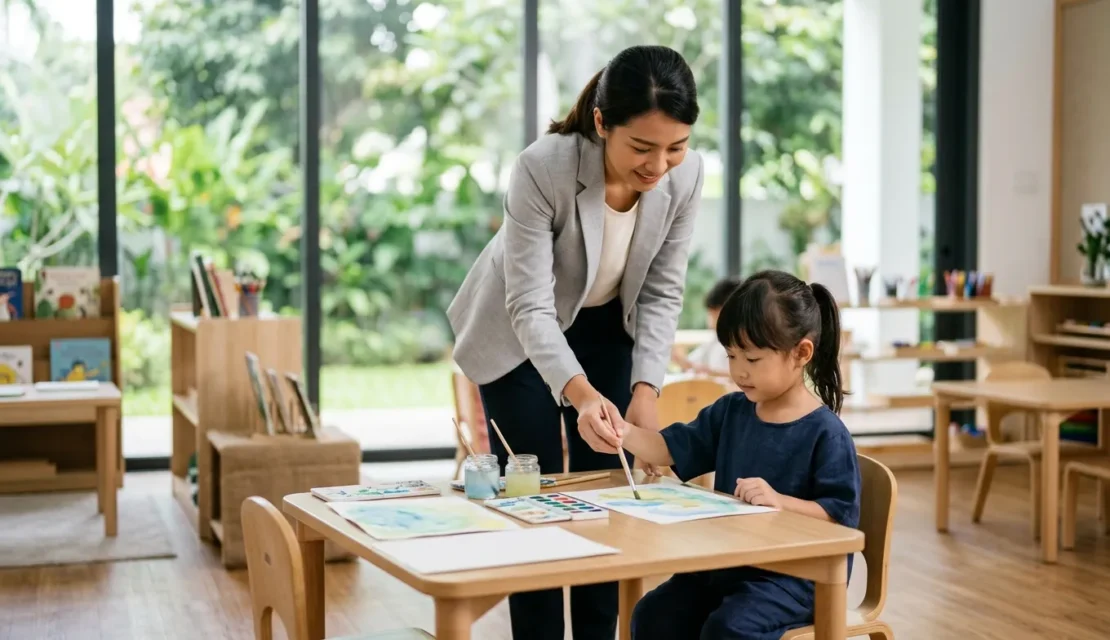
A child who is sensitive needs an environment that feels safe, warm, and predictable. That is why choosing the right school matters so much. At Apple Tree, we believe children learn best when they feel understood, not rushed.
Our classrooms are designed to support both confidence and emotional security. Through our Singapore based curriculum and caring classroom routines, we help children build communication, independence, and resilience while still feeling supported. If you want to explore the right fit for your little one, you can see our programs and find the class that matches your child’s age and stage.
Teachers and parents need to work together
When a sensitive child cries easily, consistency between home and school is incredibly helpful. If teachers and parents use similar language, similar routines, and similar calming strategies, children adapt faster. They begin to trust that the adults around them understand how to help.
We always encourage open communication with parents. Sometimes one small detail, like a rough morning, poor sleep, or a recent family change, explains a lot. The more we know, the better we can support your child with kindness and patience.
Growing Strong, Without Losing That Soft Heart
If your sensitive child cries easily, try to remember that sensitivity is not something to be embarrassed about. Your child is not “too much,” and you are not doing a bad job. With steady support, emotional coaching, and the right learning environment, sensitive children often grow into wonderfully aware, caring, and resilient people.
If you are looking for a preschool that understands children gently and works closely with parents, we would love to welcome you to Apple Tree Pre-School BSD. You can Chat with us on WhatsApp or call us at +62 888 1800 900 to learn more about classes and daily routines. Come play and learn with other children, and let us help your little one feel safe, confident, and happy at school.





Be the first to write a comment.