


If your child afraid of public speaking suddenly “forgets” every word the moment someone looks at them, you are not imagining it, and your child is not being dramatic. We see this often at Apple Tree Pre-School BSD in the Educenter BSD Building, where even confident kids can freeze when it is their turn to speak. The weird part is that many of these same children can talk nonstop at home about dinosaurs, Roblox, or why their sock “feels suspicious,” but the moment an audience appears, their voice disappears. If that sounds familiar, you are in the right place.
You probably want two things at once: you want your child to feel brave, and you want the process to not become a daily struggle. Good news, you can build speaking confidence without forcing your child into scary situations or turning every family dinner into a performance review.
Helping a Child Afraid of Public Speaking: What’s Really Going On
Public speaking fear is rarely about the words. It is usually about attention, uncertainty, and the fear of being judged. Children often interpret “everyone is watching me” as “everyone is deciding if I am good enough,” even when the audience is just Grandma smiling like it is the cutest thing she has seen all year.
Signs Your Child’s Fear Is More Than Shyness
Shyness is a temperament. Fear is a stress response. A child afraid of public speaking may show:
- Avoidance, hiding behind you, refusing to participate, or suddenly needing the toilet
- Physical symptoms like tummy aches, sweating, shaky voice, or tears
- Perfectionism, refusing to try unless they can do it “perfectly”
- Anger or silly behavior as a cover, because embarrassment feels unbearable
These signs are not proof your child is “not confident.” They are proof your child needs tools and safe practice.
Why It Can Start So Young
Children learn fast from small moments. One laugh from classmates, one rushed correction from an adult, one experience of being put on the spot, and their brain decides speaking is dangerous. Some kids are also more sensitive to attention naturally, which means they need smaller steps and more predictability.
What Not to Do With a Child Afraid of Public Speaking
It is tempting to “fix it” quickly, especially if you feel worried about school presentations later. But a few common approaches can backfire by making speaking feel even more threatening.
Avoid Forcing “Just Do It” Moments
Pushing a scared child onto a stage style situation can create a memory of panic, not growth. You might get compliance once, but you pay for it later with more resistance and more fear.
Avoid Over-Reassurance That Accidentally Dismisses Feelings
Saying “There’s nothing to be scared of” can sound logical to adults, but it often lands as “Your feelings are wrong.” Better is: “It feels scary, and we can practice little by little.”
Avoid Critiquing Performance Right After
If your child speaks up, even a little, do not jump into “Say it louder next time.” In that moment, your child needs safety, not a review. You can coach later, gently, when their body is calm.
Step by Step Strategies That Actually Build Speaking Confidence
Confidence comes from repeated success, not from pep talks. The goal is to build a ladder where each rung is slightly challenging but still achievable.
Start With “Private Practice” at Home
Before you ask your child to speak in front of people, help them practice speaking with zero pressure. That might look like telling a short story to a stuffed animal or explaining a drawing to you.
Keep it short. One to two minutes is enough at the start. End while your child still feels successful.
Use the “Small Audience Ladder”
A child afraid of public speaking needs gradual exposure that stays within their tolerance. Try this progression:
- Speak to you alone
- Speak to you plus one trusted person, like Dad or a sibling
- Speak to two people, like both parents
- Speak to a small group, like three to five family members
- Speak in a familiar setting, like a playdate “show and tell” moment
Move up only when the current step feels mostly comfortable. If your child panics, the ladder rung is too high right now.
Practice “Micro Scripts” Instead of Long Speeches
Long speeches feel overwhelming. Micro scripts feel doable. Help your child memorize one simple structure:
- “This is my ___.”
- “I like it because ___.”
- “Thank you.”
That is it. Short, clear, and repeatable. Once your child trusts their script, you can expand it slowly.

Teach Body Tools for the Moment Fear Hits
When fear spikes, the body takes over and language shuts down. You cannot reason your way through fight or flight, you have to calm the body first.
Use Two Simple Calm Down Tools
Pick one or two tools and practice them when your child is calm, not only when they are anxious.
- “Smell the flower, blow the candle,” two slow breaths
- “Grounding feet,” press feet into the floor and count three slow breaths
Tell your child this is not a trick to “stop feeling scared.” It is a tool to help the body feel safer while they speak.
Make a “Reset Plan” for Freezing
Freezing is common. Prepare a plan so your child knows what to do if their mind goes blank.
A simple reset plan:
- Pause
- Take one slow breath
- Say, “I need a second” or “Can you help me?”
That single sentence is powerful. It turns freezing into communication, which is a win.
Turn Speaking Practice Into Play, Not Pressure
Children learn faster through play because play lowers the stakes. If you make speaking practice fun, your child will do more reps without feeling forced.
Try Pretend “Microphone Time”
Use a toy microphone, a spoon, or anything your child finds funny. Give each person in the family one turn to say something short. The rule is that everyone claps, even if someone says, “My favorite food is rice,” and then runs away laughing.
This normalizes speaking and makes it safe. It also shows your child that everyone gets nervous sometimes, and nobody dies.
Use Storytelling Games
Try:
- “Tell me three things about your day”
- “Make up a story using a cat, a banana, and a rainstorm”
- “Teach me how to play your favorite game”
Teaching is a form of public speaking with training wheels. It builds voice, structure, and confidence.
Helping Your Child Afraid of Public Speaking at School Age
As children get older, speaking becomes more formal. That is where habits you build now really pay off.
Focus on Preparation, Not Perfection
Perfectionism makes speaking terrifying because it turns mistakes into disasters. Teach your child that the goal is clarity, not flawless performance.
You can say: “We want you to be understood, not perfect.” That one line often reduces pressure immediately.
Build Familiarity With “Practice Like the Real Thing”
If your child has a show and tell or presentation, practice in a similar way:
- Stand up
- Hold the object or note card
- Speak for one minute
- End with “Thank you”
Keep practice short and frequent rather than long and exhausting. Five minutes a day beats a one hour rehearsal that ends in tears.
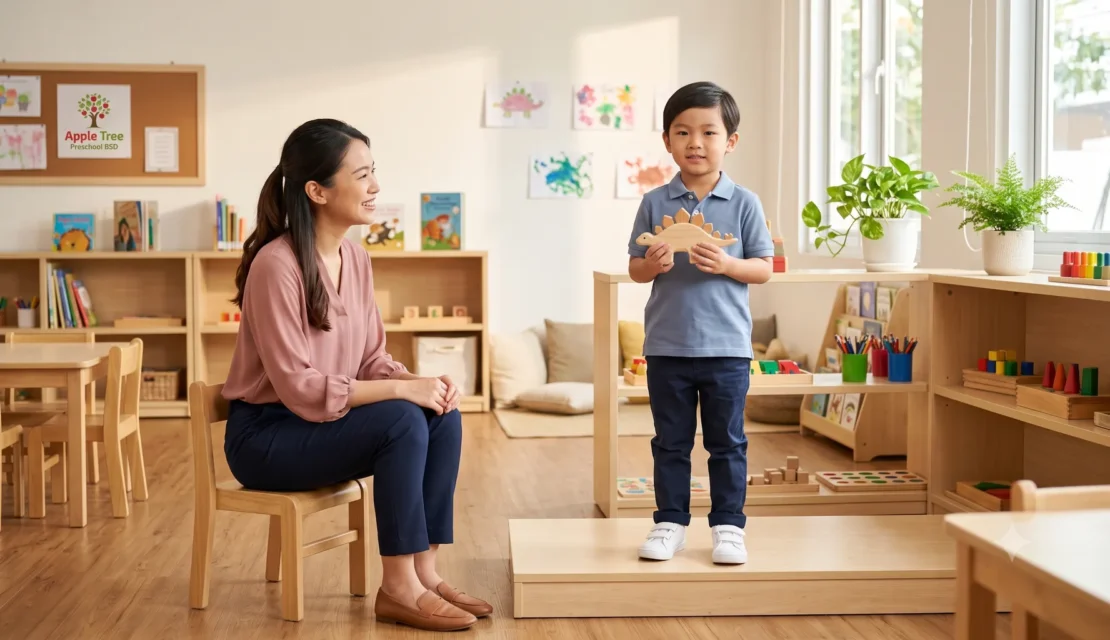
How We Support Speaking Confidence at Apple Tree
At Apple Tree Pre-School BSD, we build speaking confidence through daily routines that feel safe, not stressful. Children practice greeting, sharing ideas, answering simple questions, storytelling, and performing in small ways, all supported by warm teachers and predictable classroom structure.
Our Singapore curriculum includes English, Chinese, Moral, Social Studies, Music, and more, and speaking skills naturally grow inside those activities. Children gain confidence when they feel seen, respected, and allowed to try again without embarrassment.
If you want to see how our classes support communication at each age, you can explore our programs. Matching home routines with school routines often makes a big difference.
Your Next Small Step Can Start Today
If your child afraid of public speaking, you do not need to “fix” it in one week. You just need a steady plan that creates small wins. Start with one micro script, one calm down tool, and one tiny audience. Then repeat.
A simple weekly starter plan:
- Day 1: Your child speaks to you for 30 seconds about a toy
- Day 2: Same script, add “thank you”
- Day 3: Same script, record audio only, no video
- Day 4: Repeat with one extra family member listening
- Day 5: Celebrate effort, no coaching, just pride
Small wins build courage. Courage builds confidence. Confidence builds a voice that shows up when it matters.
Come Practice Brave Moments With Us
If you want your child to grow into a confident communicator, we would love to support you. Helping a child afraid of public speaking is easier when your child practices speaking skills daily in a warm environment, with teachers who know how to guide gently without pushing too hard.
Visit us at the Educenter BSD Building and see how we help children grow smart and happy, together with parents.
Come play and learn with other children!
Chat with us on WhatsApp or call +62 888-1800-900 to ask about schedules and class availability.





Be the first to write a comment.