
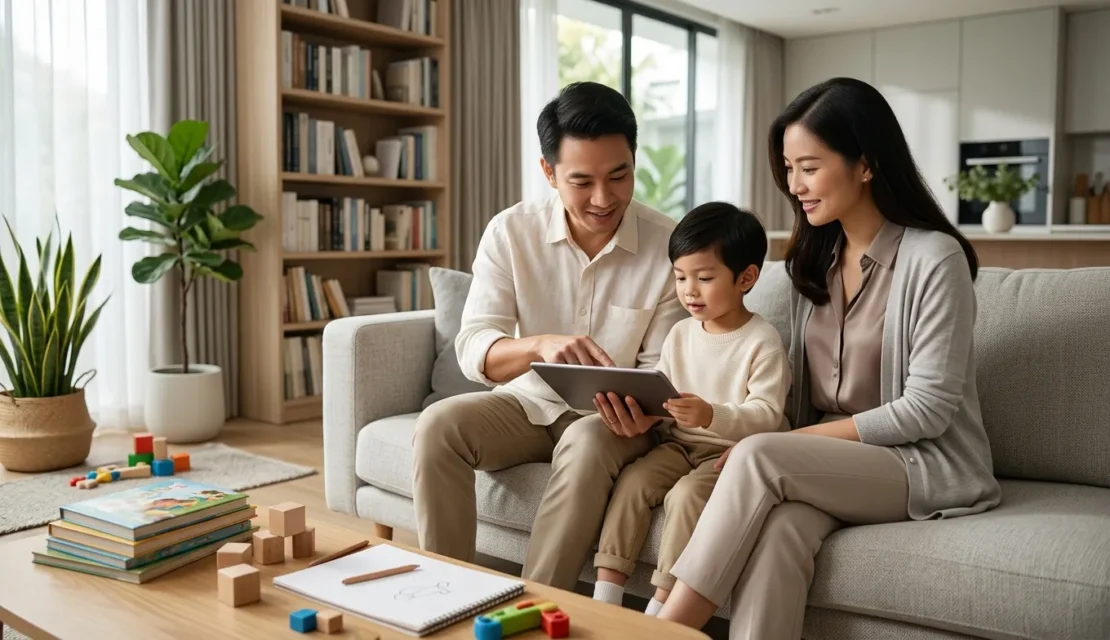
If you have ever looked up from making dinner and realised your child has been staring at a screen long enough to forget that blinking is still a thing, you are not alone. At Apple Tree Preschool BSD, located in the Educenter BSD Building, we talk with families all the time about Screen time guidelines, because modern parenting now includes the daily puzzle of balancing cartoons, learning apps, video calls, and the occasional “just five more minutes” that somehow turns into half an hour. The goal is not to make screens the villain of the story. The goal is to use them wisely, so your child’s eyes, sleep, mood, and growing brain all stay in a healthy place.
The truth is, screens are now part of childhood. That is just reality. But healthy boundaries still matter, especially in the preschool years, when your child’s body and brain are learning at full speed and need much more than passive watching to thrive.
Screen Time Guidelines for Young Children Today
The latest Screen time guidelines are less about one magical number for every child and more about age, quality, timing, and what screen use is replacing in everyday life. The American Academy of Pediatrics says there is not one fixed limit that fits all children, and recommends parents focus on the content, the context, and family habits around media use.
For younger children, though, the recommendations are still quite clear. The World Health Organization says no screen time is recommended for children under 1, no screen time for 1 year olds, no more than one hour for 2 year olds, and no more than one hour for ages 3 to 4, with less being better. The AACAP also notes that for children ages 2 to 5, non educational screen time should be about one hour on weekdays and around three hours on weekend days.
Why these screen time guidelines matter so much
Young children do not just need entertainment. They need sleep, movement, messy play, conversation, eye contact, outdoor time, and all the wonderfully ordinary experiences that build strong development. When screens start taking over too much of the day, those other essentials quietly get pushed aside.
That is why Screen time guidelines are really about protecting the bigger picture. We are not only limiting devices. We are protecting opportunities to run, imagine, talk, rest, and connect.

How Too Much Screen Time Affects Eyes and Mental Health
This is where things get personal for many families. You are not just wondering about numbers on a chart. You are noticing real things at home, tired eyes, late bedtimes, cranky moods, shorter attention spans, and a child who somehow melts down when the tablet disappears.
Eye strain is real, even for children
Eye specialists warn that screen use can cause eye strain, eye pain, headaches, and blurry vision in children. One reason is simple. Screens are a close up task, and children often stay so focused that they blink less and keep their eyes working hard for long stretches.
The American Academy of Ophthalmology recommends the 20 20 20 rule, which means every 20 minutes, children should take a 20 second break and look at something 20 feet away. Experts also recommend avoiding screen use in bright glare and encouraging good posture while using devices. Small habits like these make a surprisingly big difference.
Mental health and mood can take a hit too
Not all screen time affects children the same way, but too much fast paced or poorly timed media can leave children overstimulated, irritable, and emotionally worn out. You may notice more whining, more resistance, and that mysterious end of day mood where absolutely everything feels like a crisis, including the wrong colour spoon.
Sleep is also part of this conversation. When screen use runs late into the evening, children miss the calm wind down their brains need before bedtime. That can affect emotional regulation the next day, which means one restless night may lead to one very dramatic morning.
Practical Screen Time Guidelines That Actually Work at Home
The best Screen time guidelines are the ones you can genuinely follow on a normal Tuesday, not just the ones that sound nice in theory. Families need rules that are clear, realistic, and calm enough to maintain even when life gets busy.
Keep screen time tied to purpose, not habit
Before handing over a device, ask one simple question: what is this screen for right now? Is it educational, social, calming, or just filling a gap because everyone is tired and needs ten quiet minutes? No judgment there, by the way. We have all had days like that.
Being intentional helps you avoid the automatic slide into endless viewing. It also helps your child understand that screens are one tool among many, not the default setting for every spare moment.
Set clear family rules children can predict
Children cope better with boundaries when the routine is consistent. You do not need a ten page media contract pinned to the fridge, though that would be impressive. You just need a few dependable household rules.
Some helpful examples include:
- No screens during meals
- No screens one hour before bedtime
- Screen time only after outdoor play or reading
- Educational content first, entertainment second
- Devices stay in shared family spaces
Predictable rules reduce negotiation. And less negotiation is good for everyone’s blood pressure.
Choose quality over quantity whenever possible
The AAP emphasizes quality and context, not just total minutes. A short, thoughtful program watched with conversation is not the same as endless random videos playing in the background. The content matters. So does whether your child is alone with it or engaging with you around it.
When possible, watch together. Ask questions. Laugh together. Repeat a song. Turn the screen moment into a real interaction. That shift makes media more useful and much less passive.
Healthy Screen Habits That Protect Eyes and Emotions
If you want Screen time guidelines to work, daily habits matter as much as daily limits. Think of this as the part where the rules become routine.
Build breaks into every screen session
Do not wait until your child looks glazed over like a tiny office worker after a twelve hour shift. Plan breaks before they need them. Use the 20 20 20 rule for eye relief, and add movement breaks whenever possible.
A quick stretch, a walk to get water, or a silly dance in the middle of the room can reset both body and mood. Preschoolers are not designed for long sitting sessions. Frankly, many adults are not either.
Protect sleep like it is gold
Because it is. Good sleep supports attention, mood, growth, and learning. Keep screens out of the bedroom when possible, and switch to calmer offline routines before bed, like reading, puzzles, or storytelling.
This is one of the most important Screen time guidelines for mental health. A well rested child is usually more regulated, more cheerful, and much less likely to fall apart because their banana broke in half.
Make real life more interesting than the screen
This may be the most powerful trick of all. Children need alternatives that are genuinely engaging. Art supplies, building toys, books, outdoor play, music, pretend games, and family conversation all give children the kind of rich stimulation screens often replace.
At Apple Tree Preschool BSD, this is exactly why we build our days around movement, creativity, language, and hands on discovery. If you would like to see how that looks in daily practice, you can explore our programs. When children are deeply engaged in real experiences, screens naturally take up less space.
A Kinder Way to Raise Healthy Digital Habits
The best Screen time guidelines are not about guilt, fear, or pretending screens do not exist. They are about helping your child use technology in a way that protects their eyes, supports their mental health, and leaves plenty of room for sleep, play, movement, and connection. Start small, stay consistent, and remember that progress matters more than perfection.
If you are looking for a preschool where healthy routines, joyful learning, and whole child development all go hand in hand, we would love to welcome your family. Chat with us on WhatsApp or call us at +62 888-1800-900. Come play and learn with other children at Apple Tree Preschool BSD.



Be the first to write a comment.