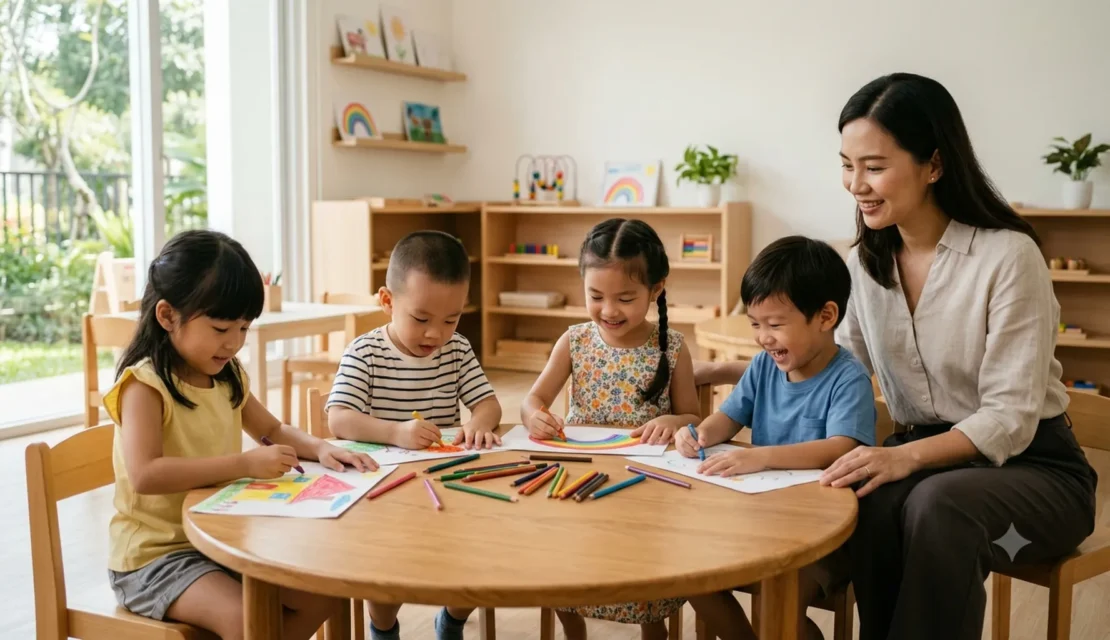
When you are encouraging child artistic talents, it can feel weirdly high pressure. One day your child draws a stick figure and you are calm, the next day they mix five crayons into one dramatic “brown” masterpiece and you start wondering if you are raising the next Picasso or just funding the crayon industry. At Apple Tree Preschool BSD, we meet lots of BSD parents who want to support creativity but also want a clear, practical way to do it without turning the living room into a permanent art explosion.
We teach and learn in the Educenter BSD Building, and being around families here has taught us something simple: kids do not need a “perfect” art parent. They need you to notice them, give them space, and not panic when glitter appears in places glitter should never be. If you have ever found a sticker on your shirt that you definitely did not put there, you are already part of the club.
We are going to share what actually helps your child’s artistic growth, what accidentally shuts it down, and how we support creativity at school in a way that also builds focus, language, confidence, and social skills. You will get easy ideas you can use at home, even if you are busy, even if you think you cannot draw, and even if you secretly hate slime.
Encouraging Child Artistic Talents Starts With the Right Mindset
If you want your child to grow artistically, the biggest “secret” is making art feel safe. Safe means they can try, mess up, change their mind, and still feel proud. When children feel judged, they stop experimenting, and experimentation is basically the whole point of art.
We often see parents accidentally treat art like a performance. You might mean well, but when the first question is “What is it” the child can feel like they need a correct answer. Try switching the goal from “make something pretty” to “explore and enjoy.”
Praise the process, not just the result
When you only praise the final picture, your child learns that the picture is the important part. When you praise effort and choices, your child learns that they are the important part. That is where confidence comes from, and confidence is what keeps kids creating even when it gets tricky.
Here are simple lines we use that you can steal:
- “I noticed you used lots of lines here, tell me about that.”
- “You kept going even when it got messy, that is real patience.”
- “You picked your own colors, I love how bold that is.”
Let your child lead the story
If your child says the purple circle is a “flying meatball princess,” we recommend you nod like this is completely normal. Because in their world, it is. When you accept their ideas, you are telling them their imagination is welcome, and that is a powerful message for creative development.
You do not need to correct them into realism. Realism can come later, and honestly, the flying meatball princess phase is more fun anyway.
Set Up a Home Environment That Makes Art Easy
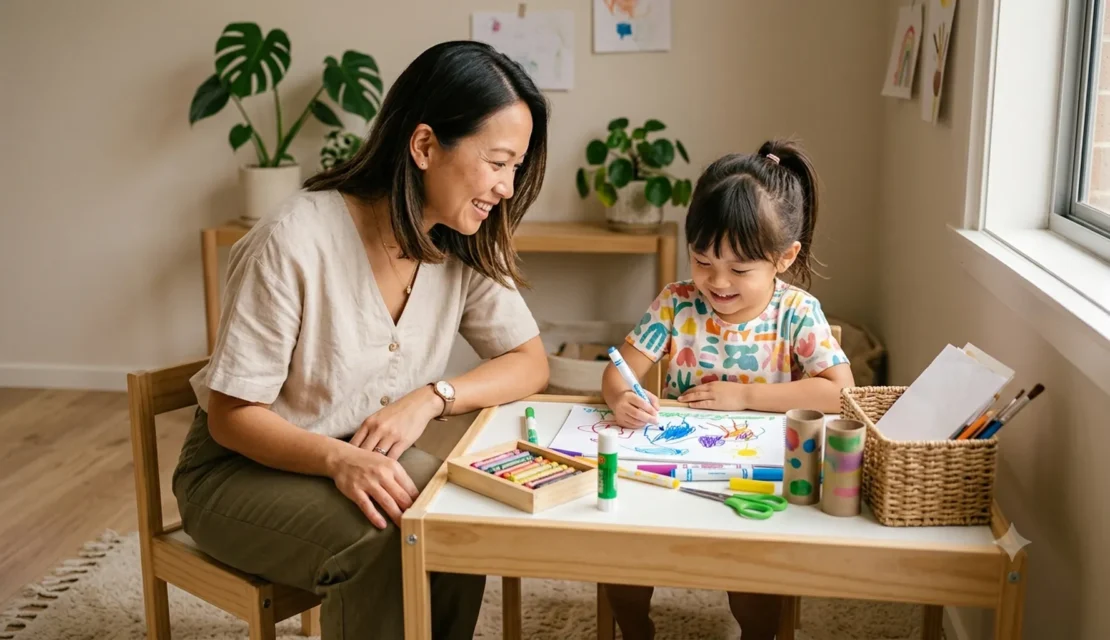
You do not need a fancy art room. You need fewer barriers between “I want to make something” and “I can start right now.” If the supplies are hard to access, children give up fast, and then you end up hearing “I am bored” every seven minutes.
Create a simple art corner you can actually maintain
Keep it small and doable. A basket and a flat surface is enough. The goal is not perfection, it is availability.
A starter kit that works for many families:
- Paper in different sizes, including scrap paper
- Crayons, colored pencils, washable markers
- Child safe scissors and glue stick
- A few recycled items like boxes, paper rolls, bottle caps
- Wet wipes for quick clean up, because reality
Make “mess rules” clear and calm
Kids can handle rules when rules are predictable. Instead of shouting mid activity, decide the boundaries before you start. That helps your child relax, and relaxed kids create more.
Try something like:
- “Art stays on the table.”
- “We wear the art shirt.”
- “When we finish, we clean together.”
If you do it consistently, your child will treat it like a normal routine, not a special event that ends in chaos.
Teach Skills Without Turning Art Into Homework
Yes, your child can learn real skills, but you want to sneak it in like vegetables in fried rice. If it feels like pressure, creativity shrinks. If it feels like play, skills grow naturally.
Offer “invitations” instead of instructions
An invitation is when you set something up and let your child choose what to do with it. You can place paper, crayons, and leaves on the table and say, “I wonder what we can make with these.” That is it. No lecture.
If you want to guide gently, give one tiny suggestion, then step back. Children need time to think and test ideas without someone hovering like a helicopter.
Build artistic muscles through mini challenges
Short, fun challenges build confidence. Keep them playful and optional, not mandatory.
Ideas you can try:
- Draw with only three colors
- Make patterns, then switch patterns
- Create a character, then give it a home
- Use music and draw what it “feels like”
These help with observation, planning, and problem solving, which support more than just art.
Support Creativity Through Language and Emotional Skills
Art is not only about making pretty pictures. It is also a way children communicate feelings and experiences before they have the vocabulary for it. When you are encouraging child artistic talents, you are also supporting emotional expression.
Ask open questions that invite sharing
Try questions that do not demand a correct answer:
- “What is happening in your picture?”
- “How did you choose these colors?”
- “Which part was the hardest, which part was the funniest?”
You will hear amazing things. Also, you may hear nonsense, and that is fine too. Nonsense is often a sign your child feels comfortable with you.
Help them handle frustration
Kids get frustrated when a drawing does not match what they imagined. That is normal and it is a big learning moment.
You can coach gently with:
- “Let’s try again on a new paper.”
- “We can add details step by step.”
- “It is okay if it looks different than you planned.”
This builds resilience, and resilience is basically the superpower behind creativity.
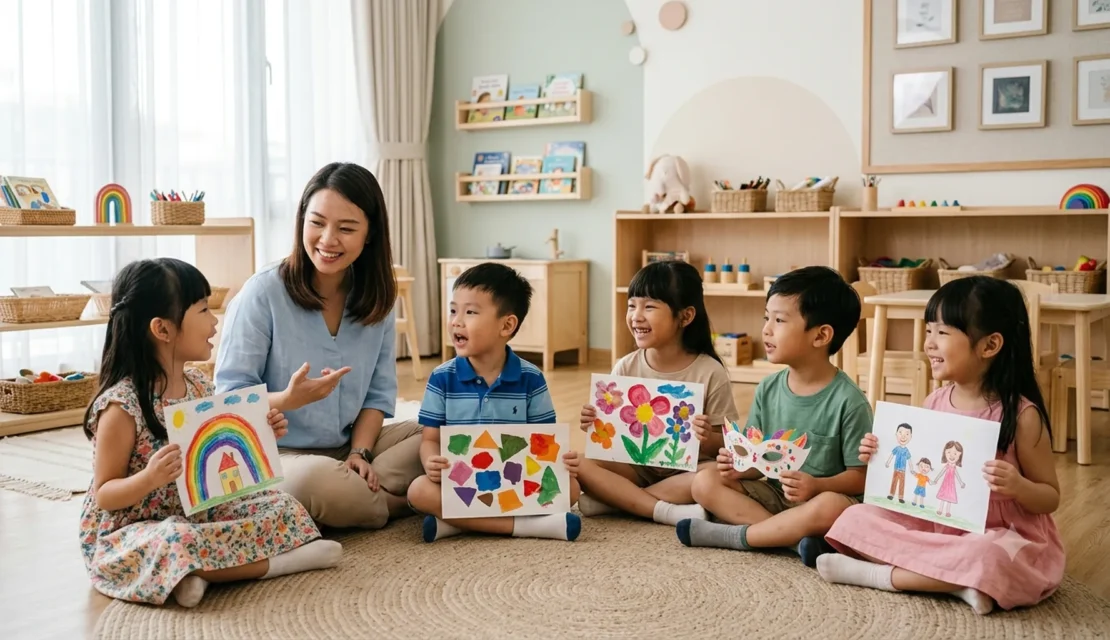
How We Nurture Artistic Talents at Apple Tree Preschool BSD
At school, we treat creativity as a core skill, not a bonus activity. We use an adopted Singapore curriculum covering English, Mathematics, Chinese, Creativity, Social Studies, Science, Bahasa, Moral, Music, Physical Education, and Phonics, and we weave creative thinking through all of it. Creativity shows up when children build, experiment, cooperate, and express themselves.
We also use routines that help children focus long enough to finish a project, but not so long that they melt into a puddle of fatigue. That balance matters. Art should feel satisfying, not draining.
We offer age appropriate classes with realistic class sizes:
- Toddler 2 times per week, age 1.5 to 2 years, 12 children per class
- Toddler 3 times per week, age 1.5 to 2 years, 12 children per class
- Pre Nursery, age 2 to 3 years, 16 children per class
- Nursery, age 3 to 4 years, 20 children per class
- Kindergarten 1, age 4 to 5 years, 20 children per class
- Kindergarten 2, age 5 to 6 years, 20 children per class
If you want to see which class fits your child’s stage best, you can check our programs and get a clearer picture of what your child will experience day to day.
Common Mistakes That Can Quiet Your Child’s Creativity
This part is not to make you feel guilty. We are parents and educators too, we have all said the wrong thing at the wrong time. The win is noticing it and adjusting.
Comparing your child to others
Even “positive” comparisons can backfire. If your child hears “Look, your friend draws better,” they may stop trying. Art is personal, and progress is not linear.
Correcting their art too quickly
If you jump in with “That is not how a cat looks,” your child learns that their ideas are not trusted. Try curiosity instead: “Your cat has such long legs, tell me about it.”
Over scheduling the week
Creativity needs downtime. If every afternoon is filled with classes, your child may have no space to daydream, explore, or play freely. Boredom, in small healthy doses, is often where imagination starts.
Let’s Grow Their Creativity Together, Without the Pressure
Encouraging child artistic talents is not about producing perfect artwork. It is about helping your child feel brave enough to try, proud enough to share, and calm enough to keep going when it gets messy. When you give your child time, materials, and supportive words, you are building creativity that will support learning in every subject.
If you would like your child to explore creativity in a warm classroom setting, with routines, guidance, and friends to learn alongside, we would love to welcome you to Apple Tree Preschool BSD.
Chat with us on WhatsApp Direct phone: +62 888-1800-900
Register now, come play and learn with other children, and let’s help your child’s creativity grow in a way that feels joyful for you and for them.



Be the first to write a comment.