
If your child easily distracted studying, you are not alone, and you are definitely not failing as a parent. We see this all the time with families who visit Apple Tree Pre-School BSD, and honestly, we get it because even we can forget what we were doing when someone mentions snacks. Our school is located in the Educenter BSD Building, and being surrounded by a community full of busy parents has taught us one thing, attention is a skill, not a personality trait.
We are going to talk about what distraction really looks like, why it happens, and what you can do at home without turning study time into a daily drama series. Along the way, we will also share how we build focus skills through play and routines inside the classroom, because yes, even toddlers can learn to focus, just not for an hour straight, and that is completely normal.
By the end, you will have practical strategies you can try today, plus a gentle option if you want your child to practice these skills with trained teachers and a consistent curriculum.
Child Easily Distracted Studying, What Is Really Going On?
When we say your child is easily distracted while studying, we usually mean they struggle to stay with one task long enough to finish it. They start writing, then suddenly need to sharpen a pencil that is already sharp, then remember they have not told you an extremely urgent story about a cat they saw last week. This is not “naughty” behavior, it is often a mix of development, environment, and habits.
Focus has layers. There is the ability to start a task, stay with it, ignore distractions, and come back when the mind wanders. Adults wobble on these too, especially when our phones are nearby pretending not to be interesting.
Common signs we see when a child easily distracted studying include:
- They keep switching tasks and do not complete simple steps.
- They need repeated reminders, even for routines they already know.
- They get frustrated quickly, then avoid the activity.
- They seem to focus well on games, but not on “study” tasks.
That last one is important. It usually means your child can focus, but the task design and the setting might not be helping.
When “Easily Distracted” Is Actually Age Appropriate
If your child is in toddler, nursery, or early kindergarten age, short attention spans are part of the package. A rough guide is that many children can focus for about two to five minutes per year of age on a teacher guided task, sometimes longer if it is hands on and fun. So if you expect a four year old to sit like a tiny university student, you are setting yourself up for disappointment and setting them up for tears.
We try to reframe it like this: your child is not broken, the expectation is just too big. Once we match the task to their developmental stage, the “distraction” often drops.
Why Your Child Easily Distracted Studying at Home
At home, distraction often comes from things you can actually adjust. We notice a few patterns again and again with BSD families.
First, the environment is full of cues. Toys, TV sounds, siblings, deliveries, and yes, your phone buzzing like it has its own agenda. Second, the tasks can feel abstract. Worksheets without context are harder than activities with movement and meaning. Third, routines might be inconsistent. If study time changes every day, the brain treats it like a surprise attack.
And sometimes, kids are simply tired, hungry, or emotionally overloaded. No one focuses well when they are running on fumes, not even us.
Practical Ways to Improve Focus Without Turning Into “Study Police”
We want you to imagine focus like a muscle. You do not build it by lifting a truck on day one. You build it by repeating small, doable challenges with rest in between.
Here are strategies that work especially well when a child easily distracted studying.
Make Study Time Shorter, Then Win More Often
Instead of pushing for one long session, go for short bursts and celebrate finishing. We often suggest a simple cycle like this: do a small task, take a tiny break, then repeat.
Try:
- 5 to 10 minutes focused activity
- 2 minutes break with movement
- Repeat one or two rounds, then stop while it is still going well
Stopping while it is still positive sounds strange, but it builds confidence. Tomorrow feels easier because yesterday did not feel like a battlefield.
Use a “First Then” Script That Feels Calm
We use “first then” language a lot because it is clear and not emotional.
For example: “First we do two lines of writing, then you choose a sticker.” “First we read one short story, then we play outside.”
The magic is that you are not negotiating forever. You are simply showing the path. Kids love knowing what happens next, even when they pretend they do not.
Remove the Sneaky Distractions, Including Adult Ones
If your child easily distracted studying, the fastest improvement can come from removing triggers.
Set up a “study zone” with:
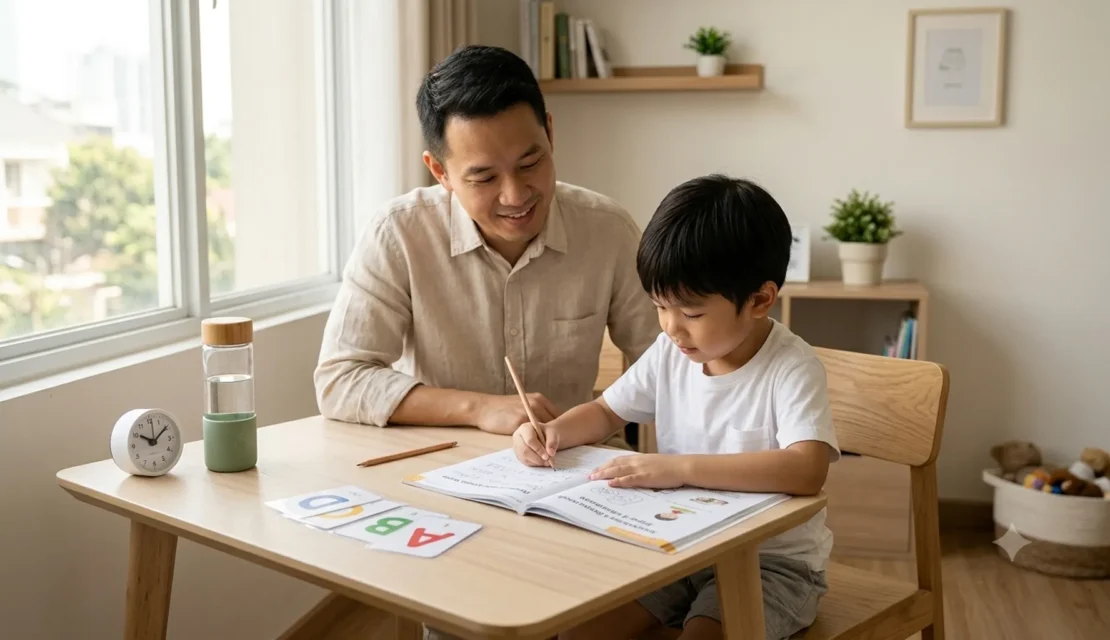
- A clear table, only the materials needed
- No TV sound in the background
- One toy basket far away, not beside the table whispering “play with me”
- Phones out of sight, for you too
Yes, we said for you too. Children are expert observers. If you are half scrolling, they will half study.
Turn Learning Into Something Their Body Can Do
Young children learn through movement. If studying means “sit still and stare,” many kids will drift.
Some ideas:
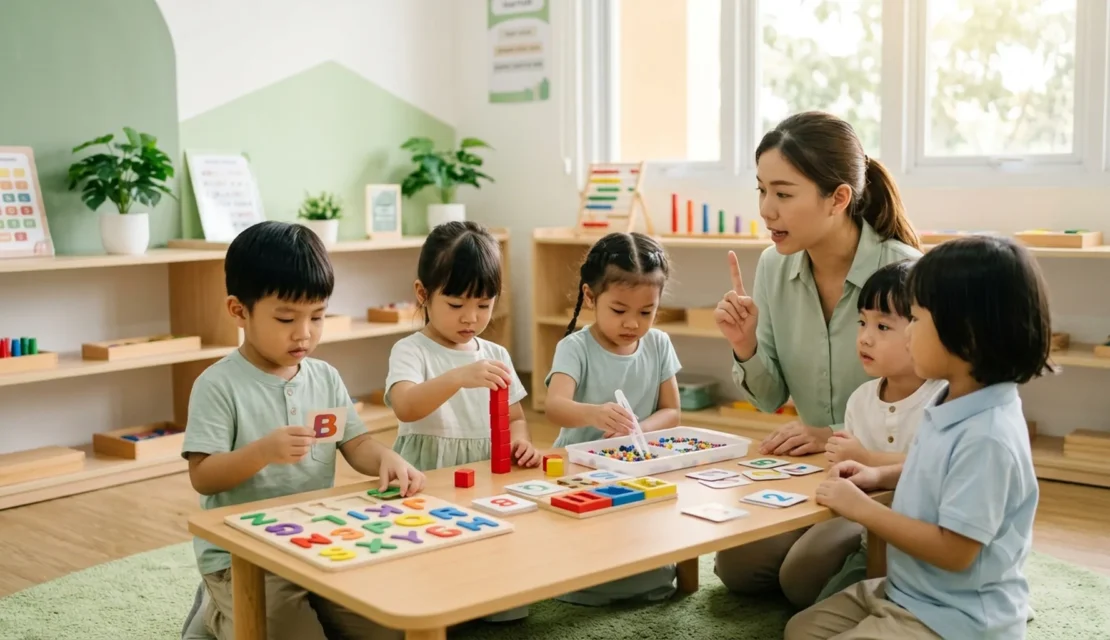
- Use letter cards they can touch and move
- Let them trace letters in sand, rice, or shaving foam
- Practice counting with snacks, then eat the evidence
- Do phonics with clapping and jumping sounds
At school, we blend subjects through active learning. Our Singapore adopted curriculum covers English, Mathematics, Chinese, Creativity, Social Studies, Science, Bahasa, Moral, Music, Physical Education, and Phonics, but we teach it in ways that feel alive, not like a paperwork marathon.
Give One Instruction at a Time, Not a Full Speech
When kids are distracted, long instructions become background noise. Keep your language short, kind, and specific.
Instead of: “Okay, you need to sit properly, and finish this page, and stop turning around, and hurry up.”
Try: “Hands on the table. Write your name.”
Then pause. Let them do it. Then give the next step. It feels slower, but it usually finishes faster.
Building Focus as a Daily Life Skill, Not Just for Worksheets
When a child easily distracted studying, we also look outside “study time.” Focus grows from routines, independence, and self control across the day.
Sleep, Food, and Transitions Matter More Than You Think
If your child sleeps late, skips breakfast, or has back to back activities, focus will be harder. Also, many children struggle right after transitions, like coming home, finishing a meal, or stopping play. Their brain needs a reset.
A simple home routine can help:
- Snack and water first
- Ten minutes of free play
- Then a short study burst
You are not spoiling them. You are helping their nervous system switch gears.
Emotional Connection Before Correction
Sometimes distraction is not about attention, it is about connection. If your child has been separated from you all day, they may “act distracted” as a way to pull you in. We see this often, especially with younger kids.
Try a two minute “fill the cup” moment before studying:
- A cuddle
- A silly joke
- A quick chat about their day
Then start. You may be surprised how much smoother it goes.
How We Support Focus at Apple Tree Pre School BSD
We do not expect children to magically focus. We teach it gently through structure, repetition, and play based learning. That is one reason we keep class sizes realistic, so teachers can actually guide children instead of just managing chaos.
Our classes include:
- Toddler 2 times per week, age 1.5 to 2 years, 12 children per class
- Toddler 3 times per week, age 1.5 to 2 years, 12 children per class
- Pre Nursery, age 2 to 3 years, 16 children per class
- Nursery, age 3 to 4 years, 20 children per class
- Kindergarten 1, age 4 to 5 years, 20 children per class
- Kindergarten 2, age 5 to 6 years, 20 children per class
If you want to see what might fit your child best, you can explore our programs and compare schedules based on age and readiness.
Inside the classroom, we build focus through predictable routines, multi sensory learning, and clear teacher language. We also help children practice waiting, taking turns, listening, and finishing small tasks, which are the real foundations of “being able to study” later.
When You Should Consider Extra Support
We are going to be honest, some children need more than a few home tweaks. If your child is struggling in multiple settings, not just at home, it is worth paying attention. If teachers notice the same pattern and it affects learning, social life, or emotional wellbeing, it can help to talk with professionals for guidance.
This is not about labels. It is about giving your child the right tools early, in a supportive way, so they can enjoy learning instead of fearing it.
Ready to Help Your Child Focus Without the Daily Power Struggle?
If your child easily distracted studying, you do not need to “fix” them, you just need the right environment, the right rhythm, and patient practice. We can support you with structured learning, caring teachers, and a curriculum that balances academics with play, so your child grows smart and happy with you, not away from you.
If you want to visit and see how our classes run in real life, come by and chat with us. We would love to meet you and your little one, and yes, we also understand if they sprint into the room first and say hello later.
Chat with us on WhatsApp Or call us directly: +62 888-1800-900
Come play and learn with other children at Apple Tree Preschool BSD, and let’s build focus skills in a way that feels fun for your child and doable for you.





Be the first to write a comment.