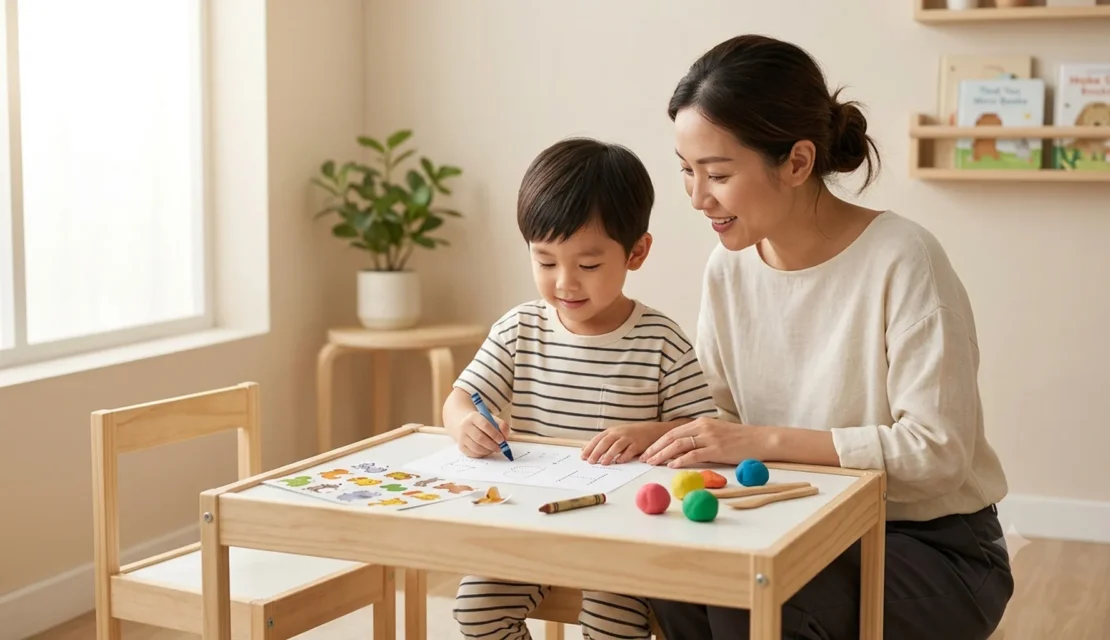
If your child struggles with writing, you are probably living a very specific kind of after school scene: you sit down with big hopes, your child holds the pencil like it is a slippery eel, and somehow a “simple” task turns into a negotiation worthy of a courtroom drama. We see this often at Apple Tree Preschool BSD, and since we teach in the Educenter BSD Building, we hear the same worry from many BSD parents: “Is this normal, and what can I do without stressing them out?”
We want you to know two things right away. First, writing is a surprisingly complicated skill for young children, even when they are bright and talkative. Second, you can support writing in a way that feels lighter, more playful, and more effective than repeating “Try harder” for the tenth time.
By the end of this article, you will have practical, child friendly strategies you can use at home, plus a clear idea of how we build early writing foundations through our classroom routines and our Singapore adopted curriculum.
Child Struggles With Writing, What Is Actually Hard About It?
When adults think “writing,” we often picture letters on paper. For children, writing is a full body project. They need hand strength, finger control, posture, focus, and the ability to remember what a letter looks like while their hand is busy doing something completely different.
If your child struggles with writing, it might be happening in one or more areas:
- Fine motor control, like holding a pencil steadily or controlling pressure
- Hand strength, which affects endurance and comfort
- Visual motor integration, meaning “my eyes see it, my hand can copy it”
- Language and planning, like knowing what to write and in what order
- Confidence, because feeling “bad at it” makes kids avoid it fast
So no, it is not “just laziness.” Sometimes it is simply that the building blocks are still under construction.
Signs your child needs a different approach, not more pressure
We get concerned when writing is consistently stressful, not when it is imperfect. Early writing is supposed to be messy.
You might notice:
- They avoid drawing and coloring too, not only writing letters
- Their hand gets tired quickly or they complain it hurts
- They melt down when asked to write their name
- They write very lightly, or press so hard the paper looks angry
- They can say great stories, but cannot get anything onto paper
If these sound familiar, you are in the right place.
The Most Common Mistakes Parents Make (And How to Fix Them)
We say this with love, because we have done it too. When you care, you rush to help, and sometimes that help accidentally backfires.
Pushing “neat” too early
Neat handwriting is a later goal. If you demand neatness before your child has control, writing becomes scary. Scared kids avoid, and avoided skills do not improve.
A better mindset is: first comfort, then control, then clarity.
Doing too much correcting mid writing
If you correct every letter while they write it, your child never gets to feel the satisfaction of finishing. Imagine someone correcting your spelling while you text your friend. You would “mysteriously” need to go to the bathroom too.
Try this instead: let them finish, then choose just one thing to improve next time.
Comparing them to siblings or classmates
Even “friendly” comparisons can feel brutal for young children. Writing develops at different speeds, and confidence is part of the skill. Protect confidence, and progress usually follows.
Support Writing Skills by Strengthening the Hands First
If your child struggles with writing, start with what looks like play but is secretly training. Stronger hands and better finger control make pencil work easier.
Quick activities that build writing muscles
Use these for five to ten minutes, then stop while it is still fun:
- Playdough rolling, pinching, making tiny balls
- Using tongs to move pom poms or small toys
- Peeling stickers, then placing them in a pattern
- Squeezing a sponge during water play
- Building with small blocks, nuts and bolts toys, or beads
You are not “wasting time.” You are building the foundation that makes writing less tiring.
Pencil grip tips without the lecture
We usually aim for a comfortable grip, not a perfect grip. If you over focus on grip too early, your child may tense up.
Try:
- Shorter pencils or broken crayons, they naturally encourage a better hold
- Triangular crayons or chunky pencils for beginners
- Reminding “soft fingers” instead of grabbing their hand and repositioning it
If grip is consistently very awkward and painful, it is worth asking a pediatric occupational therapist for guidance.
Make Writing Feel Meaningful, Not Like Punishment
Kids work harder when the task has a purpose they care about. Worksheets often feel random, so children resist. Meaningful writing feels like communication.
Writing that does not look like “writing practice”
If your child struggles with writing, try these instead:
- Write a shopping list together, they can add one item with a drawing and a letter
- Make a “family restaurant” menu, they can write one food name
- Label toys or bins, even with the first letter only
- Create a birthday card, they write “To” and their name
- Make a simple “daily journal” with one drawing and one word
This approach works because it links writing to real life.
Use the “one tiny win” rule
Instead of “finish the whole page,” try one small target. Children build courage through success.
Examples:
- “Let’s write just the first letter of your name.”
- “Let’s write one word, then you choose the next activity.”
- “Let’s trace two letters, then we stop.”
Small wins add up faster than big battles.
Teach Letters and Sounds the Fun Way
When writing is paired with phonics, children understand what they are doing. They are not just copying shapes, they are representing sounds.
At school, phonics is part of our curriculum, and at home you can reinforce it gently.
Easy phonics based writing games
Try:
- Say a sound and hunt for objects that start with it, then write the first letter together
- Make “sound boxes” with pictures, your child matches and writes the first letter
- Clap out syllables of a word, then write one letter per clap
Keep it playful. If it turns into a test, motivation drops.
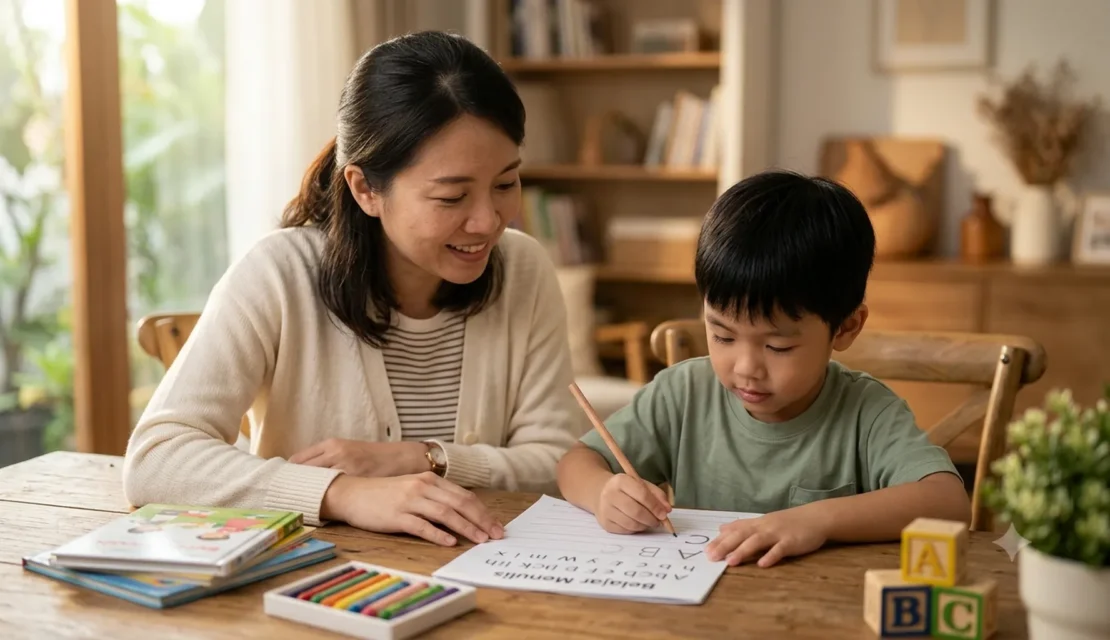
How We Support Children Who Struggle With Writing at Apple Tree Preschool BSD
At Apple Tree Preschool BSD, we do not treat writing like a performance. We treat it like a developmental skill that grows through routine, play, and careful progression. Our adopted Singapore curriculum includes English, Mathematics, Chinese, Creativity, Social Studies, Science, Bahasa, Moral, Music, Physical Education, and Phonics, and writing support shows up across many of these areas.
We build writing readiness through:
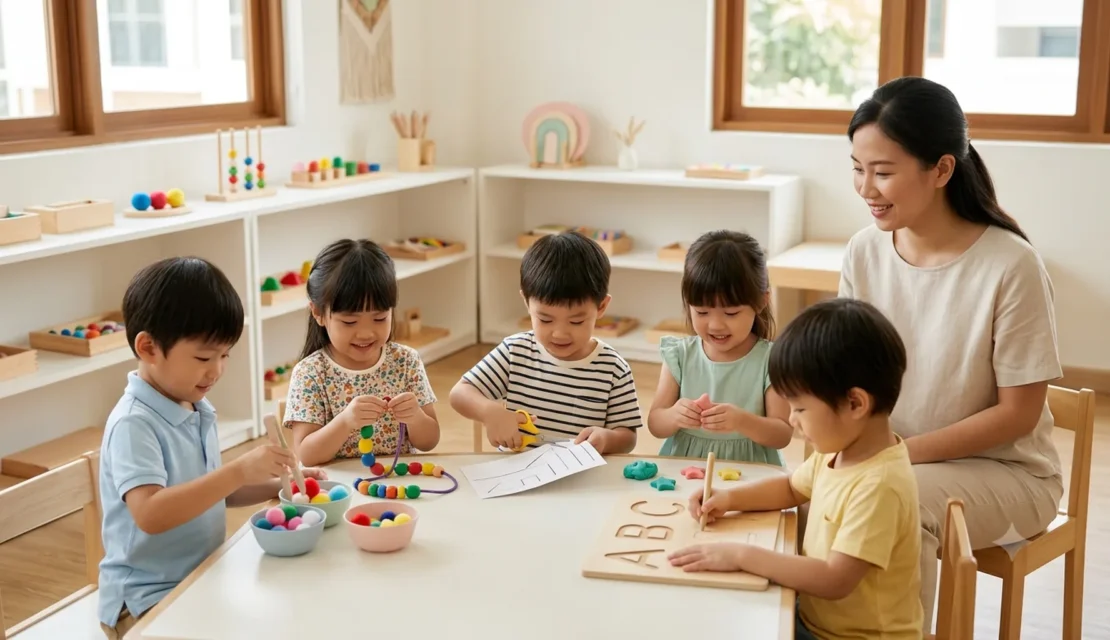
- Fine motor stations, like cutting, pasting, threading, and building
- Multi sensory letter practice, like tracing, forming letters with materials, and pattern play
- Teacher modeling with simple, repeatable steps
- Positive feedback that focuses on effort and progress
- Short practice moments that match the child’s age and attention span
If you want to see which class level fits your child’s stage, you can check our programs and see how learning is structured from toddler to kindergarten.
Our classes and why structure helps
We offer Toddler classes for ages 1.5 to 2 years, Pre Nursery for ages 2 to 3, Nursery for ages 3 to 4, and Kindergarten levels for ages 4 to 6, with class sizes designed for real support. Structure matters because children learn writing best when routines are consistent and teachers can notice small struggles early.
If your child needs more time, we give more time. If your child needs more challenge, we give more challenge. The goal is steady growth, not rushing.
When to Get Extra Support
Most writing struggles improve with the right approach, but sometimes you need an extra set of eyes. If your child struggles with writing and you also notice persistent difficulties with fine motor tasks, coordination, or extreme frustration, it can be helpful to talk to a professional.
Consider extra support if:
- Pain, cramping, or fatigue happens quickly during writing
- Avoidance is intense and constant, across home and school
- Progress stays stuck for months despite gentle practice
- Teachers observe the same patterns in class tasks
Getting support early is not a scary step. It is often a relief.
Ready to Make Writing Feel Easier for Your Child?
If your child struggles with writing, you do not need to turn your home into a strict handwriting bootcamp. You can build the skills through play, tiny wins, and confidence, and your child will usually meet you there once the pressure drops.
If you want your child to practice these foundations with caring teachers, consistent routines, and a curriculum that supports both academic growth and happiness, we would love to welcome you.
Chat with us on WhatsApp Direct phone: +62 888-1800-900
Register now, come play and learn with other children, and let’s help your child grow into a confident writer, one small step at a time.





Be the first to write a comment.