Your child remembers every single word to their favourite song, every character in their favourite show, and exactly where you hid the biscuits three weeks ago. And yet, when you ask them to put on their shoes and grab their bag before school, it somehow takes four reminders, a mild negotiation, and a small miracle to get out the door.
Sound familiar? You are in very good company, and there is actually a fascinating developmental explanation for exactly this.
What you’re dealing with is a set of brain skills called executive function skills, and they are arguably the most important set of abilities your child will develop in their entire early childhood. Not reading speed. Not arithmetic. Not even vocabulary. Executive function skills are the mental tools that determine whether everything else your child learns actually gets used effectively in real life. And here’s the part that changes everything: these skills are not fixed. They are trainable, and the preschool years are the single best window you have to start building them.
What Executive Function Skills Actually Are and Why They Matter So Much
Executive function skills is a term that gets used quite a lot in early childhood education, but it’s worth being clear about what it actually means, because it covers more ground than most parents realise.
Executive function is the set of mental processes that allow a person to plan, focus attention, remember instructions, manage multiple tasks, and regulate impulses and emotions. Think of it as the brain’s air traffic control system. It doesn’t fly any of the planes, but without it, nothing lands where it’s supposed to.
In practical terms, executive function skills are what allow a child to:
- Stop playing and transition to a new activity without falling apart
- Remember a two-step or three-step instruction and carry it out
- Wait for their turn without grabbing or interrupting
- Shift their attention from one task to another flexibly
- Control an impulse, think before acting, and choose a response rather than just reacting
- Start a task independently and stick with it long enough to finish
Every single one of those sounds like basic behaviour. And yet each one of them requires a specific, learnable brain skill that develops gradually between birth and roughly the mid-twenties. The preschool years, specifically ages 3 to 6, represent the most explosive period of executive function development in a human lifetime.

The Three Core Executive Function Skills You Need to Know
Researchers broadly organise executive function skills into three core categories. Understanding them helps you see more clearly what you’re actually nurturing when you support your child’s development in this area.
Working Memory: The Brain’s Mental Whiteboard
Working memory is the ability to hold information in mind and use it. It’s what allows a child to follow a sequence of instructions, hold the rules of a game in their head while playing, or remember what the teacher just said while completing the task.
A child with developing working memory is the one who gets halfway to the bathroom and forgets why they went there. This is completely normal at age 3 and still pretty normal at 5. Working memory develops gradually, and the good news is that it responds beautifully to practice.
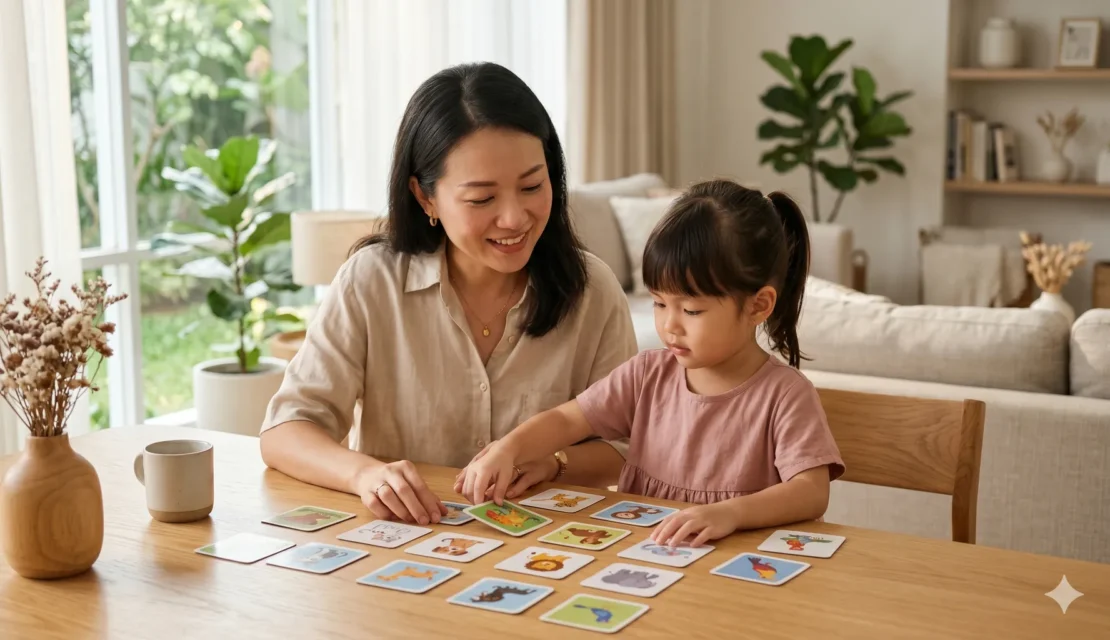
Activities that build working memory include storytelling where children retell the sequence of events, simple card-matching games, songs with actions, and instructions that increase in complexity over time. These aren’t elaborate interventions. They are the kinds of things that happen naturally in a rich, language-filled early childhood environment.
Cognitive Flexibility: The Ability to Shift Gears
Cognitive flexibility, sometimes called mental flexibility or shifting, is the ability to adapt to new information, change approaches when something isn’t working, and see things from a different perspective. It is the executive function skill most closely associated with creativity, problem-solving, and resilience.
A child who melts down completely when the plan changes, who gets stuck on one way of doing things even when it clearly isn’t working, or who struggles to understand that another child might see a situation differently, is showing signs that cognitive flexibility is still catching up developmentally.
This is not a character flaw. It is a brain development stage. And it is one that responds exceptionally well to play-based experiences involving pretend play, role switching, games with changing rules, and gentle, patient exposure to new situations and perspectives.
Inhibitory Control: The Pause Button
Inhibitory control is the ability to pause before acting, resist a dominant impulse, and choose a more considered response. It is the executive function skill behind waiting your turn, not grabbing, managing frustration without hitting, and resisting the very compelling urge to blurt out the answer before the other person has finished asking.
This particular skill has one of the strongest correlations with long-term outcomes of any developmental measure researchers have studied. Children with stronger inhibitory control in the preschool years consistently show better academic performance, stronger social relationships, and better health outcomes decades later.
The famous “marshmallow test” was measuring exactly this. And while the research around it has become more nuanced over the years, the core insight remains: the ability to delay gratification and regulate impulse is one of the most powerful gifts early childhood can develop.
How to Build Executive Function Skills at Home and at School
Here is where things get practical and genuinely encouraging. Executive function skills are not something children either have or don’t have. They are built through experience, repetition, and the right kind of supportive challenge. Here’s what that looks like across both home and school environments.
Play Is the Most Powerful Executive Function Workout Available
This is the finding that still delights us every time we share it, because it means the best thing you can do for your child’s executive function development is let them play freely and imaginatively. Particularly pretend play.
When children engage in dramatic play, they are exercising every dimension of executive function simultaneously. They hold the rules of the imaginary world in working memory. They shift flexibly between roles and scenarios. They inhibit their impulses to break out of character or grab props out of turn. They plan, negotiate, problem-solve, and regulate their emotions across the entire interaction.
A four-year-old playing “doctors and patients” with a friend for forty-five minutes is doing some of the most sophisticated cognitive work of their day. It just doesn’t look like it from the outside.
Routines Are Underrated Brain Training
Consistent daily routines do something very specific for executive function development: they externalise the structure that children’s brains are still learning to create internally. When a child knows that the sequence is always “home, snack, play, dinner, bath, books, bed,” they don’t have to use limited cognitive resources managing transitions. The pattern does that work for them.
As children get older and the routine becomes automatic, you can gradually introduce flexibility, a change in the order, an unexpected event, and their brains practise adapting. This is exactly the kind of graduated challenge that builds cognitive flexibility over time.
Practical routine-builders that specifically support executive function skills at home:
- A visual morning routine chart that children can check and tick off independently
- A consistent after-school sequence that is the same every weekday
- A “first, then” language approach for transitions (“first we finish dinner, then we have storytime”)
- Regular family meals with conversation, turn-taking, and the gentle social demands that come with them
Teach Waiting as a Skill, Not a Virtue
One of the most practically useful things you can do to develop inhibitory control in your child is to treat waiting as a learnable skill rather than a test of character. Children don’t wait well because they lack willpower. They wait poorly because waiting is genuinely hard when your prefrontal cortex is still three to four years away from being fully online.
Teaching strategies helps. “Let’s think of three things we can see while we wait.” “Let’s count to twenty together.” “Let’s think about what we’ll do first when we get there.” These are not distractions. They are genuine cognitive tools that give the developing brain something to hold onto during the very difficult task of not acting on impulse.
Read Together and Ask Questions That Make Children Think
Shared reading is one of the richest executive function activities available to parents, and it costs nothing. The act of following a story requires working memory. Predicting what comes next builds cognitive flexibility. Discussing why a character made a particular choice exercises inhibitory control and emotional reasoning simultaneously.
The secret ingredient is the conversation that happens around the book. “Why do you think she did that?” “What would you have done differently?” “What do you think happens next?” These questions are not just comprehension checks. They are genuine exercises in the kind of thinking that executive function skills make possible.

Where Great Executive Function Development Really Happens
The research is very clear on one point: executive function skills develop most powerfully in environments that are warm, predictable, stimulating, language-rich, play-centred, and socially connected. Every single one of those conditions describes exactly what a great preschool environment should provide.
At Apple Tree Preschool BSD, located in the Educenter BSD Building, building executive function skills is not a special programme we run on Tuesdays. It is woven into the texture of every single day. Through our Singapore curriculum, children develop focus, memory, flexibility, and self-regulation through play, creative activities, social interaction, music, storytelling, and structured learning experiences that are always calibrated to where each child actually is developmentally.
From our Toddler classes for children as young as 18 months through to Kindergarten 2, every stage of our programmes is designed to give children the experiences their developing brains need most, in an environment that feels safe, joyful, and alive with possibility.
Because a child who enters primary school with strong executive function skills doesn’t just have better academic outcomes. They have better friendships, better emotional health, and a far stronger foundation for everything that comes after.
The Best Time to Start Is Right Now
Executive function skills develop across childhood, but the preschool years are genuinely the golden window. The brain is more plastic, more responsive, and more hungry for the right experiences during this period than it will ever be again.
You don’t need a special programme or an expensive toolkit. You need connection, consistency, play, language, and an environment that challenges children gently and supports them warmly. That is what we show up to provide every single day.
Come play and learn with other children at Apple Tree Preschool BSD, and give your little one the executive function foundation they deserve! Chat with us on WhatsApp or call us at +62 888-1800-900. We would love to meet your family and find the perfect programme for your child!





Be the first to write a comment.