At Apple Tree Pre-School BSD, located in the Educenter BSD Building, we often see how teaching child money management can start much earlier than most parents expect. You do not need to wait until your child can calculate discounts, compare brands, or suddenly become very interested in your wallet at the supermarket. In early childhood, money lessons begin with simple habits like waiting, choosing, counting, and understanding that not everything can be bought right now.
That matters because young children are already forming attitudes about value, wants, needs, and self control. If you have ever taken your child into a store for one item and somehow walked out negotiating over snacks, stickers, and a toy shaped like a dinosaur dentist, you already know this is real life learning territory. When you guide these moments well, you are not just avoiding drama, you are building smart habits that can last for years.
Teaching Child Money Management Starts With Daily Habits
When parents hear the phrase teaching child money management, they sometimes imagine formal lessons or serious talks at the dining table. We think it is much simpler than that. For preschool children, money management is really about learning how to make choices, how to wait, and how to understand that resources are limited.
Young children are concrete thinkers. They may not fully understand banking, budgets, or long term saving, but they can absolutely understand ideas like “we choose one,” “we save for later,” and “we take care of what we have.” Those early ideas are the foundation of healthy money habits later on.
Why smart money skills should start early
The early years are when children build their everyday thinking patterns. If you wait too long, you may miss the easiest stage for shaping routines around patience, responsibility, and decision making. We have found that children who practice small choices early often handle bigger lessons more calmly later.
You also do not need to make money feel heavy or stressful. In fact, that usually backfires. The goal is to make it practical, calm, and age appropriate so your child sees money as a tool, not a mystery.
What your child really needs to learn first
Before children learn how to manage money, they need to understand a few simple concepts. These early ideas are much more useful than giving them a long explanation they will forget two minutes later.
Here are the basics we suggest focusing on:
- Needs and wants, so your child begins to notice the difference between what is necessary and what is simply exciting in the moment
- Waiting and saving, so your child learns that some things are worth planning for
- Choice making, so your child understands that choosing one thing often means not choosing another
- Caring for belongings, so your child connects value with responsibility
Simple Ways to Practice Teaching Child Money Management at Home
You do not need a perfect system, color coded charts, or a tiny accountant living in your kitchen. What you need is consistency. The best home strategies for teaching child money management are usually the simplest ones, especially when they happen naturally in everyday routines.
Let your child see money decisions in real life
Children learn a lot just by watching how you make decisions. If you talk out loud in simple ways, they start to connect actions with reasons. You might say, “We are buying fruit first because that is what we need,” or “We are skipping this toy today because we already planned for something else.”
This kind of language helps your child see that money is connected to priorities. It also makes spending feel less random. Over time, your child begins to understand that buying something is a choice, not an automatic event triggered by pointing.
Use play to make money lessons stick
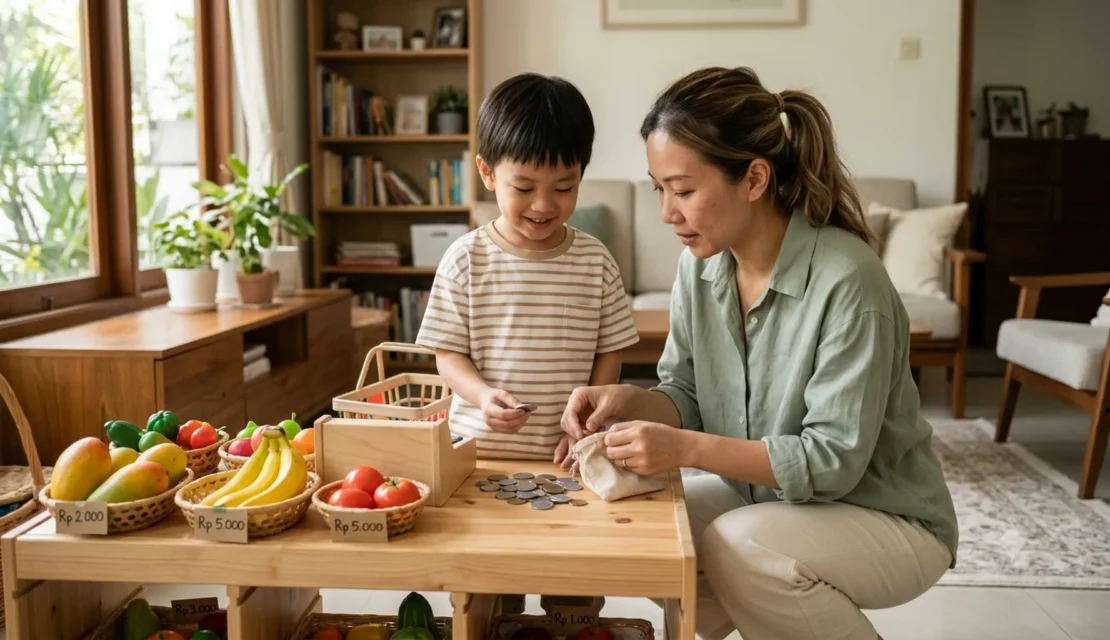
Play is one of the easiest ways to teach young children about money. You can set up a pretend shop at home, use play coins, label prices with simple numbers, and let your child choose what to “buy.” Suddenly, your living room becomes a tiny market, and your child becomes surprisingly passionate about selling one banana for ten imaginary coins.
This kind of role play teaches counting, turn taking, and simple decision making. It also takes the pressure off. When learning feels playful, children are much more willing to join in.
Try a save, spend, share routine
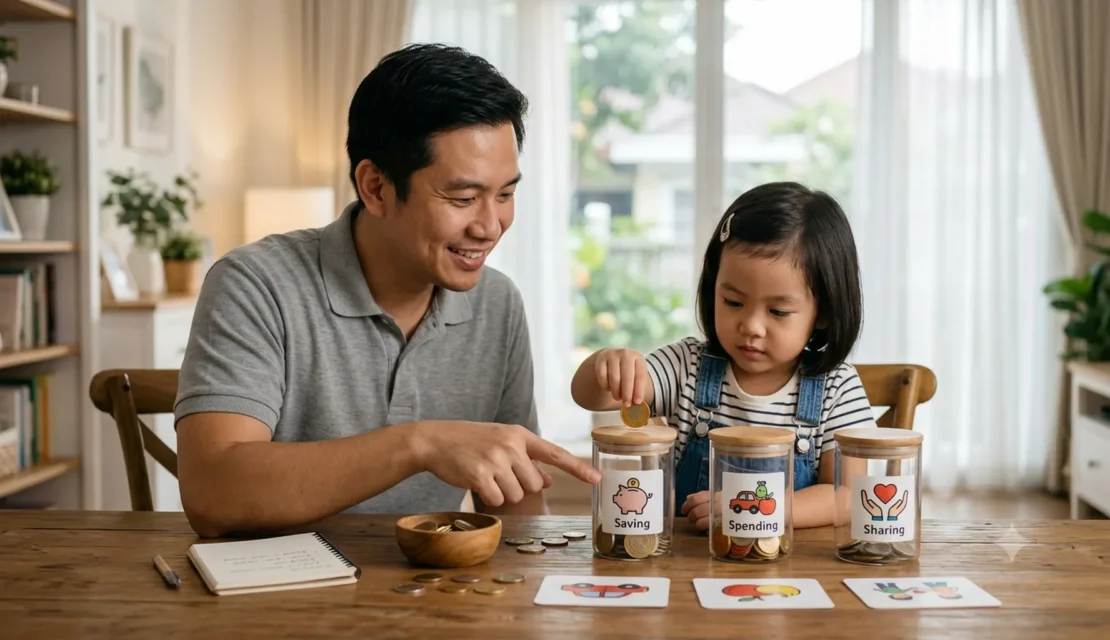
A very simple jar system can work well for preschoolers. You can use three clear containers and label them save, spend, and share. When your child receives a small amount of money from a special occasion, you can guide them in placing it into each jar.
What we like about this method is that children can actually see progress. Saving becomes visible, spending becomes intentional, and sharing becomes part of their normal thinking. You are teaching structure without making it feel like a lecture.
You can keep it easy with steps like these:
- Put a small amount into the save jar for something your child wants later
- Put a little into the spend jar for a small treat or choice
- Put some into the share jar to help others, donate, or give thoughtfully
Common Mistakes Parents Make When Teaching Child Money Management
Even with good intentions, money lessons can go sideways. We have seen parents become too strict, too vague, or accidentally turn money into a source of tension. The goal is not perfection, it is clarity and balance.
Turning every shopping trip into a battle
If every outing becomes a test of character, your child may start reacting to the tension rather than learning from the experience. You do not need to create a moral lesson out of every biscuit request. Sometimes it is better to set one clear limit and move on.
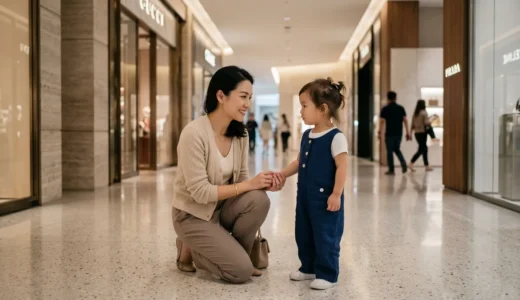
Try saying what the plan is before you enter the store. Children do better when expectations are clear early, not announced dramatically in aisle seven next to the chocolates.
Giving in after saying no
This one is very common, especially when everyone is tired and people are staring. We understand, because public meltdowns have a special talent for making even the calmest adult question every life decision. Still, if no often becomes yes after enough protesting, your child learns that persistence changes the rule.
Consistency matters more than a perfect explanation. A calm, predictable response teaches more than a long speech ever will.
Making money feel scary
Some parents try to teach caution by making money sound stressful all the time. Children then absorb anxiety instead of wisdom. It is better to frame money as something you use thoughtfully, not something frightening or shameful.
You can be honest without sounding worried. A calm tone helps children learn responsibility in a healthy way.
How Preschool Supports Early Money Skills Without Making It Feel Formal
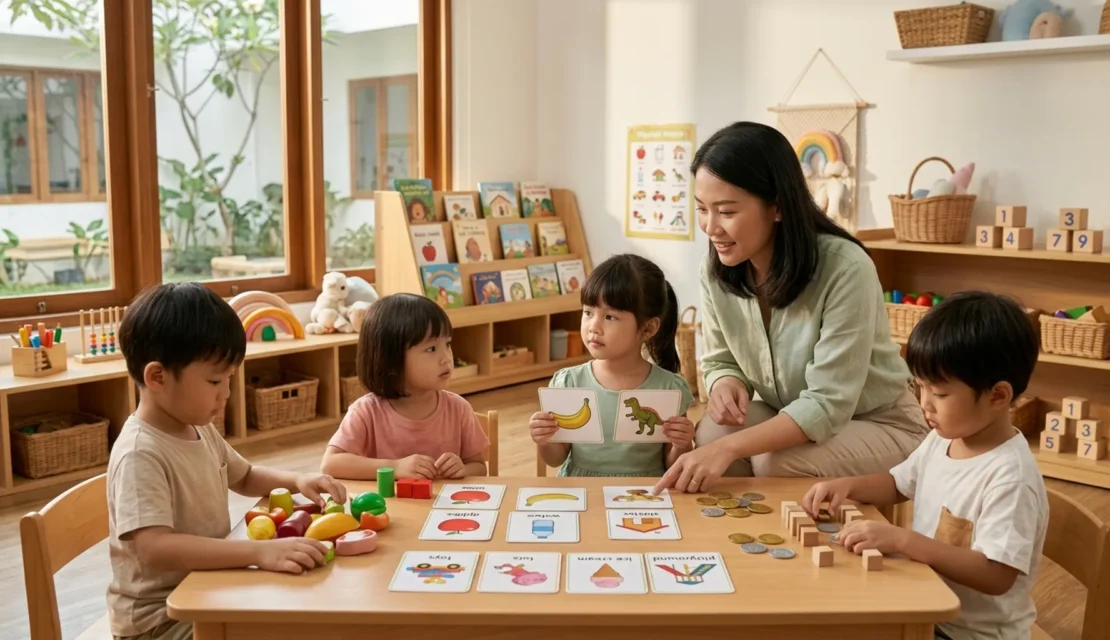
At preschool age, money management is tied closely to wider life skills. Children learn it through counting, sorting, waiting for turns, sharing materials, making choices, and understanding routines. These are the same building blocks that support confidence in daily learning.
At Apple Tree, our Singapore based curriculum includes English, Mathematics, Chinese, Creativity, Social Studies, Science, Bahasa, Moral, Music, Physical Education, and Phonics. While we are not handing preschoolers spreadsheets, we are helping them build the thinking habits behind wise choices, responsibility, and independence. That is one reason many families explore our programs when they want a well rounded early learning environment.
Why parent and school partnership matters
Children learn best when home and school reinforce the same habits. If you are encouraging patience, responsibility, and simple choices at home, and your child is also practicing routine, self control, and problem solving at school, the lessons stick much faster. That consistency gives children a sense of security.
We often remind parents that you do not need to do everything alone. When children are supported by both educators and families, growth feels more natural and a lot less exhausting.
Growing Smart Habits, One Small Choice at a Time
The heart of teaching child money management is not about raising a tiny financial expert. It is about helping your child become thoughtful, patient, responsible, and aware that choices have meaning. When you start early with simple routines, playful practice, and calm consistency, you give your child a strong foundation that reaches far beyond money.
If you are looking for a warm preschool environment where children grow smart and happy together with parents, we would love to welcome you. You can Chat with us on WhatsApp to learn more about enrollment, or call us directly at +62 888 1800 900. Come join us at Apple Tree Preschool BSD, where children learn life skills in ways that feel joyful, practical, and just right for their age.




Be the first to write a comment.