
If child poor concentration span is showing up at home as “can’t sit still,” “forgets instructions,” or “starts, stops, starts, stops,” you are not alone. We see this all the time at Apple Tree Preschool BSD in the Educenter BSD Building, and the truth is usually kinder than it looks: most young children are not “lazy,” they are overwhelmed, under-rested, under-practiced, or just developmentally normal.
You might be wondering if you should be worried, or if you should push harder. The better question is: what is stealing your child’s attention right now, and what small changes will give it back? Attention is a skill, and skills grow with the right environment and the right routines.
We are going to keep this practical and realistic for busy parents. No fancy equipment, no superhero-level patience required.
Child Poor Concentration Span: What It Really Means
Before we “fix” anything, it helps to define what you are actually seeing. Many parents expect preschool focus to look like older-child focus, and that expectation alone can create stress for you and your child.
What Focus Looks Like by Age
In early childhood, focus often comes in bursts. A child may focus deeply on building blocks, then completely lose focus when asked to trace letters. That does not mean your child cannot focus, it means the task is not engaging yet, or it is too hard, or it is not presented in a child-friendly way.
A rough guideline many educators use is that sustained attention grows gradually and is highly dependent on interest. If your child can focus well on play but not on “study time,” that is common. Your job is to bridge play focus into learning focus, not demand instant maturity.
When It’s Normal and When It’s a Red Flag
A child poor concentration span can be normal when it’s occasional, situation-based, and improves with sleep, food, movement, and structure. It can become a concern when it is constant across settings, significantly impacts daily functioning, or comes with strong impulsivity, extreme emotional swings, or major sleep problems.
If you suspect something bigger is going on, it is reasonable to discuss it with your pediatrician or a child development professional. That is not panic, that is responsible parenting.
Why Your Child’s Focus Is Slipping
Focus is not just a personality trait. It is a system. If one part of the system is off, attention drops.
The Big Four: Sleep, Food, Movement, and Overstimulation
In our experience, these four factors explain most “my child can’t focus” complaints:
- Sleep: Too little sleep, inconsistent bedtime, or late screen time can make attention collapse the next day.
- Food: Long gaps without protein, iron-rich foods, or hydration can cause energy dips that look like distractibility.
- Movement: Children need physical activity to regulate their bodies. A still body often requires a moved body first.
- Overstimulation: Too much noise, too many toys out at once, or too much screen input can reduce the brain’s tolerance for slower tasks like listening or reading.
If you fix only one thing, start with sleep. It is the foundation under everything.
The Hidden One: Task Difficulty Mismatch
Sometimes your child looks unfocused because the task is either too hard or too easy. Too hard leads to avoidance. Too easy leads to boredom. Both look like “not paying attention.”
A quick test: if you sit beside your child and make the task one step easier, do they suddenly focus? If yes, it is not a motivation issue, it is a design issue.
Improving Focus at Home With Simple Structure
You do not need a strict schedule, but you do need predictable rhythms. Children focus better when they know what is coming next.
Use “Same Time, Same Place” for High Focus Moments
Choose one daily pocket for focus practice, ideally at the same time each day. It can be short. Ten minutes is plenty.
Pick one spot, a small table or a floor mat. Keep supplies in one box. The goal is low friction. When setup takes two minutes, you actually do it. When setup takes twenty minutes, nobody survives, including you.
Reduce Visual Noise
If everything is available, your child’s attention will hop. This is not bad behavior. It is how young brains work.
Try these small shifts:
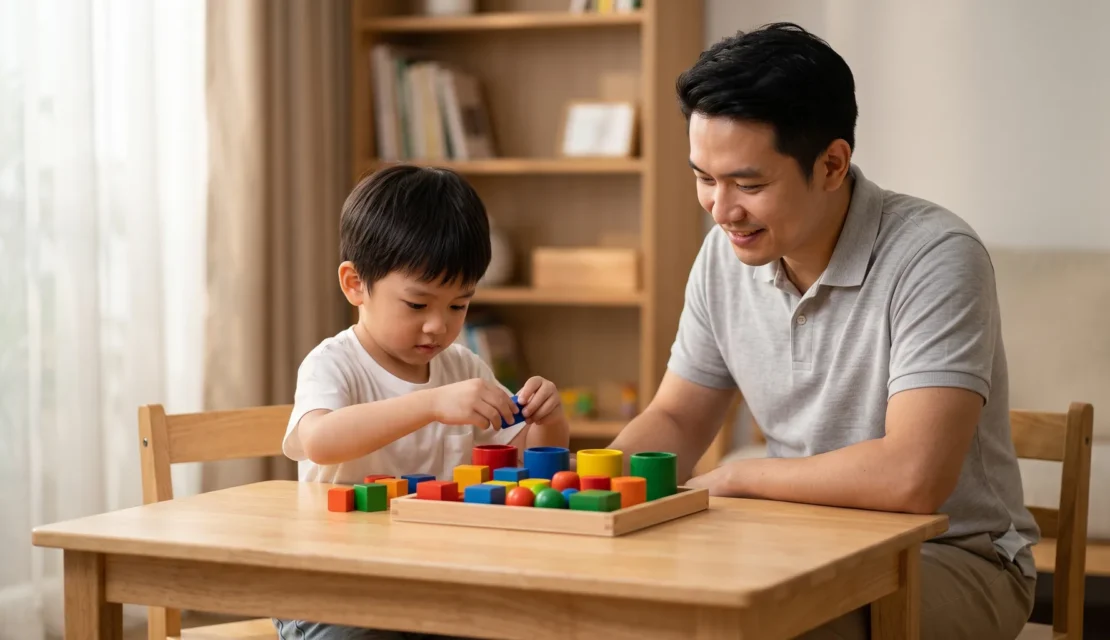
- Put only one activity on the table at a time.
- Use a tray or placemat to define the workspace.
- Store extra toys out of sight during focus time.
This is not about being minimalistic. It is about making attention easier.
Practical Activities to Train Attention Daily
The best attention training for young children is active, playful, and short. You are building brain stamina the way you build muscle, with small reps.
Focus Games That Work for Preschoolers
Try rotating these during the week:
- Freeze game: play music, dance, freeze when it stops.
- Sorting: buttons or blocks by color, size, or shape.
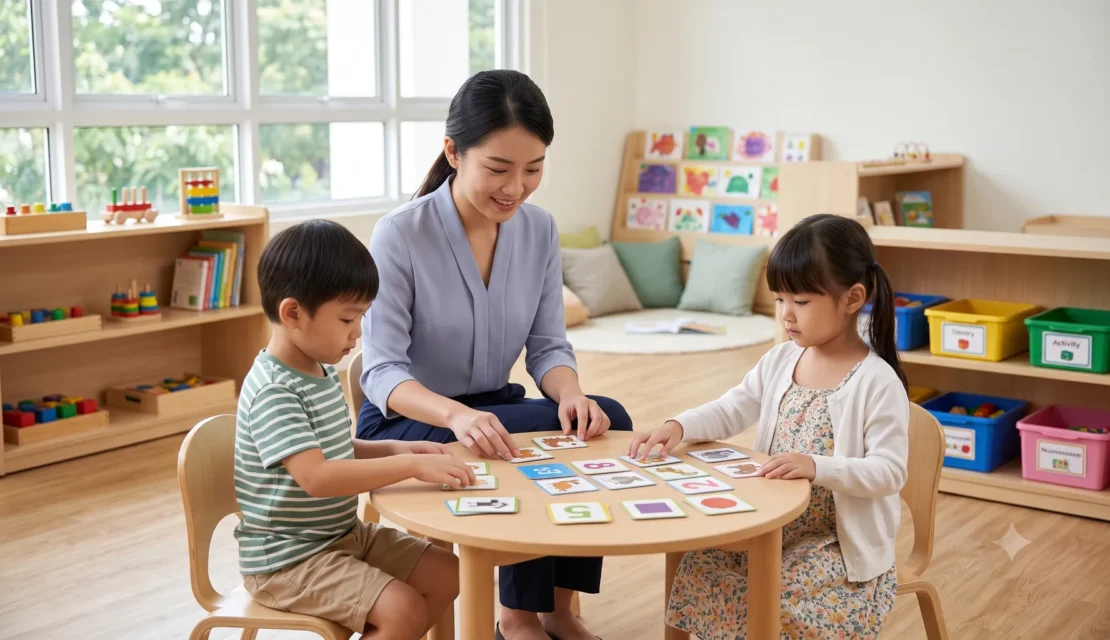
- Matching: memory card games with fewer pairs at first.
- Puzzle ladder: start easy, move up slowly.
- Story listening: short story, then one simple question.
Each activity builds a piece of attention: inhibitory control, working memory, and sustained focus.
The “Two Minute Start” Trick
When your child resists, do not argue for twenty minutes. Start tiny.
Say, “Let’s do this for two minutes.” Once they begin, many children continue longer because starting was the hardest part. If they still stop at two minutes, you still win because you created a successful start, and starts are habits.
Managing Screens Without Making It a War
Screens are not the enemy, but unbounded screens make slower focus activities feel unbearable.
Protect One Screen-Free Zone and One Screen-Free Time
Keep it simple:
- Screen-free bedroom at night, or at least screen-free one hour before bed.
- Screen-free dinner, even if it is messy and loud, which it will be.
This reduces overstimulation and improves sleep quality, which improves attention span.
Use “First, Then” Language
Instead of “Stop watching,” use structure.
“First homework or puzzle time, then screen time.” This keeps boundaries clear without turning you into the daily villain.
How We Support Focus and Attention at School
At Apple Tree Preschool BSD, we treat attention as a skill that children learn through routines, movement, and engaging lessons, not through pressure. Our days are structured with predictable transitions, hands-on learning, and a balance of quiet focus and active play. That balance matters because children cannot focus well if their bodies are desperate to move.
Our Singapore curriculum includes English, Mathematics, Chinese, Creativity, Social Studies, Science, Bahasa, Moral, Music, Physical Education, and Phonics. Attention grows when children practice listening, turn-taking, completing small tasks, and trying again in a supportive environment.
If you want to see how our learning is structured by age, explore our programs. Matching home routines with school routines often makes focus improve faster.
A Simple Weekly Plan to Improve Concentration
If you want a plan that works in real life, keep it light and repeatable. Here is a weekly template many parents can actually maintain:
- Monday: 10 minutes puzzle or sorting
- Tuesday: 10 minutes story time plus one question
- Wednesday: 10 minutes fine motor, cutting, tracing, sticker patterns
- Thursday: 10 minutes memory match or “spot the difference”
- Friday: 10 minutes movement focus game, freeze game or simple yoga poses
- Weekend: outdoor play plus one calm activity, coloring or building
Your child poor concentration span improves when attention practice is consistent, not intense.
A Softer Path to a More Focused Child
Improving a child poor concentration span is usually about making focus easier, not demanding more willpower from a young brain. When you protect sleep, reduce overstimulation, structure the environment, and practice attention in small daily reps, you give your child the best possible conditions to grow steady focus.
If you want a learning environment that supports attention, confidence, and joyful routines every day, we would love to meet your family at the Educenter BSD Building. You can visit, ask questions, and see how our classrooms help children build focus naturally through play and structure.
Register now, or come play and learn with other children!
Chat with us on WhatsApp or call +62 888-1800-900 to ask about schedules and the best class fit for your child.





Be the first to write a comment.