

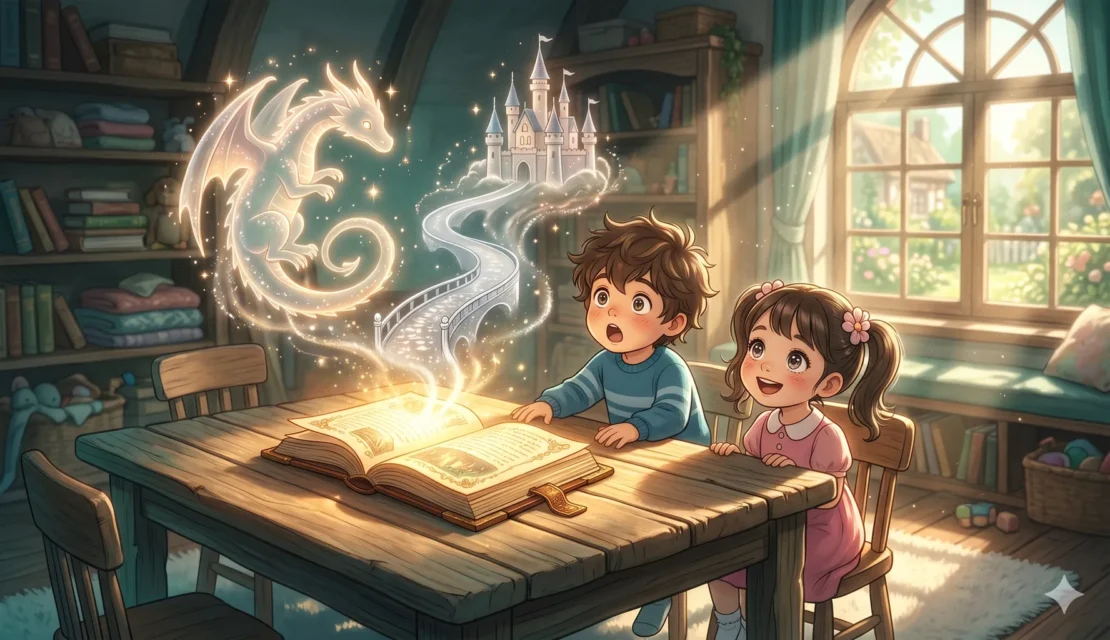
Some stories have been around for hundreds of years and they are still being read at bedtime tonight, in homes across every continent, in dozens of languages, by parents doing their best voices while secretly enjoying it just as much as the children. That is the enduring, almost stubborn power of fairy tales for kids. They survive everything because they speak to something fundamental in all of us, the belief that courage matters, that kindness is rewarded, and that magic, in one form or another, is always possible.
Here at Apple Tree Preschool BSD, nestled inside the Educenter BSD Building, we read stories every single day because we’ve seen what they do to a child’s imagination, empathy, and love of learning. So we’ve put together 11 original, fully written fairy tales for kids, each one packed with brave heroes, enchanted worlds, and lessons that land softly but stay forever.
Make yourself comfortable. These stories are waiting.
11 Fairy Tales for Kids Full of Courage, Wonder, and Magic
From fearless youngest sons to enchanted forests and clever girls who outwit giants, these classic fairy tales, original children’s stories, and magical tales for young readers are the kind your child will ask for again and again.
1. The Girl Who Befriended the North Wind

In a village at the very edge of the world, where the winters lasted nine months and the summers were so brief and sweet that people held their breath trying to make them last, there lived a girl named Solveig. She was twelve years old, practical, sharp-eyed, and completely unbothered by cold in a way that her neighbours found slightly unnerving.
Her mother was ill, and had been ill for three winters running. The village healer had done everything she knew how to do. The fire burned day and night. The blankets were piled high. But something in Solveig’s mother had grown cold in a deeper way than wool and flame could reach, a cold that sat inside her bones and would not leave.
One evening, an old woman who passed through the village buying scraps of copper told Solveig that the only cure was a spoonful of summer honey from the far meadows beyond the Northern Mountains, which the North Wind guarded jealously and which no one had been permitted to cross for a generation.
Solveig thanked the old woman, packed a bag, and left before sunrise the next morning, telling no one except her little brother where she was going.
The walk to the Northern Mountains took eleven days. She slept in barns and under tree roots and once, memorably, inside a hollow log that turned out to already have an occupant, a hedgehog who was more irritated than frightened and whom she apologised to sincerely.
On the twelfth day, she reached the pass through the mountains. The North Wind was waiting.
He was not what she had expected. She had expected something monstrous. What she found was something ancient, enormous, and deeply, profoundly bored. He had been guarding the pass for so long that the novelty had worn off centuries ago. He sat across the path like a bank of white fog, and when she approached, he said, in a voice that rattled the mountain stones, “Turn back.”
Solveig stopped. She looked at him carefully.
“Why do you guard the meadows?” she asked.
The North Wind was quiet for a moment. This was not usually the question.
“Because I was told to,” he said finally.
“By whom?”
Another pause. Longer this time. “I don’t entirely remember.”
Solveig sat down on a boulder. “I’m trying to reach the summer meadow. My mother is ill. I need a spoonful of honey. Just one spoonful. I’ll be gone before the afternoon.”
The North Wind looked at her for a long time. He had turned back soldiers, merchants, three separate kings, and a witch of considerable reputation. He had never had a twelve-year-old girl simply sit down on a boulder and ask him a question he hadn’t thought about in several centuries.
“What is wrong with your mother?” he asked.
Solveig told him. She told him about the cold in the bones, the healer’s visits, the nine-month winters, the blankets that never seemed enough. She spoke plainly and without drama, the way people speak when they are telling the truth rather than constructing a story.
When she finished, the North Wind was quiet for a very long time.
Then, slowly, he moved aside.
“One spoonful,” he said.
“One spoonful,” she agreed.
The summer meadow beyond the pass was the most astonishing thing Solveig had ever seen. After eleven days of grey and white and cold, it was like stepping into a painting done in colours she hadn’t known existed. Bees moved through flowers so thick and sweet-smelling that the air itself seemed to hum. She found a honeycomb in a hollow tree and took one careful spoonful, wrapped it in cloth, and tucked it into her bag.
On the way back, the North Wind was waiting.
“Did you take only one spoonful?” he asked.
“Only one,” she said.
He nodded. Then, because he was the North Wind and had been standing in a mountain pass alone for a very long time, he asked, “Will you come back? Not to take anything. Just to talk.”
Solveig looked at him for a moment.
“Yes,” she said. “I’ll come back in spring.”
She walked home in eight days, because the North Wind cleared the path of ice and snow ahead of her the whole way without being asked.
Her mother recovered within a week.
Solveig went back to the pass every spring for the rest of her life.
Lesson: Kindness and curiosity can open doors that strength and demand never could. Even the loneliest things soften for someone who takes the time to ask.
2. The Three Brothers and the Silver Bridge

In a kingdom at the foot of a great mountain range, a king lay dying and called his three sons to his bedside. He told them that the kingdom’s greatest treasure, a magical silver bridge that connected their land to a kingdom of abundance and peace, had been stolen by an enchantment and hidden at the top of the highest mountain. Whoever brought the bridge home would inherit the kingdom.
The eldest son, Roderick, left immediately, with a large horse, a full pack, and absolute confidence in himself. He reached the mountain by nightfall and began to climb. He was strong and fast and not particularly interested in anything that slowed him down. When an old man sitting by the roadside asked him where he was going, Roderick called down “None of your business” without breaking stride. When a small bird with a broken wing lay in the middle of the path, he stepped over it. When a stream crossing his path was too wide to jump, he pushed through it impatiently and was soaked and cold and miserable for two days.
He reached the summit exhausted, found the silver bridge, and tried to lift it. It would not move. He pulled. He pushed. He tried every angle and every technique. The bridge sat as if it had been there since the beginning of time.
He came home empty-handed and refused to discuss it.
The middle son, Aldric, went next with a moderately good horse and a somewhat more thoughtful approach. He reached the same old man on the roadside and paused for a moment, then shook his head and continued past. He picked up the bird with the broken wing and set it in a tree, which was kind, but did not think to look for the reason it was injured or whether it needed more help. At the stream, he built a rough crossing but knocked it apart when he was done.
He reached the bridge. He studied it for a long time. He tried lifting from different angles. He tried using his ropes. The bridge did not move.
He came home empty-handed and quite frustrated.
The youngest son, Caspian, was seventeen and had been listening from the doorway when his brothers returned. He had no great horse. He borrowed the cook’s old pony and set off with a modest pack and his complete attention.
When he reached the old man by the roadside, he sat down and asked if the man needed anything. The old man said he was cold, so Caspian gave him his spare cloak. The man thanked him and said nothing else, and Caspian continued on.
When he found the bird, he sat with it for half an hour, determined that a cat had frightened it and it had hit a stone, and fashioned a small splint for its wing from a twig and a strip of cloth. He left it in a warm, sheltered spot with a small pile of berries he had found.
When he reached the stream, he built a solid crossing and left it standing, thinking it might be useful for whoever came after him.
At the summit, he found the silver bridge glowing in the cold air. He placed his hands on it gently and looked at it for a long time. He didn’t immediately try to lift it.
Instead, he asked, very quietly, “What do you need?”
The bridge spoke, which surprised him considerably. “I need to be asked,” it said simply. “Your brothers tried to take me. No one has ever asked.”
“Then I’m asking,” said Caspian. “Will you come home with me?”
The bridge rose into the air on its own and followed him down the mountain like a dog that had been waiting a long time for the right person to come along.
The old man he had given his cloak to was waiting at the base of the mountain, because the old man was, as they so often are in fairy tales, not merely an old man. He smiled when he saw the bridge following Caspian like a faithful companion.
“Kindness has a habit of coming back to you,” he said, “usually in ways you weren’t expecting.”
Caspian was the last person to feel surprised by anything after that.
Lesson: The things worth having in this world are rarely taken. They are asked for, with humility and genuine care.
3. The Lighthouse Keeper’s Daughter and the Sea Dragon
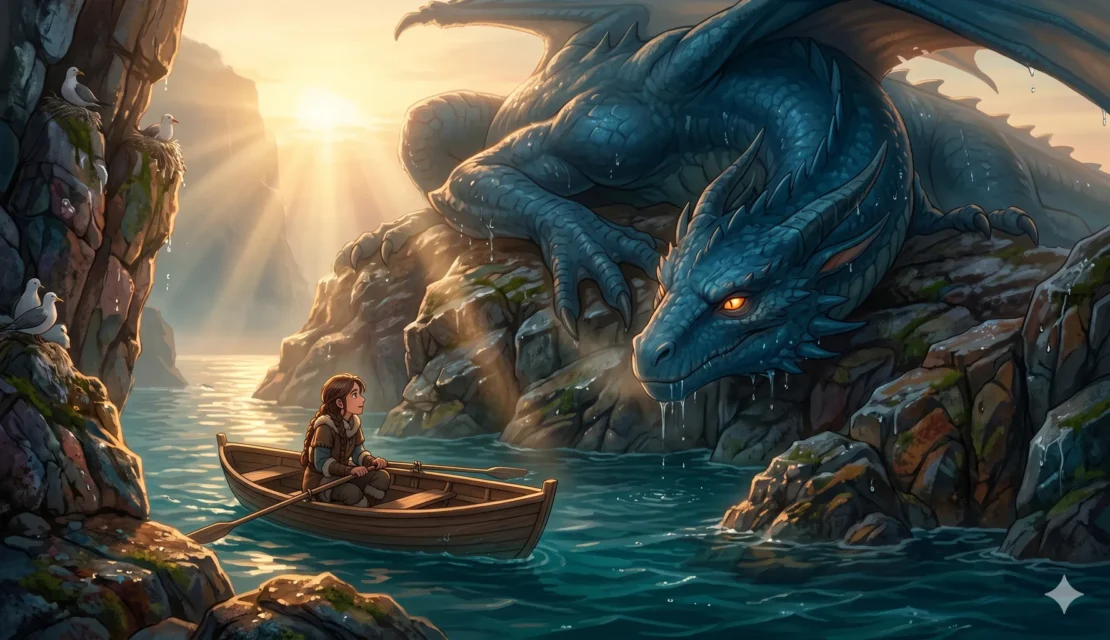
On a rocky island three miles off the coast of a northern sea, there lived a lighthouse keeper named Oskar and his daughter, a girl of eleven named Petra. Petra had been born on the island and had never in her life been afraid of the sea, which her father considered one of her finest qualities and also occasionally one of his greatest parental challenges.
The lighthouse had been lit every night for one hundred years without interruption, guiding ships safely past the treacherous rocks that ran beneath the surface like a jagged underwater wall. Every ship that passed owed something, though none of them knew it, to the steady light and the careful hands of whoever happened to be keeping it.
Then one autumn, a sea dragon arrived.
He surfaced near the island on a Thursday afternoon, which Petra noted was an inconvenient day for anything dramatic. He was enormous, the colour of deep water, with eyes like amber lanterns and scales that caught the light in a way that she had to admit was genuinely beautiful despite the circumstances. He circled the island twice and then settled in the water just off the eastern rocks and appeared to go to sleep.
Ships stopped passing.
The news spread up and down the coast with the speed that only frightening news ever seems to achieve. Captains who had sailed those waters for forty years were anchored in port, refusing to move. The harbour master sent a letter asking Oskar to “deal with the situation,” which Oskar read several times trying to determine what, exactly, they expected a lighthouse keeper to do about a sea dragon.
Petra had already made up her mind.
She took the small rowboat out on Friday morning before her father was fully awake, which she acknowledged was not her most considerate decision but which she felt the circumstances justified. She rowed to the eastern rocks and shipped the oars and waited.
The dragon opened one amber eye.
“Go away,” he said. The voice was like water moving over stone, deep and old and a little rough around the edges.
“I will in a moment,” said Petra. “I wanted to ask you something first.”
The dragon raised his enormous head slightly. “People don’t usually want to ask me things. They usually want to run away or fight me.”
“I’m not going to do either of those,” said Petra reasonably. “Are you alright? You’ve just been sleeping here for two days and you seem tired.”
The dragon stared at her for a long moment.
“I am tired,” he said, with some surprise, as though this had not been stated out loud before.
“What happened?”
What came out over the next hour was a considerable story. The dragon had been swimming for weeks without stopping, fleeing from hunters further south who had decided that his scales and his bones were valuable enough to be worth the considerable risk of pursuing a sea dragon across three hundred miles of ocean. He was exhausted in the deepest sense, the kind of tired that isn’t fixed by one night’s sleep but by something more like safety and time.
“No one is hunting you here,” said Petra. “The coast is quiet. You can stay as long as you need.”
“The ships,” he said.
“I’ll light extra signals to guide them around the northern route. It’s longer, but it’s safe. They’ll manage.”
The dragon was quiet for a while.
“Why are you being kind to me?” he asked.
Petra considered this. “Because you’re tired and scared and you haven’t done anything wrong. That seems like enough of a reason.”
He stayed for three weeks. The ships took the northern route without incident. Petra brought him fish in the evenings and they talked, which her father eventually accepted with the philosophical resignation of a man who had raised a very particular sort of child.
On the morning he left, the dragon dove beneath the surface and came up with a single scale that had come loose naturally, iridescent and the size of Petra’s palm, and left it on the eastern rock for her.
It glowed faintly in the dark for the rest of her life, and she kept it on the windowsill of the lighthouse where it caught the beam every night and threw small coloured lights across the walls.
Her father said it was the most useful thing she’d ever brought home.
Lesson: Fear is almost always based on what something looks like rather than what it actually is. Ask first. You might find a tired friend where you expected a monster.
4. The Boy Who Collected Stars
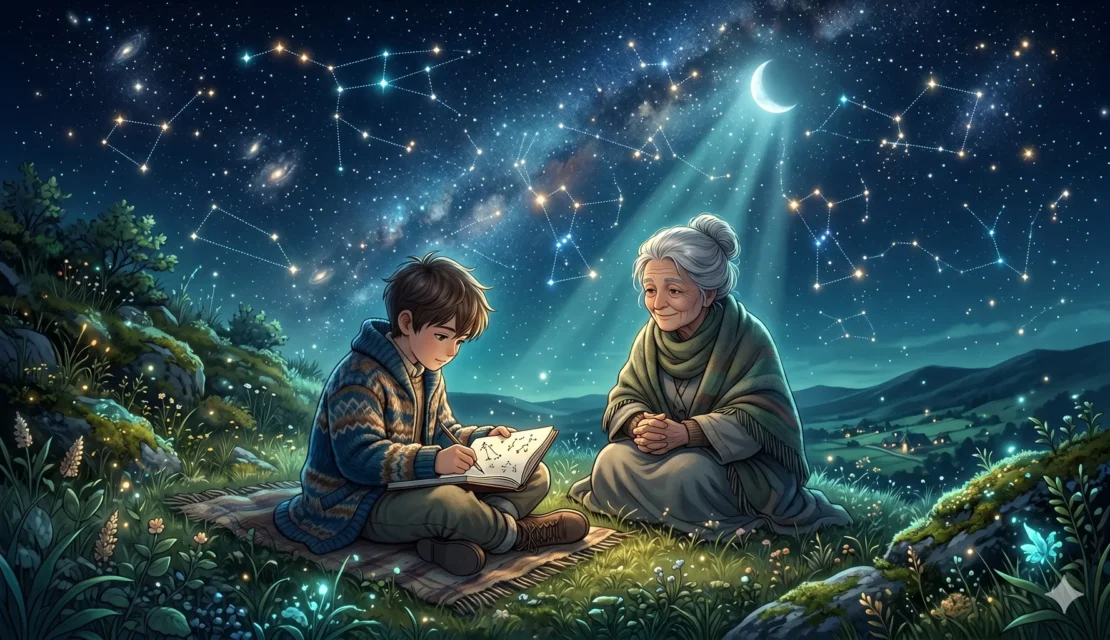
In a village where the nights were very dark and very clear, a boy named Emilio had developed the habit of counting stars. Not just counting, but naming them, drawing maps of them in a notebook with careful dotted lines connecting the ones that belonged to each other, writing notes about which ones appeared first in the evening and which ones were still visible after sunrise if you knew exactly where to look.
His family did not entirely understand this hobby, but they supported it in the warm, slightly baffled way that families support the deep peculiarities of children they love. His father bought him better notebooks. His grandmother knitted him a thick coat for the cold nights. His little sister sat with him sometimes on the hillside, asking questions he took seriously even when they were not entirely answerable.
Then one autumn, the stars began to go out.
Not all at once. One here, one there. Emilio noticed because he always noticed. A star he had named the Blue Shepherd, which appeared above the eastern hills every evening at dusk, simply wasn’t there one Tuesday. He marked it in his notebook with a question mark.
By the following week, six more were gone.
He went to the village’s eldest resident, a woman named Baba Vera who was reputed to know things. She confirmed what she knew without making him feel foolish for asking.
“Stars go out when they are forgotten,” she said. “You have been watching them. You know their names. But you cannot hold a hundred stars in your attention forever, and the ones that slip through the cracks go dark.”
“How do I stop it?” Emilio asked.
“You can’t do it alone,” she said.
Emilio went home and thought about this for a long time. Then he started writing.
He wrote descriptions of each of his named stars in plain, clear language. Where they appeared, when, how bright, what colour, what he had named them and why. He drew his maps neatly and annotated everything. He made twelve copies of the notebook and gave them to twelve different people in the village, people of different ages, different habits, people who stayed up late and people who rose before dawn, people with good eyes and people who already had their own reasons for looking up.
He asked each of them to watch for certain specific stars. Not all of them, just their assigned few.
Within a month, none of the remaining stars had gone out.
Within a year, two of the previously darkened stars had come back, slowly, like lights being turned up from a great distance.
Baba Vera came to find him on the hillside one evening and sat down beside him.
“You understood something that most people spend their whole lives missing,” she said.
“What’s that?” asked Emilio.
“That caring for things, beautiful, important, precious things, is not a task for one person. It was never meant to be. The stars need as many eyes as possible.”
Emilio looked at the sky. Every one of his named stars was burning steadily. The Blue Shepherd was back above the eastern hills.
He opened his notebook to a fresh page and started mapping the ones he hadn’t got to yet.
Lesson: The beautiful things in the world are kept alive by the people who pay attention to them. And the best way to keep something from being lost is to teach someone else to love it too.
5. The Princess and the Paper Kingdom
There was once a kingdom so small that it fit on a single sheet of paper, which was not a metaphor but a literal fact.
Princess Mira had found it in the royal library when she was nine, tucked inside an old atlas between the pages covering a stretch of sea that most maps ignored. It was a complete world rendered in intricate lines and colours: mountains, rivers, cities, roads, forests, and at the centre of it all, a tiny palace smaller than her thumbnail. And in the palace, she could just make out, with her best magnifying glass, the shapes of tiny people.
She had not told anyone about it.
For two years she studied it carefully, making her own copies of the map, learning the geography, working out from the position of the sun in the tiny illustrations what the climate must be like, deducing from the roads the patterns of trade and travel. She became, over time, a genuine expert on a kingdom that nobody else knew existed.
Then one morning she woke up and the paper was gone.
She searched the library for three days. She checked every atlas, every loose page, every forgotten folder. She questioned the library staff with the focused intensity of someone who had lost something irreplaceable. Nothing.
On the fourth day, she found a note in the atlas where the paper had been. It was written in a hand so tiny she needed her magnifying glass.
We knew you were watching. We wanted to know: would you use what you know to help, or to rule? Come to the eastern cliff at midnight. Bring your maps.
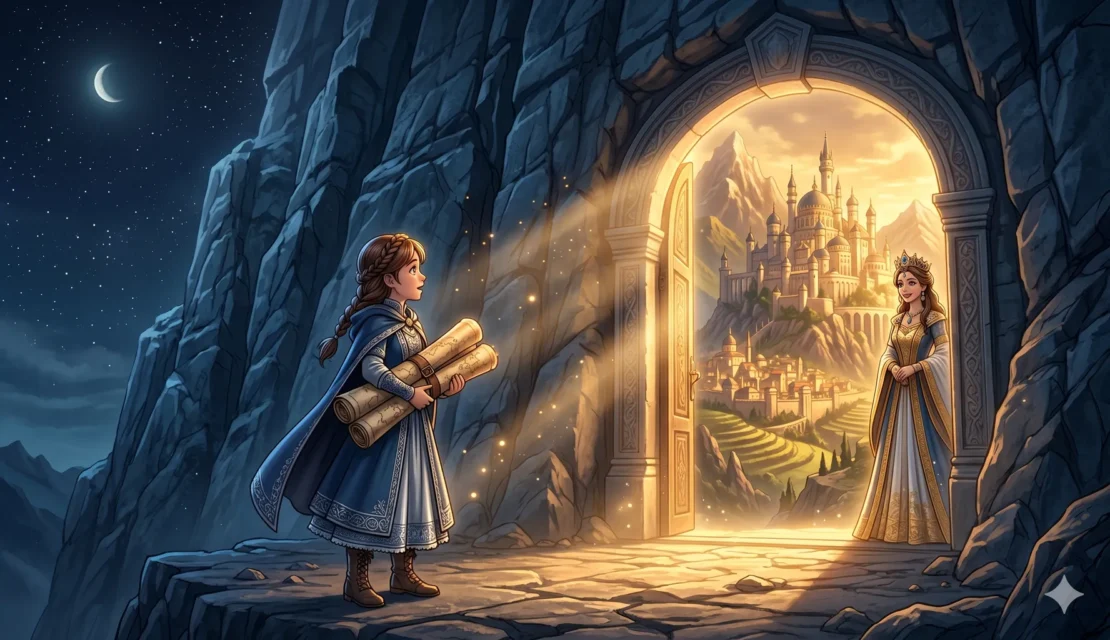
Mira went to the eastern cliff at midnight with every copy of every map she had made.
Waiting for her was a door in the rock face that she was absolutely certain had not been there before, standing open, light coming from somewhere inside it that was warmer and more golden than any torch she had ever seen.
She went through.
The paper kingdom was real, and it was not small. It was exactly the right size from the inside. The people were full-sized, the mountains were genuine mountains, the rivers ran cold and fast and smelled of rain and stone. They had watched her for two years, visible to her through a glass but entirely unreachable until now.
The queen of the paper kingdom met her in the palace courtyard.
“You studied us,” she said. “Not to conquer. Not to profit. Why?”
“Because you were extraordinary,” said Mira simply. “I wanted to understand.”
“And your maps?” asked the queen.
Mira held them out. “I thought they might be useful to you. I might have made errors. I’d like to know which ones.”
The queen looked at her for a long time. Then she smiled, the genuine, slightly surprised smile of someone who has been proven right about something important.
“You are the first person in two hundred years who has found us and come through that door,” she said. “The others came to take. You came to give.”
Mira spent a month in the paper kingdom, correcting her maps and making better ones. She learned the names of the mountains, the histories of the cities, the reasons the roads bent where they bent. She left knowing things that no atlas would ever contain.
When she went home, the door in the cliff closed behind her.
But every year on the same date, a new note appeared in the atlas.
She always went back.
Lesson: Curiosity used with respect and generosity opens more doors than ambition and cleverness ever will.
6. The Tailor’s Apprentice and the Giant’s Coat
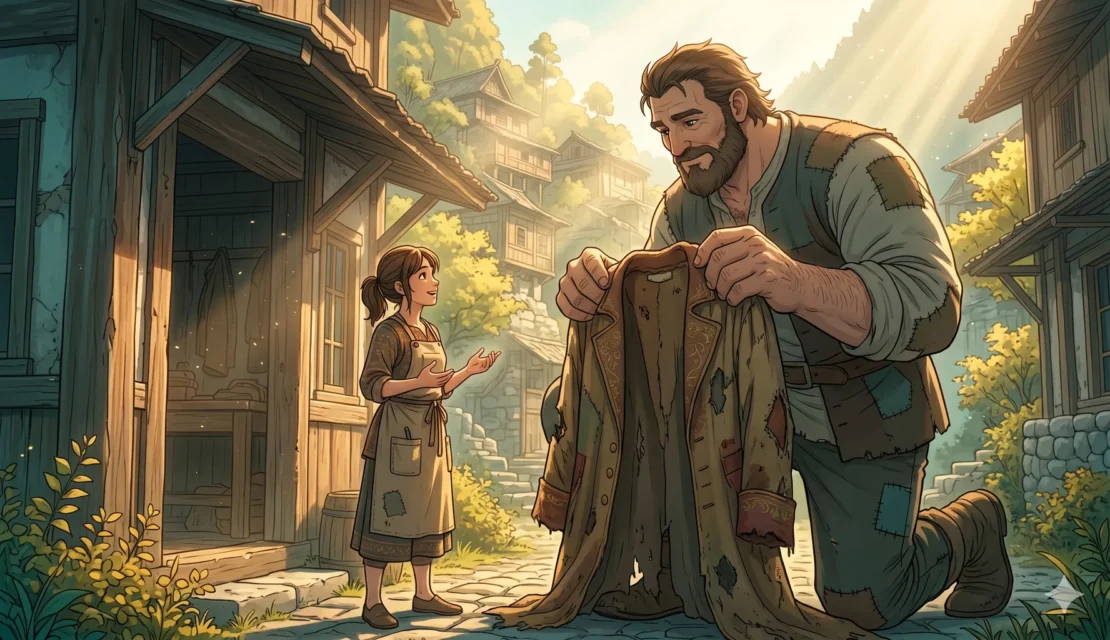
In a mountain town where the winters were famous and the tailors were legendary, a young apprentice named Pip had been learning the trade for three years. She could sew a straight seam blindfolded. She could cut cloth with the kind of confidence that made the fabric seem glad to be shaped. She was, by every measure, exceptionally good at the small and precise work of making things fit.
What she had never made was anything large.
Then the giant came to town.
He arrived on a Wednesday, which was a perfectly ordinary Wednesday until it wasn’t. He was enormous, polite, and carrying, under one arm, the tattered remains of what had once been a very fine coat. He ducked through the town gate with the careful deliberateness of someone who had learned, through experience, to be thoughtful around doorways.
Every tailor in town closed their shutters.
Pip’s master bolted the door and stood behind it.
Pip went outside.
“Excuse me,” she said, craning her neck considerably. “Can I help you?”
The giant looked down at her for a moment. He seemed mildly surprised to be addressed at all.
“My coat,” he said, holding up the ruins. “I’ve had it thirty years. I need it mended. The tailors here are apparently busy.”
Pip looked at the coat. It was large, obviously, and old, and had been through considerable adventures, but the cloth was still fine, and the construction underneath the damage was beautiful work.
“I’ll do it,” she said.
“You’re an apprentice,” he observed.
“I’m an excellent apprentice,” she said. “Bring it inside.”
Getting the coat through the workshop door required removing the door, temporarily, from its hinges. Pip’s master watched from behind the counter with the expression of someone who has given up on controlling events.
The mending took two days. Pip had to improvise. The thread she had wasn’t strong enough on its own, so she braided it in a way she invented on the spot. The patches required cloth she didn’t have in the right weight, so she doubled a lighter cloth and adjusted the tension. She had to build her own scaffolding to reach the shoulders.
When the giant came back on Friday to collect his coat, he held it up in the morning light and turned it slowly. The mends were invisible. The coat hung right. It was better, actually, than it had been in years.
He reached into his pocket and produced a thimble the size of a cooking pot, which he had clearly commissioned from somewhere.
“For your tools,” he said. “The biggest work sometimes needs the smallest precision.”
Pip kept the thimble on the workbench for the rest of her career. When young apprentices came to learn from her and found it there and asked what it was for, she told them the story and then said this: “Every piece of work you’ll ever do is just small pieces done well, assembled together. Learn the small pieces first. The large ones will take care of themselves.”
Lesson: Master the small things completely and thoroughly. Every great thing is made up of small things done well.
7. The Enchanted Forest of Honest Mirrors

In the kingdom of Aradell, there was a forest that no one entered voluntarily. It was not dangerous, exactly. Nothing in it would harm you. But the trees of the forest were made of something between silver and glass, and if you passed between them, you saw reflections. Not of your face or your clothing, but of yourself as you actually were, your character, your motives, the gap between who you presented to the world and who you were when no one was watching.
Most people found this uncomfortable enough to stay out.
A young nobleman named Felix had been appointed to deliver a royal treaty to the kingdom on the other side of the forest. The road that went around the forest added eight days to the journey. The path through the forest took four hours.
Every courier before him had taken the long road.
Felix, who considered himself a person of entirely good character, decided to go through the forest and save the four days.
He entered at noon on a clear Tuesday.
The first reflection he saw stopped him completely.
It showed him, in perfect clarity, the morning three weeks ago when a servant had dropped a tray and he had said nothing unkind out loud but had thought, quite clearly, that the servant was incompetent, and had thought it with a contempt that he had not examined until this moment.
He stood with that for a while.
The next reflection showed him a conversation with his younger sister, in which he had listened to her problem for approximately forty seconds before steering the conversation back to his own plans because, he understood now, he had found her concern less interesting than his own.
The reflections continued as he walked.
None of them were monstrous. That was the thing, the thing he had not expected. He was not being shown the worst version of himself but rather the ordinary, everyday version, the small selfishnesses and casual vanities and comfortable justifications that accumulated, quietly and without drama, into the texture of a person.
He walked through the forest for four hours.
When he came out the other side, he sat on a log for a long time.
Then he delivered the treaty. Then he went home, and he had, without any grand declarations or formal announcements, a number of quiet conversations with people he had treated carelessly. He paid the servant he had thought contemptible a genuine compliment on work done well. He sat with his sister for two full hours and listened with his complete attention.
He went back through the forest on the return journey voluntarily.
Some of the reflections were better this time.
Not all of them. But some.
He made it an annual visit.
Lesson: Honest self-reflection is not comfortable. It is also one of the most important things a person can do. The gap between who we think we are and who we actually are closes only when we look at it directly.
8. The Dragon and the Little Inventor
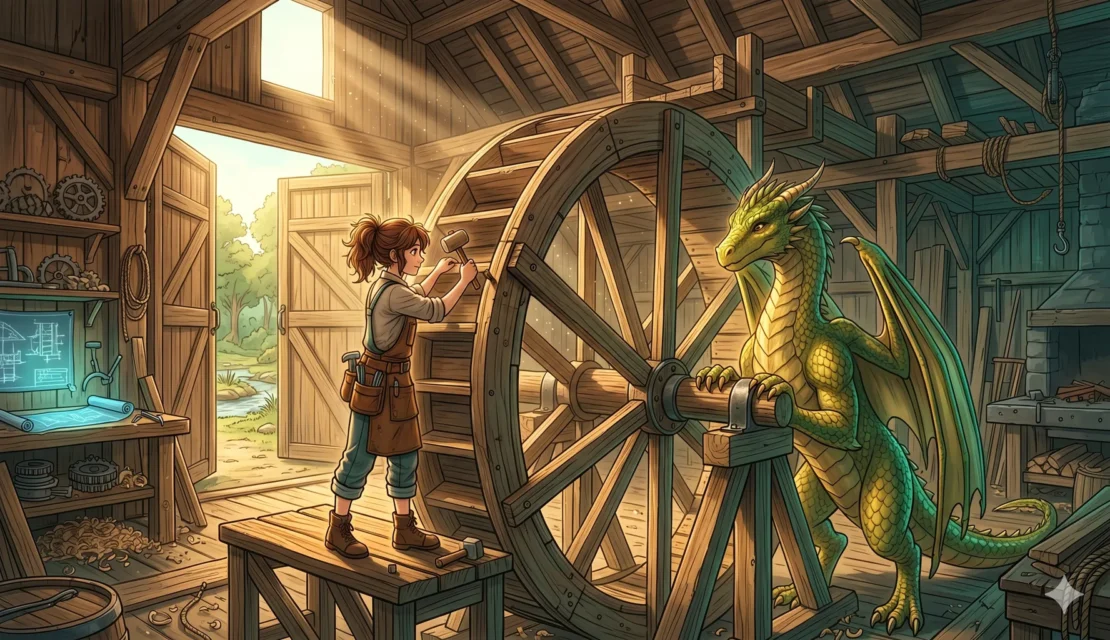
In the northern province of a kingdom famous for its engineers and builders, a twelve-year-old girl named Ada had a workshop in the barn behind her family’s house where she built things. She built things out of wood, metal, wire, glass, springs, and on one occasion a very surprising combination of clock parts and kitchen utensils that had produced something which nobody could definitively explain but which worked reliably for opening stuck jar lids.
She was, in the considered opinion of anyone who had watched her work, the most naturally gifted young engineer in the province.
She was also, at this particular moment, sitting in her workshop staring at a problem she could not solve.
The problem was a waterwheel for the village mill. The old one had broken in the autumn storms and the miller could not afford a replacement from the city. Ada had the plans, the materials, and the skill. What she did not have was a way to hold the central axle at the correct angle while she fixed the housing, because the whole mechanism weighed considerably more than a twelve-year-old and required three adult pairs of hands to hold, and all three adults who were available had hurt themselves in the same storm and were operating at reduced capacity.
She needed something large and strong that could hold an exact position without moving for approximately two hours.
What arrived at her barn door at that particular moment was a young dragon.
He was not enormous, as dragons go. Perhaps the size of a large horse, with green-gold scales and the slightly embarrassed expression of someone who had gotten lost and would really prefer not to make a fuss about it.
“Sorry,” he said, peering in. “I smelled metal being worked. I’m rather interested in metalwork.”
Ada looked at him. She looked at the waterwheel problem laid out on her workbench. She looked at his very solid-looking front legs.
“Can you hold still for two hours?” she asked.
He blinked. “Yes?”
“Can you hold something at precisely this angle,” she demonstrated with her hands, “without shifting at all?”
“Probably. Why?”
She explained the problem. He looked at the plans with what she recognised, with some surprise, as genuine professional interest. He pointed out, with one careful claw, a detail in the housing joint that she had overlooked and which would have caused problems later.
“You know engineering?” she said.
“I’ve been watching builders for two hundred years,” he said. “One picks things up.”
They worked together for the rest of the day and into the evening. He held the axle with the perfect, settled steadiness of something that weighs considerably more than the things it is holding, and he made three suggestions during the process that all proved to be correct and that significantly improved the finished design.
The new waterwheel worked better than the original.
The miller cried a little when it ran for the first time, which Ada found touching, and the dragon found slightly overwhelming but also rather moving.
Ada and the dragon corresponded by letter for the next fifteen years, swapping designs and problems and solutions across whatever distance happened to be between them. She became the most celebrated engineer in the kingdom. He became, in certain circles, a consultant of considerable reputation.
Neither of them ever quite got over the coincidence of that first afternoon.
Lesson: The most useful partners are rarely the obvious ones. Keep the door of your workshop open, and you never know what remarkable help might wander in.
9. The Brave Little Seamstress and the Seven Giants
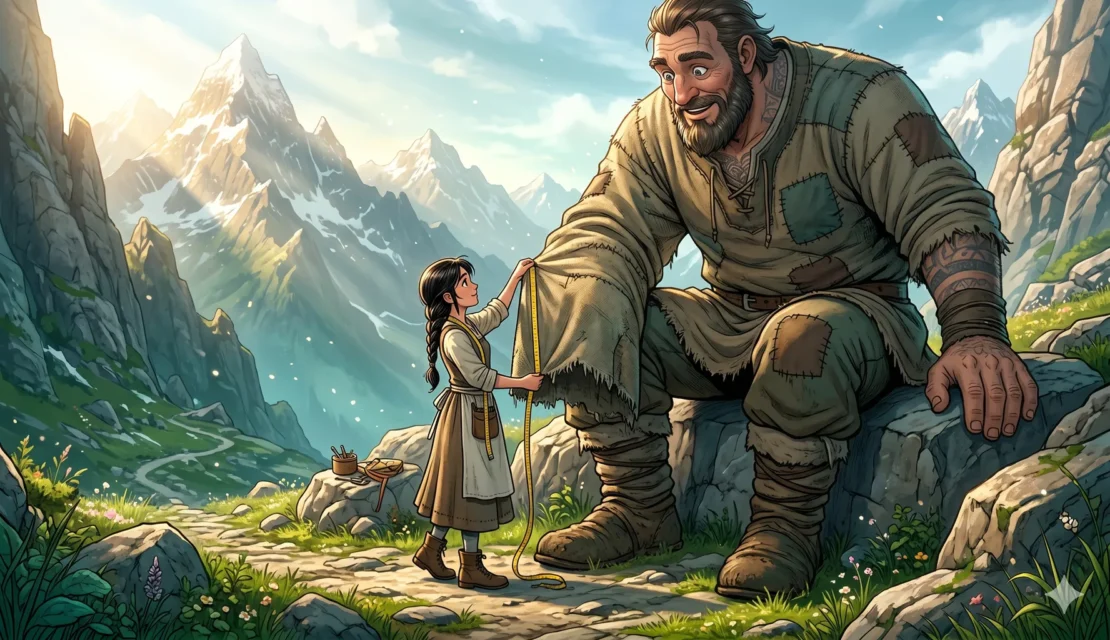
In a valley between seven mountains, a young seamstress named Bea had set up a small shop and was doing a perfectly reasonable trade in alterations, repairs, and the occasional celebration outfit when she was presented with an extraordinary challenge.
The seven giants who lived in the seven mountains had been arguing for thirty years over which of them deserved the largest cloak, as the cloak was, in their tradition, a symbol of status and precedence. The argument had escalated over the decades to the point where it was beginning to affect the weather in the valley, because when giants argue with real conviction, the results tend to manifest atmospherically.
Three tailors before Bea had attempted to resolve the situation. Two had retired immediately. One was still, last anyone heard, hiding in a coastal town somewhere and had taken up pottery.
Bea went up the first mountain on a Monday morning with her measuring tape, her notebook, and a directness that the giants found immediately disorienting.
“I’ll make seven cloaks,” she told them, assembled in the central pass where they held their monthly arguments. “One each. Each one will be the largest cloak that has ever been made for that particular giant. No one’s cloak will be the same as anyone else’s.”
“That is not how precedence works,” said the largest giant.
“Precedence,” said Bea, writing something in her notebook, “is what you’ve been arguing about for thirty years. How’s that working out?”
A silence fell across the mountain pass.
She measured all seven giants in two days, working with the focused efficiency of someone who has been dealing with difficult clients her whole career and has learned that the only thing to do is get on with the job.
Each cloak was designed to fit its wearer perfectly and to show their individual character. The eldest giant’s cloak was cut from deep charcoal wool with silver-grey lining, formal and ancient-looking. The youngest’s was made from green cloth the colour of new growth, because he was, Bea had noticed, the one who still got genuinely excited about things. One giant who collected rocks had his cloak embroidered with geological strata along the hem, which delighted him more than he admitted.
She delivered all seven cloaks on a Thursday.
The giants put them on.
There was a long silence, a different kind of silence from the arguing kind.
“Mine is the finest cloak I have ever worn,” said the eldest, eventually.
“Mine fits perfectly,” said the youngest.
“Mine has the geological strata,” said the rock collector, still looking at his hem.
The argument about precedence, having been completely bypassed rather than adjudicated, quietly ceased to be an argument about anything at all. There was nothing left to argue about because no hierarchy had been established. They had simply each been given something perfect and their own.
Bea walked back down to the valley with her empty bag and her full notebook.
The weather improved significantly by the weekend.
Lesson: Some arguments cannot be won. They can only be dissolved by someone creative enough to find a solution that gives everyone something they genuinely value.
10. The Clockmaker’s Daughter and the Frozen Kingdom
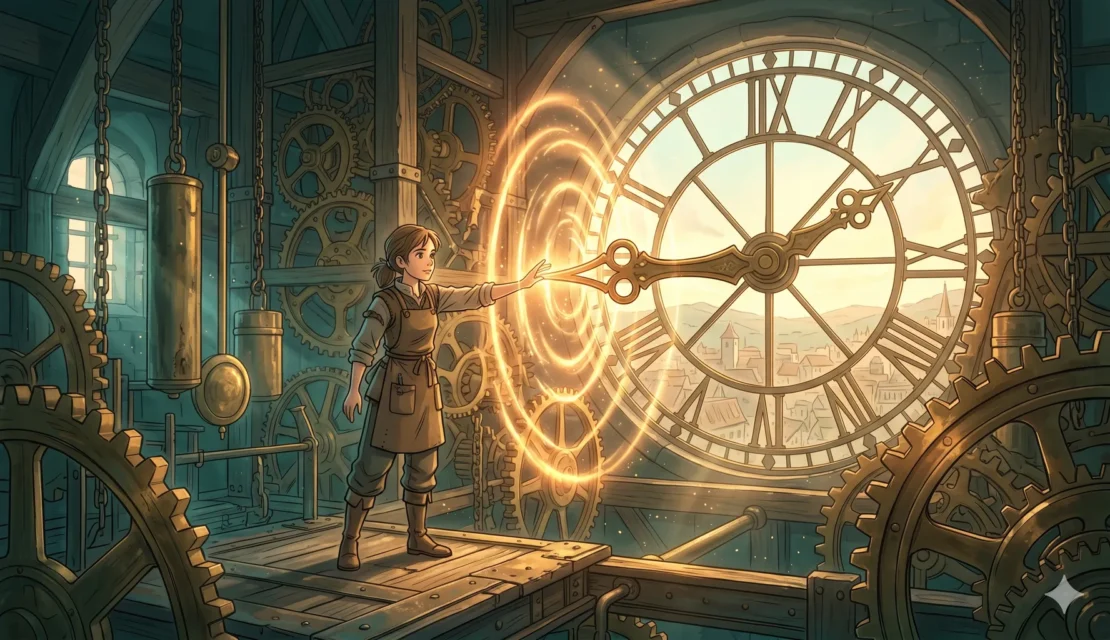
At the top of a great mountain, under a permanent winter sky, a kingdom had been frozen in time for one hundred years. Not by ice, though there was plenty of that too, but by an enchantment that had stopped every clock in the kingdom at precisely midnight on the last day of autumn, and with the clocks stopped, time itself had simply ceased to move forward.
The people were not dead. They were paused. The king stood in the middle of a sentence he had been speaking for a century. The cook’s spoon hung in the air above a soup that had not cooled. Children were mid-run in a courtyard game. The whole kingdom waited, in perfect and indefinite suspension, for someone to start the clocks again.
The problem was that the enchantment had been laid with one specific intention: the clocks could only be restarted by someone who truly understood them, not just mechanically but in the sense of understanding what time actually was and why it mattered.
Three clockmakers had gone up the mountain in the past century. All three were technically brilliant. All three had failed. The first had wound the clocks and nothing happened. The second had repaired every mechanism and still nothing moved. The third had replaced several parts and left in frustration.
A clockmaker’s daughter named Ines, seventeen, had grown up hearing about the frozen kingdom from her father the way other children heard fairy tales. She had also grown up surrounded by clocks, taking them apart and putting them together since she was old enough to hold a tool. But unlike her father and the other clockmakers, she had always been more interested in the why than the how.
She went up the mountain in early spring with a small bag of tools and, more importantly, a notebook full of questions.
She spent three days in the frozen kingdom, walking among the paused people, examining the stopped clocks, sitting quietly in rooms that had not changed since before her grandmother was born.
On the third evening, she sat in the great clock tower at the centre of the kingdom and looked at the master clock, the largest in the kingdom and the one that all others followed. It was wound. The mechanism was perfect. Everything was technically correct.
She sat with it for a long time.
Then she understood.
She opened her notebook and wrote for an hour, writing about the children frozen mid-run, the cook with the spoon, the king’s unfinished sentence. She wrote about what those moments meant, the urgency of a game, the warmth of a kitchen, the importance of a word being completed. She wrote about what time was for.
Then she reached out and, with one deliberate hand, moved the minute hand forward by one minute.
The kingdom began.
Not all at once. Gradually, like a piece of music finding its tempo from a single note. One clock ticked. Then another. Then the great clock above her began to move, and with it, across the kingdom, every clock resumed, and with the clocks, every moment that had been waiting for a hundred years simply continued from where it had left off.
The king finished his sentence. The soup stayed warm. The children ran to the end of their game.
Ines climbed down the clock tower into a kingdom that was suddenly, bewilderingly, alive.
Nobody could explain quite what she had done differently from the three clockmakers before her.
“I understood what I was restarting,” she said, when the king asked. “Not just the mechanism. The meaning.”
Lesson: Understanding why something matters is more powerful than knowing how it works. The heart of a thing is always more than its mechanism.
11. The Wolf Who Learned to Read
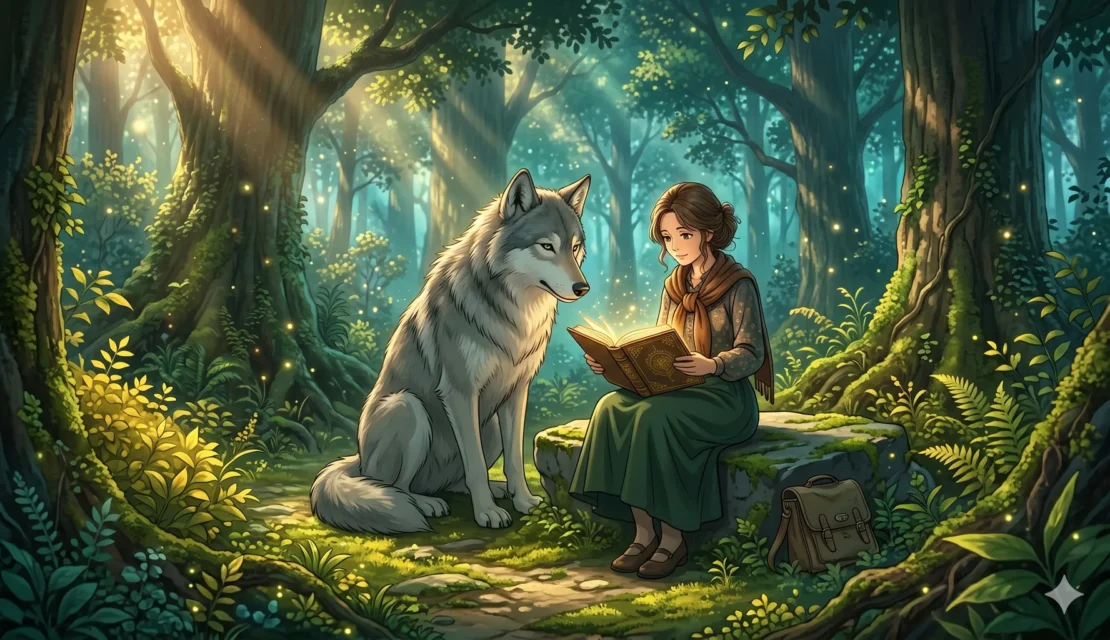
In a dark forest on the edge of a kingdom where wolves were feared and books were loved, there lived a wolf named Gregor who had, for years, been puzzled by books.
Not afraid of them. Not hostile. Puzzled. He had watched, from a distance, the way humans held them, the way their faces changed while reading, the quiet intensity that came over even the most restless person when a story got hold of them. He had tried to understand what was in the flat, papery things that produced this effect, and had reached the conclusion that he was missing something fundamental.
The problem was that wolves, traditionally, did not read.
There were no wolves’ schools. There were no wolves’ libraries. There was a significant social barrier between “wolf in the forest” and “creature who sits in a chair and turns pages,” and Gregor was aware of all of this.
He was also very curious, and in Gregor’s experience, curiosity had always outweighed common sense.
He waited until the village schoolteacher, a woman named Marta who walked home through the forest every evening, sat down on the flat stone she always sat on to eat her dinner before the remaining mile home.
He stepped out from between the trees.
Marta did not run. She was, to her credit, a person of considerable personal steadiness.
“I would like to learn to read,” said Gregor, because there was no comfortable way to open this particular conversation and he had decided to lead with the point.
Marta looked at him for a long moment.
“Sit down,” she said, and moved along the stone to make room.
The lessons happened on the flat stone every evening for six months. Marta brought primers and then simple books and then more complex ones, adjusting her pace to Gregor’s progress, which was not as slow as she had expected. He had a tremendous memory, as it turned out, and an analytical mind that made grammar intuitive once he understood the underlying logic.
The first book he read entirely by himself was a book of folk tales from a forest kingdom very like his own.
He read it in one sitting, which he’d been warned not to do but couldn’t help.
He had expected to find the stories strange. He did not. The emotions in them, the longing, the courage, the love, the fear of being misunderstood, were all entirely familiar. He had simply never encountered them expressed in words before.
He came to the flat stone the next evening with the book and sat down.
“Were you surprised?” asked Marta.
“That stories about people would make sense to a wolf?”
“Yes.”
“No,” said Gregor. “That’s the point, isn’t it? That’s what’s inside the books.”
Marta smiled. “That’s exactly what’s inside the books.”
He read everything he could get access to after that. Marta brought books from the school library and then from the town library and then, eventually, from the university library two towns over, which she visited specifically on his behalf without mentioning why she needed so many books about forests and philosophy and natural sciences.
Years later, when Marta was asked what the greatest lesson of her teaching career had been, she said this: “The most important thing a reader needs is not the ability to decode letters. It is the belief that the story was written for them. Once a reader believes that, no book is closed to them.”
The wolf in the forest, she did not add but was thinking, had understood that from the first page.
Lesson: Stories are for everyone. And once you discover that the world of books is open to you, something changes permanently and for the better.
Why Fairy Tales for Kids Are Still One of the Most Powerful Things You Can Give Your Child
With everything available to children today, the streaming services, the games, the apps that do seventy-seven things at once, it is easy to wonder whether the old fairy tales still have a place. We think they have more of a place than ever, and here is why.
Fairy Tales Teach Emotional Literacy in the Safest Possible Way
When a child hears Solveig ask the North Wind a question, or watches Pip solve an impossible problem with creativity instead of force, they are processing complex emotions and situations at a safe remove. They are practising empathy, learning to imagine other perspectives, and building the emotional vocabulary that will serve them in real-world relationships for decades. That is not incidental to the story. It is the whole point.
Brave Heroes Model What Courage Actually Looks Like
So many of the heroes in these fairy tales for kids are brave not because they are the biggest or the strongest, but because they ask the right questions, persist through difficulty, treat others with genuine respect, and keep going when things are hard. These are the models of courage that serve children far better than invincibility. They are also models that children can actually aspire to, because they are human in the best sense.
Every Story Is a Conversation Waiting to Happen
At Apple Tree Preschool BSD, we use storytelling as a doorway into some of the richest learning conversations we have with children. After a fairy tale, the question “what would you have done?” opens up the kind of thinking and speaking and reasoning that builds real intelligence, the relational, reflective, empathetic kind. Our programmes are built around exactly this kind of whole-child learning, through our Singapore curriculum, through storytelling and Moral and Social Studies and creativity and all the other threads that make up a truly complete early education.
We believe, in our bones, that the children who grow up hearing good stories grow into people who understand the world more deeply and live in it more kindly.
Come and Be Part of Our Story
We hope these 11 fairy tales for kids gave your family a full evening, or several evenings, of magic, laughter, and the kind of quiet conversation that follows a really good story. These tales are gifts you can give your children again and again, and they will find something new in them every time.
If you would love for your little one to learn and grow in a place where stories, imagination, courage, and kindness are at the heart of every single day, we would be so genuinely delighted to welcome your family to Apple Tree Preschool BSD.Register now and come play, dream, and learn with other children! Chat with us on WhatsApp or give us a call at +62 888-1800-900. We cannot wait to meet your little hero.


Be the first to write a comment.