Last Ramadan, something happened during our morning circle time that still makes our hearts warm every time we think about it. Three-year-old Aisha was sitting quietly when she suddenly started whispering “Alhamdulillah” while looking at the flowers we’d just planted in our garden. Her friend next to her heard it and whispered it too. Within minutes, five tiny voices were softly saying “Alhamdulillah” together, completely unprompted. That beautiful moment reminded us why teaching simple dhikr for kids during the holy month creates such powerful, lasting connections between children and their faith.
Here at Apple Tree Pre-School BSD, we believe that introducing simple dhikr for kids should feel as natural as breathing. It’s not about memorizing words they don’t understand or sitting perfectly still during long recitations. It’s about weaving these beautiful phrases into everyday moments so they become part of how your child experiences the world, especially during the magical atmosphere of Ramadan.
The holy month offers a uniquely special opportunity to introduce simple dhikr for kids because the entire family and community are already focused on spiritual connection, gratitude, and reflection. Children pick up on this energy and are naturally more receptive to learning about faith when everyone around them is engaged in spiritual practices.
How to Start Teaching Simple Dhikr for Kids at Different Ages
Every child is ready for different levels of dhikr learning depending on their age and developmental stage. At our location in the Educenter BSD Building, we’ve found that matching dhikr activities to children’s abilities creates positive associations with spiritual practices that last far beyond Ramadan.
The key principle is keeping it simple, joyful, and connected to real experiences. Children don’t need to understand complex theology to begin building a relationship with dhikr. They need to feel the warmth and peace that comes from saying these beautiful words, and they need to see the important adults in their lives doing the same.
1. Begin with Three Foundation Phrases
Start your child’s dhikr journey with the three most fundamental phrases that even the youngest children can learn to say and begin to understand.
The Three Foundation Dhikr Phrases:
- “Alhamdulillah” (All praise is for Allah) for moments of gratitude and happiness
- “SubhanAllah” (Glory be to Allah) for moments of wonder and amazement
- “Allahu Akbar” (Allah is the Greatest) for moments of awe and celebration
Introduce one phrase at a time rather than all three at once. Spend a week on each phrase, using it naturally throughout the day until your child starts saying it spontaneously.
2. Connect Each Dhikr to Real Moments
Simple dhikr for kids becomes meaningful when connected to experiences they can see, touch, and feel. When your child sees a beautiful butterfly, say “SubhanAllah, look how amazing!” When they eat their favorite fruit at iftar, say “Alhamdulillah, this mango is so yummy!” When they accomplish something new, say “Allahu Akbar, you did it!”
These connections help children understand that dhikr isn’t just words to repeat but expressions of real feelings, gratitude, wonder, and celebration that naturally flow from everyday experiences during the holy month and beyond.
3. Use Songs and Rhythmic Repetition
Young children learn best through music and rhythm, which makes singing dhikr incredibly effective. Create simple melodies for dhikr phrases or find age-appropriate nasheeds that incorporate the phrases your child is learning.
Clapping, gentle swaying, or tapping along while saying dhikr makes the experience multi-sensory and engaging. In our programs, we’ve seen how musical dhikr activities help even our youngest toddlers remember phrases surprisingly quickly.
Fun Musical Dhikr Activities:
- Create a simple clapping rhythm while saying “SubhanAllah” three times
- Sing “Alhamdulillah” to the tune of a familiar nursery rhyme
- Use a small tambourine or drum to accompany dhikr repetition
- Make up movement actions for each phrase, like raising hands for “Allahu Akbar”
- Record your child’s dhikr singing and play it back so they can hear themselves
4. Create a Special Dhikr Corner at Home
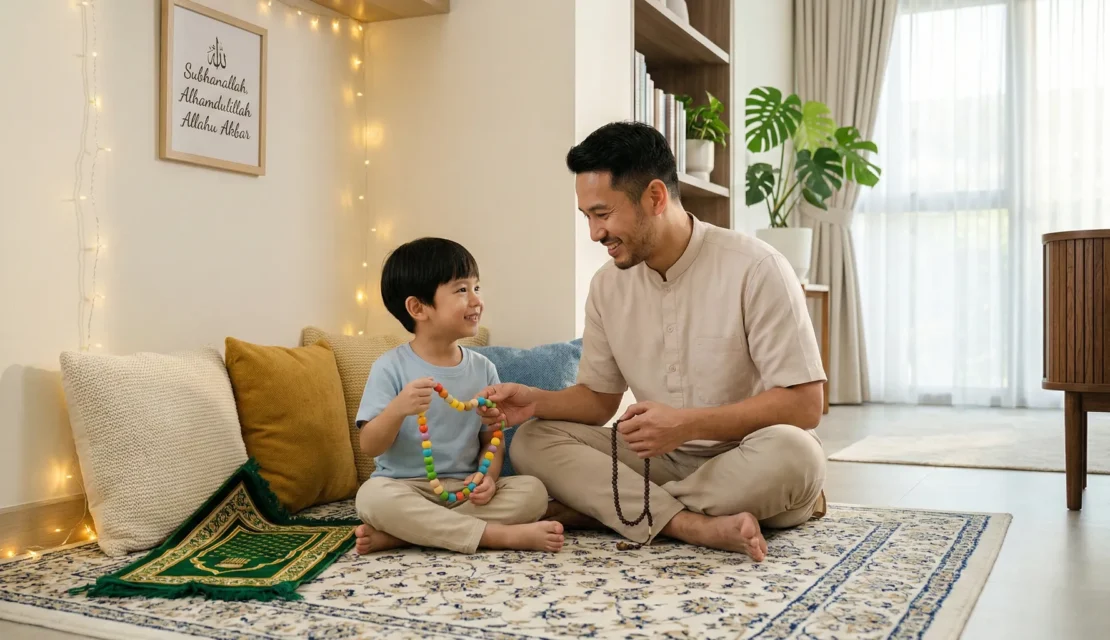
Designate a small, cozy space in your home as the “dhikr corner” during Ramadan. Fill it with soft cushions, fairy lights, a small prayer mat, and simple dhikr cards with pictures that represent each phrase. This becomes a special place where your child associates peace and comfort with spiritual practice.
Having a physical space dedicated to simple dhikr for kids makes the practice feel important and special rather than just another activity squeezed into the day.
5. Practice Dhikr During Daily Routines
Weave simple dhikr for kids into routines they already follow. Say “Bismillah” before meals, “Alhamdulillah” after eating, and “SubhanAllah” when looking at the moon during Ramadan evenings. When dhikr becomes part of the daily rhythm, children internalize it naturally without feeling pressured.
Morning routines, meal times, car rides, and bedtime are perfect moments for gentle dhikr practice. The more naturally these phrases appear in daily life, the more authentic they feel to your child.
6. Use Visual Aids and Counting Tools
Simple dhikr for kids becomes more engaging when children can see and touch their progress. Create a colorful dhikr chart where your child places a sticker each time they say a phrase. Use colorful beads or small stones as counting tools, letting them move one bead for each repetition.
Simple Dhikr Counting Tools You Can Make:
- Colorful bead strings with 10 or 33 beads for counting repetitions
- Sticker charts with spaces for daily dhikr practice tracking
- Small stones or gems in a jar, adding one for each dhikr session
- Finger counting games for younger children who enjoy tactile learning
These visual and tactile elements make abstract spiritual practices concrete and fun for young minds.

Helpful Tips for Making Dhikr a Joyful Experience
Teaching simple dhikr for kids works best when the experience feels warm, loving, and completely free from pressure. Children who associate dhikr with happy family moments will naturally want to continue the practice.
Here are some essential tips we share with families during Ramadan:
- Never force dhikr or use it as punishment, keep it positive always
- Model dhikr yourself so children see it as something adults genuinely value and enjoy
- Celebrate effort rather than perfection, even approximate pronunciation deserves praise
- Keep sessions very short for young children, two to three minutes is plenty
- Let children lead sometimes, choosing which dhikr to say and when
- Share stories about why these phrases are special during bedtime conversations
- Include dhikr in family gatherings so children see it as a communal, joyful practice
- Be patient with pronunciation and understanding, both develop naturally over time
FAQ About Teaching Simple Dhikr for Kids
Q: What age is appropriate to start teaching simple dhikr for kids?
A: Children as young as 18 months can begin hearing and absorbing dhikr phrases through songs and repetition. By age two or three, many children can say simple phrases like “Alhamdulillah” with encouragement. The key is starting with exposure and letting active participation develop naturally.
Q: My child pronounces dhikr phrases incorrectly. Should I correct them?
A: Gentle, positive modeling works better than direct correction. Say the phrase correctly yourself and let your child hear the proper pronunciation repeatedly. Their accuracy will improve naturally over time without creating anxiety or negative associations.
Q: How long should dhikr sessions be for preschoolers?
A: Keep sessions between two to five minutes for children under six. Short, frequent practice is far more effective than long, occasional sessions. Quality of engagement matters much more than quantity of time.
Q: What if my child seems uninterested in dhikr activities?
A: Step back and try a different approach. Some children respond better to musical dhikr, others to physical movement, and some to quiet one-on-one time. Follow your child’s lead and find the approach that resonates with their personality and learning style.
Start Your Child’s Beautiful Spiritual Journey This Ramadan
Teaching simple dhikr for kids during the holy month plants seeds of faith, gratitude, and wonder that grow throughout your child’s life. At Apple Tree Pre-School BSD, we understand that spiritual development is just as important as academic growth, and we support families in nurturing both during these precious early years.
The most important thing to remember about simple dhikr for kids is that it should always feel like love, never like a lesson. When children connect dhikr with warmth, family, and beautiful Ramadan moments, they carry these associations for a lifetime.
If you’re looking for a learning environment that values character development, moral education, and joyful learning alongside academic excellence, we’d love to welcome your family. Our programs nurture the whole child, heart, mind, and spirit.
Send us a WhatsApp message or give us a call at +62 888-1800-900 to learn more about our approach.
Come play and learn with other children, because every child’s journey of faith and learning begins with small, beautiful steps! 🌙✨💚