


The envelopes keep coming. Aunties, uncles, grandparents, neighbors, and even that distant relative whose name you can never quite remember. By the end of Eid celebrations, your little one might be sitting on a small fortune of angpao money, looking at you with wide eyes and even bigger dreams of toy store adventures. This is where teaching kids about Eid money management becomes one of the most valuable lessons you can offer during the festive season.
At Apple Tree Pre-School BSD, we’ve watched countless children receive their Eid money with pure joy. We’ve also seen the aftermath when that money vanishes within days on impulse purchases that end up forgotten under the bed. That’s why we believe Eid presents a golden opportunity to introduce basic financial concepts in a fun, age-appropriate way. Trust us, your future teenager will thank you for starting early.
Why Eid Money Management Matters for Young Children
You might think financial literacy is something for older kids to worry about. But here’s what we’ve learned from years of early childhood education: the foundations of money management start much earlier than most parents realize. Children as young as three can begin understanding simple concepts like saving versus spending.
Eid money is particularly special because children receive it as gifts, making it “their” money in a very personal way. This ownership creates the perfect teaching moment. When kids feel that connection to their money, they’re more motivated to learn how to handle it wisely.
Beyond the practical skills, teaching Eid money management also builds character. Patience, delayed gratification, and thoughtful decision-making are all muscles that need exercise. And what better gym than a handful of crisp new bills?
How to Teach Kids About Eid Money Management
1. Start with the Concept of Three Jars
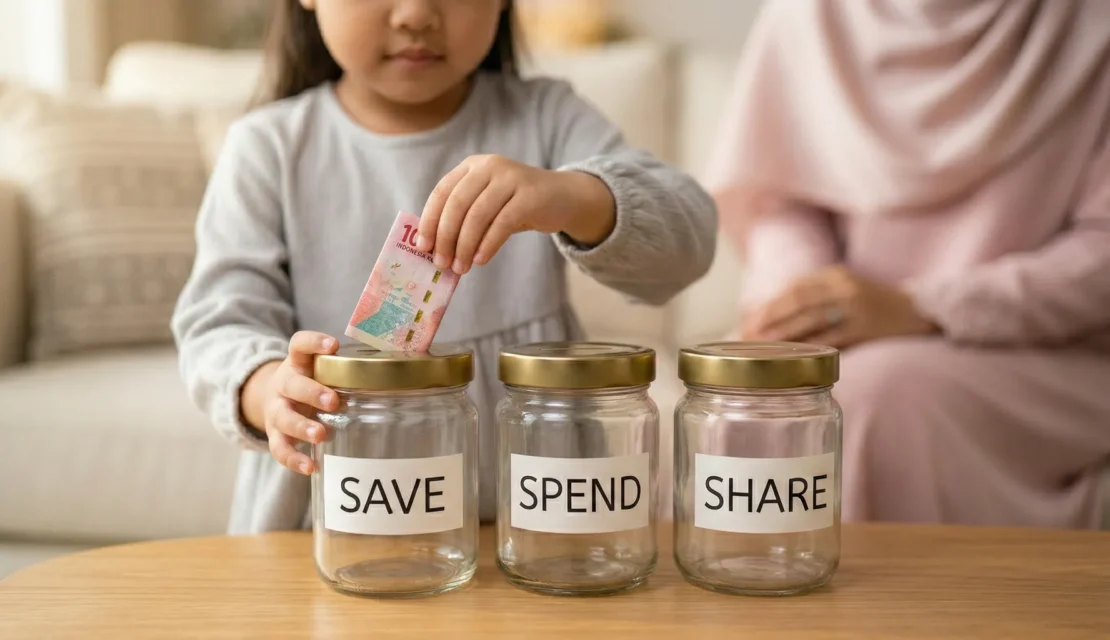
Before your child receives any Eid money, introduce a simple system they can visualize and physically interact with. The three jar method works beautifully for young children because it’s tangible and easy to understand.
Here’s how to set up the three jar system:
- Find three clear jars or containers and label them “Save,” “Spend,” and “Share”
- Explain that every time they receive money, some goes into each jar
- Let them decorate the jars with stickers or drawings to create ownership
- Decide together on a percentage split, such as 50% save, 40% spend, and 10% share
- Practice with pretend money before Eid so they understand the process
- Celebrate when they put money in each jar to make it feel positive
The beauty of this system is that children can see their savings grow. There’s something magical about watching coins and bills accumulate in a clear container. It makes the abstract concept of saving wonderfully concrete.
2. Make Saving Goals Visual and Exciting
Children are naturally focused on the present moment. Asking them to save for “the future” means absolutely nothing to a four-year-old. Instead, help them identify something specific they want and create a visual tracker for it.
Maybe your child wants a particular toy, a special outing, or even a book series they’ve been eyeing. Whatever it is, find a picture of it and create a simple chart showing how much they need. Each time they add to their savings jar, they can color in a section of the chart. This transforms saving from a boring chore into an exciting journey toward a real goal.
We use similar visual goal-setting techniques in our Apple Tree classrooms, and children absolutely love tracking their progress. The principle works just as well for money as it does for learning achievements.
3. Teach Thoughtful Spending Through Questions
When your child wants to use money from their “Spend” jar, resist the urge to simply say yes or no. Instead, guide them through a thinking process that builds wise decision-making habits.
Questions to ask before spending:
- Do you really want this, or do you just want it right now?
- Do you have something similar at home already?
- Will you still want this next week?
- Is this the best use of your spending money?
These questions aren’t meant to prevent all spending. Remember, the “Spend” jar exists precisely so children can enjoy their money. The goal is simply to add a pause between impulse and action. Even a few seconds of reflection can help children make choices they feel good about later.
4. Introduce the Joy of Sharing
The “Share” jar might be our favorite part of Eid money management. Teaching children that money can help others creates empathy and generosity that extends far beyond financial lessons. During Eid, sharing holds special significance as it connects beautifully with the values of charity and community care.
Even young children can experience the happiness that comes from giving. Let them choose how to use their sharing money, whether donating to a cause they care about or buying something kind for someone in need. This sense of agency makes the lesson stick.
5. Let Them Make Mistakes
Here’s something many parents struggle with: allowing children to make poor money choices. We get it. Watching your child spend their entire “Spend” jar on something that breaks within an hour is painful. But these small failures teach powerful lessons.
When children experience the natural consequences of impulse purchases, they learn far more than from any lecture we could give. Be there to comfort them without saying “I told you so,” and help them reflect on what they might do differently next time.
6. Practice Counting and Math Skills Together
Eid money management doubles as a fantastic learning opportunity for basic math skills. Counting money, adding totals, and calculating how much more they need for a goal all reinforce what children learn in school.
What you’ll need for counting practice:
- Real coins and bills in various denominations
- A notebook or simple chart to track totals
- A calculator for checking their math
- Stickers or stamps to reward correct counting
Make it playful rather than like homework. You can pretend to run a little shop at home or play “bank” where they deposit their Eid money. These games build number confidence while reinforcing money management concepts.

Tips for Making Eid Money Management Fun
Short attention spans and abstract concepts don’t mix well. Keep these tips in mind to ensure your financial lessons actually stick and your child stays engaged throughout the learning process.
- Use play money for practice sessions before handling real cash
- Turn counting money into a game with songs or fun challenges
- Let children physically handle their money rather than just talking about it
- Celebrate small wins like reaching a mini savings goal
- Read children’s books about money and saving together
- Be patient and keep lessons brief, around five to ten minutes maximum
- Model good money habits yourself since children learn by watching you
Building Financial Foundations That Last
Teaching kids about Eid money management wisely isn’t about creating tiny accountants. It’s about giving your children tools they’ll use throughout their lives. The patience to save, the wisdom to spend thoughtfully, and the generosity to share freely are gifts far more valuable than any amount of angpao money.
At Apple Tree Pre-School BSD, located in the Educenter BSD Building, we believe in nurturing well-rounded children who grow smart and happy. Our Singapore-based curriculum includes lessons on responsibility, decision-making, and character building that complement everything you teach at home.Ready to give your child the best start in life? Come visit us and see how we help little ones develop into confident, capable learners. Contact us via WhatsApp or call +62 888 1800 900 to schedule a tour. Register now and let your child play and learn with wonderful friends at Apple Tree Pre-School BSD!