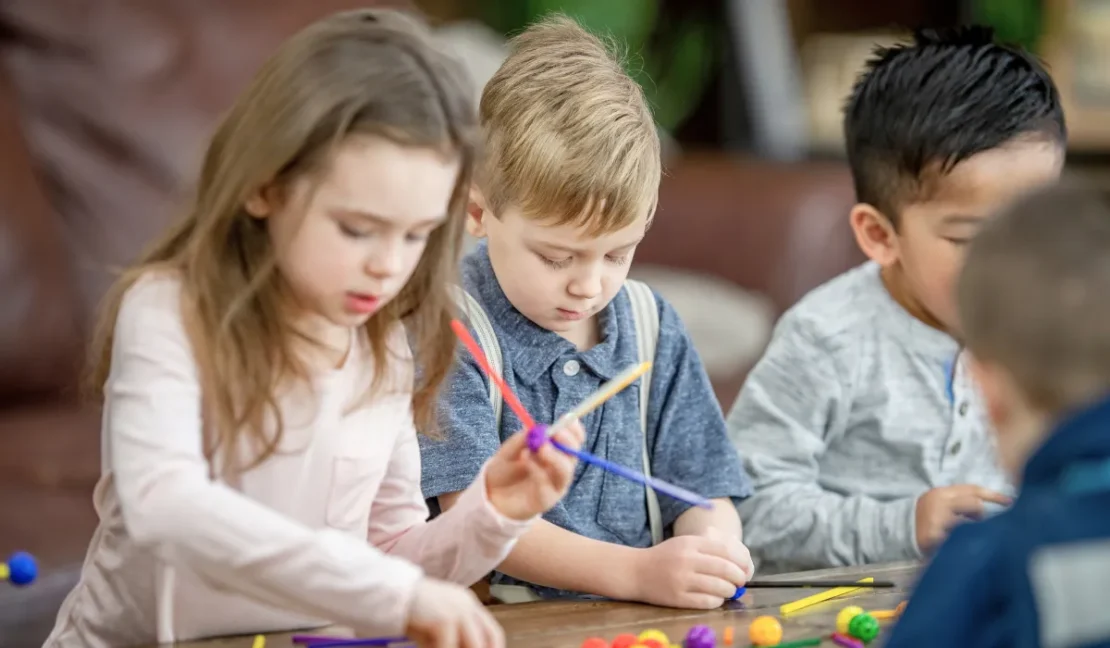
This morning, five-year-old Sophie in our Kindergarten 2 class made a discovery that left everyone speechless. She was building with blocks when she suddenly announced, “If I make the bottom bigger, my tower won’t fall down!” What followed was twenty minutes of intense experimentation as she tested different base sizes, documenting her findings with excited squeals and careful observations.
That’s the beauty of STEM learning in early childhood. It doesn’t require lab coats or complicated equations. It happens naturally when curious minds meet simple materials and the freedom to explore. At Apple Tree Pre-School BSD, we’ve discovered that some of the most profound scientific breakthroughs happen at ground level, with tiny hands and enormous imaginations leading the way.
Here’s what many parents don’t realize: your preschooler is already a natural scientist, engineer, and mathematician. Every time they stack blocks, mix colors, or figure out how to make their toy car go faster, they’re engaging in authentic STEM thinking. Our job isn’t to teach them to be curious, it’s to channel that curiosity into meaningful learning experiences.
Why STEM Activities Matter for Young Learners
Let’s talk about something we see every day in our classrooms at the Educenter BSD Building. Children who engage regularly with hands-on STEM activities develop critical thinking skills that extend far beyond science and math. They become better problem solvers, more confident experimenters, and more resilient when faced with challenges.
STEM activities for preschoolers aren’t about preparing them for advanced calculus or chemistry labs. They’re about nurturing the natural wonder that drives all great discoveries. When three-year-old Marcus spends thirty minutes trying to figure out why his paper airplane keeps nose-diving, he’s not just playing. He’s learning about trial and error, cause and effect, and the satisfaction that comes from solving problems independently.
The magic happens when children realize they can test ideas, make predictions, and discover answers through their own investigations. This mindset becomes the foundation for lifelong learning and innovation.
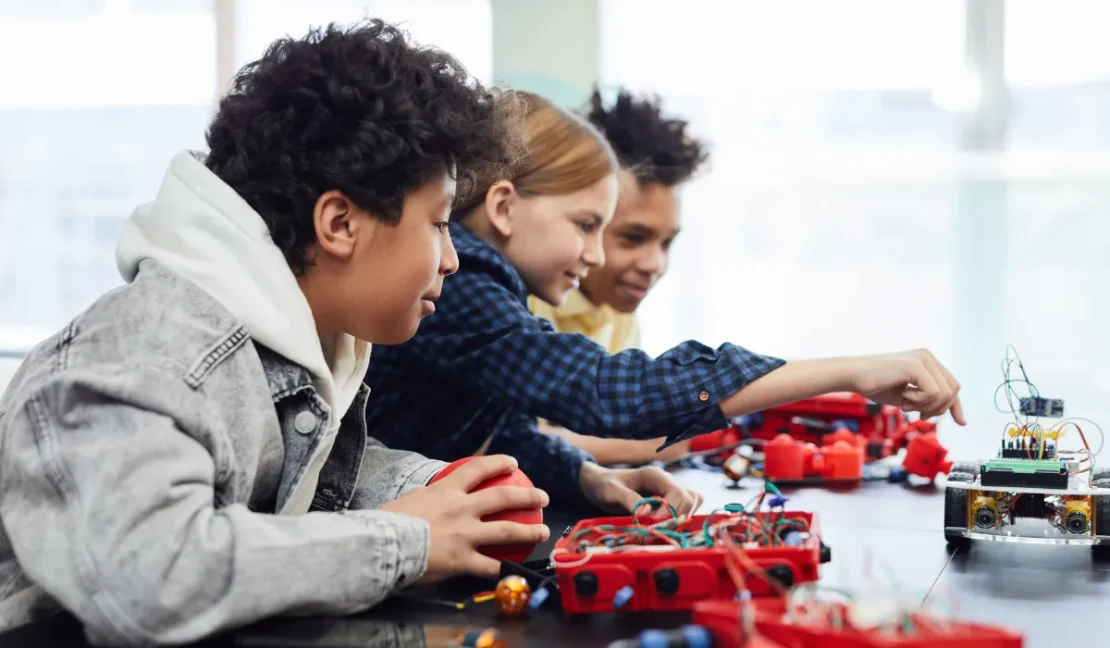
Image Source: Canva
Simple Science Experiments That Wow Every Time
Kitchen Chemistry Adventures
Your kitchen is basically a science lab waiting to be discovered. We’ve found that some of our most successful STEM activities happen with everyday ingredients you probably have in your pantry right now.
Take the classic baking soda and vinegar volcano. Sure, it’s been done a million times, but watch a four-year-old’s face when that reaction bubbles up for the first time. We like to extend this experiment by trying different ratios, adding food coloring, or even freezing the mixtures to see what happens.
Another crowd-pleaser is density experiments with oil and water. Add some food coloring and small objects, and suddenly you’ve got a captivating investigation into why some things float and others sink. Our Pre-Nursery students can spend ages dropping different items into these mixtures, making predictions and testing their hypotheses.
Weather in a Jar
This activity never gets old, and it perfectly demonstrates how complex scientific concepts can be made accessible to young minds. Fill a clear jar with hot water, place a plate on top with ice cubes, and watch as clouds form and “rain” falls inside the container.
The best part isn’t the wow factor, though that’s pretty spectacular. It’s the conversations that follow. Children start asking questions about real weather, making connections between the experiment and what they see outside, and developing genuine understanding of natural phenomena.
Engineering Challenges That Spark Creativity
Building Bridges and Towers
Engineering activities for preschoolers are all about the design process: plan, build, test, and improve. We love challenges that use simple materials but require complex thinking.
Our “marshmallow tower” challenge using spaghetti and marshmallows has become legendary among our Kindergarten 1 students. Teams work together to build the tallest tower possible, learning about stability, teamwork, and creative problem-solving. The inevitable collapses aren’t failures, they’re learning opportunities that lead to stronger, more innovative designs.
Bridge building with cardboard and tape takes this concept even further. Children learn to consider load-bearing, span distance, and structural integrity while having an absolute blast testing their creations with toy cars.
Simple Machines in Action
Pulleys, levers, and ramps might sound like advanced engineering concepts, but preschoolers grasp these ideas intuitively through play. We set up stations where children can experiment with different simple machines, often without even realizing they’re learning fundamental physics principles.
A ramp station with cars of different weights teaches about friction and momentum. A pulley system for lifting small objects introduces mechanical advantage. These hands-on experiences create concrete understanding that will support more abstract learning later.
Math That Doesn’t Feel Like Math
Pattern Play and Number Adventures
STEM activities naturally incorporate mathematical thinking in ways that feel organic and engaging. Sorting activities using natural materials like leaves, rocks, or shells introduce classification skills and pattern recognition.
Our “number scavenger hunts” around the classroom or playground help children see mathematics in their everyday environment. Finding groups of three flowers, counting steps, or measuring shadows with non-standard units makes math concrete and meaningful.
Measurement Explorations
Preschoolers love to measure everything, and this natural inclination opens doors to rich mathematical learning. We provide measuring tools ranging from rulers to cups to string, then let curiosity guide the investigation.
Cooking activities are particularly rich in measurement opportunities. Following recipes introduces concepts like more and less, fractions, and sequencing while creating something delicious. Our students have measured everything from their own height to the distance toy cars travel, developing number sense through authentic experiences.

Image Source: Canva
Technology Integration That Makes Sense
While hands-on activities form the core of effective STEM learning, age-appropriate technology can enhance these experiences beautifully. We use tablets with coding apps that let children create simple sequences and see immediate results.
Our interactive smart boards allow whole-class investigations where students can manipulate digital objects, test hypotheses, and document findings together. The key is choosing technology that supports rather than replaces hands-on exploration.
Digital microscopes connected to large screens let children explore textures, patterns, and details invisible to the naked eye. These tools amplify natural curiosity rather than replacing it with passive screen time.
Making STEM Learning Stick at Home
The most powerful STEM learning happens when school and home experiences reinforce each other. We encourage parents to become co-investigators with their children, asking open-ended questions and expressing genuine curiosity about their discoveries.
Create a “STEM box” filled with materials that invite experimentation: magnifying glasses, measuring tools, building materials, and simple science supplies. Having these resources readily available transforms ordinary moments into learning opportunities.
Remember, the goal isn’t to have all the answers. Some of our best learning happens when adults and children explore together, modeling the questioning and investigating that drive all scientific progress.
Building Tomorrow’s Innovators Today
STEM activities for preschoolers plant seeds that will grow into lifelong passions for learning and discovery. At Apple Tree Pre-School BSD, we’ve watched shy children become confident experimenters, cautious kids become bold inventors, and quiet students become enthusiastic collaborators through engaging STEM experiences.
The beauty of early STEM education lies not in the complexity of the activities, but in the depth of thinking they inspire. When children learn to ask “what if?” and “how might we?” they develop skills that will serve them well regardless of their future paths.
Our comprehensive programs from Toddler through Kindergarten 2 are designed to nurture this natural curiosity while building the foundational skills that support all future learning.
Ready to watch your child discover the joy of scientific thinking? We’d love to show you how our hands-on approach to STEM learning creates confident, creative, and curious learners. Send us a WhatsApp message or give us a call at +62 888-1800-900.
Come play and learn with other children, because the future belongs to those who never stop asking “why?” and “what if?” 🔬🚀✨