
Your neighbor’s two-year-old is reciting the alphabet and narrating elaborate stories about her stuffed animals while your same-age child communicates primarily through pointing, grunting, and the occasional “mama” or “no.” You tell yourself every child develops differently (they do) and that Einstein didn’t talk until age four (possibly true, possibly parent legend). But at 2 a.m., you’re googling “when should my toddler be talking” and falling down rabbit holes of speech delay concerns that leave you both reassured and more worried than before. The pediatrician said “let’s wait and see” but you’re not sure if you should be waiting, seeing, or actively doing something right now.
Here’s what makes speech delay concerns so difficult to navigate: there’s enormous variation in normal language development, making it genuinely hard to know when your child is just taking their time versus when they need support. What complicates things further in multilingual environments like BSD is that children learning multiple languages simultaneously often hit milestones differently than monolingual children, which means standard charts don’t always apply. At Apple Tree Pre-School BSD, we work with children developing language skills in English, Chinese, and Bahasa simultaneously, giving us daily insights into speech delay concerns parents face and when intervention truly helps versus when patience is the right answer.
The stakes feel high because language is fundamental to everything: learning, socializing, expressing needs, building relationships, and developing confidence. Understanding when speech delay concerns warrant action versus when they’re within normal variation can save you months of unnecessary worry or, conversely, catch issues early when intervention is most effective. Ready to understand what’s actually typical, what’s concerning, and what you can do about it?
Understanding Speech Delay Concerns: What’s Normal and What’s Not
Before panicking or dismissing speech delay concerns, let’s establish what typical language development actually looks like and where the red flags genuinely appear.
Typical Language Milestones by Age
Language development follows general patterns, though with significant individual variation. These milestones help assess whether speech delay concerns are warranted.
Ages 1 to 2 years:
- 12 months: First words, understanding simple commands
- 15 months: 3 to 5 words, following simple directions
- 18 months: 10 to 20 words, can point to body parts or familiar objects when named
- 24 months: 50+ words, starting to combine two words (“more milk,” “daddy go”)
Ages 2 to 3 years:
- Two-word phrases becoming more complex
- 200 to 1,000 word vocabulary by age 3
- Strangers can understand about 75% of speech by age 3
- Starting to use plurals, past tense, pronouns
Ages 3 to 4 years:
- Speaking in sentences of 4+ words
- Can tell simple stories
- Strangers understand almost all speech
- Using grammar mostly correctly
Ages 4 to 6 years:
- Complex sentences with proper grammar
- Clear speech with all sounds mostly correct
- Can have conversations and answer questions
- Telling elaborate stories with sequence and detail
In our programs from Toddler with 12 children per class through Kindergarten 2 with 20 children, we see the full spectrum of typical development, which helps us recognize when speech delay concerns need attention.
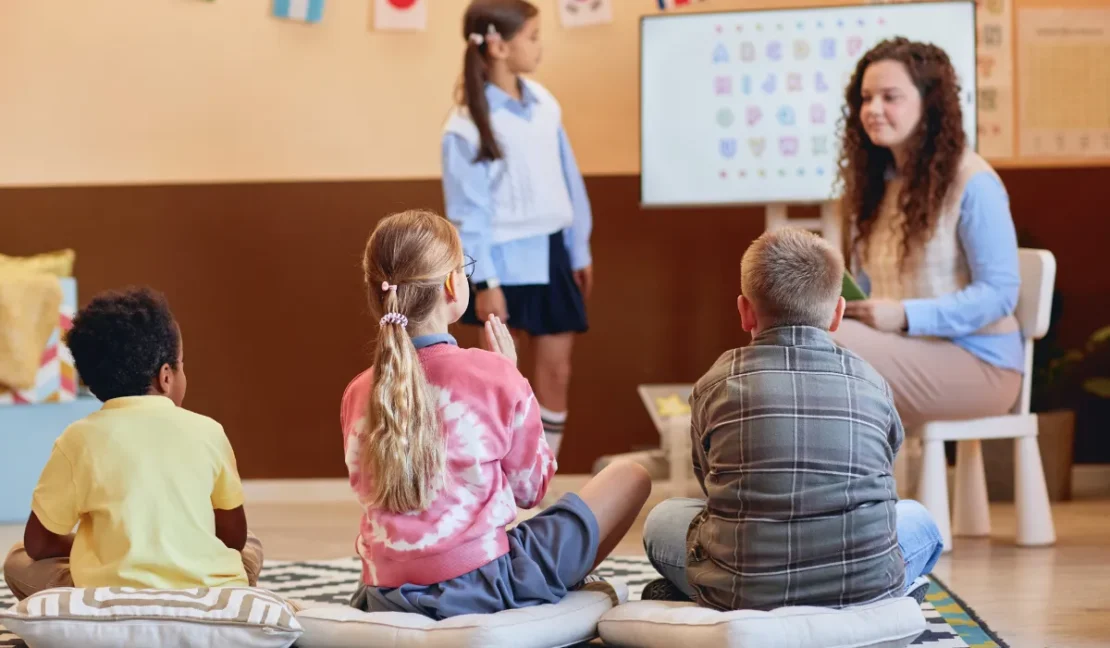
Image Source: Canva
Red Flags That Warrant Evaluation
While variation is normal, certain signs suggest speech delay concerns should be taken seriously and evaluated by professionals.
Concerning signs at different ages:
- 12 months: No babbling, no gestures (pointing, waving)
- 18 months: Fewer than 6 words, not understanding simple commands
- 24 months: Fewer than 25 words, not combining two words, not imitating words
- 3 years: Difficult for family members to understand, limited sentences, not engaging in back-and-forth conversation
- 4+ years: Consistently difficult to understand, grammatical errors, limited vocabulary
Additional red flags at any age include loss of previously acquired skills, lack of interest in social interaction, frustration with communication leading to behavior problems, and not responding to their name or to sounds.
If you’re experiencing speech delay concerns related to these red flags, trust your instincts and seek evaluation. Early intervention makes significant differences, and evaluations are free through many programs.
Multilingual Considerations in BSD Context
This is where speech delay concerns get complicated for families in our BSD community where children often hear English at preschool, Bahasa at home with household staff, and perhaps Mandarin or other languages with family.
What’s typical for multilingual children:
- May have smaller vocabularies in each individual language but similar total vocabulary across all languages
- May mix languages in sentences (code-switching, which is normal)
- May have temporary “silent periods” in new languages
- May reach some milestones slightly later than monolingual peers but catch up by school age
When multilingualism isn’t the explanation:
- Delays across all languages the child hears
- Not understanding any language well
- No progress over several months
- Other developmental concerns beyond language
At our Educenter BSD Building campus, our Singapore curriculum covering English, Mathematics, Chinese, Science, Creativity, Social Studies, Bahasa, Moral, Music, Physical Education, and Phonics supports multilingual development. We help parents distinguish between typical multilingual development and genuine speech delay concerns.
Common Causes Behind Speech Delay Concerns
Understanding why speech delays happen helps address speech delay concerns more effectively and determines appropriate interventions.
Hearing Issues
This is the first thing professionals check because it’s common and highly treatable. Children can’t develop normal speech if they can’t hear clearly.
Hearing-related causes:
- Chronic ear infections causing temporary or permanent hearing loss
- Fluid in ears affecting hearing
- Structural issues with ears
- Auditory processing difficulties
If you have speech delay concerns, get hearing tested first. It’s non-invasive and rules out a highly treatable cause. We’ve seen children make dramatic language progress after ear tubes or hearing aids address underlying hearing problems.
Oral Motor Issues
Some children have difficulty with the physical act of producing sounds even though they understand language fine.
Oral motor challenges include:
- Tongue tie or lip tie affecting articulation
- Low muscle tone in face and mouth
- Apraxia (brain difficulty coordinating muscles for speech)
- Dysarthria (muscle weakness affecting speech)
These children often have feeding difficulties too, drooling beyond typical age, or difficulty with chewing. Speech therapy targeting oral motor skills specifically addresses these speech delay concerns.
Developmental and Cognitive Factors
Sometimes speech delay concerns are part of broader developmental patterns rather than isolated language issues.
Related conditions:
- Global developmental delays affecting multiple areas
- Intellectual disabilities
- Autism spectrum disorder (often with social communication differences)
- Specific language impairment
When speech delays accompany delays in other areas like motor skills, social interaction, play skills, or cognitive development, comprehensive evaluation determines what support children need across domains.
Environmental Factors
Not all speech delay concerns stem from issues within the child. Sometimes the environment isn’t providing enough language input and interaction.
Environmental contributors:
- Limited conversation and interaction with caregivers
- Excessive screen time replacing human interaction
- Anticipating child’s needs so they don’t need to communicate
- Lack of exposure to rich vocabulary and conversation
- Multiple caregivers who don’t share common languages
These environmental speech delay concerns are often easiest to address through parent education and environmental changes.
What to Do About Speech Delay Concerns: Taking Action
If you’re experiencing speech delay concerns, here’s your action plan from immediate steps to longer-term strategies.
Step 1: Get Professional Evaluation
Don’t “wait and see” indefinitely if you have genuine speech delay concerns. Early intervention is most effective, and evaluations provide either reassurance or access to help.
Where to get evaluated:
- Pediatrician for initial screening and referrals
- Speech-language pathologist for comprehensive evaluation
- Early intervention programs (often free for young children)
- Audiologist for hearing assessment
Come prepared with specific speech delay concerns: what your child can and can’t do, examples of their language, and questions about what’s typical. Video examples of your child communicating can be helpful.
Step 2: Hearing Assessment
Before anything else, rule out hearing issues. This is quick, painless, and eliminates a major potential cause of speech delay concerns.
Even if your child “seems to hear fine,” get formal testing. Children can hear some sounds but miss others, particularly if they have fluid in ears affecting certain frequencies. This partial hearing loss can significantly impact language development while being non-obvious in daily life.
Step 3: Increase Language-Rich Interactions at Home
While waiting for evaluations or alongside therapy, you can address speech delay concerns by dramatically increasing quality language input.
Effective home strategies:
- Narrate your activities throughout the day
- Read books together daily, multiple times
- Sing songs, nursery rhymes, and finger plays
- Reduce screen time and replace with human interaction
- Follow your child’s interests and talk about what engages them
- Expand on what your child says (“Dog!” becomes “Yes, big brown dog!”)
- Wait for responses instead of anticipating needs
- Play interactive games that require communication
In our English and Phonics curriculum, we use many of these same strategies in structured ways. The good news about speech delay concerns related to input is that they’re highly responsive to increased quality interaction.
Step 4: Consider Speech Therapy
For genuine speech delay concerns confirmed by evaluation, speech therapy is the gold standard intervention.
What speech therapy addresses:
- Articulation (pronouncing sounds correctly)
- Expressive language (using words and sentences)
- Receptive language (understanding language)
- Pragmatic language (social use of language)
- Oral motor skills
Speech therapy is play-based for young children and includes parent training so you can support progress at home. Most children with speech delay concerns make significant progress with consistent therapy.
Step 5: Optimize Your Child’s Learning Environment
Beyond direct intervention for speech delay concerns, the right educational environment supports language development across the day.
What to look for in preschool:
- Small class sizes for individualized attention
- Language-rich curriculum across subjects
- Teachers trained in language development
- Opportunities for peer interaction and conversation
- Explicit vocabulary instruction
- Support for multilingual learners
At Apple Tree Pre-School BSD, our small class sizes from 12 children in Toddler programs to 20 in Kindergarten allow us to support each child’s language development individually. Our comprehensive curriculum provides vocabulary and language experiences across English, Mathematics, Chinese, Science, Creativity, Social Studies, Bahasa, Moral education, Music, Physical Education, and Phonics.

Image Source: Canva
Supporting Language Development at Different Ages
Addressing speech delay concerns looks different depending on your child’s age and developmental stage.
Supporting Toddlers (Ages 1.5 to 3)
For speech delay concerns in toddlers, focus on building foundation skills and vocabulary.
Effective toddler strategies:
- Simplify your language to match their level plus one step
- Use gestures alongside words
- Create communication opportunities (put favorite toys out of reach so they must request)
- Imitate their sounds and encourage imitation of yours
- Label everything throughout the day
- Use simple books with pictures for labeling and conversation
In our Toddler and Pre-Nursery programs with 12 to 16 children per class, we create language-rich environments where even children with speech delay concerns hear constant, varied language input at appropriate levels.
Supporting Preschoolers (Ages 3 to 5)
Speech delay concerns in preschoolers often involve moving from words to sentences and expanding vocabulary rapidly.
Preschool language strategies:
- Ask open-ended questions that require more than yes/no
- Introduce new vocabulary in context across activities
- Encourage storytelling and narrative skills
- Provide opportunities to talk with peers
- Play games requiring verbal communication
- Explicitly teach concepts like colors, numbers, shapes, categories
Our Nursery and Kindergarten 1 programs with 20 children each incorporate these strategies throughout the day in structured and play-based learning.
Supporting Kindergarteners (Ages 5 to 6)
By kindergarten, speech delay concerns often involve articulation, complex grammar, or using language for learning.
Kindergarten language support:
- Rich vocabulary across academic subjects
- Explicit grammar instruction
- Opportunities for presentations and speaking to groups
- Phonological awareness activities supporting reading
- Conversations about abstract concepts
- Encouragement of elaborate storytelling
In our Kindergarten 2 program, we prepare children for primary school communication demands while addressing any remaining speech delay concerns.
When Speech Delay Concerns Are Actually Something Else
Sometimes what looks like speech delay concerns are actually different issues that present similarly but require different approaches.
Selective Mutism
Some children can speak perfectly at home but don’t talk in other settings like preschool. This isn’t a speech delay, it’s an anxiety disorder called selective mutism.
Signs of selective mutism:
- Normal or advanced language at home
- Consistent silence in specific settings
- Not shyness (which gradually improves) but persistent inability to speak
- Often accompanied by social anxiety
This requires different intervention than speech delay concerns, typically involving anxiety treatment and gradual exposure rather than speech therapy alone.
Stuttering
Stuttering or disfluency is common in young children as language develops faster than their ability to produce it. Most outgrow it, but persistent stuttering needs attention.
When stuttering needs evaluation:
- Continues beyond age 5
- Worsening over time rather than improving
- Child shows frustration or awareness of stuttering
- Family history of stuttering
Early stuttering therapy is highly effective, so don’t adopt the “wait and see” approach if stuttering persists or worsens.
Social Communication Differences
Some children have adequate vocabulary and grammar but struggle with using language socially, which raises different speech delay concerns.
Social communication challenges:
- Difficulty with back-and-forth conversation
- Not understanding social cues or nonverbal communication
- Unusual tone or prosody
- Difficulty staying on topic or understanding context
- Overly literal interpretation
These pragmatic language concerns sometimes indicate autism spectrum disorder or social communication disorder and benefit from intervention targeting social use of language specifically.
The Role of Preschool in Addressing Speech Delay Concerns
Quality preschool environments don’t just accommodate children with speech delay concerns, they actively support language development for all children.
How We Support Language Development at Apple Tree
At Apple Tree Pre-School BSD, language development is woven throughout every aspect of our Singapore curriculum and daily routines.
Our language-rich approach:
- Small class sizes allowing individualized attention and conversation
- Teachers trained to recognize and support speech delay concerns
- Explicit vocabulary instruction across all subjects
- Multiple languages providing rich linguistic input
- Peer interaction opportunities throughout the day
- Regular communication with parents about language progress
- Collaboration with speech therapists when children receive outside services
In our English curriculum, we provide structured language instruction. In Science and Social Studies, we teach content vocabulary. In Music and Physical Education, we use songs, chants, and verbal instructions. Language learning happens everywhere.
Creating Communication Opportunities
Beyond explicit instruction, we address speech delay concerns by creating countless opportunities for children to communicate throughout the day.
Daily communication opportunities:
- Morning greetings and circle time sharing
- Requesting materials during activities
- Negotiating with peers during play
- Asking and answering questions during lessons
- Storytelling and show-and-tell
- Conversations during snack and transitions
Children with speech delay concerns benefit enormously from these natural communication opportunities with both teachers and peers.
Supporting Multilingual Development
In BSD’s multilingual environment, we help parents understand how multiple language exposure affects development and whether their speech delay concerns are typical for multilingual children or warrant intervention.
Our multilingual approach:
- Teaching in English while respecting home languages
- Chinese instruction providing additional language exposure
- Understanding that multilingual development follows different timelines
- Recognizing when delays cross all languages (true concern) versus affecting only one language (typical)
Parents often come to us with speech delay concerns about multilingual development, and we can provide perspective based on seeing hundreds of multilingual children’s language journeys.
Practical Tips for Parents with Speech Delay Concerns
Beyond professional intervention, everyday strategies can significantly support children’s language development.
Talk, Talk, Talk
The single most important thing you can do to address speech delay concerns is increase the amount and quality of language your child hears.
Effective talking strategies:
- Narrate daily activities: “I’m washing the dishes. Here’s a plate. It’s wet and soapy.”
- Self-talk about what you’re doing, thinking, feeling
- Parallel talk about what your child is doing: “You’re building a tall tower!”
- Expand their utterances: Child says “dog,” you say “Yes, a big fluffy dog”
- Model correct grammar without explicitly correcting
Research shows that children’s language development correlates strongly with the amount of conversational turns they experience. Make conversation a constant part of your day.
Read Together Daily
Reading addresses speech delay concerns by providing exposure to vocabulary, grammar, and narrative structure beyond everyday conversation.
Reading strategies that boost language:
- Read the same books repeatedly (repetition builds mastery)
- Ask questions about the story and pictures
- Let your child “read” to you from familiar books
- Act out stories together
- Choose books slightly above their current level to stretch skills
In our literacy instruction, we see dramatic differences in language development between children who are read to daily versus those with limited book exposure.
Reduce Screen Time, Increase Face Time
Screens don’t cause speech delay concerns directly, but they displace the human interaction that builds language.
Why screens don’t support language like interaction does:
- One-way communication with no back-and-forth
- Fast pace and scene changes affecting attention
- Replacing time that could involve conversation
- Not responsive to child’s specific interests and level
The research is clear: children don’t learn language from screens effectively. They learn from responsive, engaged human interaction. If you have speech delay concerns, dramatically reduce screens and replace that time with conversation, play, and interaction.
Create Communication Needs
Sometimes we anticipate children’s needs so effectively that they don’t need to communicate. For speech delay concerns, create situations requiring communication.
Ways to create communication opportunities:
- Put favorite toys just out of reach so they must request help
- Offer choices requiring verbal response
- Pretend you don’t understand gestures: “I can’t tell what you want. Use your words.”
- Wait expectantly rather than rushing to fulfill needs
- “Sabotage” situations: give them a cup without a drink so they must request it
This isn’t being mean, it’s creating motivation to communicate that jumpstarts language for children with speech delay concerns.
Why This Matters at Apple Tree Pre-School BSD
Everything we’ve explored about speech delay concerns connects directly to our mission at Apple Tree Pre-School BSD to help children grow smart and happy. Language is foundational to both the “smart” (academic learning across subjects) and “happy” (social connections, emotional expression, confidence) parts of development.
Our Singapore curriculum covering English, Mathematics, Chinese, Science, Creativity, Social Studies, Bahasa, Moral education, Music, Physical Education, and Phonics is delivered in language-rich environments where children with typical development and those with speech delay concerns all receive support matching their needs. With thoughtfully sized classes from 12 children in Toddler programs to 20 in Kindergarten, we provide the individualized attention and conversation that supports language growth.
At our Educenter BSD Building campus, we partner with families navigating speech delay concerns, communicating openly about each child’s progress, collaborating with speech therapists when needed, and creating environments where language development happens naturally throughout every activity and interaction.
Concerned about your child’s speech and language development? At Apple Tree, we create language-rich environments where children develop communication skills through play, conversation, and comprehensive curriculum across multiple languages. Discover how we support every child’s language journey from first words to fluent storytelling or call us at +62 888-1800-900.
Join our Apple Tree family where every child’s voice is heard and celebrated! 🍎