Yesterday afternoon, five-year-old Sophie in our Kindergarten 1 class made a discovery that had her practically bouncing with excitement. She was playing our “Cookie Monster Counting Game” when she suddenly shouted, “Miss! I just figured out that five cookies plus three more cookies makes eight cookies, and that’s the same as four plus four!” The look of pure triumph on her face reminded us once again why math games for kids are absolute magic in disguise.
Here’s what we’ve learned after countless hours of watching little minds light up with mathematical understanding at Apple Tree Pre-School BSD. Math doesn’t have to be scary worksheets filled with abstract numbers. When we disguise learning as play, children naturally absorb mathematical concepts while having the time of their lives.
The secret isn’t in expensive educational toys or complex teaching methods. Some of our most effective math games happen with simple household items, a bit of creativity, and the willingness to turn everyday moments into learning adventures. When children don’t even realize they’re “doing math,” that’s when the real learning magic happens.
Why Interactive Math Games Transform Young Learners
We’ve witnessed something remarkable in our classrooms at the Educenter BSD Building. Children who initially avoided anything that looked like math work become enthusiastic problem-solvers when learning is wrapped in playful, engaging activities.
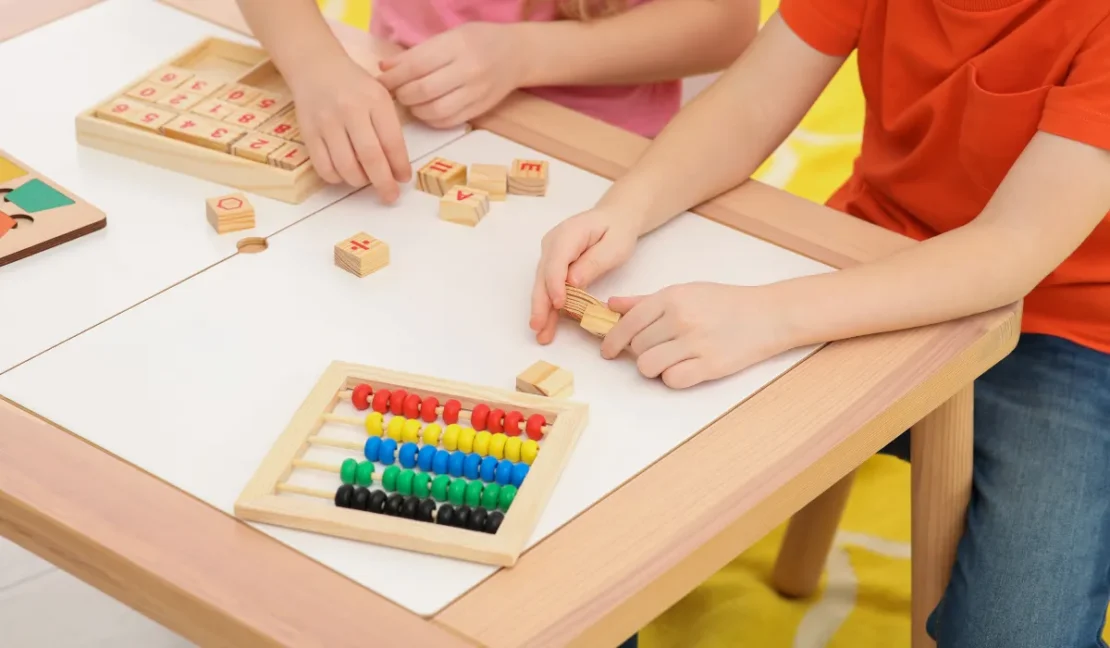
Math games for kids work because they make abstract concepts concrete and relatable. When three-year-old Marcus uses actual blocks to understand that two blocks plus two blocks equals four blocks, he’s building neural pathways that will support much more complex mathematical thinking later. The physical manipulation of objects helps young brains understand mathematical relationships in ways that abstract numbers on paper simply cannot.
Game-based learning also removes the fear factor that many children develop around mathematics. Instead of worrying about getting the “right answer,” children focus on having fun, experimenting, and exploring. This positive emotional association with mathematical thinking becomes the foundation for lifelong learning and confidence.
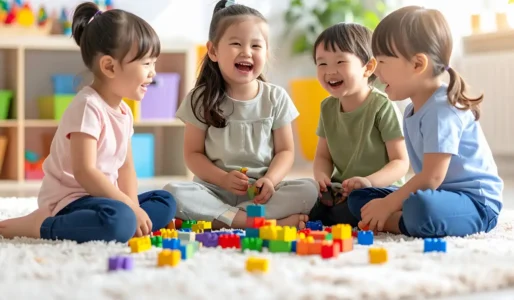
The social aspect of math games adds another layer of learning that worksheets can’t provide. When children play math games together, they’re explaining their thinking, learning from each other, and developing mathematical vocabulary naturally through conversation and collaboration.
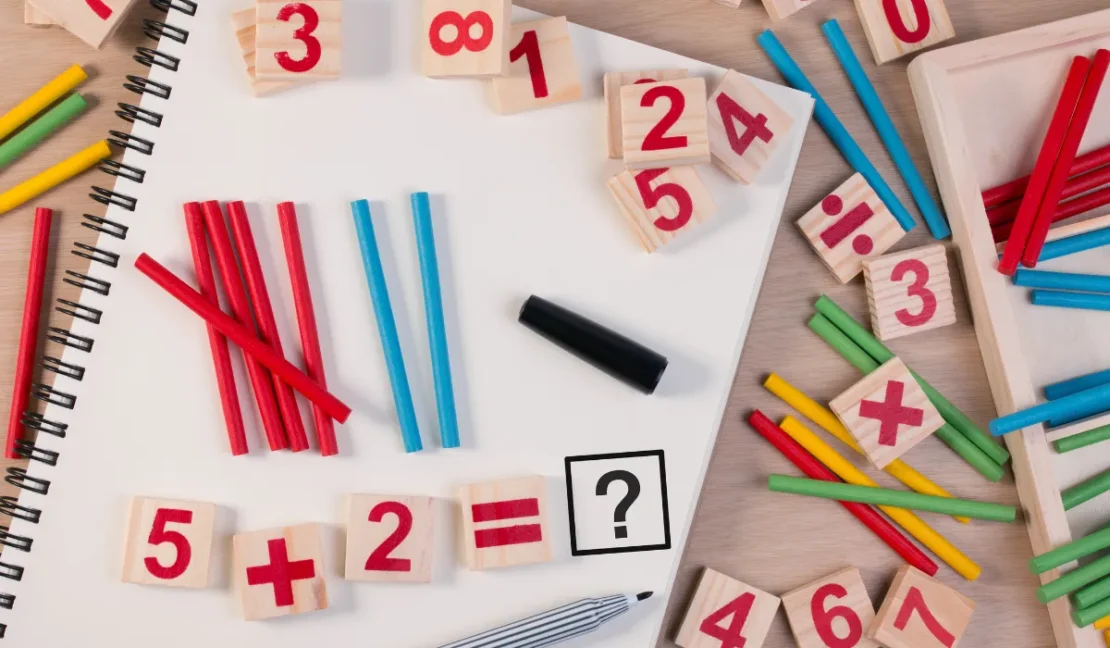
Image Source: Canva
Number Recognition Adventures for Little Mathematicians
Treasure Hunt Counting Games
Transform your home or classroom into an exciting mathematical adventure with simple treasure hunts that reinforce number recognition and counting skills. Hide numbered cards around the space and challenge children to find them in order, or create hunts where they must collect specific quantities of different objects.
We love variations where children hunt for items in groups. “Find three red things,” “Collect five round objects,” or “Gather seven things that start with ‘B'” combine counting with observation skills and category thinking. The movement involved keeps energy levels high while learning stays engaging and purposeful.
The beauty of treasure hunt games lies in their flexibility. You can adjust difficulty levels instantly by changing the numbers involved, adding simple addition or subtraction challenges, or incorporating estimation skills. “About how many steps do you think it will take to reach the treasure?” naturally introduces mathematical thinking.
Interactive Number Line Activities
Create giant number lines using painter’s tape on the floor, then turn them into active learning experiences that get children moving while reinforcing number concepts. Children can hop to different numbers, follow simple addition and subtraction problems by moving along the line, or play games that involve finding numbers that are “bigger than five” or “smaller than three.”
Physical number lines help children visualize mathematical relationships in ways that traditional methods often miss. When they physically move from two to five, they’re experiencing the concept of “three more” with their whole bodies, creating stronger memory connections and deeper understanding.
Creative Counting and Addition Games
Kitchen Math with Snack Time
Some of our most successful math learning happens during snack preparation, where real-world applications make mathematical concepts immediately relevant and meaningful. Counting crackers, distributing fruit equally among friends, or measuring ingredients for simple recipes provides authentic mathematical experiences.
“If we have twelve grapes and four friends, how many grapes does each friend get?” becomes a practical problem-solving challenge rather than an abstract math worksheet question. Children naturally engage with division concepts when they’re dividing actual food among actual people.
Cooking activities are treasure troves of mathematical learning opportunities. Measuring cups introduce fractions, recipe following teaches sequence and following directions, and timer use introduces time concepts. Plus, the delicious results provide immediate positive reinforcement for mathematical success.
Board Game Bonanza for Number Skills
Simple board games provide structured opportunities for practicing counting, number recognition, and strategic thinking without feeling like formal instruction. Games with dice naturally reinforce addition skills, while moving game pieces reinforces counting and number sequence understanding.
We’ve discovered that children often grasp mathematical concepts during board game play that they struggle with in other contexts. The game structure provides clear rules and immediate feedback, while the fun factor keeps motivation high and anxiety low.
Create variations of familiar games to target specific mathematical skills. Add extra dice for practicing larger number addition, modify rules to include subtraction when moving backwards, or create simple games using numbered cards that require children to make mathematical comparisons.
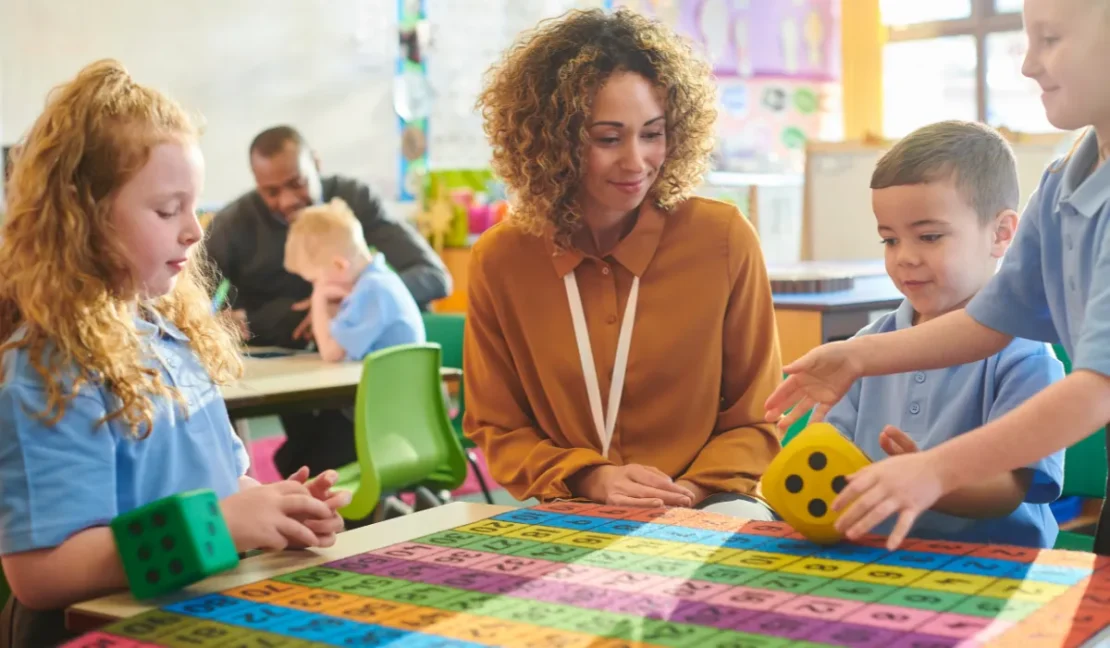
Image Source: Canva
Hands-On Geometry and Shape Recognition
Building Block Mathematical Explorations
Building activities naturally introduce geometric concepts, spatial reasoning, and mathematical problem-solving in engaging, tactile ways. Challenge children to build towers using specific numbers of blocks, create patterns with different shapes, or construct buildings that are “taller than” or “shorter than” reference objects.
Pattern creation with blocks reinforces sequencing skills while introducing early algebra concepts. “Red block, blue block, red block…” challenges children to identify and continue patterns, building logical thinking skills that support all mathematical learning.
Three-dimensional building experiences develop spatial reasoning skills that directly support geometry understanding and mathematical visualization abilities. When children experiment with balance, symmetry, and structural stability through block play, they’re engaging with complex mathematical concepts in developmentally appropriate ways.
Shape Sorting and Classification Adventures
Transform shape learning into active investigations where children become “shape detectives” searching for geometric forms in their environment. Challenge them to find all the circles in the classroom, identify triangles in architectural features, or hunt for rectangles in books and picture frames.
Shape sorting activities can evolve into complex classification games that develop logical thinking and category understanding. Start with simple shape identification, then progress to sorting by multiple attributes like size, color, and shape simultaneously.
Real-world shape applications help children understand that geometry isn’t just an academic subject but a practical tool for understanding their physical environment. When they notice that wheels are circles because circles roll, they’re making mathematical connections that will support future learning.
Technology-Enhanced Mathematical Learning
Educational Apps That Reinforce Concepts
Carefully selected educational apps can provide additional practice and reinforcement for mathematical concepts learned through hands-on activities. Look for apps that allow manipulation of objects, provide immediate feedback, and adapt to individual learning pace and progress.
The key is using technology to supplement, not replace, hands-on mathematical experiences. Apps work best when they reinforce concepts children are exploring through physical manipulation and real-world applications.
Choose apps that encourage mathematical thinking rather than rote memorization. The best educational technology asks children to solve problems, make predictions, and explain their reasoning rather than simply selecting correct answers from multiple choice options.
Math games for kids provide incredible opportunities for building mathematical confidence, understanding, and enthusiasm. At Apple Tree Pre-School BSD, we’ve discovered that when learning feels like play, children naturally absorb complex mathematical concepts while developing positive associations with mathematical thinking.
The goal isn’t to rush children through mathematical concepts but to build solid foundations through engaging, meaningful experiences. When children understand mathematical relationships through hands-on exploration and playful investigation, they develop number sense and mathematical reasoning that will serve them throughout their academic journey.
Our comprehensive programs integrate mathematical learning naturally throughout each day, ensuring children develop strong numerical foundations while maintaining joy and curiosity about mathematical exploration.
Ready to watch your child discover the joy of mathematical thinking? We’d love to show you how our play-based approach to mathematics creates confident, enthusiastic learners who see math as an exciting adventure rather than a challenging subject. Send us a WhatsApp message or give us a call at +62 888-1800-900.
Come play and learn with other children, because mathematics is all around us waiting to be discovered! 🔢🎲✨