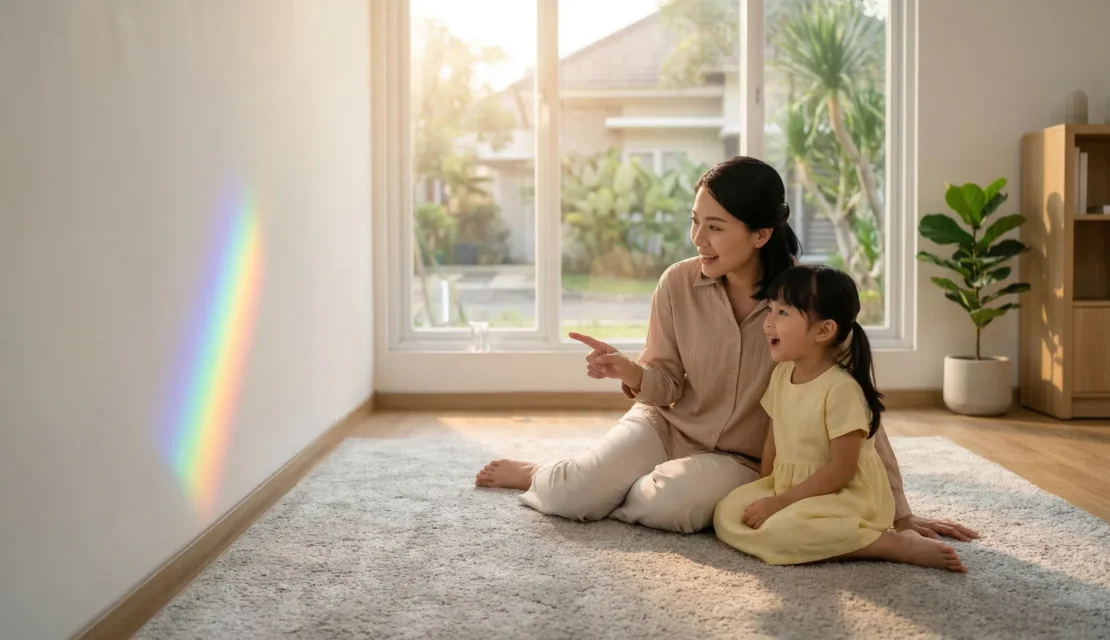
Picture this: your little one looks up at the sky after a rainy afternoon, points to a bright arc of color, and asks, “Mommy, where did that come from?” Cue the moment of quiet panic where you try to remember anything from your old school science class. We’ve all been there, haven’t we? Here’s the good news, though. Understanding how rainbows form is something you and your child can explore together, right at home, with just a mirror, a bowl of water, and a little bit of sunlight. No storm required.
How Rainbows Form (And Why It’s Cooler Than You Think)
Let’s get into the science a little, but keep it fun, we promise. A rainbow happens when sunlight passes through tiny water droplets suspended in the air. The light bends, splits, and bounces back to your eyes as a full spectrum of color: red, orange, yellow, green, blue, indigo, and violet. That’s it. No magic wand needed, just physics being its most beautiful self.
The Science Behind the Colors
When white light enters a water droplet, it slows down and bends in a process called refraction. Because each color of light bends at a slightly different angle, they fan out and separate into that gorgeous arc we all recognize. So the next time your child asks why the rainbow is curved, you can smile knowingly and say, “Because light is showing off.” And honestly, that’s not even wrong.
Why This Is the Perfect Activity for Curious Little Minds
Young children are naturally wired for curiosity. Their brains are growing at an incredible rate during these early years, and hands-on discovery is one of the best ways to feed that curiosity. When we explore how rainbows form through a simple experiment, we’re not just teaching science. We’re teaching children to observe, to wonder, to ask “what if?” and to find joy in figuring things out. That’s a skill set worth building early.
What You’ll Need
Good news: no trip to the craft store required. Everything on this list is probably already somewhere in your home right now.
- A shallow bowl or wide container
- Clean water, room temperature is perfectly fine
- A small flat mirror, a compact mirror works great
- A sunny spot near a window or an outdoor area with direct sunlight
- A plain white wall, or a sheet of white paper or cardboard to catch the light
- Optional: a flashlight, for doing this experiment at night or in a darker room
Step by Step: Let’s Make a Rainbow
Ready? This is the part where things get genuinely exciting. Follow these steps with your little one and get ready for some big reactions.
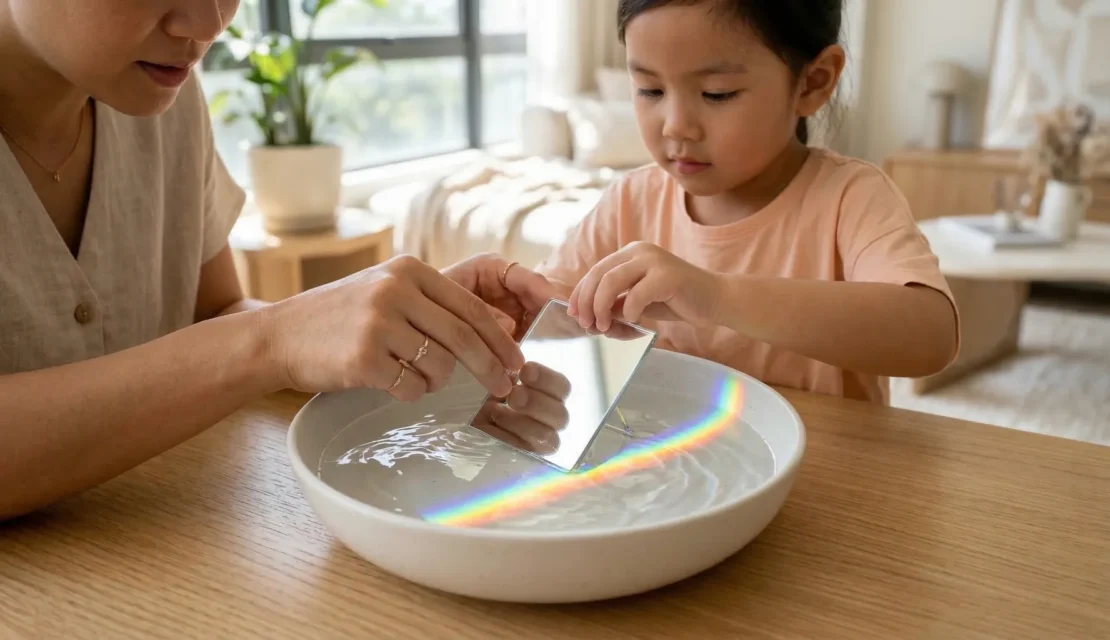
- Fill your bowl with water, about halfway up is enough. You want enough depth for the mirror to sit at a comfortable angle without fully submerging.
- Place the mirror inside the bowl, leaning it against one side at roughly a 45-degree angle. Don’t worry about being too precise here, a little tilting and adjusting is part of the fun.
- Bring the bowl to a sunny window, or carry it outside to a spot with direct sunlight. The brighter the light, the more vivid your rainbow will be.
- Aim the mirror toward the sunlight. You want the sunlight to hit the surface of the water first, then reflect off the mirror. This is the key to the whole experiment.
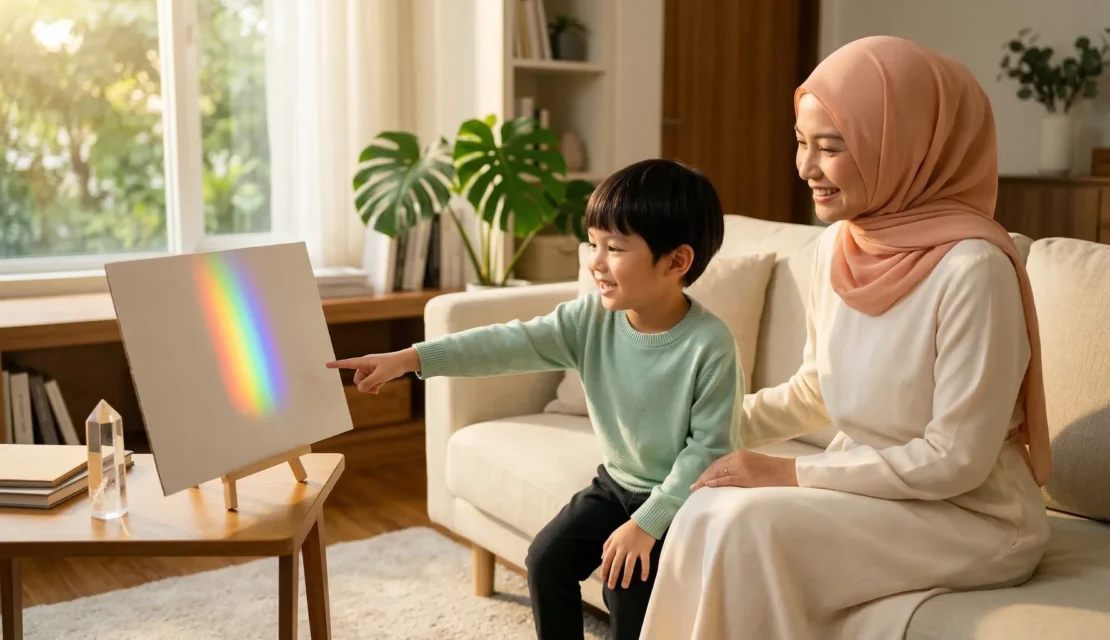
- Look for the rainbow on a nearby white surface. Hold up your piece of white paper, or simply look at the wall opposite the mirror. The rainbow should appear as a soft arc or band of color.
- Adjust the angle of the mirror slowly if you don’t see anything right away. Even small tilts can make a big difference. Let your child take a turn adjusting it and watch their face light up the moment the colors appear.
- Try moving the bowl closer to or further from the wall and observe how the size of the rainbow changes. Closer means a smaller, sharper image, and further means a larger, more spread-out arc.
- Block the sunlight with your hand for a moment, then remove it. This is a great way to show your child the direct connection between light and the rainbow. No light, no rainbow. Simple, brilliant, beautiful.
- Let your child trace the colors on the wall with their finger and name each one out loud. Red, orange, yellow, green, blue, indigo, violet. This doubles as a fantastic vocabulary and sequencing exercise without feeling like a lesson at all.
- Take a photo of your rainbow and celebrate! Stick it on the fridge, share it with grandma, or bring it to school. At Apple Tree Preschool BSD, we love hearing about what our little scientists discover at home.
A Few More Rainbow Facts Worth Sharing
Now that you’ve made your own rainbow, here are a few extra facts to keep the curiosity going. These are perfect for bedtime chats or car ride conversations.
- Rainbows are actually full circles. We only see an arc from the ground because the earth gets in the way. From an airplane on a clear day, you can sometimes spot the whole ring.
- No two people ever see the exact same rainbow. The angle between your eyes, the sun, and the water droplets is completely unique to your position. So your rainbow is, quite literally, yours alone.
- Double rainbows happen when light bounces twice inside a water droplet. The outer rainbow is always fainter, and its colors appear in reverse order, which is just wonderfully extra, if you ask us.
- The colors always appear in the same order. Red is always on the outside of the arc and violet is always on the inside. Every single time, without fail. Nature loves a consistent routine, just like toddlers.
- You can never walk up to a rainbow. As you move toward it, it moves with you. It’s always the same distance away, which makes it one of the universe’s most beautiful illusions.
Understanding how rainbows form is just one small doorway into a much bigger love of learning, and moments like these, curious, hands-on, and full of wonder, are exactly what we nurture every day at our school inside the Educenter BSD Building. If you’d love for your child to bring that same energy into a classroom built just for them, we would absolutely love to meet your family.
Learning Never Stops, And Neither Do We
Understanding how rainbows form is just one tiny doorway into a much bigger love of learning. When you take the time to experiment, explore, and wonder alongside your child, you show them something important: that curiosity is worth following, and that learning doesn’t only happen in a classroom. It happens at the kitchen table, by the window, with a bowl of water and a mirror, and with a parent who’s willing to say, “I don’t know. Let’s find out together.”
If you’d love for your child to carry that same sense of wonder into every school day, we would absolutely love to meet your family. Come and discover what makes Apple Tree Preschool BSD a place where children grow smart and happy together with the people who love them most.
📲 Chat with us on WhatsApp: Say hello here! 📞 Call us directly: +62 888-1800-900
Register now and come play and learn with other children at Apple Tree Preschool BSD!