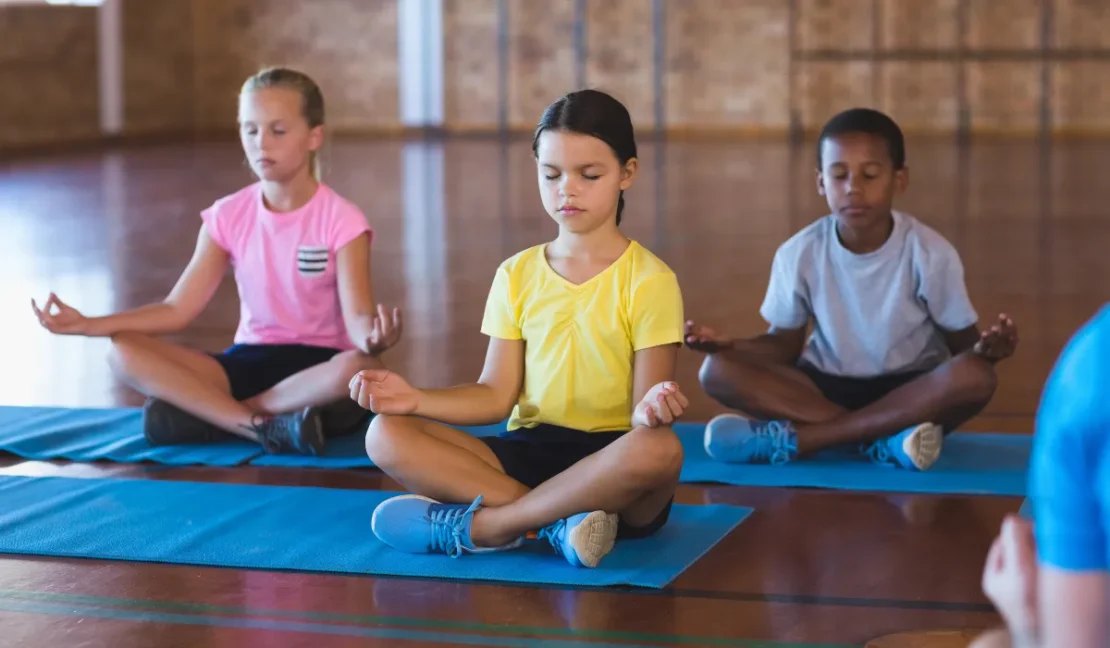
Your three-year-old just spent 45 minutes pretending to be a helicopter, complete with sound effects and crashing into furniture. The idea of this tiny tornado sitting still for meditation seems about as likely as her suddenly developing an interest in filing taxes. Yet five minutes later, you find her lying on her back in a sunny spot, completely still, hands on her belly, watching it rise and fall with her breath. “I’m doing my breathing like we do at school,” she announces peacefully. Wait, when did meditation for kids become something that actually works instead of wishful thinking from wellness blogs?
Here’s what’s catching many parents by surprise: meditation for kids isn’t about achieving zen-like stillness or emptying young minds of thoughts (good luck with that). When done age-appropriately, it’s actually about giving children simple, concrete tools to notice their bodies, recognize their feelings, and find moments of calm in ways that match how young brains actually work. At Apple Tree Pre-School BSD, we’ve woven meditation for kids into our daily routines, and the results aren’t just calmer classrooms (though that’s nice), it’s children developing genuine self-regulation skills that serve them in countless situations.
The key phrase here is “age-appropriate.” Asking a toddler to sit in lotus position for twenty minutes of silent meditation is setting everyone up for failure and frustration. But teaching that same toddler to take three deep “birthday candle breaths”? That actually works. Ready to discover meditation for kids techniques that match real developmental stages instead of Pinterest-perfect fantasies?
Understanding Meditation for Kids: What Actually Works
Before diving into specific techniques, let’s clarify what meditation for kids really means and why it matters more now than ever.
What is Age-Appropriate Meditation?
Meditation for kids isn’t a miniature version of adult meditation practice. It’s developmentally designed activities that teach children to pay attention to their bodies, notice their breath, recognize emotions, and find calm using methods that match their cognitive and attention abilities.
For young children, this looks more like brief, playful, movement-integrated activities rather than silent sitting. We’re building the foundation for meditation skills, not expecting fully developed practice. At our Educenter BSD Building campus, meditation for kids happens in 30-second to 3-minute bursts throughout the day, integrated naturally into transitions and routines.
The goal isn’t perfect stillness or empty minds. It’s helping children develop body awareness, emotional recognition, breath control, and the ability to self-soothe. These are foundational executive function and emotional regulation skills that research shows support everything from academic learning to social relationships.
Why Modern Children Need Meditation Skills
You might wonder why meditation for kids has become such a focus in early childhood education. The simple answer: children’s environments have changed dramatically, but their nervous systems haven’t evolved to match.
Modern stressors children face:
- Overstimulation from screens, lights, sounds, and constant activity
- Overscheduled lives with limited downtime
- Performance pressure starting earlier than previous generations
- Less free play and outdoor time to naturally decompress
- Family stress and busy, distracted parents
- Social pressures even at young ages
Meanwhile, children’s brains are still developing the prefrontal cortex regions responsible for emotional regulation and impulse control. Meditation for kids provides external tools and practices that support these developing capacities. We’re essentially scaffolding the brain systems that will eventually do this work automatically.
The Science Behind Meditation for Kids
Research on meditation for kids shows measurable benefits across multiple domains. Studies document improved attention and focus, better emotional regulation and fewer meltdowns, enhanced self-control and impulse management, reduced anxiety and stress, better sleep quality, and improved social skills and empathy.
Brain imaging shows that meditation practices actually change brain structure over time, strengthening areas associated with attention, emotional regulation, and self-awareness. For young children, we’re building neural pathways during the peak window of brain plasticity, when these practices have maximum impact.
In our comprehensive Singapore curriculum covering English, Mathematics, Chinese, Science, Creativity, Social Studies, Bahasa, Moral, Music, Physical Education, and Phonics, we see meditation for kids supporting learning across all subjects by improving children’s ability to focus, regulate emotions, and persist through challenges.
Image Source: Canva
Meditation for Kids by Age: Developmental Guidelines
Effective meditation for kids looks completely different at different ages. Here’s what works when, based on both research and our daily experience with children from toddlers through kindergarten.
Toddlers (Ages 1.5 to 2): Meditation in Motion
Don’t expect stillness from toddlers. At this age, meditation for kids focuses on very brief body awareness and breath connection, often integrated with movement.
Effective techniques for toddlers:
- “Smell the flower, blow out the candle” breathing (2-3 breaths)
- “Big arms up, breathe in, big arms down, breathe out” stretches
- Feeling heartbeat after running around
- Belly breathing while lying down for just 30 seconds
- Simple “squeeze and release” with hands or whole body
- Guided imagery lasting 15-30 seconds maximum
In our Toddler programs with 12 children per class (offered both 2x and 3x per week), meditation for kids looks like 15 to 30-second activities several times daily. We do a calming breath before snack, a body awareness moment after outdoor play, and a brief settling activity before story time. These tiny moments add up to build awareness without exceeding attention capacity.
The key at this age is making meditation for kids playful, movement-based, and very brief. We’re planting seeds of body awareness, not expecting sustained practice.
Pre-Nursery (Ages 2 to 3): Playful Breathing Games
By age two to three, children can engage in slightly longer meditation for kids activities, especially when presented as games or paired with props.
Techniques that work well:
- Blowing bubbles slowly and mindfully
- “Stuffed animal breathing” (toy on belly rising and falling)
- “Hot chocolate breathing” (pretend to cool and sip slowly)
- Simple body scans: “Can you feel your toes? Your knees? Your belly?”
- “Freeze dance” with pausing to notice body and breath
- Listening games: “Close eyes and count how many sounds you hear”
- Gratitude moments: “One thing that made you happy today”
In our Pre-Nursery class with 16 children, we do meditation for kids activities lasting one to two minutes, typically two or three times daily. Children at this age are beginning to connect breath with emotional states and can start using breathing when upset, with support.
The practice is still highly scaffolded and adult-led, but we’re seeing the beginning of independent use of calming strategies.
Nursery (Ages 3 to 4): Building Independence
Three and four-year-olds in our Nursery program with 20 children are ready for more complex meditation for kids practices. They can sustain attention longer and are beginning to use strategies independently.
Effective practices for this age:
- Guided visualizations lasting 2-3 minutes (flying like a bird, floating like a cloud)
- “Balloon breathing” (expanding belly and chest)
- Progressive muscle relaxation in playful terms (“Squeeze like you’re holding ice, then let the ice melt”)
- Mindful eating exercises with small snacks
- Emotion recognition paired with breath (“When you feel angry, what happens? Let’s try three calm breaths”)
- Simple mantras or repeated phrases (“I am calm, I am strong”)
- Nature observation with focused attention
We incorporate meditation for kids into daily transitions: before circle time to settle, after recess to calm, before rest time to relax. Activities last two to four minutes and children are beginning to request breathing exercises when upset without prompting.
This is the age where meditation for kids starts connecting explicitly to emotional regulation. “When you feel big feelings, you can do your breathing” becomes a concrete tool children begin using.
Kindergarten 1 (Ages 4 to 5): Intentional Practice
Four and five-year-olds in our Kindergarten 1 program show readiness for more intentional meditation for kids practices. They understand the purpose and can sustain attention for 5 to 7 minutes with engaging guidance.
Appropriate techniques:
- Body scan meditations (3-5 minutes)
- Visualization journeys with more elaborate scenarios
- Counting breaths (up to 10)
- “Thoughts like clouds” (noticing thoughts without engaging)
- Loving-kindness practice in simple language (“Think of someone you love, send them kind thoughts”)
- Mindful movement sequences (yoga-inspired)
- Sound meditation with singing bowls or chimes
Meditation for kids at this age includes more discussion and reflection. After a practice, we might ask: “How did your body feel before? How does it feel now? When might this be helpful?” Children are connecting the practice to real-life application more independently.
We see kindergarteners at this age using breathing or calming strategies unprompted when facing challenges, feeling upset, or needing to focus.
Kindergarten 2 (Ages 5 to 6): Growing Sophistication
Our oldest students in Kindergarten 2 with 20 children per class can engage with meditation for kids practices that begin resembling modified adult meditation, though still with child-friendly framing and shorter duration.
Advanced techniques for this age:
- Seated breathing meditation (5-7 minutes)
- Noticing thoughts and emotions without judgment
- Gratitude practices with reflection
- Body awareness in stillness
- Mindful listening and observation
- Simple breath counting or anchor-breath focus
- Introducing the concept of meditation as a tool they can use throughout life
At this age, meditation for kids becomes something children understand and value. They can articulate why they practice, how it helps, and when to use different techniques. Some children even request meditation time or teach techniques to family members.
This is also when individual differences become more apparent. Some children naturally gravitate toward meditation practices and show deep capacity for stillness and focus. Others benefit from the skills but will always prefer movement-based versions. Both are completely normal and valid.
Practical Meditation for Kids Techniques to Try at Home
Ready to introduce meditation for kids in your own home? Here are specific, tested techniques organized by what you’re trying to achieve.
For Calming Before Bed
Bedtime is often when families first try meditation for kids because everyone desperately wants calm and sleep.
Bedtime meditation techniques:
- “Sleepy body scan”: Starting at toes, imagine each body part getting heavy and relaxed
- “Balloon breathing”: Breathe in while imagining a balloon inflating in your belly, breathe out as it deflates
- “Gratitude three”: Name three things from the day you’re grateful for
- “Melting meditation”: Imagine you’re ice cream slowly melting into the bed
- “Star breathing”: Trace a star with your finger while breathing (in for one point, out for the next)
Keep these brief (3 to 5 minutes maximum) and make them routine. The predictability helps signal to the nervous system that sleep is coming.
For Managing Big Emotions
This is where meditation for kids really shines, giving children concrete tools when feelings overwhelm.
Emotion regulation techniques:
- “Five-finger breathing”: Trace one hand’s fingers with the other hand, breathing in going up, out going down
- “Volcano breath”: Big breath in, hold briefly, slow breath out (releasing the pressure)
- “Color breathing”: Breathe in a calm color (blue, green), breathe out the yucky feeling (visualized as gray or red)
- “Weather report”: Name the emotion like weather (“I’m having a rainstorm feeling right now”)
- “Calm jar”: Shake a glitter jar and watch it settle while breathing slowly
The key is practicing these when calm so they’re available when needed. We practice emotion regulation meditation for kids during calm moments, not just during meltdowns.
For Building Focus and Attention
Meditation for kids supports attention skills that help with everything from homework to listening to instructions.
Attention-building techniques:
- “Mindful looking”: Choose an object (flower, toy, picture) and notice every detail for 1-2 minutes
- “Sound hunt”: Close eyes and count how many different sounds you notice
- “Listening meditation”: Ring a bell or chime and raise hand when you can no longer hear it
- “Breath counting”: Count breaths up to 10, then start over
- “Follow the leader breathing”: Match your breath to a parent’s breath
These practices build the neural circuitry for sustained attention that supports all learning.
For Morning Energy and Focus
Meditation for kids doesn’t always mean calming down. Sometimes it’s about focusing energy and preparing for the day.
Energizing morning practices:
- “Sun breath”: Arms up reaching while breathing in, arms down while breathing out
- “Lion breath”: Big inhale through nose, open mouth and stick out tongue while exhaling with a “ha” sound
- “Wake-up body scan”: Notice each body part and give it a little wiggle or stretch
- “Intention setting”: “Today I will…” (be kind, try new things, have fun learning)
- “Energizing breath”: Quick inhales through nose, slower exhales through mouth
These set a positive, focused tone for the day ahead and take just 1 to 2 minutes.
Creating a Meditation Practice: Environment and Routine
Successful meditation for kids isn’t just about technique, it’s also about creating an environment and routine that support the practice.
Setting Up a Meditation Space
You don’t need a dedicated meditation room, but having a consistent spot helps signal to children that it’s meditation time.
Elements of a good meditation space:
- Quiet corner away from visual distractions
- Comfortable spot to sit or lie down (cushion, mat, cozy rug)
- Optional: calm jar, small bell, or soft toy for belly breathing
- Natural light if possible
- Clear of screens and electronic distractions
In our classrooms, we have a “calm corner” that serves multiple purposes including meditation for kids, emotion regulation, and quiet time. Children know this space and what happens there.
Building Meditation into Daily Routines
Meditation for kids works best when it’s routine rather than random. Consistent practice builds skills much more effectively than occasional use.
Strategic times for meditation:
- Morning: Set intentions and focus for the day
- Transitions: Between activities to reset attention
- Before meals: Practice gratitude and mindful preparation
- After active play: Bring energy down and body awareness up
- Before homework or focused activities: Prime attention
- Bedtime: Calm body and mind for sleep
Even 1 to 2 minutes at each of these times totals 10 to 15 minutes of meditation for kids daily, which accumulates significant benefits.
Making it Fun, Not Forced
The fastest way to make children hate meditation for kids is to force it or make it feel like punishment. Keep it playful, optional when possible, and positive.
Tips for keeping meditation positive:
- Use child-friendly language (not “meditation” but “breathing time” or “calm-down practice”)
- Make it playful with props, visualizations, and games
- Keep it brief, always ending before children are truly done
- Celebrate effort, not perfect stillness
- Model the practice yourself
- Connect it to things children care about (helps you play better, feel happier, sleep easier)
When children resist, don’t force it. Instead, try a different technique or do it yourself nearby. Often curiosity brings them back.
Meditation for Kids in Our Curriculum at Apple Tree
At Apple Tree Pre-School BSD, meditation for kids isn’t a separate add-on but rather woven throughout our day and integrated across our curriculum.
How We Incorporate Meditation Daily
In all our programs from Toddler through Kindergarten 2, meditation for kids appears multiple times daily in age-appropriate forms.
Our daily integration:
- Morning circle includes breathing and intention-setting
- Transitions between activities include brief grounding moments
- Physical Education incorporates mindful movement and body awareness
- Music class includes listening meditation and breath awareness with rhythm
- Rest time uses guided relaxation and body scan techniques
- Social-emotional learning explicitly teaches meditation for kids as emotion regulation tool
- Moral education connects meditation to values like patience, kindness, and self-control
Because meditation for kids is routine rather than special, children see it as a normal, useful part of their day rather than something strange or difficult.
The Outcomes We See
After introducing more intentional meditation for kids practices across our programs, we’ve observed measurable changes.
What we notice:
- Smoother transitions with less dysregulation
- Children independently using breathing when upset
- Improved attention during circle time and lessons
- More empathy and kindness in peer interactions
- Better conflict resolution (children can calm down enough to problem-solve)
- Enhanced body awareness in Physical Education
- Improved rest time settling
Parents report similar changes at home: better bedtime routines, fewer and shorter meltdowns, and children teaching meditation for kids techniques to family members.
Training and Professional Development
Effective meditation for kids requires teachers who understand both meditation practices and child development. Our educators receive ongoing training in age-appropriate mindfulness and meditation, trauma-informed practices, emotional regulation support, and integrating meditation naturally rather than as separate curriculum.
This ensures meditation for kids at Apple Tree is developmentally appropriate, culturally sensitive, and truly beneficial rather than just trendy.
Common Mistakes Parents Make with Meditation for Kids
Even with the best intentions, parents often stumble when introducing meditation for kids. Here are common pitfalls and how to avoid them.
Expecting Adult-Level Practice
The biggest mistake is imagining your four-year-old will sit in lotus position for twenty minutes of silent meditation. That’s developmentally inappropriate and sets everyone up for frustration.
Reality check:
- Toddlers: 15 to 30 seconds of focused attention is success
- Preschoolers: 1 to 3 minutes is realistic
- Kindergarteners: 3 to 7 minutes is appropriate
- Movement and playfulness are features, not bugs
Meditation for kids that’s truly age-appropriate looks nothing like adult meditation and that’s exactly right.
Using Meditation as Punishment
“You’re being wild, go do your meditation!” completely undermines the practice. Meditation for kids should never be punishment or time-out disguised as mindfulness.
Instead, meditation should be presented as a helpful tool, something positive and empowering. Practice when calm so it’s available when needed, but don’t make it the consequence of misbehavior.
Forcing When Children Resist
Some children initially resist meditation for kids, and forcing creates negative associations that are hard to overcome.
Better approaches when children resist:
- Model the practice yourself without requiring participation
- Make it more playful and short
- Offer choices between different techniques
- Try at different times of day
- Connect it to things they care about
- Take a break and try again later
Genuine buy-in develops gradually, and respecting children’s autonomy while providing consistent opportunity works better than forcing participation.
Inconsistency
Trying meditation for kids once or twice, then forgetting about it, won’t build skills. The benefits come from regular, consistent practice over time.
Even 1 to 2 minutes daily is more effective than 20 minutes once. Make it routine, embed it in existing rituals, and stick with it long enough to see benefits (typically several weeks minimum).
Image Source: Canva
Beyond Meditation: Building Mindful Children
Meditation for kids is one tool in the larger project of raising mindful, self-aware, emotionally intelligent children. It works best when paired with other practices and values.
Modeling Mindfulness Yourself
Children learn far more from what you do than what you say. If you want meditation for kids to stick, practice yourself.
When stressed, visibly use breath work. Mention: “I’m feeling frustrated, I’m going to do some deep breathing.” Practice gratitude aloud. Move through your day with attention and presence rather than constant distraction and rushing.
Your modeling makes meditation for kids seem normal, useful, and adult-approved, all of which increase children’s engagement.
Creating Space for Boredom and Stillness
Modern children’s lives are often scheduled to the minute with constant stimulation. Meditation for kids works better when children also experience ordinary stillness and unstructured time.
Allow boredom without immediately filling it. Provide regular tech-free, activity-free time. Build in daily moments of natural quiet and calm. This creates the conditions where meditation practices can take root.
Teaching Emotional Intelligence
Meditation for kids is most effective when paired with explicit emotional intelligence education. Children need vocabulary for feelings, understanding that all emotions are okay, strategies beyond meditation for emotion regulation, and practice identifying emotions in themselves and others.
Our Moral education and Social Studies curriculum at Apple Tree explicitly teaches these skills, and meditation for kids becomes one of many tools children use for emotional health.
Why This Matters at Apple Tree Pre-School BSD
Everything we’ve explored about meditation for kids connects to our commitment at Apple Tree Pre-School BSD to help children grow smart and happy. Emotional regulation, self-awareness, and attention skills support both the “smart” (academic learning) and “happy” (emotional well-being) parts of our mission.
Our Singapore curriculum covering English, Mathematics, Chinese, Science, Creativity, Social Studies, Bahasa, Moral education, Music, Physical Education, and Phonics is delivered in an environment where meditation for kids and mindfulness practices help children access their learning potential. With thoughtfully sized classes from 12 children in Toddler programs to 20 in our Kindergarten classes, we can support each child’s individual meditation journey.
At our Educenter BSD Building campus, children experience the powerful combination of rigorous academics and emotional intelligence education, including age-appropriate meditation for kids that builds lifelong self-regulation skills.
Ready to give your child an environment where meditation for kids is naturally woven into every day? At Apple Tree, we’re teaching children tools they’ll use for life, from managing emotions to focusing attention to finding calm in a busy world. Discover how we help children grow smart and happy with mindfulness at the heart of learning or call us at +62 888-1800-900.
Join our Apple Tree family where calm minds support joyful learning! 🍎